
Freeman Maple (Acer × freemanii)
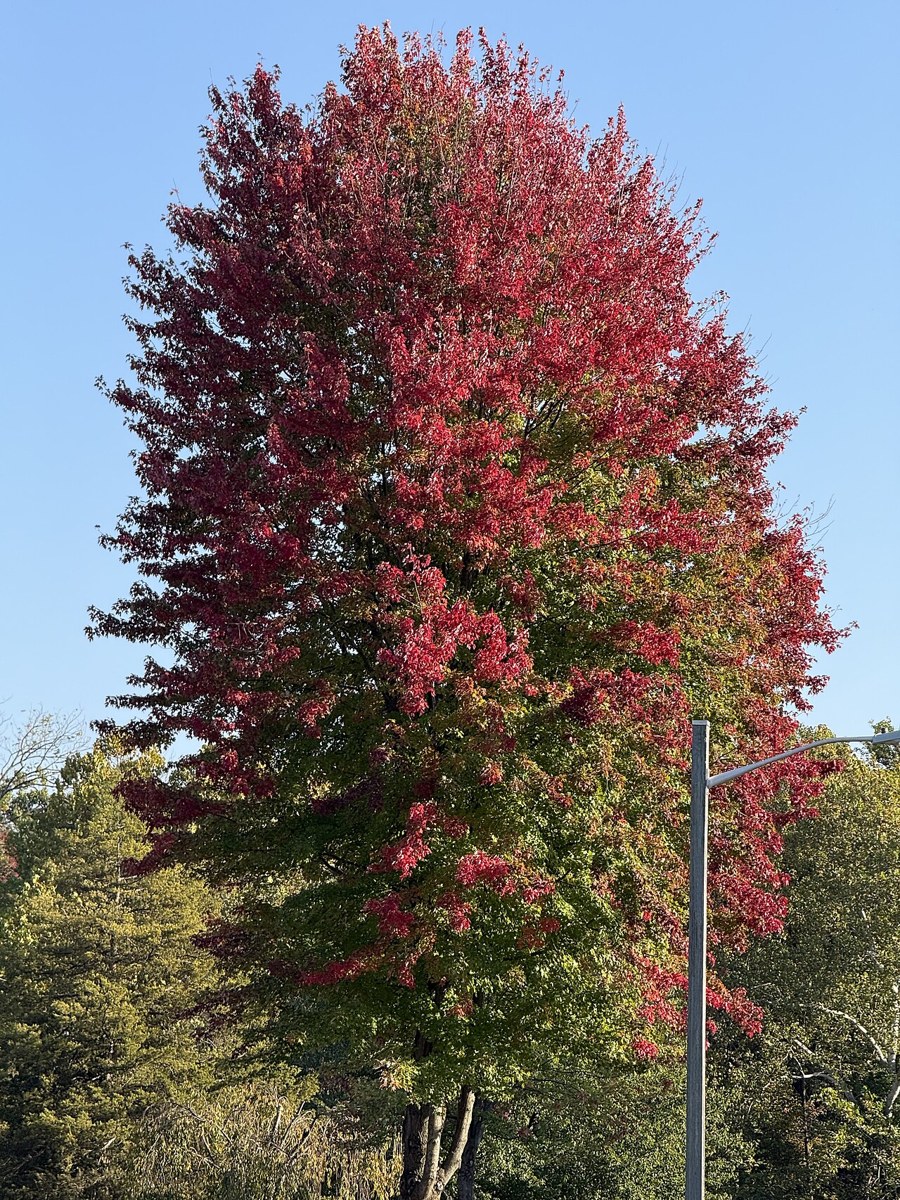
Acer × freemanii, the Freeman Maple, is a naturally occurring hybrid between two native eastern maples: red maple (Acer rubrum) and silver maple (Acer saccharinum). Where those two trees grow side by side in river bottoms, swamp edges and lakeshore forests, they sometimes cross, and the seedlings grow into fast, tall shade trees that fall somewhere between their parents in leaf shape, bark and fall color. The “×” in the name marks it as a hybrid.
Most gardeners know the Freeman maple by its cultivar names rather than its own. Autumn Blaze, Firefall, Sienna Glen, Celebration, Armstrong and Marmo are all Freeman maples, even though garden centers often label them “red maple” or “hybrid red maple.” These named trees are clones grafted or cut from selected parents, so every Autumn Blaze is genetically the same tree. They were chosen to combine the brilliant fall reds of red maple with the speed, toughness and drought tolerance of silver maple.
That combination explains the Freeman maple’s popularity on streets, lawns and new housing developments across the northern half of the country. It grows quickly, tolerates wet and compacted soils, and colors reliably in fall. It also has real weaknesses, especially brittle branch unions and a tendency to be overplanted, which this guide covers. Because it is a cross between two native trees and occurs in the wild on its own, it is a reasonable native choice for much of the East and Midwest, though planting its native parents is often an even better option for wildlife.
Identification
Freeman maple is a large deciduous tree, typically 40 to 60 feet tall in yards and streets, with an upright oval to rounded crown. Wild trees in good bottomland soil can grow taller. Because hybrids can cross back with either parent, wild Freeman maples vary a great deal, and even botanists using detailed leaf measurements have trouble separating some trees from pure red or silver maples. Named cultivars are much more uniform, since each is a single clone.
Bark & Stems
Young bark is smooth and silvery gray, like both parents. As trunks thicken, the bark breaks into long, narrow, gray plates or shaggy strips, usually less flaky than an old silver maple and rougher than an old red maple. Twigs are reddish brown with small, rounded reddish buds clustered at the tips. Broken twigs lack the strong unpleasant smell typical of silver maple, though some trees show a faint odor.
Leaves
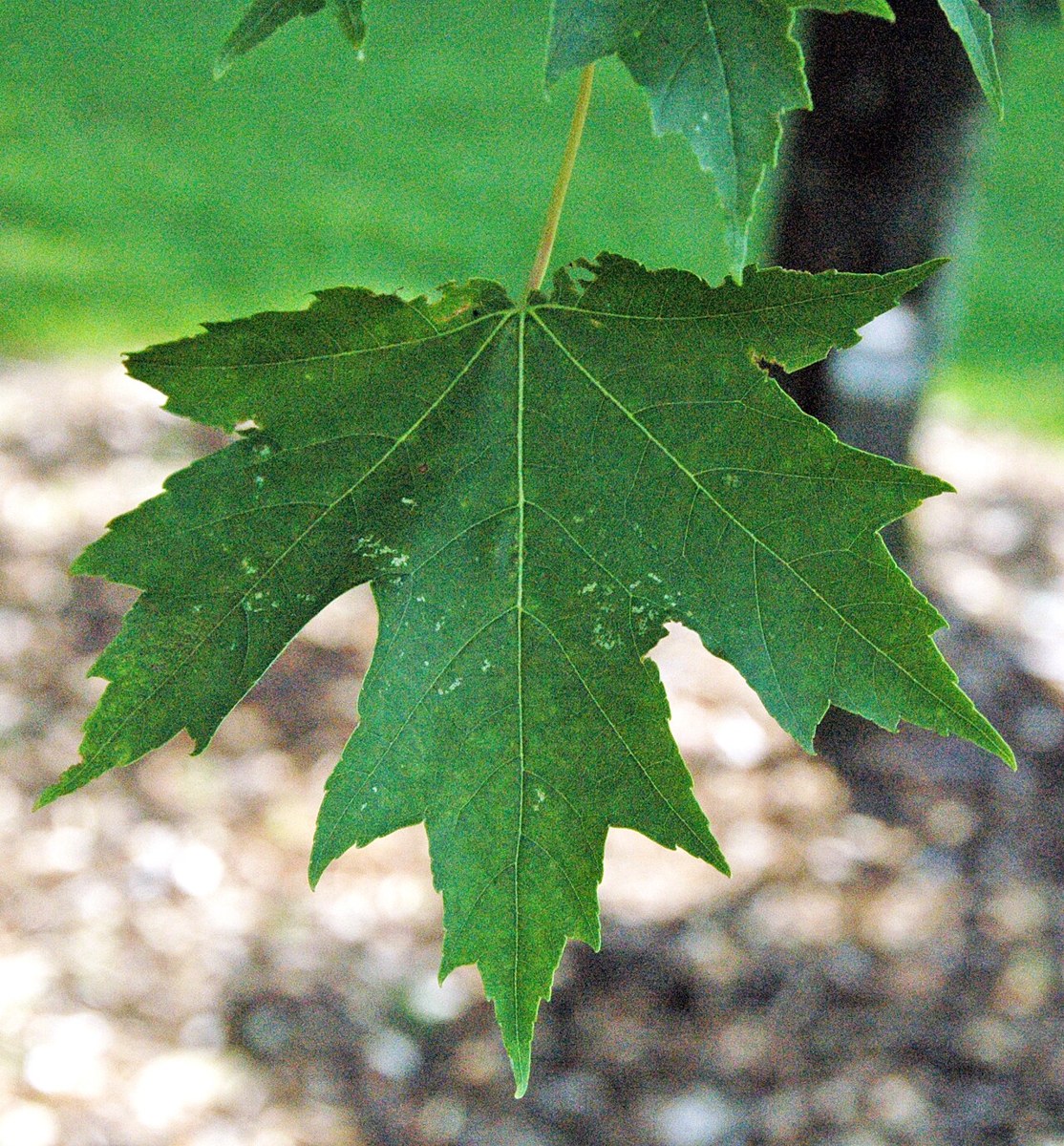
The leaves are opposite, simple and usually 3 to 5 inches long, with five lobes and toothed edges. The notches between the lobes (the sinuses) are the best field clue: they are deeper than on a red maple but not cut nearly to the midrib as on a silver maple. The middle lobe is usually not strongly divided again, as it often is on silver maple. Tops are medium to dark green and undersides are pale or silvery, which both parents share. Firefall and some other cultivars lean toward the deeply cut, lacy silver maple leaf; Autumn Blaze sits closer to the middle.
Flowers
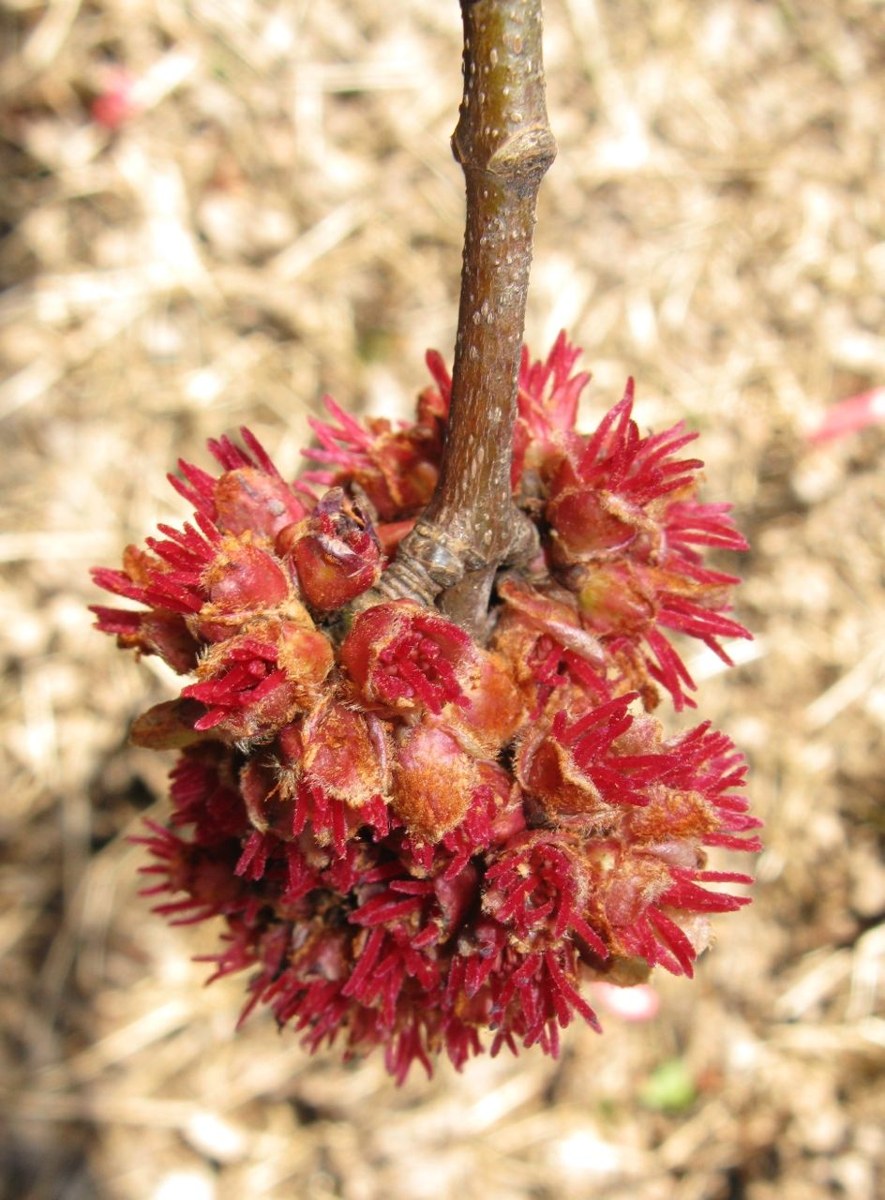
Freeman maple blooms very early, from late winter to early spring (February to April depending on latitude), well before the leaves open. The small flowers have no showy petals but come in dense red to orange-red clusters that tint the whole crown red from a distance. Like its parents, individual trees may carry male flowers, female flowers, or both. Several popular cultivars, including Marmo and Firefall, are male clones that make no seeds.
Fruit & Seeds
Female trees produce paired, winged seeds (samaras) about 1¼ to 2½ inches long, larger than red maple keys and smaller than silver maple keys. They ripen and fall in late spring, just like those of both parents, rather than in fall. Seed-producing trees can drop large crops that sprout readily in gutters and garden beds, which is one reason seedless clones are so popular.
Quick Facts
| Scientific Name | Acer × freemanii (A. rubrum × A. saccharinum) |
| Family | Sapindaceae (Soapberry; maples were formerly placed in Aceraceae) |
| Plant Type | Deciduous shade tree; naturally occurring native hybrid |
| Mature Height | 40–60 ft (wild trees occasionally taller) |
| Mature Spread | 25–40 ft (narrower in upright cultivars such as Armstrong) |
| Growth Rate | Fast |
| Sun Exposure | Full Sun to Part Shade (best color in full sun) |
| Water Needs | Moist to average; tolerates wet soil and short floods; moderate drought tolerance |
| Soil Type | Adaptable: clay, loam or sand; tolerates compaction |
| Soil pH | Acidic to near neutral preferred; more alkaline-tolerant than red maple |
| Bloom Time | February – April, before the leaves |
| Flower Color | Red to orange-red clusters |
| Fall Color | Orange-red to scarlet in the best cultivars; yellow to red in wild trees |
| Fruit | Paired samaras 1¼–2½ in, late spring (none on male clones) |
| Deer Resistant | No; young trees are browsed and bucks rub the trunks |
| USDA Hardiness Zones | 3–8 (varies by cultivar; Sienna Glen and Firefall are among the hardiest) |
Native Range
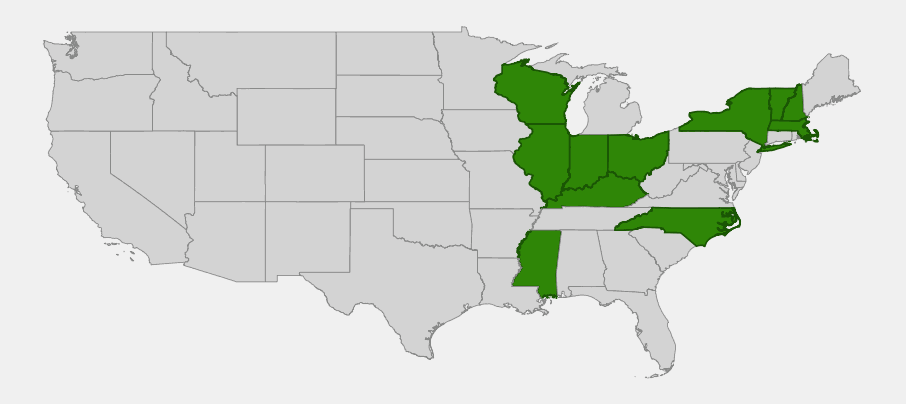
Wild Freeman maples occur where red maple and silver maple overlap, which is most of the eastern United States and southeastern Canada. Silver maple is a tree of river floodplains and wet lowlands, while red maple grows almost everywhere in the East, so the hybrids turn up mostly in bottomland forests, swamp margins, lakeshores and along streams. County-level records compiled by the Biota of North America Program are concentrated around the Great Lakes, especially Wisconsin, northern Illinois and Indiana, and in New York and northern New England, with scattered records south to Kentucky, western North Carolina and southern Mississippi.
Because Freeman maple looks so much like its parents, it is almost certainly overlooked in many places. Botanists rarely stop to separate a wild hybrid from a red or silver maple, so the map shows where it has been documented, not every place it grows. In states such as Virginia, Pennsylvania and Michigan, where both parents are common, wild hybrids probably exist but are not well recorded; we have left those states off the map rather than guess.
The named cultivars are a different matter. Autumn Blaze, Firefall, Sienna Glen and their relatives are planted far outside the hybrid’s wild range, including the Great Plains, the Rocky Mountain states and the Pacific Northwest. In those regions they are ornamental street trees, not native plants. If you garden in the West, a locally native tree such as bigtooth maple or boxelder will do more for local wildlife.
📋 Regional plant lists for Freeman Maple country: Michigan, Wisconsin & Eastern Minnesota · Illinois, Iowa & Missouri · Ohio & Indiana · Kentucky & Tennessee · New York, Pennsylvania & Northern New Jersey · New Hampshire, Maine & Vermont · Connecticut, Massachusetts & Rhode Island · North Carolina & South Carolina · Georgia, Alabama & Mississippi
Growing & Care Guide
Freeman maple is easy to establish and grows fast, which is both its biggest selling point and the source of most of its problems. A little attention in the first ten years, especially to structure, makes the difference between a long-lived shade tree and one that splits apart in an ice storm.
Light
Plant Freeman maple in full sun for the densest crown and the best fall color. It tolerates part shade, such as a site with sun for half the day, but shaded trees grow more open and often color yellow or dull orange instead of red. Avoid planting it under larger trees, where it will lean and stretch toward the light.
Soil & Water
This is one of the most adaptable maples for soil. It grows in heavy clay, loam and sand, handles compacted urban soil better than sugar maple, and tolerates wet spots and short spring flooding thanks to both of its bottomland parents. From silver maple it inherits better drought tolerance than red maple, but it is not a dry-site tree: water deeply every week or two through the first two summers and during long droughts after that. Prefer acidic to near-neutral soil. It handles moderately alkaline soil better than red maple, but on strongly alkaline, high-pH soils many trees develop yellow leaves with green veins (iron or manganese chlorosis). In those areas, test soil before planting or pick a tree better suited to limestone soils.
Planting Tips
Plant in spring or early fall. Dig a hole two to three times as wide as the root ball but no deeper, and set the tree so the root flare (where the trunk widens into roots) sits at or slightly above grade. Container-grown maples often have circling roots; cut or tease them apart at planting, because girdling roots are a common cause of decline in maples years later. Give the tree room: plan for a crown 30 to 40 feet wide and keep it at least 15 to 20 feet from the house and away from sewer lines, since its roots, like silver maple’s, can be aggressive near the surface. Thin young bark sunburns and cracks in winter, so a light-colored trunk wrap or simply good watering helps on exposed sites.
Pruning & Maintenance
Structural pruning is the most important care you can give a Freeman maple. Fast growth produces upright branches with narrow, V-shaped crotches and bark trapped between the stems (included bark), which can split under snow, ice or wind. Starting in the second or third year, choose one central leader, remove or shorten competing upright stems, and favor side branches with wide angles. Repeat every few years until the tree is about 25 feet tall. Prune in late summer or late fall to avoid heavy sap bleeding in late winter, which is harmless but messy. Watch for leafhoppers, aphids and the occasional verticillium wilt, and keep lawn mowers and string trimmers away from the trunk with a ring of mulch.
Propagation
Named cultivars are propagated by cuttings or grafting, because seedlings do not come true. A seed collected from an Autumn Blaze will grow into a variable maple, often looking like red maple or silver maple, rather than another Autumn Blaze. Wild Freeman maples can be grown from fresh seed sown in late spring right after the samaras fall, like other early-ripening maples; the seeds lose viability quickly if they dry out.
Landscape Uses
- Shade tree for large lawns, parks and school grounds in the East and Midwest
- Street and parking-lot tree, especially narrow cultivars such as Armstrong and Celebration
- Wet or poorly drained sites and rain-garden edges, alongside river birch and swamp white oak
- Fall color specimen where a fast, reliable red is wanted
- Cold-climate plantings in zone 3 and 4, using hardy selections such as Sienna Glen and Firefall
- Part of a mixed planting; avoid lining a whole street with one clone, so a single pest or disease cannot take out every tree
Wildlife & Ecological Value
Freeman maple offers much of the same wildlife value as its parents, with one big exception: seedless clones produce no seed crop for birds and small mammals.
For Pollinators
The late-winter flowers are one of the first pollen sources of the year. On mild days in March, honey bees, mining bees, early bumble bee queens and flies work the red flower clusters. Male trees, which are the ones that shed pollen, are the most useful to bees, so seedless male cultivars still have value here.
For Birds
Maples are among the most important host trees for moth caterpillars in eastern forests, and those caterpillars are what most songbirds feed their nestlings. Native maples host species such as the rosy maple moth and cecropia moth. Seeds from female and seed-bearing trees are eaten by finches, grosbeaks and other seed-eaters, and the dense crowns give nesting cover to robins, cardinals and other common yard birds.
For Mammals
Squirrels and chipmunks eat the seeds and flower buds of seed-bearing trees in spring. White-tailed deer browse twigs and young growth, and rabbits nibble young bark in winter, so protect newly planted trees. Along streams, beavers readily cut soft maples.
Ecosystem Role
In the wild, Freeman maples are part of the soft-maple floodplain forests that slow flood water, hold stream banks and shade waterways. Hybrids also show how plant species exchange genes where they meet; botanists study these maple hybrid zones to understand how closely related trees stay distinct. In yards, a Freeman maple is better for wildlife than many non-native shade trees, though a mix of native oaks, red maple and other local trees supports more species than any single clone.
Cultural & Historical Uses
The hybrid is named for Oliver M. Freeman of the U.S. National Arboretum in Washington, D.C., who deliberately crossed red maple with silver maple in 1933, hoping to combine the best traits of each. The name Acer × freemanii was published by the maple specialist A. E. Murray in 1969. Botanists later realized that the same cross also happens in the wild, and many street trees once sold as red maple or silver maple selections turned out to be Freeman maples.
The tree’s rise to fame came through the nursery trade. ‘Armstrong’, a tall, narrow tree found on an Ohio farm, was being propagated by the late 1940s. Autumn Blaze (‘Jeffersred’) was selected from seedlings in the late 1960s by nurseryman Glenn Jeffers of Fostoria, Ohio, and became one of the best-selling shade trees in North America and Europe. Later selections pushed into colder climates: Firefall (‘AF#1’) came from a University of Minnesota cross of a silver maple with a red maple and is a seedless male, while Sienna Glen is a Minnesota selection with extra cold hardiness, a pyramidal young shape and rusty orange fall color. ‘Marmo’, a seedless male from the Morton Arboretum near Chicago, and Celebration, a narrow Ohio selection introduced in 1987, are other common choices.
Like other soft maples, Freeman maples can be tapped in late winter, but their sap is less sweet than that of sugar maple, so syrup makers usually prefer sugar or black maple. Today the hybrid’s main role is as a shade and street tree. Urban foresters now caution against relying too heavily on it, since some cities planted so many Autumn Blaze maples that a single pest or storm could damage a large share of the street canopy.
Frequently Asked Questions
Is Autumn Blaze a red maple or a Freeman maple?
Autumn Blaze (‘Jeffersred’) is a Freeman maple, Acer × freemanii. It is often sold as “Autumn Blaze red maple” because of its red fall color and because one parent is red maple, but its leaves, fast growth and toughness come partly from silver maple. The same is true of Firefall, Sienna Glen and Celebration.
Is Freeman maple native?
Yes, as a wild hybrid. It forms naturally where native red and silver maples grow together in the eastern United States and southeastern Canada, and it has been documented in states from Wisconsin and New York to Kentucky, North Carolina and Mississippi. The named cultivars are nursery selections of that native hybrid. Sienna Glen, sometimes described online as an Asian tree, is a North American Freeman maple selected in Minnesota. In the West and Great Plains, all Freeman maples are planted ornamentals.
How fast does a Freeman maple grow?
Fast. In good, moist soil young trees often add 2 to 3 feet a year, and vigorous cultivars can grow even faster. That speed is why the tree needs early structural pruning to prevent weak, split-prone branch unions.
Are Freeman maple leaves toxic to horses?
Wilted or dried leaves of red maple are well known to be poisonous to horses, and silver maple and hybrids are also treated as risky. Do not plant Freeman maples where branches or fallen leaves can end up in horse pastures or paddocks. The tree is not considered a hazard to people, dogs or cats in normal garden use.
Does Freeman maple make a mess of seeds?
It depends on the tree. Seed-producing trees drop large numbers of winged seeds in late spring that sprout in beds and gutters. Male clones such as Firefall and Marmo produce no seed. If seedlings would be a nuisance, ask the nursery whether the cultivar you are buying is seedless.

Looking for a nursery that carries Freeman Maple?
Browse our native plant nursery directory: Illinois & Indiana · Kentucky, Massachusetts & Mississippi · New Hampshire, New York, North Carolina & Ohio · Vermont · Wisconsin

