
Pale Dock (Rumex altissimus)
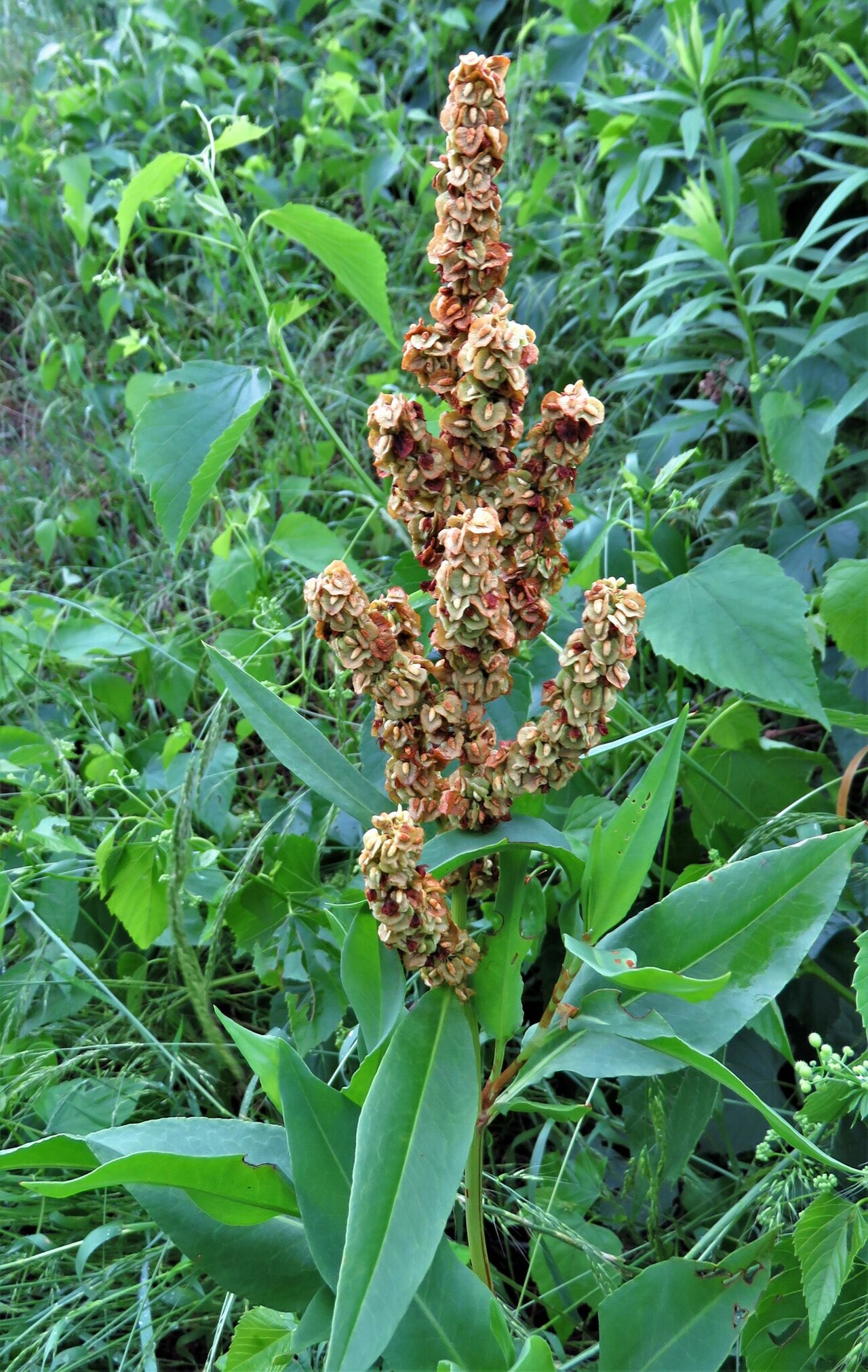
Rumex altissimus, the Pale Dock, is a tall native perennial of the buckwheat family (Polygonaceae) that grows on riverbanks, wet meadows, ditches and floodplains across much of the central and eastern United States. It is also widely called smooth dock, and sometimes tall dock or peach-leaved dock. All of those names point at what sets it apart from the weedy docks that most people know: its leaves are smooth, flat and pale green, shaped a little like peach leaves, without the crinkled, wavy edges of curly dock.
Pale dock is one of the first docks to bloom each year. By April and May it sends up stout, leafy stems 2 to 4 feet tall, topped with dense spikes of tiny green flowers that ripen into masses of heart-shaped, papery fruits. As the fruit matures in late spring and early summer, the whole spike turns from green to pink to a rich rusty brown, which makes the plant easy to spot along a creek or a wet roadside.
This is not a showy garden flower, and it is no one’s first choice for a front border. But in Missouri, Illinois, Kansas and the rest of its range, pale dock is a genuine part of the native wet-ground flora. It fits naturally into rain gardens, pond edges, wet prairie plantings and restoration seed mixes, and its seeds feed birds and small mammals. Knowing it also helps gardeners tell the native dock apart from the introduced European docks that crowd pastures and lawns.
Identification
Pale dock grows from a thick, deep taproot. Each spring the root sends up one to several erect stems that are usually unbranched below the flower cluster. The whole plant is hairless. In fruit, a mature plant stands roughly 2 to 4 feet tall, occasionally to 5 feet in rich, moist soil, and may lean or sprawl a little late in the season.
Stems
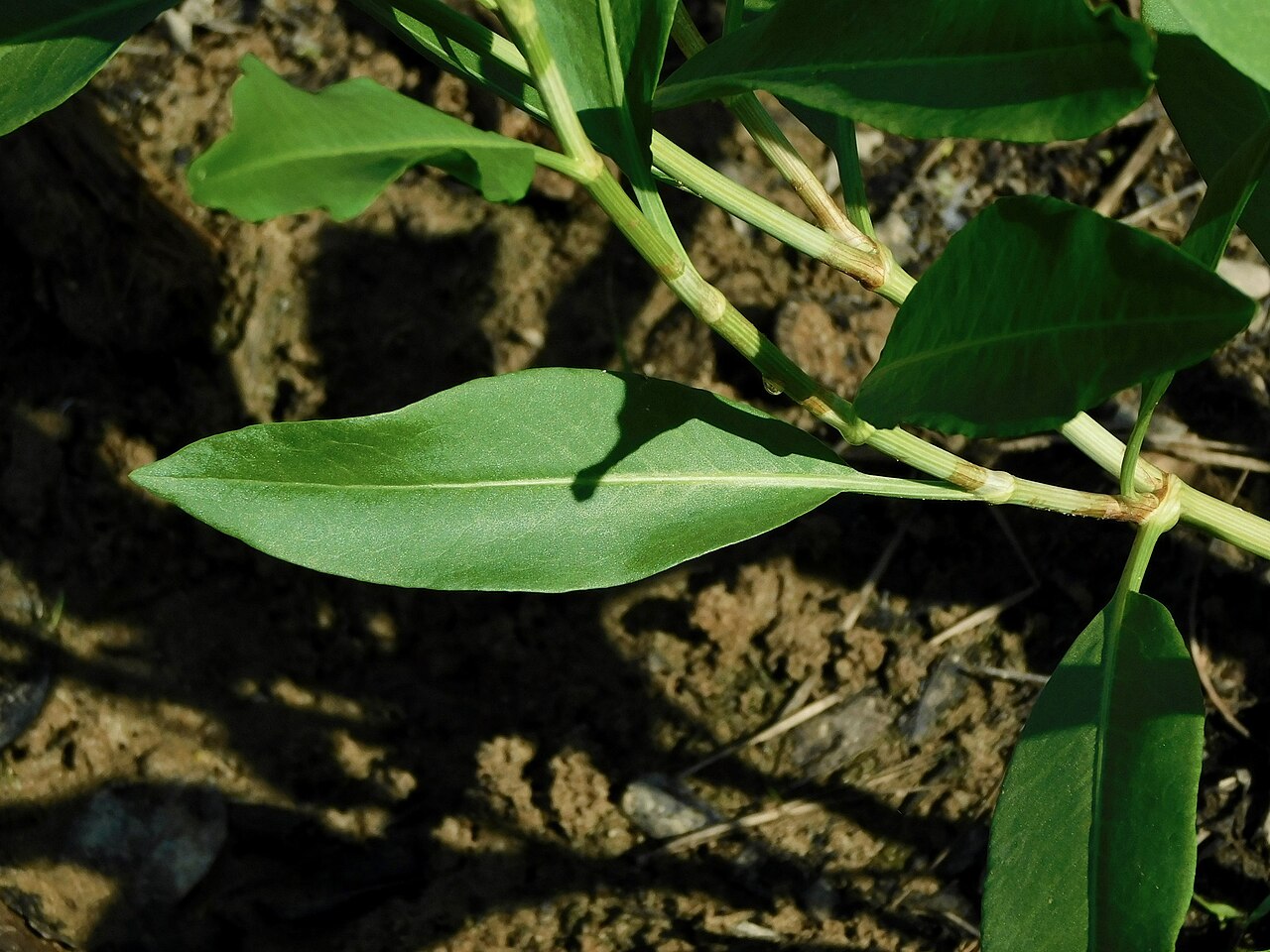
The stems are stout, smooth and ridged, green with darker green or reddish lengthwise streaks. Like all docks and smartweeds, pale dock has an ocrea at each leaf joint: a thin, papery sheath that wraps the stem where the leaf stalk attaches. On pale dock this sheath is not fringed with bristles, and it often dries brown and falls apart by the time the plant is in fruit.
Leaves
The leaves are the best field mark. They are alternate, lance-shaped to narrowly elliptic, usually 4 to 8 inches long and 1 to 2 inches wide, with a pointed tip and a tapering base. They are flat, with smooth (entire) edges that are at most slightly wavy, and they have a pale, slightly bluish-green color. The lower leaves are the largest and have short stalks; the leaves get smaller toward the top of the stem. Pale dock does not form the big, crinkled basal rosette that curly dock and bitter dock make in lawns and pastures.
Flowers
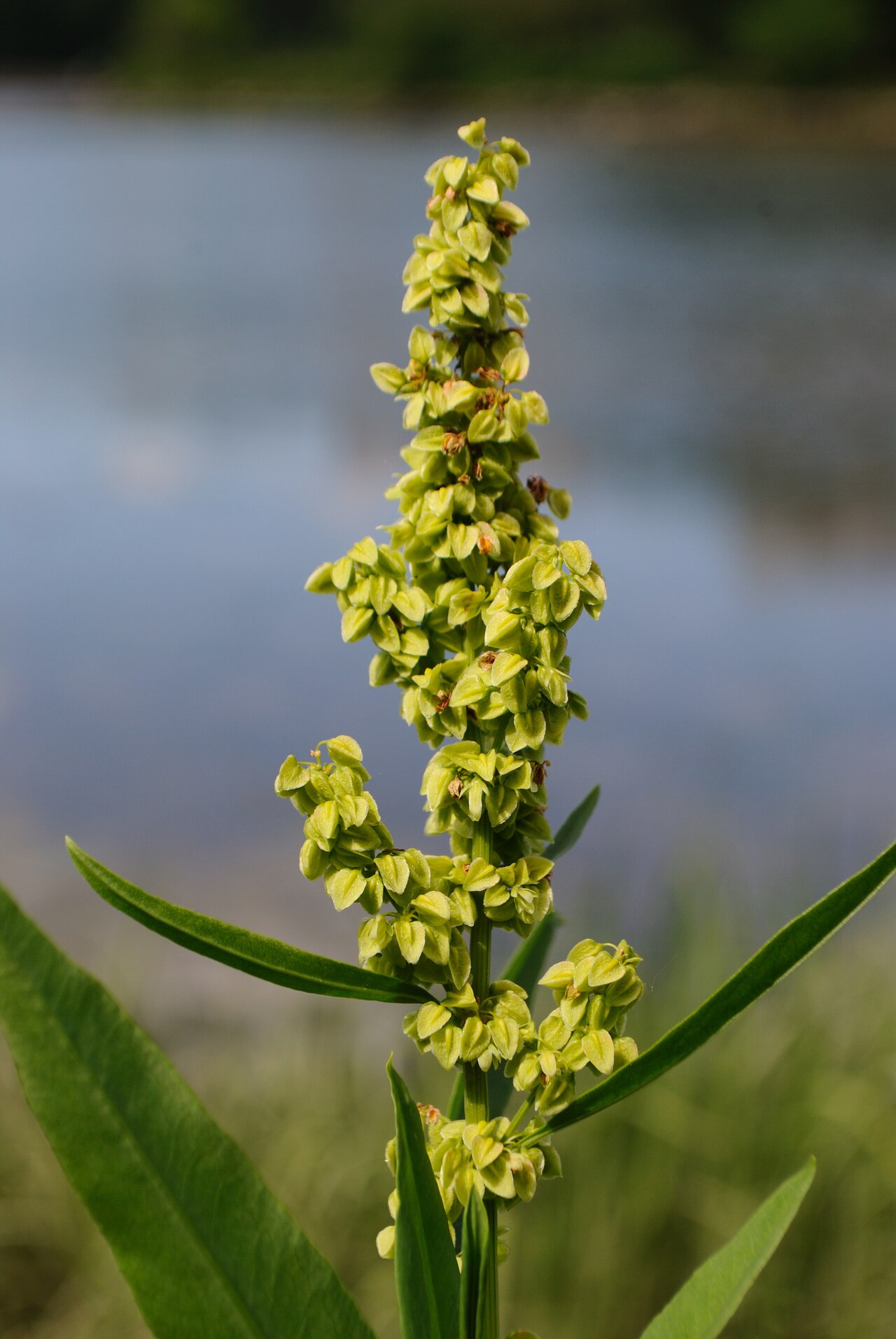
Flowering runs from about April to June, earlier in the South. The tiny flowers have no petals; each has six greenish sepals (tepals) and hangs on a short, jointed stalk. They are packed into whorls along the branches of a dense, upright flower cluster up to about a foot long, held at the top of the stem. The flowers are wind-pollinated, so they produce pollen but no showy color or strong scent.
Fruit & Seeds
Dock fruits are the most reliable way to name a species. As each flower matures, its three inner tepals (called valves) enlarge into papery wings that enclose a single shiny, three-sided brown seed (an achene). On pale dock the valves are broadly heart-shaped to triangular, about 1/5 inch (4 to 6 mm) long, with smooth, untoothed edges. Usually only one valve carries a prominent swollen bump (tubercle), and the other two are smooth or have only a tiny one. Curly dock, by contrast, usually has three tubercles; bitter dock has spiny-toothed valves; and swamp dock (Rumex verticillatus) has three tubercles on long, drooping stalks.
Quick Facts
| Scientific Name | Rumex altissimus Alph. Wood |
| Family | Polygonaceae (Buckwheat) |
| Other Common Names | Smooth dock, tall dock, peach-leaved dock |
| Plant Type | Herbaceous perennial with a deep taproot |
| Mature Height | 2–4 ft (occasionally to 5 ft) |
| Mature Spread | 1–2 ft |
| Growth Rate | Fast |
| Sun Exposure | Full Sun to Part Shade |
| Water Needs | Wet to average; tolerates brief flooding |
| Soil Type | Moist loam, silt or clay; floodplain and alluvial soils |
| Soil pH | Slightly acidic to alkaline |
| Bloom Time | April – June |
| Flower Color | Green to yellowish green (wind-pollinated) |
| Fall Color | None; stems and fruit turn rusty brown by midsummer |
| Fruit | Heart-shaped papery valves, one with a tubercle; ripens May–July |
| Deer Resistant | Generally yes (bitter, high in oxalates) |
| Wetland Indicator | FACW (usually found in wetlands) |
| USDA Hardiness Zones | 3–9 |
Native Range
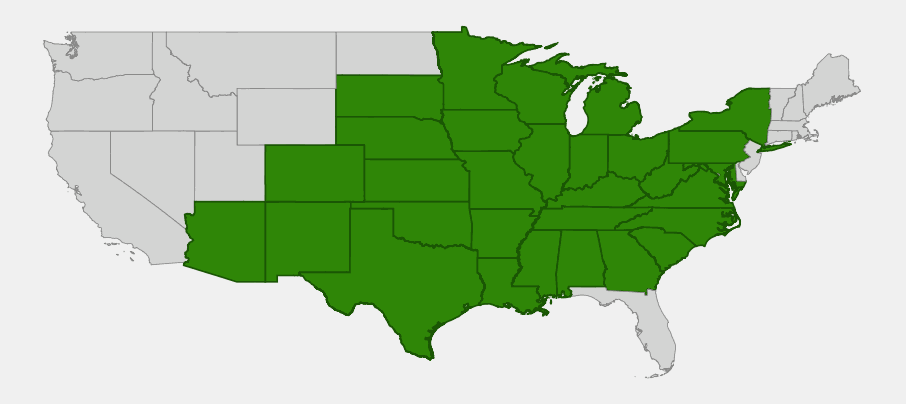
Pale dock is native to a wide swath of North America east of the Rocky Mountains, from southern Ontario south through the Great Lakes states and the Midwest to the Gulf Coast, and west across the Great Plains to Colorado, New Mexico and Arizona, reaching into northern Mexico. It is most common in the Mississippi, Missouri, Ohio and Arkansas river basins. In Missouri, for example, it grows in nearly every county, and it is just as familiar in Illinois, Kansas, Oklahoma and eastern Texas.
At the edges of its range it becomes scarce. It is uncommon to rare in the Carolinas, Maryland and Virginia, and it is absent as a native from Florida, the northern Rockies and the West Coast. In New England pale dock does show up in fields and disturbed ground, but it is not native there: botanists treat those populations as introductions from farther west, so this page and its map leave the New England states out.
Its natural habitats are all places with moist, fertile soil and plenty of light: gravel bars and sandbars, stream and river banks, floodplain meadows, sloughs, the edges of ponds and marshes, wet prairies and moist ditches. It also turns up readily on disturbed moist ground such as roadsides, railroad embankments and field edges, which is one reason it is sometimes mistaken for a weed. Unlike the European docks, though, pale dock rarely becomes a problem in lawns or pastures.
📋 Regional plant lists featuring Pale Dock: Arizona & New Mexico · Arkansas, Louisiana, Eastern Oklahoma & Eastern Texas · South & West Texas · Georgia, Alabama & Mississippi · North Carolina & South Carolina · Maryland, Virginia & West Virginia · New York, Pennsylvania & Northern New Jersey · Kentucky & Tennessee · Ohio & Indiana · Illinois, Iowa & Missouri · Michigan, Wisconsin & Eastern Minnesota · North Dakota, South Dakota & Western Minnesota · Nebraska, Kansas & Eastern Colorado
Growing & Care Guide
Pale dock is very easy to grow anywhere it gets sun and moisture. It is best used as a component of wet meadow, rain garden and streambank plantings rather than as a specimen, and it is most often established from seed in restoration mixes.
Light
Give pale dock full sun to light shade. It flowers and fruits best in full sun, as it does on open gravel bars and wet prairies. Along wooded streams it tolerates partial shade, but plants in shade are thinner and lean toward the light.
Soil & Water
This is a plant of moist to wet, fertile soil. It does well in silt, clay and loam, including heavy floodplain clays that stay wet in spring, and it handles short periods of standing water. The deep taproot lets established plants ride out summer dry spells, and the plant often finishes its growth cycle early, ripening fruit by early summer. It is not a good choice for dry, sandy upland sites.
Planting Tips
Sow seed in fall or very early spring, pressing it lightly onto bare, moist soil; seeds germinate well after a winter outdoors. Nursery plugs, where available from native wetland nurseries, can be planted in spring about 18 inches apart among other wet-meadow species. Because it is tall and narrow, pale dock looks best scattered through a planting of sedges, rushes and wetland wildflowers rather than in a clump of its own.
Pruning & Maintenance
Pale dock needs no fertilizer, watering or pruning once it is established. The flower stalks are attractive in their rusty-brown fruiting stage, but they look untidy after midsummer; cut them down then if you want a neater look or want to limit self-seeding. Leaving some stalks standing provides seeds for birds. The taproot makes mature plants hard to move, so site them where you want them to stay. Like other docks, the leaves are sometimes chewed by dock sawflies and leaf beetles, which rarely harm the plant.
Propagation
Propagate pale dock from seed. Collect the fruiting stalks when the valves are brown and dry in early to midsummer, rub out the seeds and sow them outdoors in fall, or store them dry and give them a few weeks of cold, moist stratification before spring sowing. Seedlings grow quickly and often flower in their second year.
Landscape Uses
- Rain gardens and bioswales, in the wettest zone with swamp milkweed and blue vervain
- Pond and stream edges, where the taproot helps hold soft banks
- Wet prairie and wet meadow restorations with boneset and common sneezeweed
- Floodplain plantings under scattered black willow, silver maple and buttonbush
- Naturalistic and wildlife gardens, where the brown fruiting spikes add early-summer texture
Wildlife & Ecological Value
Pale dock looks modest, but it supports a surprising number of animals in the wet places where it grows.
For Pollinators
Because it is wind-pollinated, pale dock offers little nectar. Bees and syrphid flies occasionally gather its pollen in spring. Its bigger contribution to insects is as foliage: docks (Rumex) are larval host plants for the bronze copper butterfly, a wet-meadow species of the Midwest and Great Plains, and for several other coppers and moths. Dock leaf beetles and dock sawflies also feed on the leaves, and they in turn feed birds and predatory insects.
For Birds
The seeds ripen early and stay on the stalks for weeks. Sparrows, finches, juncos and other seed-eating songbirds pick them from standing stalks, and seeds that fall into the water or onto mudflats are eaten by ducks, rails and other marsh birds. The dense wet-meadow stands where pale dock grows give nesting and foraging cover.
For Mammals
Small mammals such as mice and voles eat the fallen seeds. The leaves are bitter and high in oxalates, so deer and rabbits usually browse them only lightly. Livestock generally avoid docks, and that is just as well, because large amounts of dock foliage can be harmful to grazing animals.
Ecosystem Role
Pale dock is an early colonist of fresh sandbars, flood-scoured banks and other open, moist ground. Its deep taproot helps stabilize loose soil, and its early growth fills the spring gap before taller summer wetland plants take over. In floristic quality assessments it scores as a conservative-to-tolerant native (for example, a coefficient of 2 in Missouri), meaning it is common and adaptable rather than a sign of pristine habitat, but it is a native component of healthy wet-ground plant communities.
Cultural & Historical Uses
Docks have a long history of human use in both Europe and North America. Historical sources record that the young spring leaves and shoots of several docks, pale dock among them, were cooked as greens, usually in more than one change of water to reduce their sour, oxalate-rich taste. Like spinach and rhubarb leaves, dock foliage contains oxalic acid, and eating large amounts can be harmful, so this is a piece of history rather than a recommendation.
The large taproots of docks are rich in tannins. Various Native American nations and later settlers used dock roots for dyes and tanning, and as folk remedies, although specific traditions are usually recorded for docks in general or for other species such as canaigre (Rumex hymenosepalus) of the Southwest, which was once grown commercially for leather tanning.
Botanically, pale dock was named by Alphonso Wood, a nineteenth-century American botanist and author of popular field botanies. The species name altissimus means “tallest,” a slight exaggeration, since several other docks grow taller. In modern conservation work, pale dock is mainly valued as a dependable native seed source for wetland restoration and as a native alternative to the introduced docks.
Frequently Asked Questions
Is pale dock the same as smooth dock?
Yes. “Smooth dock” is a widely used common name for Rumex altissimus, along with pale dock, tall dock and peach-leaved dock. All of these names refer to the same native species, which has smooth, flat, pale green leaves.
How do I tell pale dock from curly dock?
Look at the leaves and the fruit. Curly dock (Rumex crispus), a European weed, has strongly wavy, crinkled leaf edges and a large basal rosette, and its fruits usually carry three tubercles. Pale dock has flat, smooth-edged leaves along the stem and fruits with only one prominent tubercle. Pale dock also blooms a few weeks earlier.
Is pale dock invasive or weedy?
No. Pale dock is native across most of the central and eastern United States and rarely becomes a problem in gardens or pastures. It can self-seed on bare, moist ground, so cut off spent fruiting stalks if you do not want seedlings. It is not native in New England, where it occurs only as an introduction.
Is pale dock safe for pets and livestock?
Treat it with caution. Like other docks, pale dock contains oxalates, which can be harmful if animals eat large amounts of the leaves. Animals usually avoid it because of its bitter taste, but do not plant it where livestock are forced to graze it heavily.
Where should I plant pale dock?
Plant it in full sun to light shade in moist or wet soil, such as a rain garden, pond edge, ditch, streambank or wet meadow. It does poorly on dry, sandy sites. It fits best mixed with other native wetland wildflowers, sedges and grasses.

Looking for a nursery that carries Pale Dock?
Browse our native plant nursery directory: Alabama, Arizona & Arkansas · Colorado & Georgia · Illinois, Indiana, Iowa & Kansas · Kentucky, Louisiana, Maryland, Michigan, Minnesota, Mississippi & Missouri · Nebraska, New Mexico, New York, North Carolina, Ohio & Oklahoma · Pennsylvania, South Carolina, South Dakota, Tennessee, Texas & Virginia · West Virginia & Wisconsin

