
Native Honeysuckles (Lonicera)
When most people picture honeysuckle, they imagine the sweet-smelling white-and-yellow vine that swallows fences and roadside thickets across the East. That plant is Japanese honeysuckle (Lonicera japonica), and it is not native. It is one of the most widespread invasive plants in the country. The good news is that the honeysuckle genus, Lonicera, also includes about 20 species that are truly native to the United States, and several of them are excellent, well-behaved garden plants.
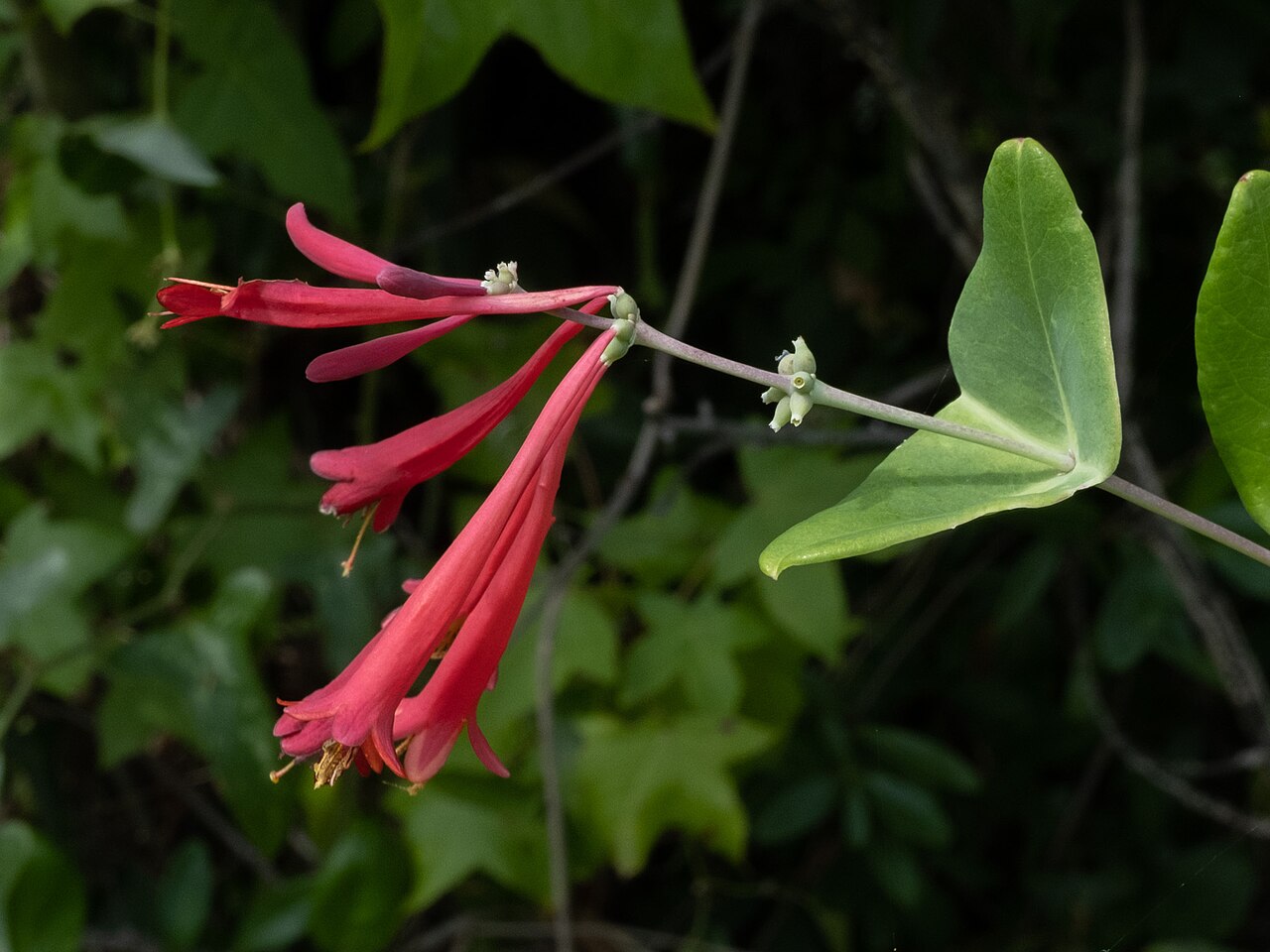
America’s native honeysuckles come in two forms. The climbing honeysuckles are twining vines with clusters of long, tubular flowers, often red, orange or yellow, that are made for hummingbirds. The best known is coral honeysuckle of the Southeast and mid-Atlantic. The shrub honeysuckles are upright bushes with small paired flowers and berries, such as American fly honeysuckle of northern woods and twinberry of the West. Between them, native honeysuckles grow in every state except Hawaii.
This guide is for gardeners who see “honeysuckle” in a planting list and want the native version. It covers how to recognize the genus, the most useful native species by region, how to grow them, and, just as important, how to tell them apart from the invasive Japanese and Asian bush honeysuckles that still turn up in nurseries and hedgerows. If you are looking for the native shrub sold as “bush honeysuckle,” that is a different genus, Diervilla, which is covered below as well.
Identification
All honeysuckles belong to the honeysuckle family, Caprifoliaceae. A few features hold true across the genus and help separate native honeysuckles from look-alikes.
Leaves & Stems
Honeysuckle leaves are always opposite (in pairs along the stem) and usually have smooth, untoothed edges. In most of the native climbing species, the last one or two pairs of leaves below each flower cluster are fused at the base into a single round or oval disk that the stem seems to pierce. This is the single most useful field mark: coral, limber, yellow, grape, hairy and orange honeysuckles all show it, while invasive Japanese honeysuckle never does. Many native species also have leaves that are pale or bluish-white (glaucous) underneath. Stems of the vines twine clockwise around supports; the shrubs have upright stems with peeling, shreddy bark on older wood.
Flowers
Honeysuckle flowers are tubular, with five lobes at the mouth. In some species the lobes are nearly equal, giving a neat trumpet (coral honeysuckle); in others they split into an upper lip of four lobes and a lower lip of one (limber and grape honeysuckles, and Japanese honeysuckle). The native vines carry their flowers in whorled clusters at the tips of the stems, just above the fused leaves. The native shrubs bear their flowers in pairs on a shared stalk in the leaf axils, often with leafy bracts beneath them, as in twinberry.
Fruit
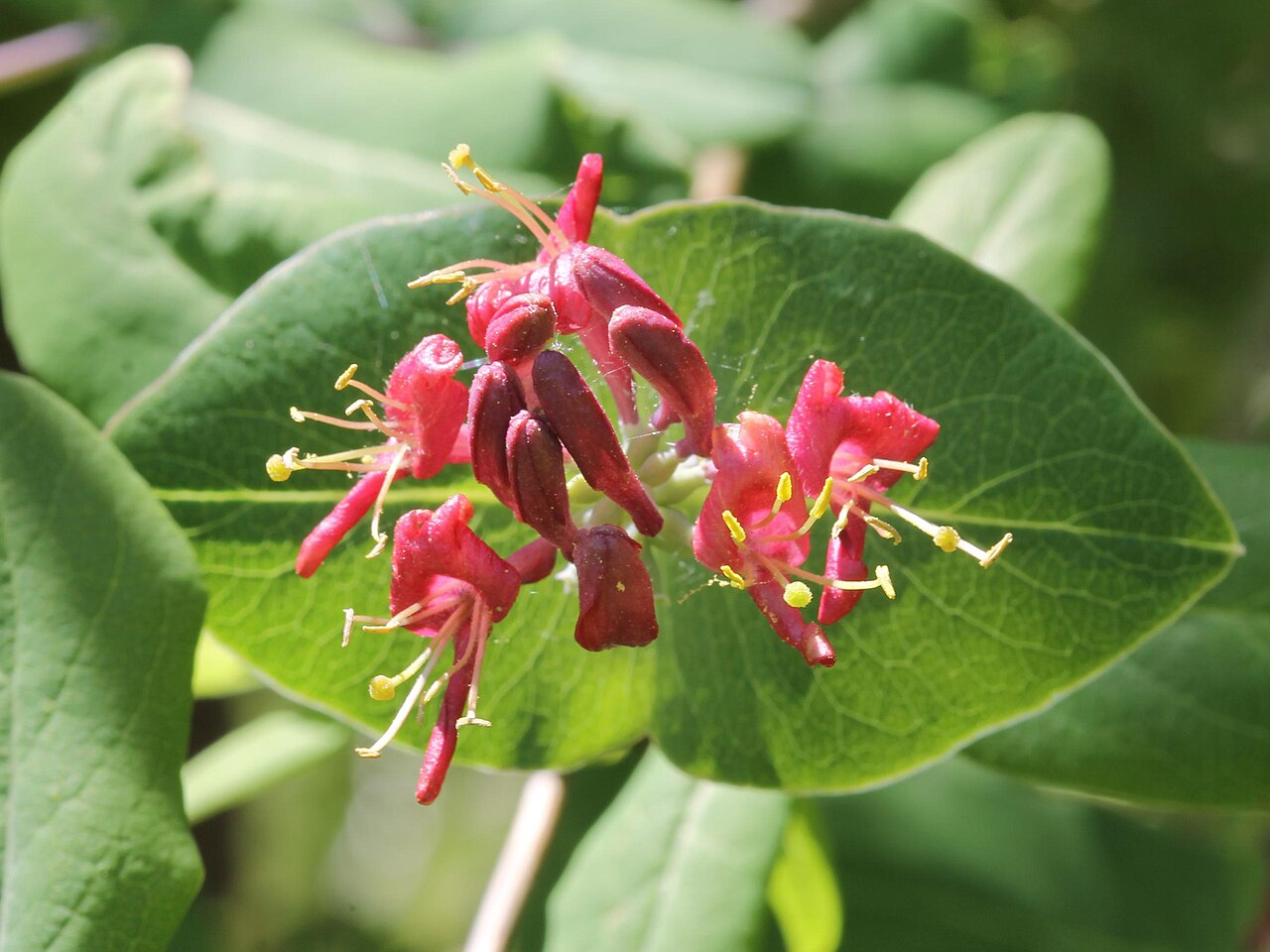
The fruit is a small, juicy berry. Native vines produce clusters of red or orange berries at the stem tips in summer and fall. The shrubs bear berries in pairs, sometimes joined into one: red in American fly honeysuckle, shiny black in twinberry, and blue in mountain fly honeysuckle. Most honeysuckle berries are bitter, and some can cause stomach upset, so they are best left for the birds.
Quick Facts
| Genus | Lonicera (honeysuckles) |
| Family | Caprifoliaceae (Honeysuckle) |
| US-Native Species | About 20 species (roughly 180 worldwide) |
| Plant Types | Deciduous or semi-evergreen twining vines and upright shrubs |
| Mature Size | Vines climb 10–20 ft; shrubs 3–10 ft tall |
| Growth Rate | Moderate to fast |
| Sun Exposure | Full Sun to Part Shade (fly honeysuckles tolerate shade) |
| Water Needs | Average; some species prefer moist or wet soil |
| Soil Type | Adaptable; most prefer well-drained loam |
| Bloom Time | Mainly April – July, depending on species and region |
| Flower Color | Red, orange, yellow, pink, cream or white |
| Fruit | Red, orange, black or blue berries, summer – fall |
| Wildlife Value | Hummingbirds, bumblebees, clearwing moths, fruit-eating birds |
| Deer Resistant | Moderately; deer browse young shoots |
| Invasive Relatives | Japanese honeysuckle; Amur, Tatarian, Morrow and Bell honeysuckles |
| USDA Hardiness Zones | 2–10 across the genus (coral honeysuckle 4–9) |
Native Range
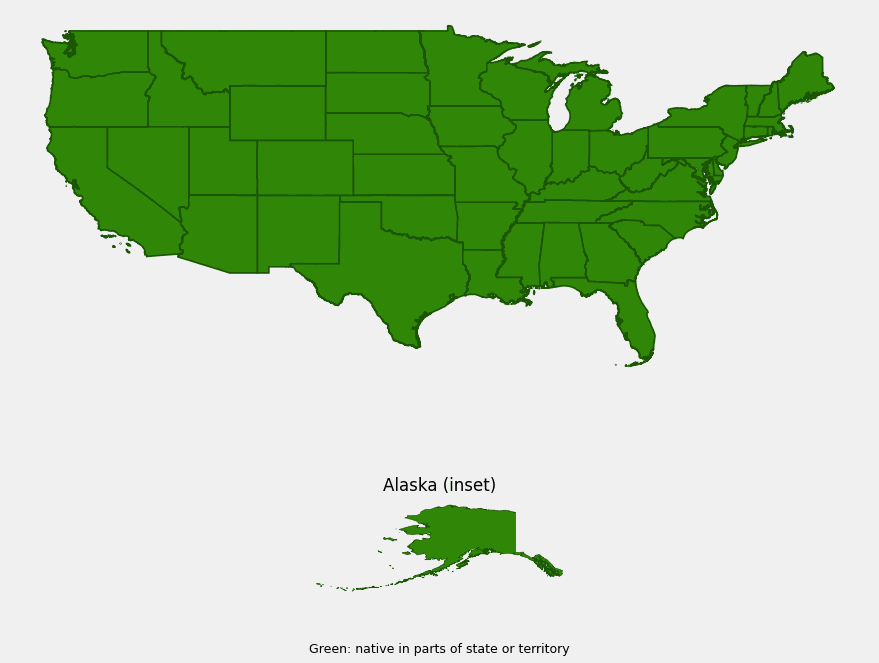
Native honeysuckles occur in every US state except Hawaii, but different regions have very different species. In the Southeast and mid-Atlantic, coral honeysuckle is the common native vine, joined by the rare yellow honeysuckle in the Ozarks and southern Appalachians. The Midwest and Great Lakes have grape, limber and hairy honeysuckle vines plus several fly honeysuckle shrubs. In New England and the northern tier, limber and hairy honeysuckles climb through woodland edges, while American fly, mountain fly and swamp fly honeysuckles grow in cool woods and bogs.
West of the Great Plains, the native honeysuckles are mostly shrubs. Twinberry and Utah honeysuckle are common in the Rocky Mountains, the Intermountain West and the Cascades, and twinberry reaches Alaska. White honeysuckle grows in the canyons and hills of Texas, Oklahoma, New Mexico and Arizona. The Pacific states add three native vines: orange honeysuckle in the Northwest and northern Rockies, pink or California honeysuckle along the coast from Washington to California, and southern honeysuckle in Southern California.
Several native honeysuckles have been planted outside their own ranges. Coral honeysuckle, for example, is widely grown and occasionally escapes in New England and the upper Midwest, where botanists generally do not treat it as native. Meanwhile, Japanese honeysuckle and the Asian bush honeysuckles have spread across much of the eastern and central US, so a honeysuckle you see in the wild is often not a native one. Use the field marks on this page before assuming a wild plant is native.
📋 Regional plant lists featuring Native Honeysuckles: Alaska · Georgia, Alabama & Mississippi · Arkansas, Louisiana, Eastern Oklahoma & Eastern Texas · Arizona & New Mexico · North Dakota, South Dakota & Western Minnesota · Delaware, Southern New Jersey & Long Island · Illinois, Iowa & Missouri · Idaho, Eastern Oregon & Eastern Washington · Ohio & Indiana · Kentucky & Tennessee · Maryland, Virginia & West Virginia · Michigan, Wisconsin & Eastern Minnesota · Montana & Wyoming · North Carolina & South Carolina · Nebraska, Kansas & Eastern Colorado · New Hampshire, Maine & Vermont · Connecticut, Massachusetts & Rhode Island · New York, Pennsylvania & Northern New Jersey · Western Oregon & Western Washington · Utah & Western Colorado · California & Nevada · South & West Texas
Native Species
These are the most widespread and garden-worthy US-native honeysuckles, grouped by growth form. Ranges are approximate; check your state’s native plant list before buying.
Native Honeysuckle Vines
- Coral Honeysuckle (Lonicera sempervirens): Native from Texas and Florida north through the Southeast and mid-Atlantic. Slender red trumpets with yellow insides from spring into summer, red berries, and evergreen leaves in the Deep South. The top native vine for hummingbirds and the best substitute for Japanese honeysuckle. Not fragrant.
- Yellow Honeysuckle (Lonicera flava): An uncommon vine of rocky woods and bluffs in the Ozarks and southern Appalachians (Missouri and Arkansas to the Carolinas, Georgia and Alabama). Bright yellow to orange flowers in spring and a light fragrance.
- Grape Honeysuckle (Lonicera reticulata): A Midwestern and Great Lakes vine of woodland edges and bluffs, with pale yellow flowers and large, conspicuously fused, bluish leaf disks. Formerly called Lonicera prolifera.
- Limber Honeysuckle (Lonicera dioica): Also called wild or glaucous honeysuckle. A sprawling vine or loose shrub of northern woods from Maine to the Dakotas and Montana, south in the mountains to Georgia. Yellow to red-purple flowers and strongly bluish-white leaf undersides.
- Hairy Honeysuckle (Lonicera hirsuta): A northern vine of moist woods and thickets in New England, New York and the Great Lakes states, with hairy leaves and orange-yellow flowers.
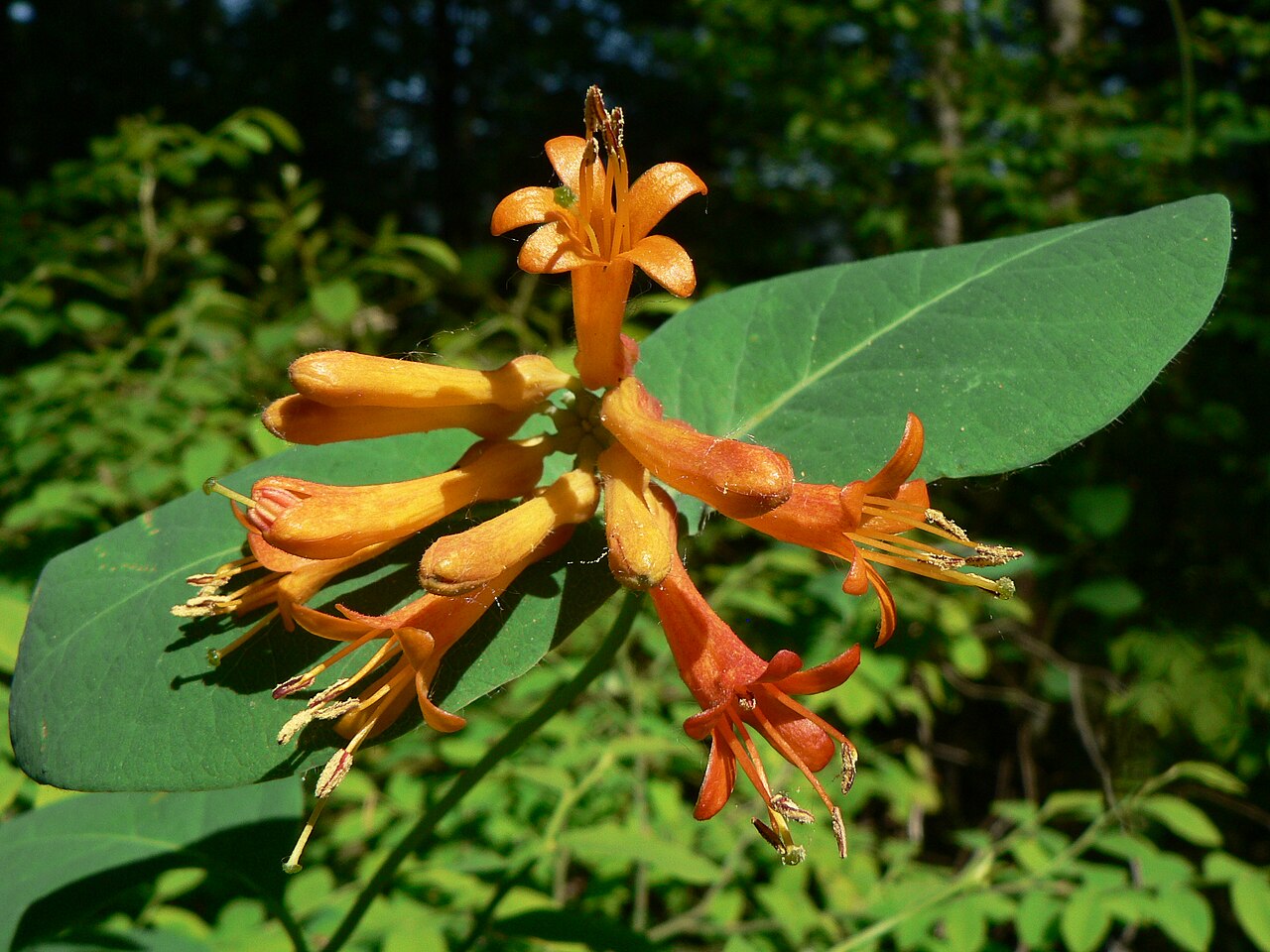
- Orange (Western Trumpet) Honeysuckle (Lonicera ciliosa): The Pacific Northwest’s showpiece native vine, with brilliant orange trumpets in late spring. Native from British Columbia to northern California and east into Idaho and western Montana.
- California (Pink) Honeysuckle (Lonicera hispidula): A rambling vine or scrambling shrub of oak woodlands and coastal forests from southern Washington to California, with small pink flowers and translucent red berries.
- Southern Honeysuckle (Lonicera subspicata): An evergreen, scrambling shrub-vine of Southern California chaparral with small, cream-colored flowers in spikes; very drought tolerant.
Native Shrub Honeysuckles
- Twinberry (Lonicera involucrata): Also called black twinberry or bearberry honeysuckle. A 3- to 10-foot shrub of moist mountain and coastal forests from Alaska to California and east through the Rockies, with a smaller range around the upper Great Lakes. Paired yellow flowers sit in leafy bracts that turn red as two shiny black berries ripen. Excellent for hummingbirds.
- Utah Honeysuckle (Lonicera utahensis): A small shrub of mountain forests across the Rockies, Cascades and Intermountain West, with paired cream-yellow flowers and paired, partly fused red berries.
- American Fly Honeysuckle (Lonicera canadensis): A low, shade-tolerant shrub of cool northern hardwood and mixed forests from Maine to Minnesota and south in the Appalachians. One of the earliest woodland shrubs to bloom, with pale yellow paired flowers and bright red berries.
- Mountain Fly Honeysuckle (Lonicera villosa): A short shrub of northern bogs, fens and rocky shores in New England, New York and the Great Lakes states. Its blue berries make it a close relative of the haskap (Lonicera caerulea) grown in fruit gardens.
- Swamp Fly Honeysuckle (Lonicera oblongifolia): An upright shrub of northern swamps, fens and wet thickets from Maine to Minnesota, with paired yellowish flowers and red to purplish berries.
- White Honeysuckle (Lonicera albiflora): A drought-tolerant shrub or weak climber of limestone hills and canyons in Texas, Oklahoma, New Mexico and Arizona, with fragrant white flowers and orange-red berries.
Native “Bush Honeysuckles” (Diervilla)
The native shrubs sold as bush honeysuckle are not Lonicera at all. Northern bush honeysuckle (Diervilla lonicera) grows from Maine to Minnesota and south in the mountains, and southern bush honeysuckle (Diervilla sessilifolia) is native to the southern Appalachians. Both are tough, suckering, 2- to 4-foot shrubs with small yellow flowers in summer, finely toothed leaves and dry seed capsules instead of berries. They are good native choices for slopes and shady banks, and they should not be confused with the invasive Asian bush honeysuckles described below.
Non-Native Look-Alikes
Several honeysuckles from Europe and Asia have escaped from gardens and become serious invasive plants, especially in the eastern half of the country. Many states, including Massachusetts, prohibit their sale, and land managers spend heavily to remove them. Learn to recognize them before you plant or buy any honeysuckle.
Japanese Honeysuckle (Lonicera japonica)
This is the fragrant “honeysuckle” of childhood memories, and it is invasive across the East, South and Midwest, from New England to Texas. It is a semi-evergreen vine that climbs over and smothers shrubs and young trees and carpets the ground in woods. Tell it apart by its white flowers that age to yellow, borne in pairs in the leaf axils along the stem rather than in clusters at the tip; its leaves, which are never fused around the stem (young leaves may be lobed); and its shiny black berries in fall. Hall’s honeysuckle is a cultivar of this species. Replace it with coral honeysuckle or another native vine.
Asian Bush Honeysuckles
Amur honeysuckle (Lonicera maackii), Tatarian honeysuckle (L. tatarica), Morrow’s honeysuckle (L. morrowii) and their hybrid Bell’s honeysuckle (L. × bella) are upright shrubs 6 to 20 feet tall. Introduced for hedges and wildlife plantings, they now dominate the understory of woodlands across the Midwest, Ohio Valley, Great Lakes and Northeast, shading out wildflowers and tree seedlings. They leaf out very early in spring and hold their leaves late into fall, produce paired white, pink or yellow flowers in spring and masses of red (sometimes orange or yellow) berries.
A quick test separates them from native shrub honeysuckles: cut an older stem and look at the center. The invasive bush honeysuckles have a hollow, brownish pith, while native fly honeysuckles and twinberry have a solid, white pith. Native shrub honeysuckles are also smaller, usually under 6 feet in the East, and grow scattered in the forest rather than in dense thickets. Native Diervilla has toothed leaves and dry capsules, which none of the Asian bush honeysuckles have.
Other Plants Called Honeysuckle
Several unrelated plants share the name. Trumpet honeysuckle and trumpet vine are sometimes confused; trumpet vine is trumpet creeper (Campsis radicans), a much bigger native vine with compound leaves. Desert honeysuckle is Anisacanthus thurberi of the Southwest, a native shrub in the acanthus family. Cape honeysuckle (Tecomaria capensis) and Himalayan honeysuckle (Leycesteria formosa) are non-native garden plants.
Growing & Care Guide
Native honeysuckles are generally easy to grow if you match the species to your region and site. Unlike Japanese honeysuckle, they stay where you plant them and do not seed aggressively into nearby woods.
Light
The native vines flower best in full sun to light shade; in heavy shade they grow leggy and bloom sparsely. A common approach is to give the roots some shade and let the vine climb up into the sun. The fly honeysuckles and twinberry are woodland and forest-edge shrubs that handle partial to fairly deep shade, especially in cool northern and mountain climates.
Soil & Water
Most native honeysuckles grow in ordinary garden soil with good drainage and average moisture, from sand to clay. Twinberry, swamp fly and mountain fly honeysuckles prefer moist to wet soils, while white honeysuckle and southern honeysuckle tolerate dry, rocky ground. Water new plants regularly through their first summer. A layer of mulch keeps roots cool, which helps limber and orange honeysuckles in particular.
Planting Tips
Plant in spring or fall. Give the vines a sturdy support such as a trellis, arbor, fence or post, since they climb by twining rather than by tendrils or clinging roots; they will not damage masonry. Space vines 3 to 6 feet apart along a fence. Plant shrubs 4 to 6 feet apart in woodland borders, hedgerows and wet areas, depending on the species.
Pruning & Maintenance
Prune native honeysuckle vines right after their main flush of bloom, since they flower on the previous year’s wood and on new shoots. Remove dead stems and thin tangled growth every few years. Shrub honeysuckles need little pruning beyond removing old, unproductive stems at ground level in late winter. Powdery mildew can whiten the leaves of coral honeysuckle in humid summers, and aphids sometimes cluster on new shoots; good air circulation, full sun and avoiding overhead watering help.
Propagation
Native honeysuckles root easily from softwood cuttings taken in early summer and from layering, where a low stem is pinned to the soil until it roots. Seeds need cleaning from the berries and two to three months of cold, moist stratification before sowing. Always buy plants of the native species by their scientific names, since “honeysuckle” alone on a nursery tag may mean an invasive species.
Landscape Uses
- Hummingbird gardens, with coral, orange or yellow honeysuckle on a trellis near a window
- Replacing Japanese honeysuckle on fences, mailboxes and arbors
- Mixed native vine plantings with crossvine, American wisteria and virgin’s bower
- Woodland and shade gardens, using American fly honeysuckle or twinberry with wild columbine
- Rain gardens and wet edges with twinberry or swamp fly honeysuckle
- Wildlife hedgerows that replace invasive Asian bush honeysuckles
Wildlife & Ecological Value
Native honeysuckles are some of the most valuable plants for hummingbirds in North America, and they feed a long list of other animals as well.
For Pollinators
The long, red and orange tubes of coral, orange and yellow honeysuckle are built for hummingbirds, and coral honeysuckle is often one of the first nectar plants blooming when ruby-throated hummingbirds return to the Southeast in spring. Bumblebees, long-tongued bees and butterflies visit the shorter flowers of limber, grape and fly honeysuckles. Honeysuckles are larval host plants for the snowberry clearwing and hummingbird clearwing moths, day-flying sphinx moths that look like tiny hummingbirds themselves.
For Birds
The berries are eaten by thrushes, catbirds, robins, cedar waxwings, purple finches and other songbirds. Dense honeysuckle vines and shrubs also offer nesting cover. Native species ripen their fruit over a shorter period than invasive bush honeysuckles, whose abundant, lower-fat berries are a poor substitute for native fall fruit for migrating birds.
For Mammals
Deer browse honeysuckle shoots, and bears eat twinberry and other honeysuckle berries in the West. Small mammals feed on fallen fruit and shelter in the tangled growth of the vines.
Ecosystem Role
Native honeysuckles fill the vine and shrub layers of forest edges, streambanks and mountain thickets, linking spring hummingbird migration, summer moths and fall bird migration. Where invasive Japanese and Asian bush honeysuckles have taken over, replacing them with native honeysuckles and other native shrubs restores this web.
Cultural & Historical Uses
The name honeysuckle comes from the old habit of sucking the sweet nectar from the base of the flower tube, a pastime that most Americans now learned on Japanese honeysuckle. Coral honeysuckle was carried to European gardens in the 1600s and has been a popular American garden vine since colonial times; Thomas Jefferson grew it at Monticello.
Native peoples across North America knew and named their local honeysuckles, and ethnobotanical records describe the flexible stems of some western vines being used for binding and weaving and various species being part of traditional practices. These are records of history, not advice, and most honeysuckle berries should not be eaten.
The story of honeysuckle in the twentieth century is largely one of introduced species. Japanese honeysuckle was promoted for erosion control and wildlife cover, and Amur and Tatarian honeysuckles were planted by conservation agencies in hedgerows. Both spread far beyond their plantings. Today, native plant societies and extension services across the country encourage gardeners to remove those species and plant native honeysuckles in their place.
Frequently Asked Questions
Is honeysuckle native to the United States?
Some honeysuckles are, and some are not. About 20 Lonicera species are native to the US, including coral, limber, grape, orange and yellow honeysuckles and several shrubs such as twinberry and American fly honeysuckle. The most common wild honeysuckles in the East, Japanese honeysuckle and the Asian bush honeysuckles, are invasive non-natives.
What is the best native honeysuckle vine?
In most of the eastern and southern US, coral honeysuckle (Lonicera sempervirens) is the top choice: long-blooming, hummingbird-friendly and easy to grow. In the Pacific Northwest, choose orange honeysuckle; in the northern states, limber or grape honeysuckle; in California, pink honeysuckle.
How can I tell native honeysuckle from Japanese honeysuckle?
Look below the flowers. Native vines usually have a pair of leaves fused into a disk around the stem just under a cluster of flowers at the stem tip. Japanese honeysuckle has separate leaves, white-to-yellow flowers in pairs along the stem, and black berries.
Are honeysuckle berries poisonous?
Most honeysuckle berries are bitter and can cause stomach upset if eaten in quantity, and some species are considered mildly toxic. Treat them as bird food rather than people food, and keep children from eating them.
Does native honeysuckle smell sweet?
Coral honeysuckle and most red and orange native species have little or no fragrance, because hummingbirds, their main pollinators, do not rely on scent. Yellow honeysuckle and white honeysuckle are lightly fragrant. The strong sweet scent most people associate with honeysuckle belongs to the invasive Japanese species.

Looking for a nursery that carries Native Honeysuckles?
Browse our native plant nursery directory: Alabama, Alaska, Arizona & Arkansas · California · Colorado, Connecticut, Delaware, Florida & Georgia · Idaho, Illinois, Indiana, Iowa & Kansas · Kentucky, Louisiana, Maine, Maryland, Massachusetts, Michigan, Minnesota, Mississippi, Missouri & Montana · Nebraska, Nevada, New Hampshire, New Jersey, New Mexico, New York, North Carolina, North Dakota, Ohio & Oklahoma · Oregon · Pennsylvania, Rhode Island, South Carolina, South Dakota, Tennessee, Texas, Utah, Vermont & Virginia · Washington · West Virginia, Wisconsin & Wyoming

