
Frost Grape (Vitis vulpina)
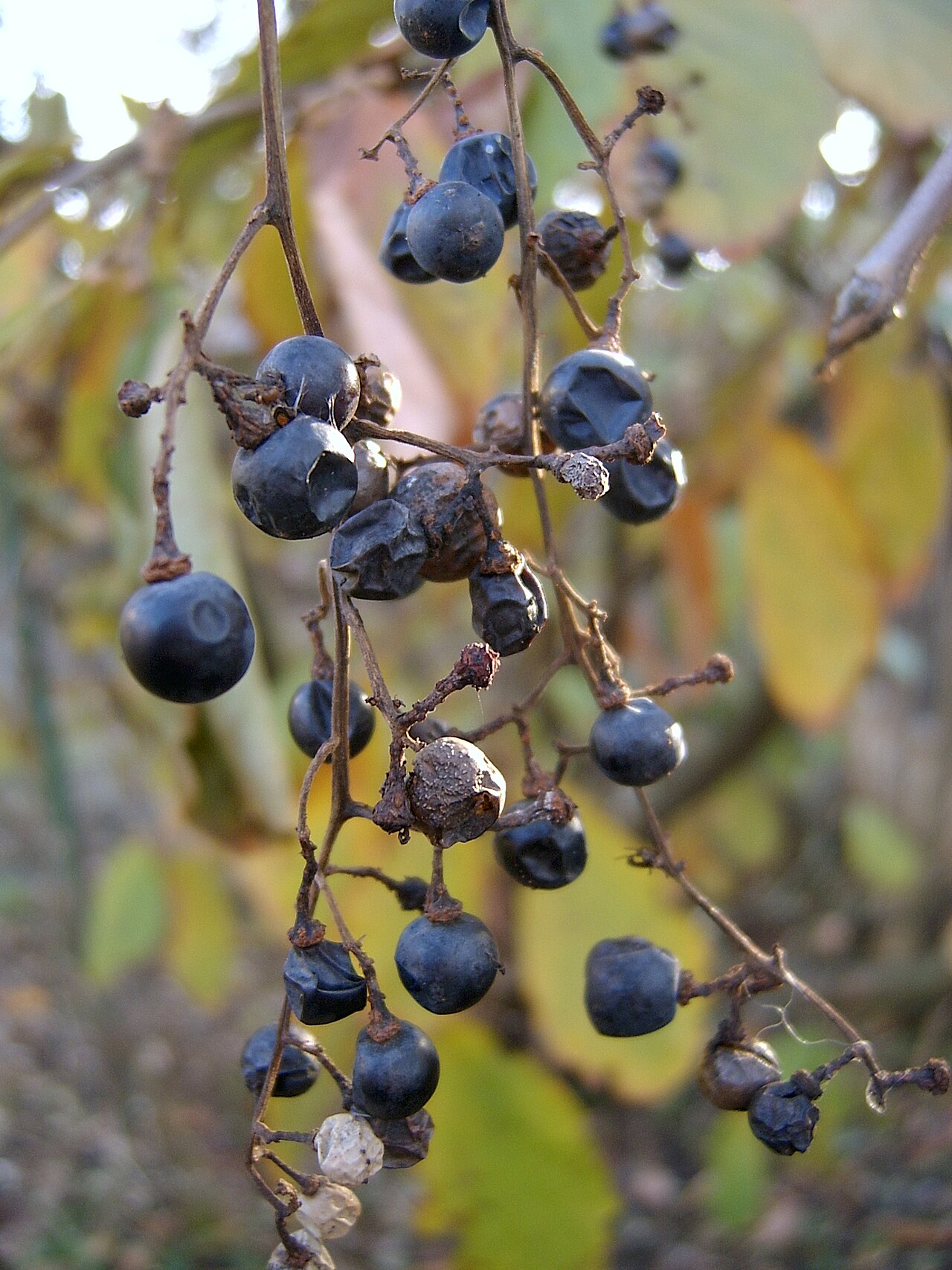
Vitis vulpina, the Frost Grape, is a big, fast-climbing native grapevine of the eastern and central United States. It is also called chicken grape, winter grape and heartleaf grape, and older books list it as Vitis cordifolia. It climbs by forked tendrils to the tops of floodplain trees, drapes fencerows and woodland edges, and can build a trunk several inches thick with shaggy, shredding bark. In late spring it bears small, sweet-scented greenish flowers, and by fall female vines carry loose clusters of small, shiny black grapes.
The common name comes from the fruit. Frost grapes are small (about 1/4 to 3/8 inch) and very sour when they first color in September and October. They hang on the vine well into winter, and after a few hard frosts they soften and become noticeably sweeter. That long hang time makes frost grape one of the most valuable late-season foods for birds and mammals in eastern woodlands.
Frost grape is easy to grow, perhaps too easy for a small yard. It belongs in naturalized edges, stream buffers, large arbors and wildlife plantings, where its vigor is an asset. This guide covers how to tell it apart from the other native grapes and its look-alikes (including the poisonous moonseed), where it grows, how to manage it in a garden, and what it does for wildlife.
Identification
Wild grapes hybridize and vary, and even botanists sometimes argue over a particular vine. Frost grape is identified mainly by its leaves, which are broad, heart-shaped and usually unlobed, glossy and nearly hairless, and by its small, sour, late-hanging fruit.
Stems & Bark
Frost grape is a woody, deciduous, high-climbing vine. Stems can reach about 50 feet or more into the canopy, and old trunks may be 4 to 8 inches across, with dark brown bark that peels in long, loose strips. Young twigs are smooth, green to reddish brown and round. Like other grapes it climbs with forked tendrils, which grow opposite the leaves; on most grapes, including frost grape, every third node lacks a tendril. Cut a young stem and you will see brown pith interrupted at each node by a woody cross-wall (diaphragm).
Leaves
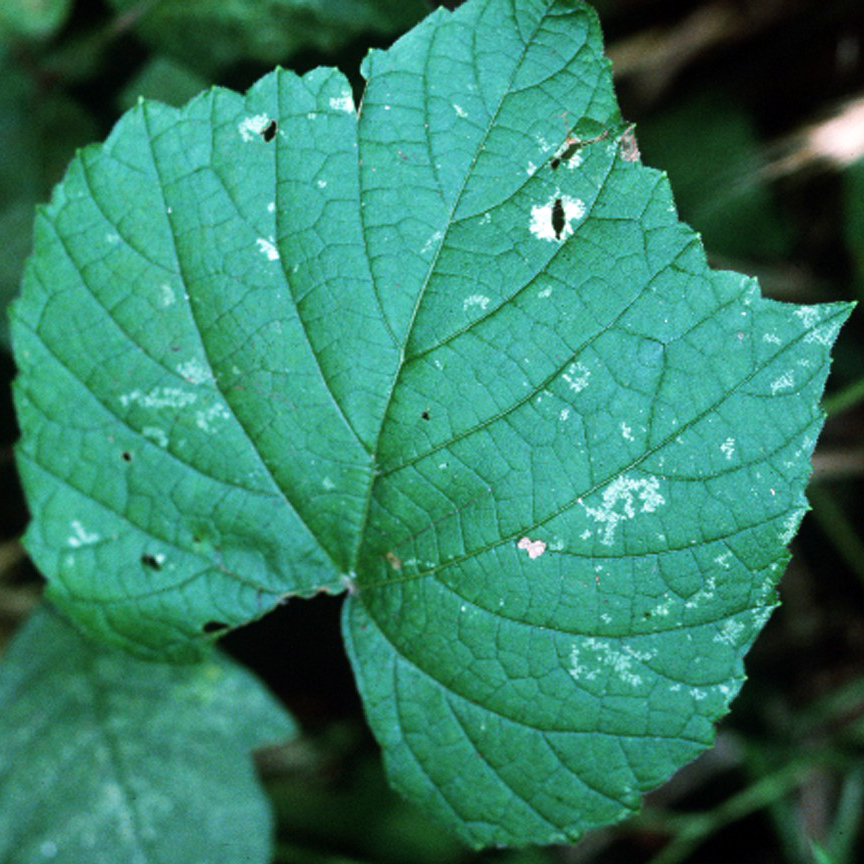
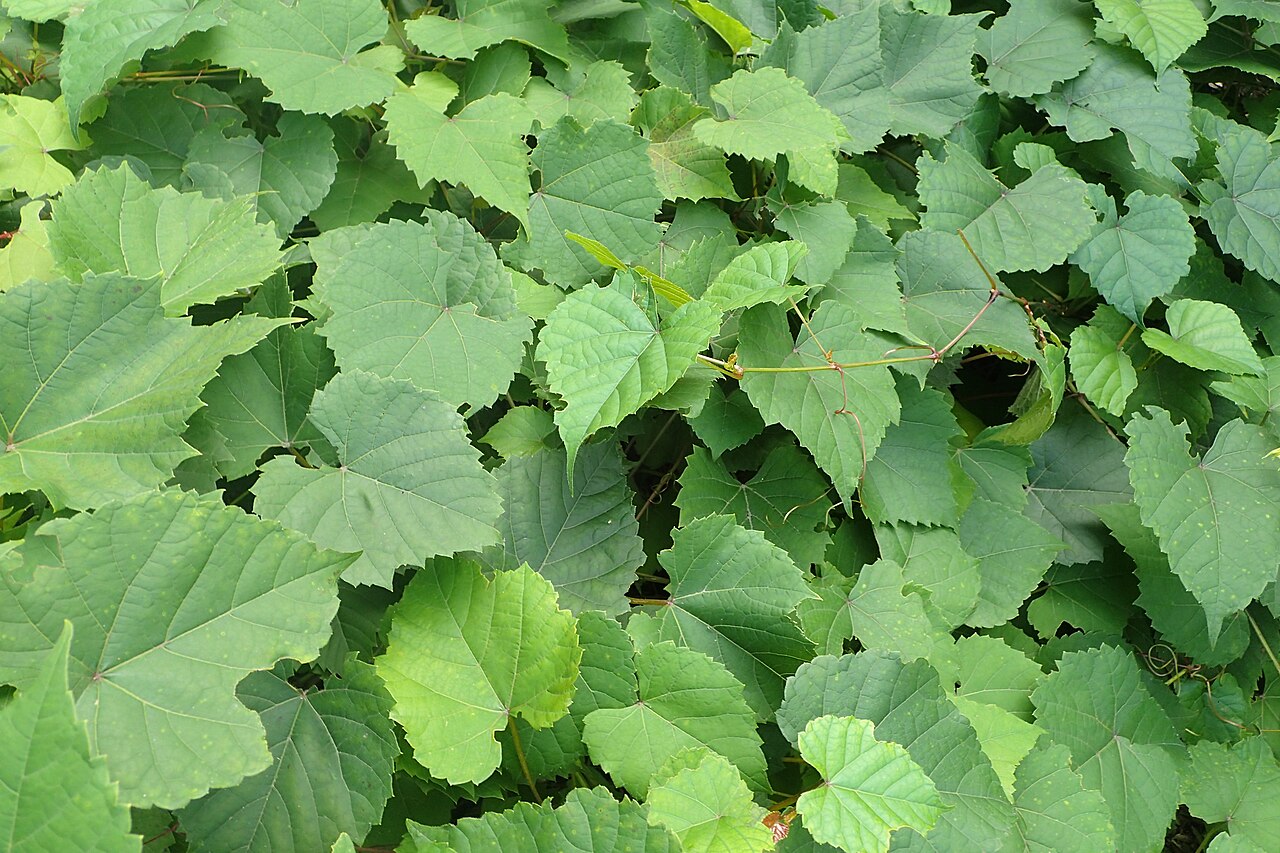
The leaves are alternate, simple and broadly heart-shaped, about 3 to 6 inches long (larger on vigorous shoots), with a deep, open notch at the base. Most are unlobed or have only two small shoulders, and the margins have coarse, sharp, uneven teeth. The upper surface is bright green and somewhat shiny; the underside is paler and smooth, with at most a few hairs along the veins and in the vein angles. This distinguishes it from Riverbank Grape, whose leaves usually have three pointed lobes and a long drawn-out tip, and from Fox Grape and summer grape, whose leaf undersides are felted with rusty or whitish hair.
Flowers
Vines bloom in May and June, as the leaves expand. Tiny greenish-yellow flowers are packed in branched clusters 3 to 6 inches long, and they have a sweet, mignonette-like fragrance that carries a long way on a warm evening. Like most wild grapes, frost grape is functionally dioecious: a vine is either male (pollen only) or female (fruiting). Only female vines produce grapes, and they need a male vine somewhere nearby.
Fruit
The fruit is a loose cluster of small round berries, each about 1/4 to 3/8 inch across, shiny black or blue-black with little or no waxy bloom. They contain one to three seeds and a thin layer of juicy, very acidic pulp. They ripen from September to November and often persist into midwinter, softening and sweetening after frost.
Look-alikes
The most important look-alike is Moonseed (Menispermum canadense), a native vine whose blue-black fruit is poisonous. Moonseed has no tendrils (it twines), its leaf stalk attaches slightly inside the leaf edge, its leaf margins are smooth, and each berry contains a single flattened, crescent-shaped seed. Grapes have tendrils, toothed leaves and round, pear-shaped seeds. Virginia Creeper often grows in the same tangles; its leaves are divided into five leaflets and its berries hang on bright red stalks. Heartleaf Peppervine has similar leaves but white pith, no diaphragms and smaller, multicolored fruit.
Quick Facts
| Scientific Name | Vitis vulpina (syn. Vitis cordifolia) |
| Family | Vitaceae (grape family) |
| Plant Type | Woody deciduous vine climbing by tendrils |
| Mature Height | Climbs 30–50 ft or more on trees; sprawls over fences and shrubs |
| Mature Spread | 15–35 ft or more |
| Growth Rate | Fast |
| Sun Exposure | Full sun to partial shade |
| Water Needs | Medium; tolerates moist bottomland soils and moderate drought once established |
| Soil Type | Moist loam, alluvial and clay soils; adaptable |
| Soil pH | About 5.5–7.5 |
| Bloom Time | May–June |
| Flower Color | Greenish yellow; fragrant |
| Fall Color | Yellow |
| Fruit | Small black grapes, ripening Sep–Nov and persisting into winter |
| Deer Resistant | No; deer browse the leaves and shoots |
| USDA Hardiness Zones | 5–9 |
Native Range
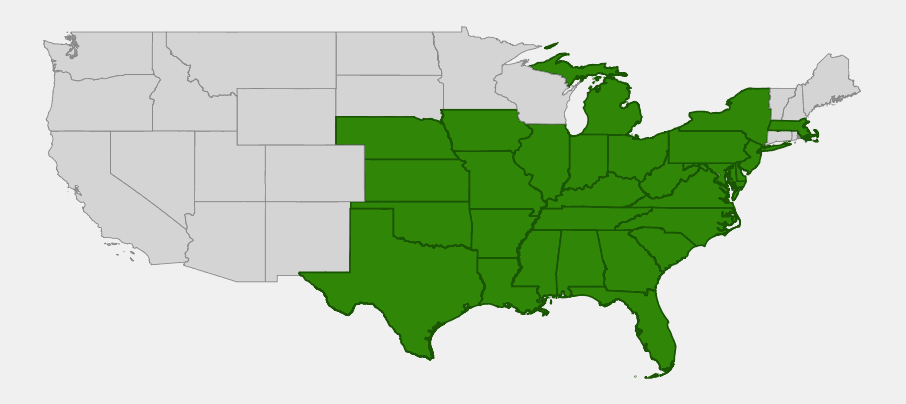
Frost grape grows across much of the eastern and central United States. USDA PLANTS and the Lady Bird Johnson Wildflower Center record it from 28 states and the District of Columbia, from southern New York, Pennsylvania and southern Michigan south to Florida, and west to Iowa, Nebraska, Kansas, Oklahoma and Texas. A Massachusetts record marks its northeastern edge. It is also reported from southern Ontario.
It is most common in the Mississippi and Ohio valleys and across the Southeast, where it is a characteristic vine of bottomland forests, river and stream banks, floodplain thickets and moist woodland borders. It also takes readily to disturbed ground and turns up on fencerows, old fields, roadsides and the edges of city woodlots. It is less common at the northern edge of its range and in the mountains.
Frost grape belongs to the true grapes (subgenus Vitis), the same group as the European wine grape and the other native wild grapes. It hybridizes with several of them where they grow together, especially riverbank grape, so intermediate vines are not unusual.
📋 Regional plant lists featuring Frost Grape: North & South Florida · Alabama, Georgia & Mississippi · North & South Carolina · Maryland, Virginia & West Virginia · Kentucky & Tennessee · Arkansas, Louisiana, Eastern Oklahoma & Eastern Texas · Illinois, Iowa & Missouri · Ohio & Indiana · Nebraska, Kansas & Eastern Colorado · Michigan, Wisconsin & Eastern Minnesota · New York, Pennsylvania & Northern New Jersey · Delaware, Southern New Jersey & Long Island · Connecticut, Massachusetts & Rhode Island
Growing & Care Guide
Frost grape needs almost no help to grow. The real work is giving it enough room and a strong support, and keeping it from swamping trees and shrubs you care about. In a large naturalized garden, a woodland edge or a stream buffer it is a superb wildlife vine.
Light
It flowers and fruits best in full sun to light shade. In the wild it races up into the sunlit canopy of floodplain trees and fruits at the top. In deep shade it survives but stays thin and rarely fruits.
Soil & Water
Frost grape is adaptable. It prefers deep, moist, fertile loam or alluvial soil but grows in clay, sandy loam and rocky ground. It tolerates periodic flooding and, once established, moderate summer drought. No fertilizer is needed; rich soil mainly produces extra leafy growth.
Planting Tips
Plant container-grown vines in spring or fall next to a sturdy fence, large arbor, pergola or dead snag. A mature vine is heavy, so light trellises collapse. Avoid planting where it can climb onto young ornamental trees, because the weight and shade of a grapevine can deform or kill a small tree. If you want fruit, remember that wild grapes are usually male or female: plant several seedlings, or rely on wild male vines nearby.
Pruning & Maintenance
On an arbor, prune hard in late winter while the vine is dormant, cutting the previous year’s growth back to a few buds on a permanent framework, the same way grape growers do. Pruning in spring makes cut stems “bleed” sap heavily, which is unsightly but rarely harmful. In naturalized areas, check every year or two that the vine is not overtopping trees you want to keep, and cut it at the base if it is. Japanese beetles, grape leaf skeletonizers and fungal leaf spots may show up, but wild vines usually shrug them off.
Propagation
Fresh seed sown outdoors in fall germinates the next spring; stored seed needs about 2 to 3 months of cold, moist stratification. Hardwood cuttings taken in late winter, with two or three buds each, root readily in moist sand. Grapes can also be layered by pinning a low stem to the ground until it roots.
Landscape Uses
- Wildlife plantings: its long-hanging fruit feeds birds and mammals well into winter
- Stream buffers and floodplain restoration: tolerates flooding and helps cover banks quickly
- Large arbors and pergolas: gives dense summer shade and fragrant spring bloom
- Fences and screens: covers a sturdy fence in two or three seasons
- Edible landscaping: the tart fruit makes good jelly, juice and syrup after frost
Wildlife & Ecological Value
Frost grape is one of the most valuable wildlife vines of eastern bottomlands. Its tangles offer food, nest sites and cover all year.
For Pollinators
Grape flowers are small but fragrant and rich in pollen. Bees, especially small native bees and honey bees, and many flies and beetles visit them in late spring. The leaves feed the caterpillars of several native moths, including the eight-spotted forester, the Pandora and Abbott’s sphinx moths, and the grape leaffolder, as well as specialist leaf miners such as Antispila oinophylla, a moth described in 2012 from frost grape in Georgia.
For Birds
Wild grapes are eaten by dozens of bird species, including wild turkey, northern bobwhite, northern cardinal, northern mockingbird, gray catbird, brown thrasher, American robin, eastern bluebird, cedar waxwing and several woodpeckers. Because frost grapes hang on the vine into midwinter, they are especially important when other fruit is gone. Many songbirds, including northern cardinals and gray catbirds, use strips of grape bark to build their nests, and the dense tangles shelter nests and roosts.
For Mammals
Raccoons, opossums, gray and red foxes, black bears, squirrels and chipmunks all eat the fruit. White-tailed deer browse the leaves and young shoots, and rabbits shelter under low tangles.
Ecosystem Role
In floodplain forests frost grape fills canopy gaps quickly after storms, floods or logging, and it binds stream banks with its roots. Heavy grape tangles can slow tree regeneration in a gap, and they sometimes pull down weakened trees, which is part of the natural turnover of bottomland forests.
Cultural & Historical Uses
André Michaux described this grape as Vitis cordifolia, the heart-leaved grape, in his 1803 flora of North America, and that name was widely used through the twentieth century. It was later recognized that Linnaeus had already named the same plant Vitis vulpina in 1753, and the older name took priority. The epithet vulpina means “of the fox”, a reference to the old name fox grape, which is now applied to Vitis labrusca instead.
Wild grapes were an important food for many Native American nations of the eastern woodlands, who ate them fresh and dried them for winter. Settlers made frost grapes into jelly, juice and wine, usually waiting until after the first frosts when the fruit was sweeter. Woodsmen have long known that a cut stem of a large grapevine drips clear, drinkable sap, and the long, tough vines were used for tying and basket-making.
Frost grape has played a smaller role in grape breeding than riverbank grape or sand grape, but it is one of the North American species with natural tolerance to grape phylloxera and fungal diseases, and it is part of the gene pool breeders draw on. Today it is mostly valued as a wild food and wildlife plant, and as a reminder of the rich native grape flora of the eastern United States, which also includes Muscadine in the Southeast.
Frequently Asked Questions
Are frost grapes edible?
Yes. They are small and very sour when they first ripen, and they are best picked after a few frosts, when they are softer and sweeter. They make good jelly, juice and syrup. Make sure you have a true grape: poisonous moonseed has similar berries but no tendrils and a single crescent-shaped seed in each fruit.
How do I tell frost grape from riverbank grape?
Frost grape leaves are usually unlobed and heart-shaped, glossy above, with coarse teeth and a short tip. Riverbank grape leaves usually have three pointed lobes, a long tapering tip and sharp, fine teeth. Frost grapes ripen later and hang on longer, and riverbank grape usually has a whitish bloom on its fruit. The two hybridize, so some vines are in between.
Why doesn’t my frost grape have fruit?
Wild grapes are usually either male or female. Male vines flower but never fruit. Female vines need pollen from a male vine nearby. A young vine may also need several years and good sun before it fruits.
Will frost grape harm my trees?
It can. A vigorous grapevine can cover the crown of a small or weak tree, shading it and adding weight that breaks branches in ice or wind. Give it its own support, or let it climb only large, healthy trees or dead snags, and cut it back if it starts overtopping trees you want to keep.
Is frost grape invasive?
No. It is native across the eastern and central United States. It is vigorous and can be weedy in gardens, but it is a natural part of bottomland forests. Non-native vines such as porcelain berry are the real invasive threat in the same habitats.

Looking for a nursery that carries Frost Grape?
Browse our native plant nursery directory: Alabama & Arkansas · Delaware, Florida & Georgia · Illinois, Indiana, Iowa & Kansas · Kentucky, Louisiana, Maryland, Massachusetts, Michigan, Mississippi & Missouri · Nebraska, New Jersey, New York, North Carolina, Ohio & Oklahoma · Pennsylvania, South Carolina, Tennessee, Texas & Virginia · West Virginia

