Hill Country Penstemon (Penstemon triflorus)
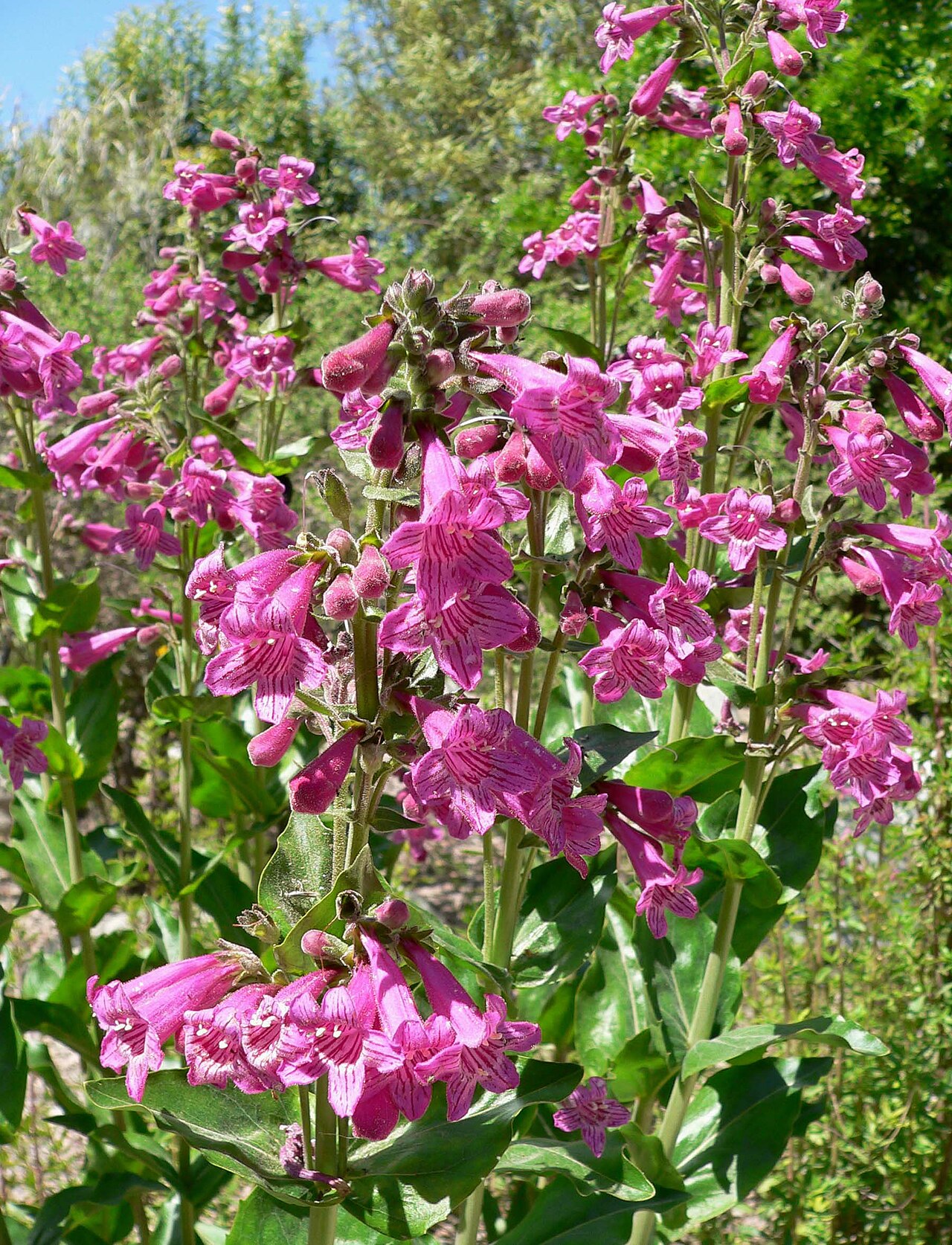
Penstemon triflorus, commonly called Hill Country Penstemon (also Hill Country Beardtongue, Scarlet Penstemon, or Heller’s Beardtongue), is a compact herbaceous perennial found nowhere in the world except the Edwards Plateau of central Texas. This member of the Plantaginaceae (plantain family, where penstemons now sit after being moved out of the old figwort family, Scrophulariaceae) is one of the most intensely colored wildflowers of the Texas Hill Country, producing two-inch, trumpet-shaped flowers in a shade of red-magenta that few other native perennials can match.
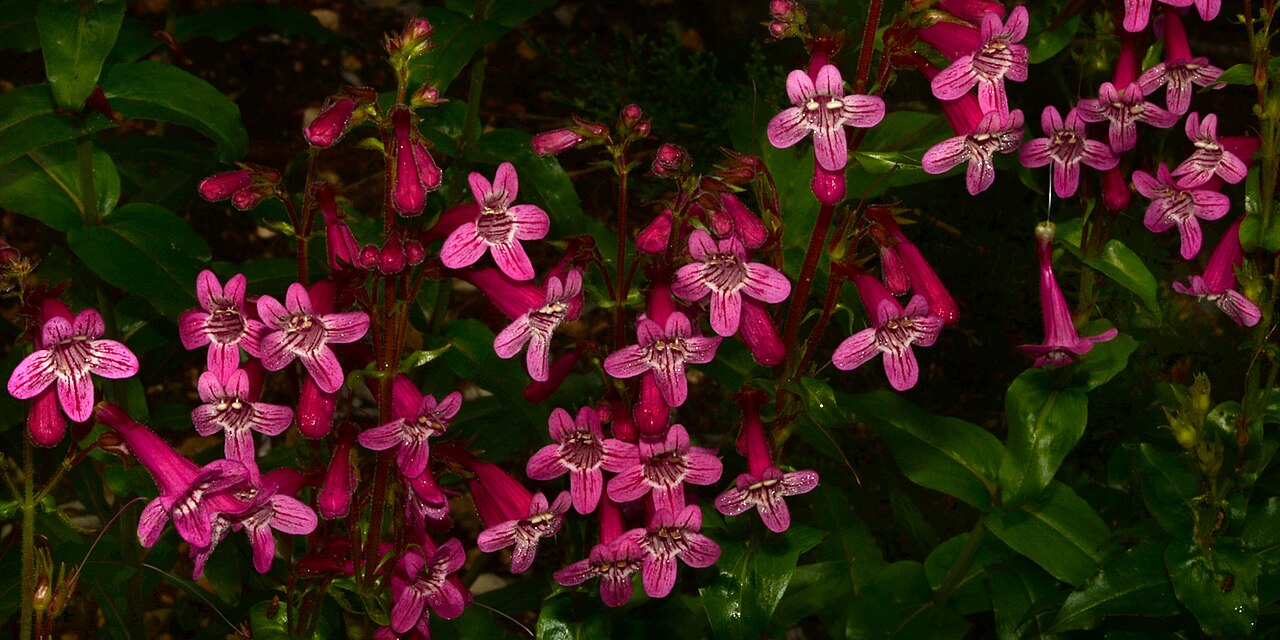
Hill Country Penstemon grows as a small, bushy clump 1½ to 2 feet tall, with pairs of smooth, dark-green leaves held opposite one another along upright flowering stems. In April and May the stems are topped with loose spikes of two-lipped, tubular flowers that open red to deep pink, each one roughly an inch wide and up to two inches long. The combination of small stature, intensely saturated flower color, and unusually large blooms for the size of the plant is what sets this species apart from the dozens of other penstemons native to Texas.
Because it is restricted to limestone hills and thin, rocky, well-drained soils of the Edwards Plateau, Hill Country Penstemon is an excellent choice for rock gardens, dry limestone beds, and xeric native plantings anywhere within or near its native range. It asks for almost nothing once established — no supplemental water, no fertilizer, no coddling — and rewards that neglect with some of the showiest flowers of the spring wildflower season, reliably drawing hummingbirds and butterflies to the garden.
Identification
Hill Country Penstemon is a low, clump-forming herbaceous perennial that dies back to a basal rosette each winter and sends up new flowering stems in spring. Mature plants form a loose, bushy mound roughly 1½ to 2 feet tall and somewhat wider, with multiple slender, upright stems rising from the base.
Stems & Leaves
Stems are slender, often tinged reddish-purple, and finely hairy (puberulent) toward the flowering tips. Leaves are arranged in opposite pairs along the stem — a reliable field mark that separates penstemons from many similar-looking mints and snapdragon relatives. Leaves are lance-shaped to oblong, smooth-surfaced, dark green, with finely toothed (dentate) margins. The basal leaves, which persist through winter, are somewhat larger and more rounded than the stem leaves.
Flowers
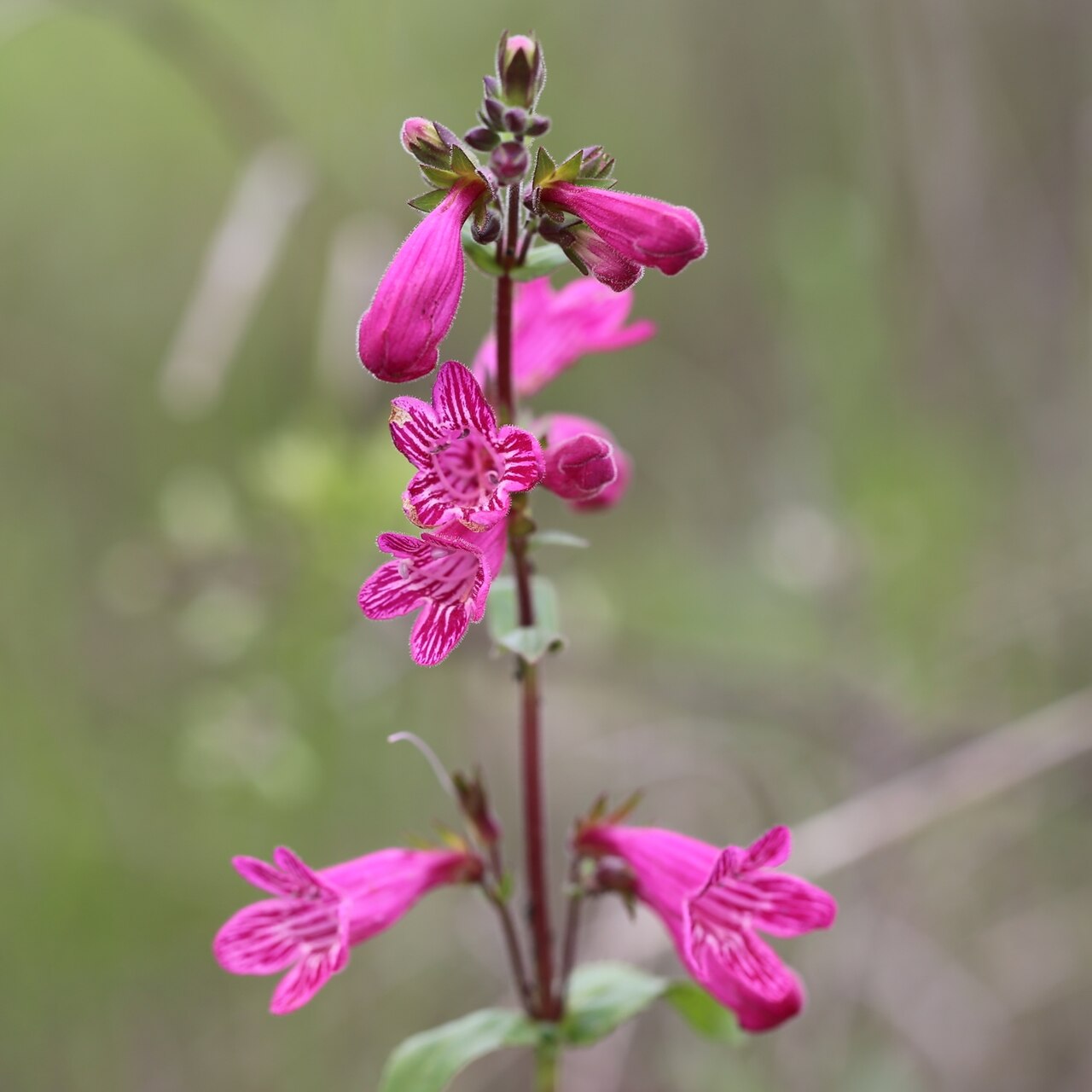
Flowers are borne in a loose, branching, terminal panicle, typically in opposite pairs at each node, giving the inflorescence a somewhat candelabra-like look. Each flower is tubular with two lips — a shorter upper lip of two lobes and a broader lower lip of three lobes — and measures up to two inches long and about an inch across at the mouth, among the largest flowers of any Texas penstemon relative to the size of the plant. Color ranges from vivid red to deep rose-pink, with faint darker nectar guide lines inside the throat. Five sepals support each flower, and the fruit that follows is a small two-chambered capsule packed with tiny seeds.
Similar Species
Hill Country Penstemon is most easily confused with its close relative Wild Foxglove / Cobaea Penstemon (Penstemon cobaea), with which it readily hybridizes where the two overlap on the Edwards Plateau. Cobaea Penstemon has much larger, broader, pale lavender to white flowers and a coarser, more open growth habit, while Hill Country Penstemon is smaller, bushier, and far more intensely colored. Guadalupe Penstemon (Penstemon guadalupensis), found further west, has smaller, paler flowers and a more sprawling habit.
Quick Facts
| Scientific Name | Penstemon triflorus |
| Family | Plantaginaceae (Plantain, formerly Scrophulariaceae) |
| Plant Type | Herbaceous Perennial Wildflower |
| Mature Height | 1½–2 ft (45–60 cm) |
| Mature Spread | 1–1½ ft (30–45 cm) |
| Growth Rate | Moderate |
| Sun Exposure | Full Sun |
| Water Needs | Low (excellent drought tolerance) |
| Soil Type | Thin, rocky, limestone-based; sandy to clay loam |
| Soil pH | 7.0–8.0 (neutral to alkaline) |
| Bloom Time | April – May |
| Flower Color | Red to deep pink/magenta |
| Fall Color | Not significant (dies back to basal rosette) |
| Fruit | Small two-chambered capsule |
| Deer Resistant | Yes, generally avoided by deer |
| USDA Hardiness Zones | 7–9 |
Native Range
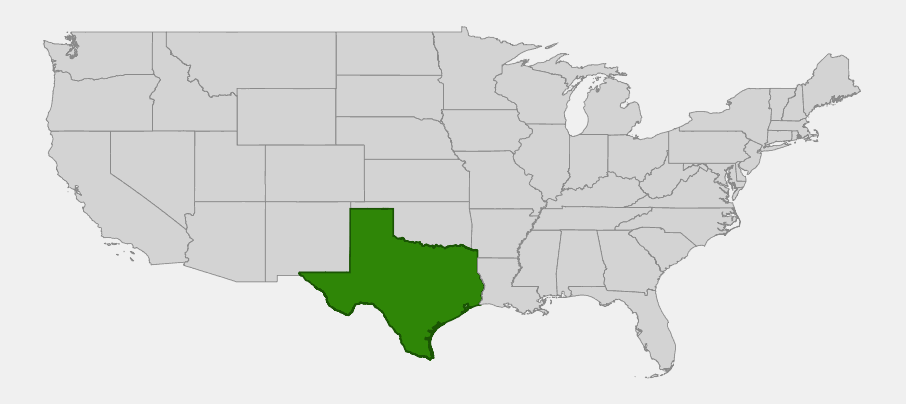
Hill Country Penstemon is a true Texas endemic, found growing wild nowhere else on Earth but the Edwards Plateau — the limestone uplift of central Texas that gives the Hill Country its name and its distinctive flora. Its range runs roughly from the Austin and San Antonio area west through the Hill Country counties toward the plateau’s western edge, including well-known wildflower counties such as Kerr, Edwards, Bandera, Real, Gillespie, and Travis.
Within this range it grows on open limestone hills, rocky slopes, and in thin, dry soils over caliche or exposed limestone — the same sun-baked, well-drained ground favored by Ashe Juniper, Texas Red Oak, and Mountain Laurel. It is a plant of open, sunny sites rather than forest interiors, typically found on roadcuts, canyon rims, glades, and rocky prairies rather than in dense woodland.
Because the Edwards Plateau’s limestone geology does not extend much beyond its own boundaries, Hill Country Penstemon is not considered native to the Texas coastal plain, the Panhandle, far West Texas, or any state outside Texas. Gardeners outside the Hill Country and immediately adjacent limestone country should treat it as a regional specialty rather than a general-purpose Texas native, though it performs well in cultivation anywhere with full sun and sharp drainage.
📋 Regional plant lists featuring Hill Country Penstemon: South & West Texas
Growing & Care Guide
Hill Country Penstemon is a satisfying but exacting garden plant: give it the sharp drainage and full sun it needs and it will reward you with some of the most vividly colored flowers in the spring garden, with very little further care required.
Light
Plant in full sun. In its native limestone hills it grows in fully exposed, open sites, and it flowers most heavily and holds its compact, bushy form best with at least six to eight hours of direct sun. In part shade it tends to stretch, flop, and bloom less.
Soil & Water
Good drainage is non-negotiable. Hill Country Penstemon is adapted to thin, rocky soils over limestone or caliche and is intolerant of heavy, wet, or poorly drained clay. Raised beds, rock gardens, and slopes amended with crushed limestone or decomposed granite suit it well. Once established it needs very little supplemental water and is genuinely drought-tolerant; overwatering, especially in winter, is the most common way to lose this plant to root and crown rot.
Planting Tips
Set out container-grown plants in fall or early spring so roots can establish before the heat of summer. Space plants about 12 to 18 inches apart to allow for their bushy, spreading form. Avoid heavy mulch piled against the crown, which traps moisture; a thin layer of gravel mulch is a better match for this plant’s native conditions than bark or compost.
Pruning & Maintenance
Cut back spent flowering stems after bloom to tidy the plant and, if seed is not wanted, to prevent the free hybridizing with other penstemons that this species is known for in gardens where Cobaea Penstemon is also grown. Left alone, the dried seed stalks will self-sow and keep a planting going for years. Established clumps are generally short-lived perennials, often fading after three to five years, so allowing some self-seeding is the easiest way to maintain a stand over time.
Landscape Uses
Hill Country Penstemon is best used where its need for drainage and sun can be met without competition:
- Limestone rock gardens and dry stone walls
- Xeric and drought-tolerant perennial beds
- Hummingbird and butterfly gardens
- Cut flower gardens — long-lasting as a cut stem
- Caliche or limestone slopes where few other perennials thrive
- Containers with fast-draining cactus or succulent mix
Wildlife & Ecological Value
Hill Country Penstemon is a magnet for nectar-feeding wildlife during its spring bloom, playing an outsized ecological role for such a compact plant.
For Pollinators
The tubular, nectar-rich flowers are a strong draw for native bees and other long-tongued pollinators able to reach into the deep corolla. The intense red-pink color and tubular shape are classic hummingbird-pollination traits, and the species is a reliable nectar source during the critical spring migration and nesting period.
For Hummingbirds
Ruby-throated and Black-chinned Hummingbirds passing through or breeding in the Hill Country regularly visit Hill Country Penstemon, timing well with its April–May bloom window and the arrival of migrating hummingbirds in Texas.
For Butterflies
Butterflies, including swallowtails and other nectar-seeking species common to Hill Country wildflower meadows, also visit the flowers, adding to the plant’s value in a pollinator garden alongside better-known Texas spring wildflowers like bluebonnets and paintbrush.
Ecosystem Role
As a small, early-flowering perennial of open limestone ground, Hill Country Penstemon fills a niche among the specialized flora that has evolved on the thin, calcium-rich soils of the Edwards Plateau — one of the most botanically distinctive regions in Texas, home to numerous endemic plants found nowhere else. Its presence in a garden or restoration planting helps support pollinator populations adapted to this limestone flora during a period when few other nectar sources are in bloom.
Cultural & Historical Uses
Hill Country Penstemon does not carry the long documented history of Indigenous or pioneer use associated with some other Texas natives; as a plant largely confined to open limestone hills rather than areas of concentrated settlement or trade, it has left little record in historical ethnobotanical sources.
Its modern significance is primarily horticultural. As Texas gardeners and the native plant movement centered on organizations like the Native Plant Society of Texas and the Lady Bird Johnson Wildflower Center popularized Hill Country natives in the latter twentieth century, Penstemon triflorus became valued as one of the showiest small perennials available for limestone gardens, prized for cut flowers and for its intensity of color among a genus otherwise dominated by paler blues, lavenders, and whites.
The species also plays a documented role in the modern story of penstemon hybridization in cultivation, where its readiness to cross with the related Cobaea Penstemon where the two grow together has been noted by Texas botanists and gardeners alike, occasionally complicating efforts to maintain genetically pure seed stock of either species in garden settings near the overlap zone.
Frequently Asked Questions
Is Hill Country Penstemon native to my part of Texas?
Only if you garden within or very near the Edwards Plateau — the limestone Hill Country region running roughly from Austin and San Antonio west through counties like Kerr, Bandera, Real, Edwards, and Gillespie. It is not native to East Texas, the Gulf Coast, the Panhandle, or far West Texas.
How tall does Hill Country Penstemon get?
Mature plants typically reach 1½ to 2 feet tall and form a bushy mound slightly narrower than that in spread. It stays notably more compact than many other garden penstemons.
Does Hill Country Penstemon need a lot of water?
No. It is adapted to thin, dry, rocky limestone soils and has low water needs once established. Overwatering, particularly in heavy or poorly drained soil, is far more likely to kill this plant than drought.
Will it attract hummingbirds?
Yes. The tubular red-pink flowers are a strong hummingbird draw and bloom during the spring migration and early nesting season, making it a good choice for a hummingbird garden in or near its native range.
Is Hill Country Penstemon short-lived?
Individual plants are often relatively short-lived, commonly fading after three to five years. Allowing some seed to mature and self-sow is the simplest way to keep a planting going over the long term.

Looking for a nursery that carries Hill Country Penstemon?
Browse our native plant nursery directory: Texas