
Large-seeded Forget-me-not (Myosotis macrosperma)
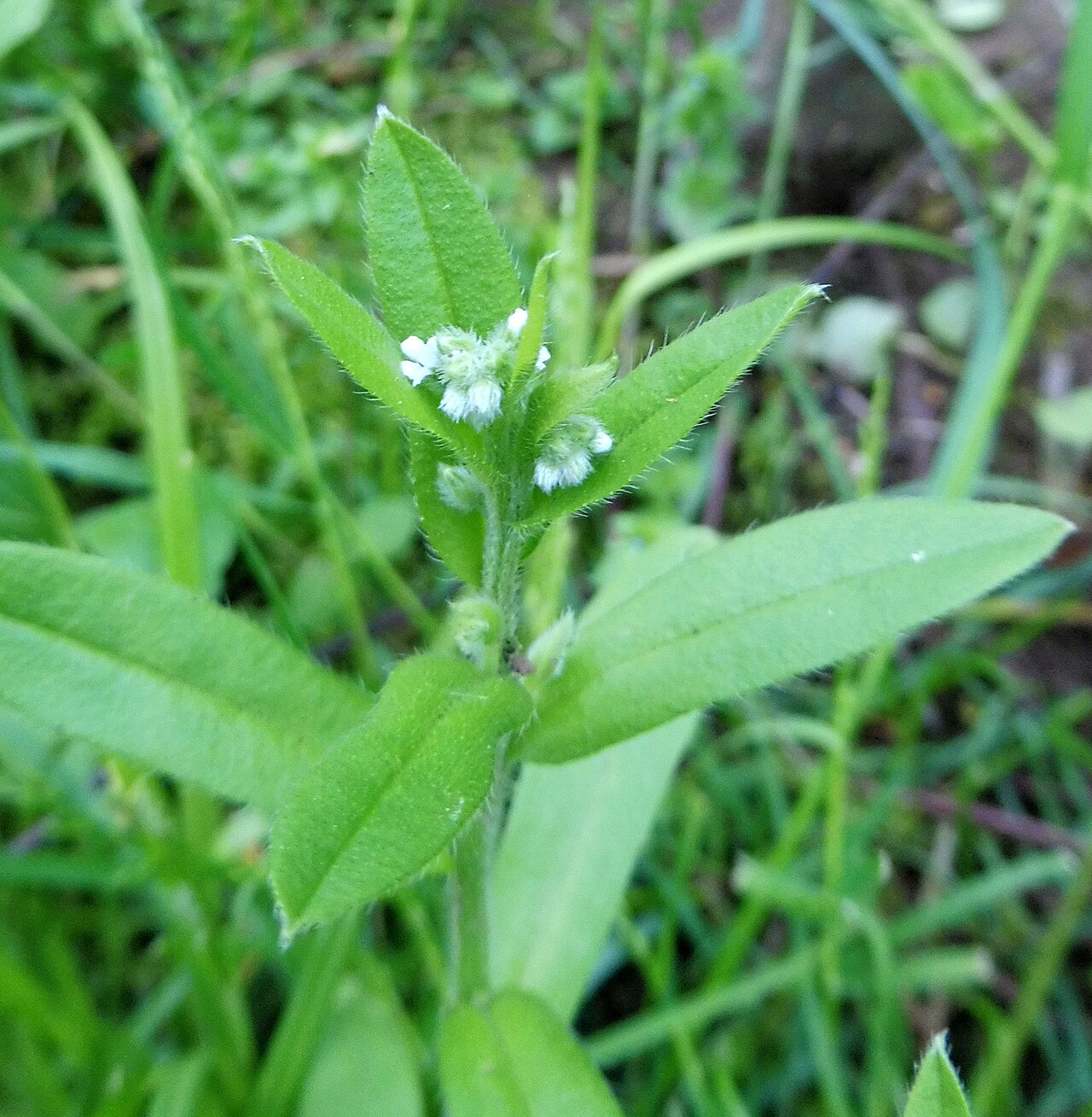
Myosotis macrosperma, known as Large-seeded Forget-me-not or largeseed forget-me-not, is a small native annual of moist woods and stream banks in the southeastern and south-central United States. It is one of the few forget-me-nots that are native to the East, and it looks very different from the blue garden forget-me-nots: its flowers are tiny and white, only about an eighth of an inch across, scattered along a long, curving stem above softly hairy leaves.
It is a winter annual in the borage family (Boraginaceae). Seeds germinate in fall, the plant spends the winter as a small rosette of leaves, and it flowers and sets seed between March and May before dying back in early summer. As the flowering stem lengthens, the flowers give way to bristly little calyces that hold four large nutlets, the “large seeds” behind the name macrosperma.
Large-seeded forget-me-not is easy to overlook, but it is common in rich, moist bottomland forests from Texas and Oklahoma east to Florida and north to Ohio, Pennsylvania and Delaware. This guide explains how to identify it, how to tell it from its close relative spring forget-me-not, and where it fits in a woodland garden.
Identification
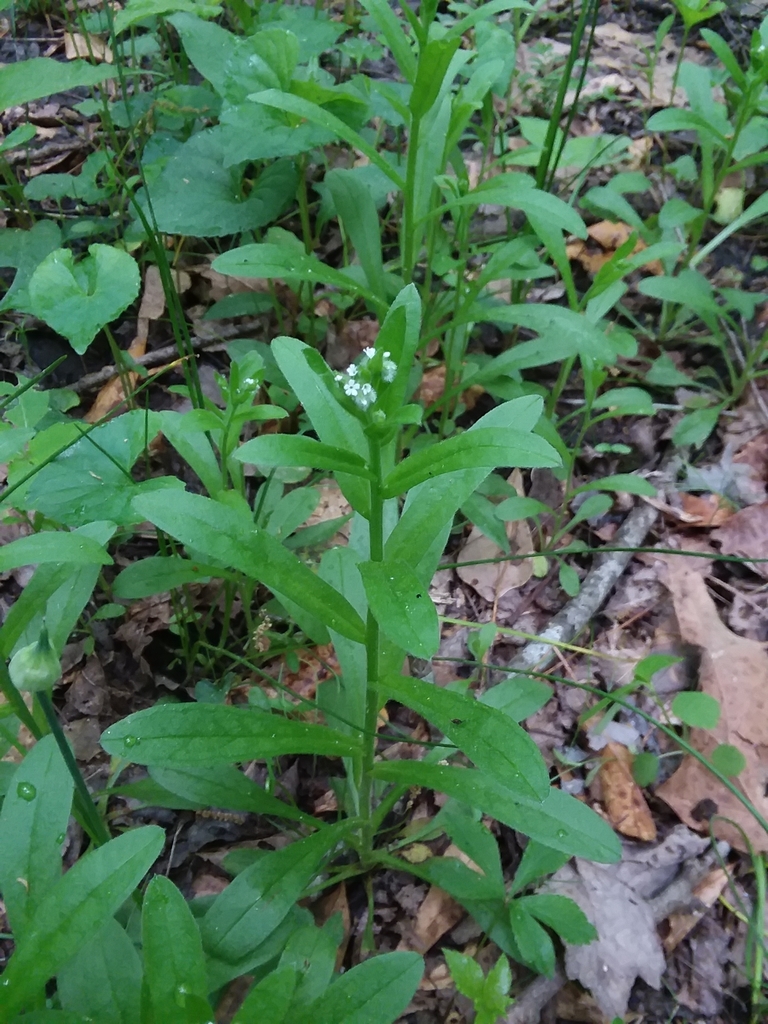
Look in early spring in moist, shady woods for a hairy annual with oblong leaves and a long stem of tiny white flowers. The most reliable way to identify it is by the fruiting stem: large-seeded forget-me-not has larger calyces and spreading fruit stalks compared with the similar spring forget-me-not.
Growth Habit
Plants grow from a small taproot, starting as a rosette in winter. In spring they send up one or several stems, usually 4 to 20 inches tall, that are often branched from the base. The stems are covered in spreading hairs and lean or sprawl as they lengthen in fruit.
Leaves
The basal leaves are spoon-shaped to oblong, and the stem leaves are oblong to lance-shaped, about 1 to 3 inches long, alternate and without stalks. Both surfaces are covered with soft to slightly rough hairs. The leaves are untoothed.
Flowers
The flowers are borne along one side of a coiled stalk that gradually unrolls and lengthens, eventually taking up most of the plant’s height. Each flower is tiny, about 2 to 3 mm across, with five rounded white petals around a small yellowish center. Often the lowest flowers sit beside small leafy bracts. Bloom time is March to May, beginning in late winter in the Deep South.
Fruit & Seeds
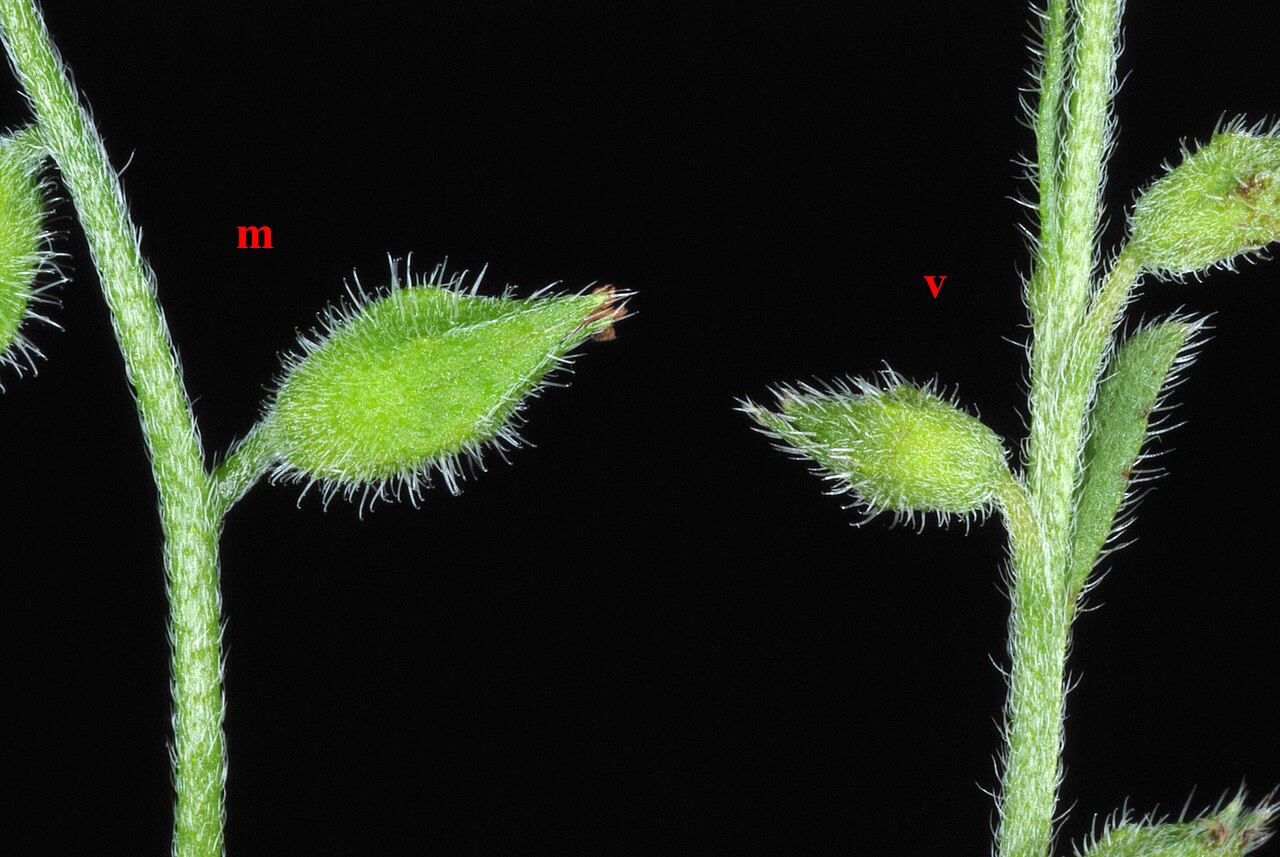
After flowering, each calyx enlarges to about ¼ inch (5 to 7 mm) long and is covered with stiff, hooked bristles. The fruit stalks are usually as long as or longer than the calyx and spread outward or curve down. Inside are four smooth, shiny nutlets, larger than those of spring forget-me-not. The hooked bristles help the fruits cling to animal fur and clothing.
Look-alikes
Spring forget-me-not (Myosotis verna) is very similar and often grows in drier, sunnier places. It has smaller calyces (about 3 to 5 mm in fruit), shorter fruit stalks that tend to point upward, and smaller nutlets. Some botanists have treated the two as a single species. The native bay forget-me-not and the introduced true forget-me-not (Myosotis scorpioides) are wetland plants with larger blue flowers.
Quick Facts
| Scientific Name | Myosotis macrosperma Engelm. |
| Family | Boraginaceae (borage family) |
| Plant Type | Winter annual herb |
| Mature Height | 4–20 in |
| Mature Spread | 4–10 in |
| Growth Rate | Fast |
| Sun Exposure | Part shade to full shade |
| Water Needs | Moderate; moist soil in spring |
| Soil Type | Rich, moist loam or alluvial soil |
| Soil pH | About 5.5–7.5 |
| Bloom Time | March–May |
| Flower Color | White |
| Fall Color | None; plants die back by early summer |
| Fruit | Bristly calyx enclosing four large, smooth nutlets |
| Deer Resistant | Not well documented |
| USDA Hardiness Zones | 5–9 |
Native Range
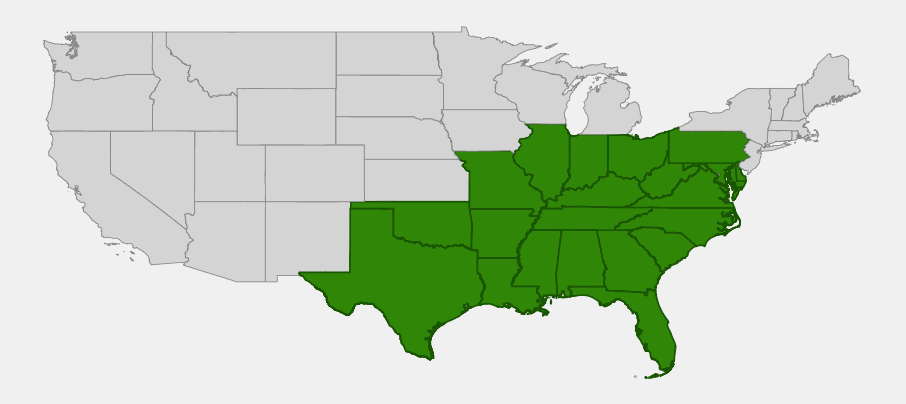
Large-seeded forget-me-not is native to the southeastern and south-central United States and southern Ontario. USDA PLANTS lists it in 21 states, from Texas, Oklahoma and Missouri east to Florida, Georgia and the Carolinas and north to Illinois, Indiana, Ohio, Pennsylvania, Maryland and Delaware.
It is most common in the interior Southeast and lower Midwest, including Tennessee, Kentucky, Arkansas, Missouri and southern Illinois and Indiana, and on the Piedmont and Coastal Plain from Virginia to Georgia and Alabama. Toward the north it becomes uncommon, and it reaches only the extreme south of Ontario. In Florida it occurs mainly in the Panhandle.
Its typical habitats are rich, moist deciduous woods, floodplain and alluvial forests, wooded stream banks and ravines, and the moist, shady edges of trails and clearings. It often grows in large numbers in openings in bottomland forest, where the soil is disturbed by flooding.
📋 Regional plant lists featuring Large-seeded Forget-me-not: North & South Florida · Alabama, Georgia & Mississippi · North & South Carolina · Maryland, Virginia & West Virginia · Kentucky & Tennessee · Arkansas, Louisiana, Eastern Oklahoma & Eastern Texas · Illinois, Iowa & Missouri · Ohio & Indiana · New York, Pennsylvania & Northern New Jersey · Delaware, Southern New Jersey & Long Island · South & West Texas
Growing & Care Guide
Large-seeded forget-me-not is not sold as a garden plant, and it is too small to make a show on its own. It does have a place in naturalistic woodland gardens and floodplain restorations within its range, where it fills gaps in the spring groundlayer and reseeds itself each year.
Light
It grows best in part shade to full shade under deciduous trees, which let in spring sun while it is actively growing.
Soil & Water
Give it moist, rich soil with some leaf litter. It tolerates brief flooding and grows well on alluvial soils. Because it completes its life cycle in spring, summer drought does not harm it.
Planting Tips
Scatter fresh seed in late spring or early summer, when it ripens, or in fall on bare, moist soil in a shady spot. Seeds germinate in fall and the plants overwinter as small rosettes. There is no need to plant seedlings.
Pruning & Maintenance
No maintenance is needed. Let the plants set seed before they die back in early summer so they can return the next year. Avoid heavy mulch where you want it to reseed.
Propagation
Propagate by seed only. Once established it usually maintains itself by self-sowing, and the hooked fruits may carry it to new spots on pets and clothing.
Landscape Uses
- Woodland gardens: a delicate spring groundlayer annual among native spring ephemerals
- Floodplain restoration: naturally colonizes moist, disturbed openings in bottomland forest
- Naturalized areas: useful for shady, informal areas where self-sowing is welcome
- Pollinator support: early flowers for small bees and flies
- Botanical study: a good example of a native forget-me-not and of hooked, animal-dispersed fruits
Wildlife & Ecological Value
Large-seeded forget-me-not is a small part of the spring flora of moist eastern woods, blooming alongside better-known spring wildflowers.
For Pollinators
The tiny flowers are visited by small native bees, such as sweat bees, and by small flies. They are also capable of self-pollination, which helps the plants set seed even in cool, wet spring weather.
For Birds
Its small size limits its direct value to birds, though ground-foraging birds may eat some nutlets.
For Mammals
The hooked calyces cling to the fur of deer, raccoons, rabbits and other mammals, which carry the seeds through the woods. It is not an important food plant for mammals.
Ecosystem Role
As a winter annual, it grows when the forest floor is open and sunny before the trees leaf out, then disappears by summer. It helps cover bare soil on floodplains and in disturbed woods during winter and spring, and its life cycle avoids competition with summer perennials.
Cultural & Historical Uses
George Engelmann, the St. Louis physician and botanist, described Myosotis macrosperma in the nineteenth century. The species name comes from the Greek makros, large, and sperma, seed. The genus name Myosotis means “mouse ear,” from the short, hairy leaves of many species.
The name forget-me-not comes from European legends attached to the blue-flowered species. The native white-flowered forget-me-nots of the eastern United States have no comparable folklore and no documented traditional uses.
Large-seeded and spring forget-me-not have long been a puzzle for botanists. They differ mainly in the size of the calyx and nutlets, and some authors have combined them. USDA PLANTS and many current floras treat them as separate species.
Frequently Asked Questions
Is large-seeded forget-me-not native?
Yes. It is native to the southeastern and south-central United States and southern Ontario. Most other forget-me-nots seen in the East, including the blue garden forget-me-nots, are introduced from Europe.
Why are its flowers white instead of blue?
Several North American forget-me-nots have small white flowers. Flower color varies within the genus, and the familiar blue color is typical of the European species grown in gardens.
How can I tell it from spring forget-me-not?
Look at the fruiting stem. Large-seeded forget-me-not has larger calyces, about 5 to 7 mm long in fruit, on longer, spreading stalks, and larger nutlets. Spring forget-me-not has smaller calyces of about 3 to 5 mm on shorter, upward-pointing stalks.
Is it a weed?
No. It is a native annual that can be abundant in moist woods and along trails, but it does not invade gardens aggressively and disappears by early summer.
Why do its seeds stick to my clothes?
The calyx around the seeds is covered in hooked bristles that catch on fur and fabric, which helps animals spread the seeds.

Looking for a nursery that carries Large-seeded Forget-me-not?
Browse our native plant nursery directory: Alabama & Arkansas · Delaware, Florida & Georgia · Illinois & Indiana · Kentucky, Louisiana, Maryland, Mississippi & Missouri · North Carolina, Ohio & Oklahoma · Pennsylvania, South Carolina, Tennessee, Texas & Virginia · West Virginia

