
Lettuceleaf Saxifrage (Saxifraga micranthidifolia)
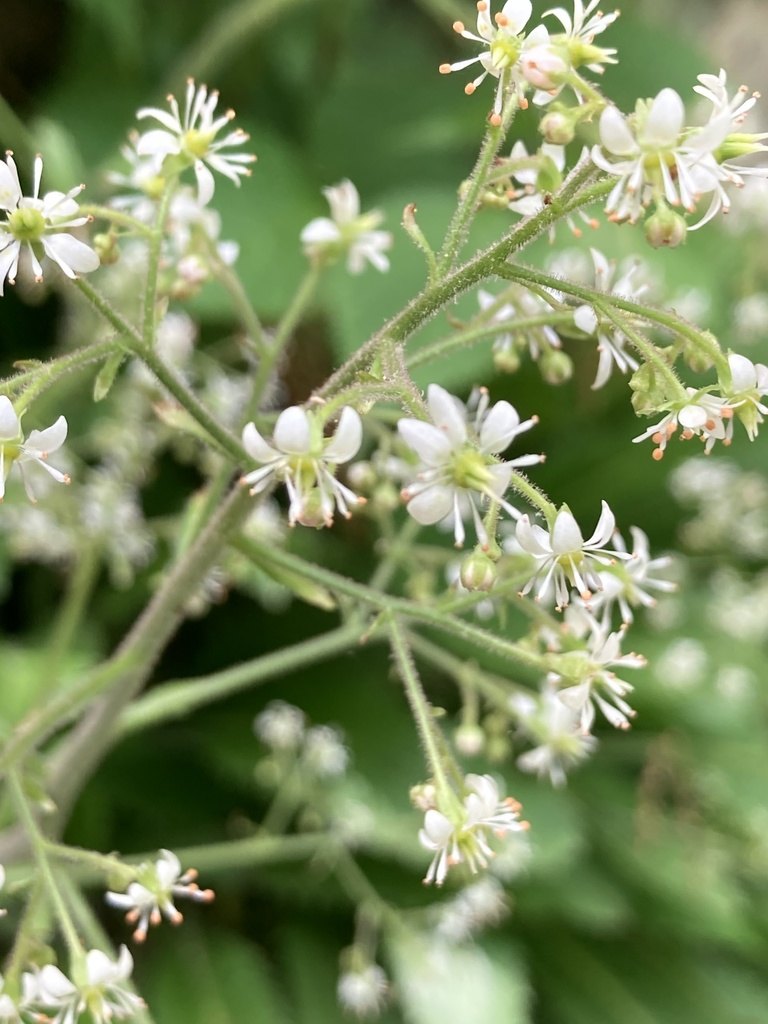
Saxifraga micranthidifolia, known as Lettuceleaf Saxifrage, mountain lettuce or branch lettuce, is a wildflower of cold mountain streams, seeps and wet rock faces in the southern and central Appalachians. In spring it forms bold rosettes of long, bright green, toothed leaves that really do look like a head of loose-leaf lettuce, and from April into June it sends up a branching stalk of tiny white, starry flowers.
It belongs to the saxifrage family (Saxifragaceae). Many botanists now place it in the genus Micranthes, as Micranthes micranthidifolia, along with its relatives early saxifrage and swamp saxifrage, but USDA PLANTS still lists it as Saxifraga. Either way, it is an Appalachian specialty, found mostly in the Blue Ridge and neighboring mountains from northern Georgia and South Carolina to Pennsylvania.
In the southern mountains its leaves have long been gathered in spring as a salad green, often wilted with hot bacon grease alongside ramps. Today it is valued more as a sign of clean, cold, constantly wet habitat. This guide covers how to identify lettuceleaf saxifrage, where it grows, how to grow it in a shady wet garden, and its role in mountain stream ecosystems.
Identification
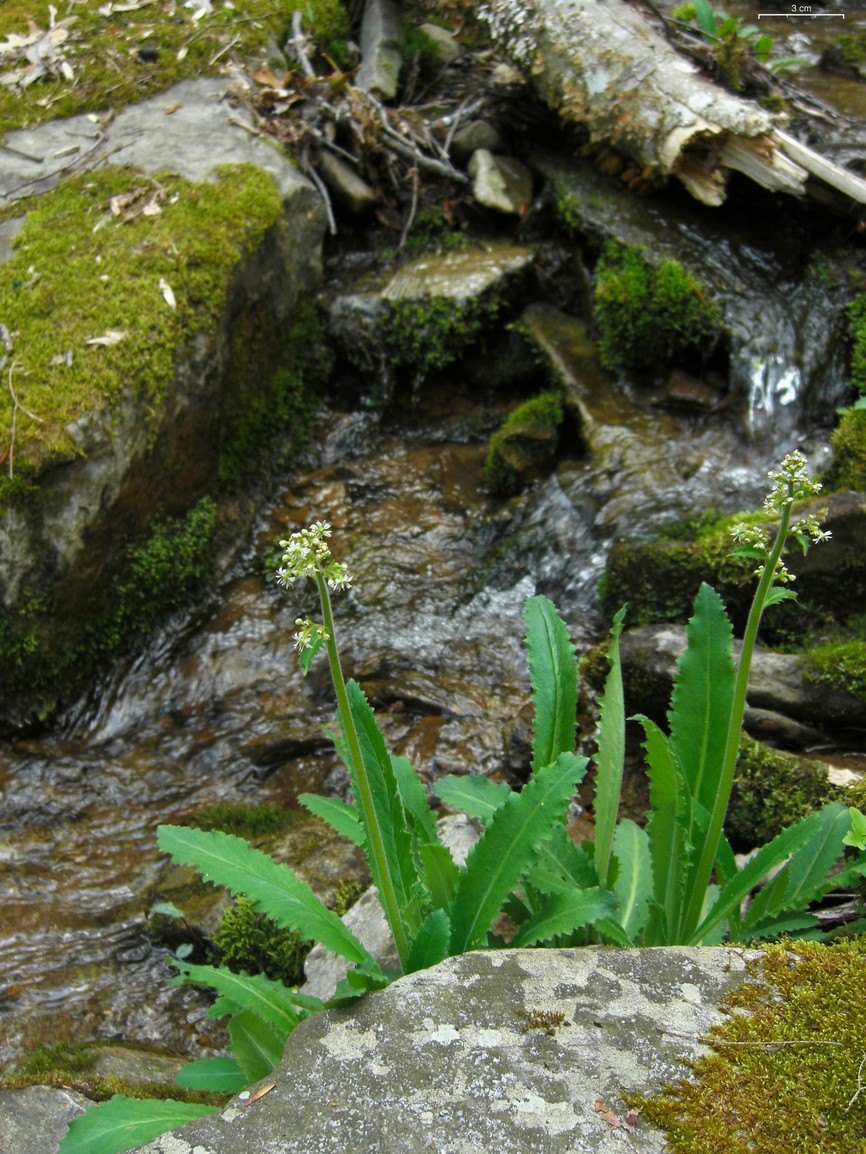
Look for lettuceleaf saxifrage in spring along the splash zone of mountain brooks, where its large rosettes of bright green leaves stand out against wet rocks and moss.
Growth Habit
It is a perennial herb that grows from a short, thick rootstock. Each plant forms a basal rosette of leaves, and in spring a single leafless flowering stalk rises from the center, usually 1 to 2½ feet tall. Plants often grow in loose colonies along streambanks and seeps.
Leaves
All the leaves are basal. They are long and narrow, oblong to lance-shaped, roughly 4 to 12 inches long, tapering gradually to the base, with coarse, sharp teeth along the edges. They are thin, smooth and bright green, and the rosettes look strikingly like loose leaf lettuce, which is the source of both the common and the scientific name.
Flowers
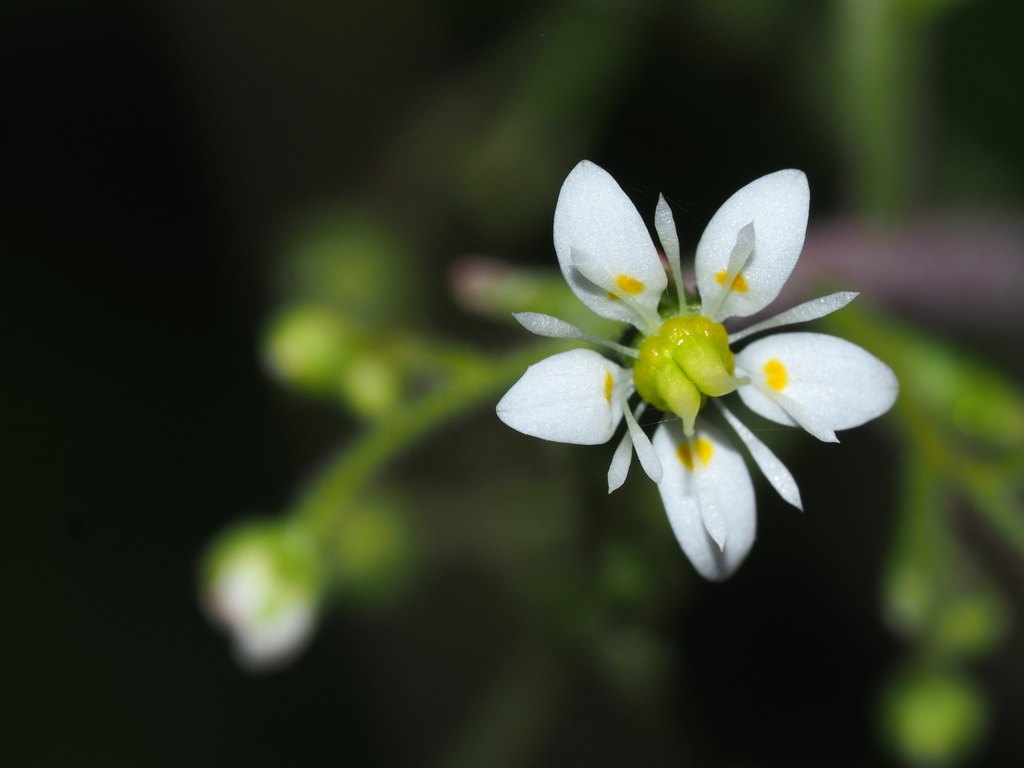
The flowering stalk branches into a broad, open panicle with many small flowers on slender stalks. Each flower is about ¼ inch across, with five narrow white petals and a small yellow spot near the base of each petal. The stamens and green, cone-shaped center are easy to see with a hand lens. The stalk is somewhat sticky-hairy, especially above. Flowering runs from about April to June, later at higher elevations.
Fruit & Look-alikes
The fruit is a small two-beaked capsule containing many tiny seeds. Swamp saxifrage (S. pensylvanica) has broader, less toothed leaves and a denser cluster of greenish-white flowers, and grows in bogs and wet meadows. Early saxifrage (Micranthes virginiensis) is much smaller and grows on drier rocks. The long, toothed, lettuce-like leaves and streamside habitat identify lettuceleaf saxifrage.
Quick Facts
| Scientific Name | Saxifraga micranthidifolia (Haw.) Steud. (syn. Micranthes micranthidifolia) |
| Family | Saxifragaceae (saxifrage family) |
| Plant Type | Herbaceous perennial wildflower |
| Mature Height | 1–2½ ft in flower (leaves 4–12 in) |
| Mature Spread | 8–18 in |
| Growth Rate | Slow to moderate |
| Sun Exposure | Part shade to full shade |
| Water Needs | High; constantly wet or seeping soil |
| Soil Type | Wet, gravelly or mossy soil and rock crevices along streams and seeps |
| Soil pH | Acidic, about 5.0–6.5 |
| Bloom Time | April–June |
| Flower Color | White with small yellow spots |
| Fall Color | None; leaves die back after summer |
| Fruit | Small two-beaked capsule with many tiny seeds |
| Deer Resistant | Not reliably; tender leaves may be browsed |
| USDA Hardiness Zones | 5–7 |
Native Range
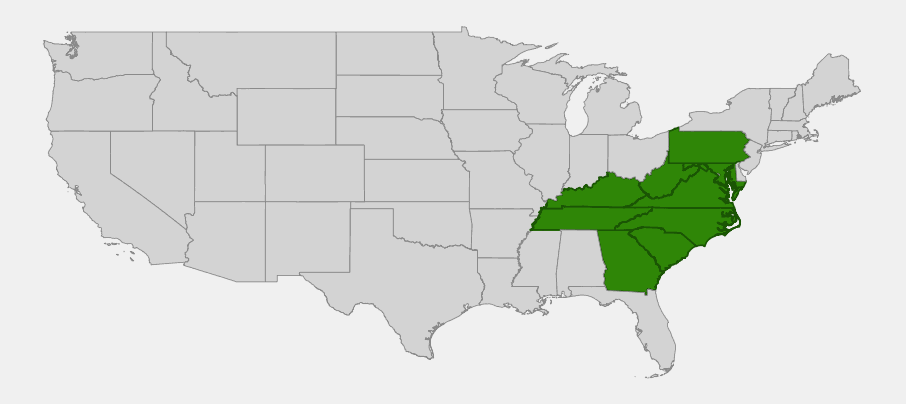
Lettuceleaf saxifrage is native to the Appalachian Mountains of the eastern United States. USDA PLANTS lists it from Georgia, Kentucky, Maryland, North Carolina, Pennsylvania, South Carolina, Tennessee, Virginia and West Virginia. Its center of abundance is the Blue Ridge of western North Carolina, eastern Tennessee and southwestern Virginia, including the Great Smoky Mountains, where it is common along many streams.
It grows in cool, permanently wet places: the spray and splash zones of mountain brooks and waterfalls, seepage areas, wet rock faces and mossy boulders, and spring-fed runs in shaded hardwood and hemlock forest. It is most often found at middle to high elevations, but follows cold streams down into lower valleys as well.
Toward the northern and southern edges of its range, in Pennsylvania, Maryland, Georgia and South Carolina, it is much more local and uncommon. Because it depends on clean, cold, shaded water, it is sensitive to logging of streamside forest, sedimentation and changes to springs and seeps.
📋 Regional plant lists featuring Lettuceleaf Saxifrage: Alabama, Georgia & Mississippi · North & South Carolina · Maryland, Virginia & West Virginia · Kentucky & Tennessee · New York, Pennsylvania & Northern New Jersey
Growing & Care Guide
Lettuceleaf saxifrage is rarely sold, but it can be grown by gardeners in or near its native mountains who have a shaded spot with constantly moving or seeping water. It is a plant for streambanks, spring-fed rock gardens and the edges of naturalistic water features, not for ordinary garden beds. Buy only nursery-propagated plants or grow it from seed, and never dig it from the wild.
Light
Give it part to full shade. In the wild it grows under rhododendron and forest canopy, and its thin leaves scorch quickly in hot sun.
Soil & Water
It needs soil that is wet all the time, ideally with cool, moving water: a streambank, the edge of a waterfall or a seep. Gravelly, mossy, acidic soil and rock crevices suit it best. It will not tolerate drying out, and it dislikes stagnant, warm water. Summer heat in the lowlands is hard on it.
Planting Tips
Plant in spring or fall between rocks at the water’s edge, where the roots can reach constant moisture but the crown is not permanently submerged. Mossy boulders and gravel help keep the roots cool. It combines naturally with ferns, foamflower and golden saxifrage.
Pruning & Maintenance
Little care is needed. Remove spent flower stalks if you want a tidier look, or leave them to drop seed. Keep leaf litter from smothering the rosettes, and never let the site dry out in summer.
Propagation
Sow the very fine seed on the surface of a moist, gritty mix in fall or late winter and keep it cool and constantly damp; it usually benefits from a period of cold. Established clumps can be divided carefully in early spring. Seedlings grow slowly at first.
Landscape Uses
- Streambank and seep gardens: bold lettuce-like rosettes at the edge of cold, moving water
- Shade rock gardens: in wet crevices and mossy boulders where few other plants thrive
- Woodland water features: softens the edges of naturalistic falls and spring runs
- Habitat restoration: for shaded mountain streambanks and seeps within its native range
- Native plant study: an Appalachian endemic and indicator of clean, cold, permanently wet habitat
Wildlife & Ecological Value
Lettuceleaf saxifrage is a small but characteristic part of Appalachian stream and seep communities, blooming in spring when the forest is coming into leaf.
For Pollinators
Its small, open, white flowers are visited by small native bees, flies and other small insects that are active along shaded streams in spring. The exposed yellow-spotted petals and easily reached nectar suit these short-tongued visitors.
For Birds
It is not an important food plant for birds, but the wet, leafy streambanks where it grows provide insects for species such as Louisiana waterthrush and other streamside songbirds.
For Mammals
Deer, rabbits and groundhogs may browse the tender spring leaves. The plant itself is not a major food source for wildlife.
Ecosystem Role
Its roots and rosettes help bind gravel and soil on wet rock ledges and streambanks, and its presence signals clean, cold, permanently wet habitat. It shares these spray-zone and seep habitats with mosses, liverworts, ferns, salamanders and many aquatic insects.
Cultural & Historical Uses
In southern Appalachia, lettuceleaf saxifrage has long been known as branch lettuce or mountain lettuce. Mountain families gathered the young leaves in early spring, often serving them “kilt” or “killed,” that is wilted with hot bacon grease and vinegar, sometimes together with ramps and green onions. It was one of the first fresh greens of the year.
The species name micranthidifolia means “with leaves like Micranthes,” a related group of saxifrages. Botanists have since moved many of those relatives, and often this species too, into the genus Micranthes based on DNA and flower structure, so you will see it under both names in field guides.
Because its habitat is limited to clean, cold streamsides and seeps, heavy foraging can damage local stands. Anyone who gathers wild greens should take only a few leaves where the plant is abundant, leave the rosettes intact, and avoid it altogether where it is uncommon.
Frequently Asked Questions
Is lettuceleaf saxifrage edible?
It is a traditional spring green in southern Appalachia, known as branch lettuce or mountain lettuce. If you forage, be certain of the identification, gather only a few leaves from large stands, and never pull up whole plants. Many stands are in parks where collecting is not allowed.
Where does lettuceleaf saxifrage grow?
Along cold mountain streams, waterfalls, seeps and wet rock faces in the Appalachians, from Georgia and South Carolina north to Pennsylvania, mostly at middle to high elevations.
Can I grow lettuceleaf saxifrage in my garden?
Only if you have a shaded site with constantly wet, cool soil, such as a streambank or spring seep, ideally in or near the Appalachians. It does not tolerate drought, hot sun or summer heat in ordinary beds.
Is it a Saxifraga or a Micranthes?
Both names are in use. USDA PLANTS lists it as Saxifraga micranthidifolia, while many recent floras call it Micranthes micranthidifolia. They refer to the same plant.
When does lettuceleaf saxifrage bloom?
From about April to June, with tiny white, yellow-spotted flowers on a tall, branching stalk above the rosette of leaves.

Looking for a nursery that carries Lettuceleaf Saxifrage?
Browse our native plant nursery directory: Georgia · Kentucky & Maryland · North Carolina · Pennsylvania, South Carolina, Tennessee & Virginia · West Virginia

