
Loulu (Pritchardia minor)
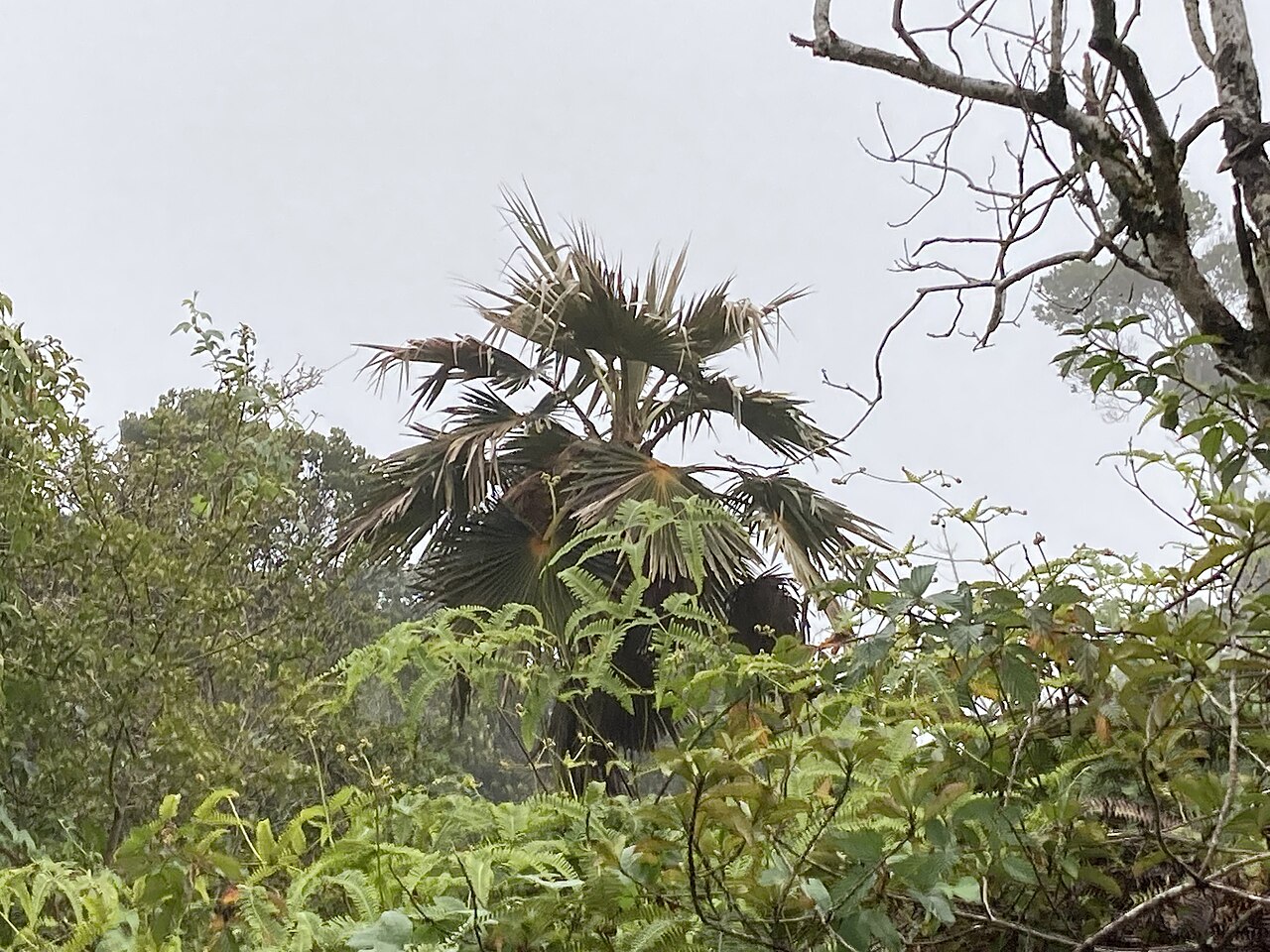
Pritchardia minor, known in Hawaiian as loulu and in English as the Alakaʻi Swamp pritchardia or Alakaʻi loulu, is a slender fan palm found in the wild only on the island of Kauaʻi. It grows in the cool, rain-soaked upland forests of central Kauaʻi around the Alakaʻi Swamp, one of the wettest places in the United States. Like the other Hawaiian loulu, it has a single straight trunk crowned by stiff, fan-shaped leaves, with sprays of small yellow flowers and shiny black fruits.
Hawaiʻi has about two dozen species of Pritchardia, and they are the only palms native to the islands. Most are rare, and each tends to be confined to a single island or a single mountain range. The Alakaʻi Swamp pritchardia is one of the few that grows at high elevation, among mossy ʻōhiʻa forest, tree ferns and bog margins, rather than in the lowland and mid-elevation forests where most loulu live. Older references sometimes treat it under the name Pritchardia eriophora, now considered a synonym.
The species is not federally listed; the U.S. Fish and Wildlife Service treats it as a resolved taxon, meaning it was once reviewed for listing. It is still a rare, single-island endemic, and wild trees and their seeds should never be disturbed. Gardeners in Hawaiʻi can grow it from plants raised by native-plant nurseries. This guide covers how to recognize it, where it grows, how cultivated plants are grown, and the place of loulu in Hawaiian culture.
Identification
As a group, Hawaiian loulu are easy to spot: no other native Hawaiian plant has big, unarmed fan leaves on a single trunk. Telling the species apart is harder and relies on technical details of the flower stalks, fruits and leaf hairs. In the wild, location is the best clue. A loulu growing in the high, wet forests of central Kauaʻi is most likely P. minor.
Trunk & Growth Habit
The Alakaʻi Swamp pritchardia is a single-trunked palm that can reach about 30 to 40 feet (up to about 12 m) in the wild, though many trees are shorter, especially on exposed sites. The gray trunk is relatively slender for a loulu, often only around 4 to 6 inches thick, and is smooth to faintly ringed with old leaf scars. Like all loulu, it has no spines on the trunk or the leaf stalks.
Leaves
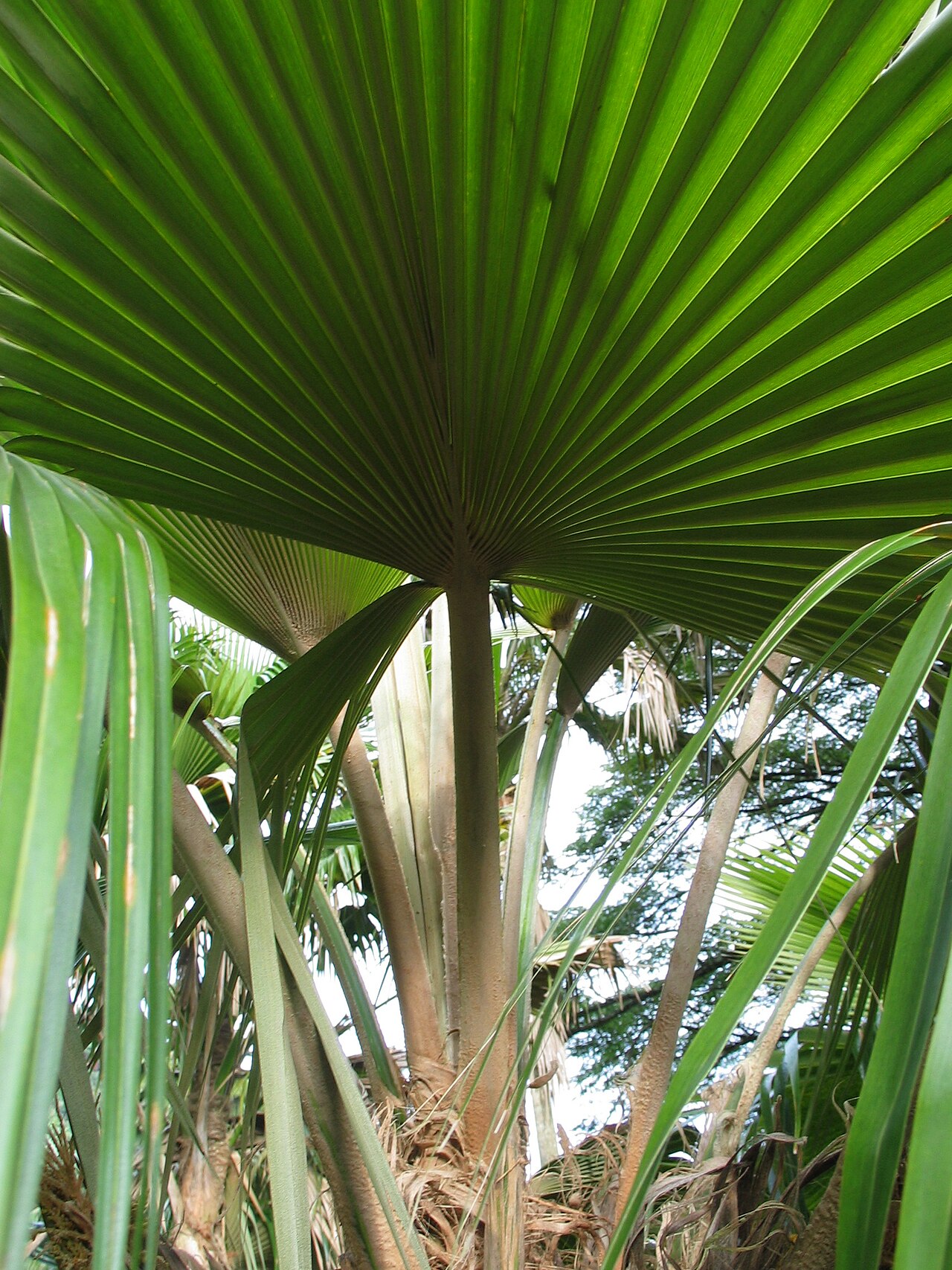
The leaves are palmate (fan-shaped) and held in a rounded crown on long, smooth stalks. The blade is pleated and split partway into many stiff segments. New leaves emerge yellowish, and the upper surface becomes smooth, leathery and green. The underside stays paler and is covered with a waxy layer and a grayish to yellowish felt of tiny hairs and scales, a useful feature for this species.
Flowers
The flowers are small, yellow and fragrant, packed along short, branched flower stalks that grow from among the leaf bases. In this species the flower clusters are fairly compact and are held within the crown rather than hanging far beyond the leaves. Cultivated trees may flower at various times of year.
Fruit
The fruits are shiny black when ripe, oval, about three-quarters of an inch (2 cm) long and roughly half an inch wide. Each holds a single hard, round seed. Introduced rats eat many loulu fruits and seeds before they can germinate, which is one reason wild seedlings are scarce.
Similar Species
Kauaʻi has several other loulu, including P. hardyi, P. napaliensis, P. viscosa, P. flynnii and P. limahuliensis; they differ in fruit size, flower-stalk length and leaf hairs, and most grow at lower elevations or in other parts of the island. On other islands, species such as Loulu Hiwa (Pritchardia martii) of Oʻahu and Loulu (Pritchardia beccariana) and Loulu (Pritchardia maideniana) of Hawaiʻi Island fill similar roles. The widely planted Fiji fan palm (Pritchardia pacifica) is not native to Hawaiʻi and has much larger leaves.
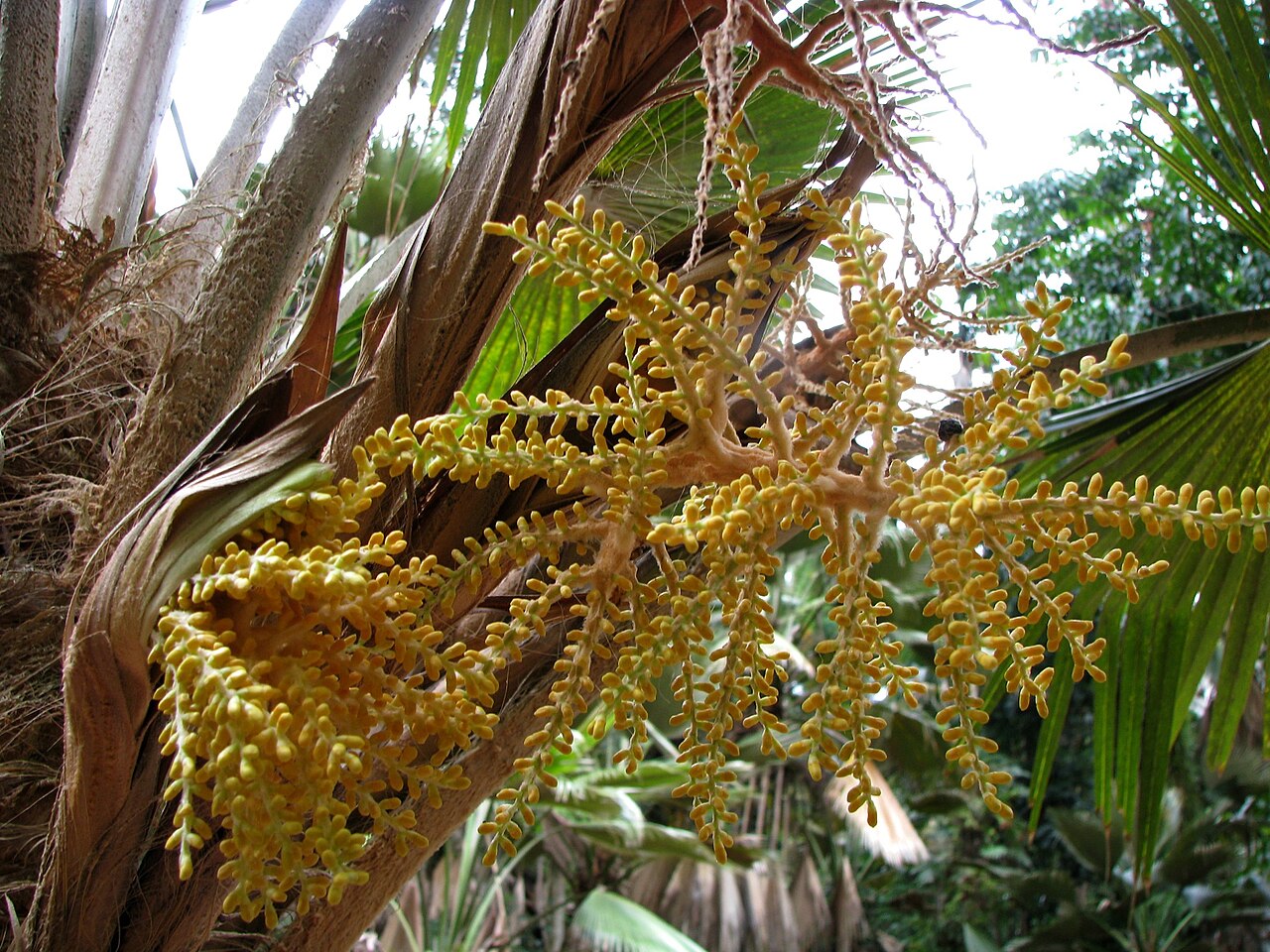
Quick Facts
| Scientific Name | Pritchardia minor Becc. |
| Family | Arecaceae (palm family) |
| Plant Type | Evergreen single-trunked fan palm; endemic to Kauaʻi |
| Mature Height | 15–40 ft (to about 12 m in the wild); slow-growing |
| Mature Spread | 6–10 ft |
| Growth Rate | Slow |
| Sun Exposure | Full sun to part shade |
| Water Needs | High; regular moisture, never dry for long |
| Soil Type | Moist, well-drained, organic-rich volcanic soil |
| Soil pH | About 5.0–6.5 |
| Bloom Time | Variable; mainly spring to summer |
| Flower Color | Yellow |
| Fall Color | None (evergreen) |
| Fruit | Shiny black, oval, about 3/4 in (2 cm), single-seeded |
| Deer Resistant | Not applicable on Kauaʻi; seedlings are eaten by pigs, goats and rats |
| USDA Hardiness Zones | 10–12 (cool, humid conditions preferred) |
Native Range
The Alakaʻi Swamp pritchardia is endemic to Kauaʻi. USDA PLANTS lists it only from Hawaiʻi, and in the wild it grows in the upland wet forests of central Kauaʻi, around the Alakaʻi Swamp and the slopes leading toward Waiʻaleʻale, at roughly 3,500 to 4,600 feet (about 1,100 to 1,400 m). Rainfall there is extremely high, cloud cover is frequent and temperatures are cool all year.
Its habitat is montane wet forest dominated by ʻŌhiʻa Lehua, with an understory of tree ferns, ʻŌlapa, native shrubs and mosses, and it also grows along the margins of the montane bogs. Trees are scattered rather than forming groves. Much of this area is protected within the Alakaʻi Wilderness Preserve, Kōkeʻe State Park and adjacent forest reserves.
Threats include feral pigs and goats, which root up and eat seedlings, introduced rats that eat fruits and seeds, and invasive plants such as Australian tree fern, strawberry guava and kāhili ginger that are spreading into Kauaʻi’s upland forests. Cultivated trees grow in botanical gardens on Oʻahu and in frost-free gardens abroad, including Auckland, New Zealand, but those plantings do not change its native range.
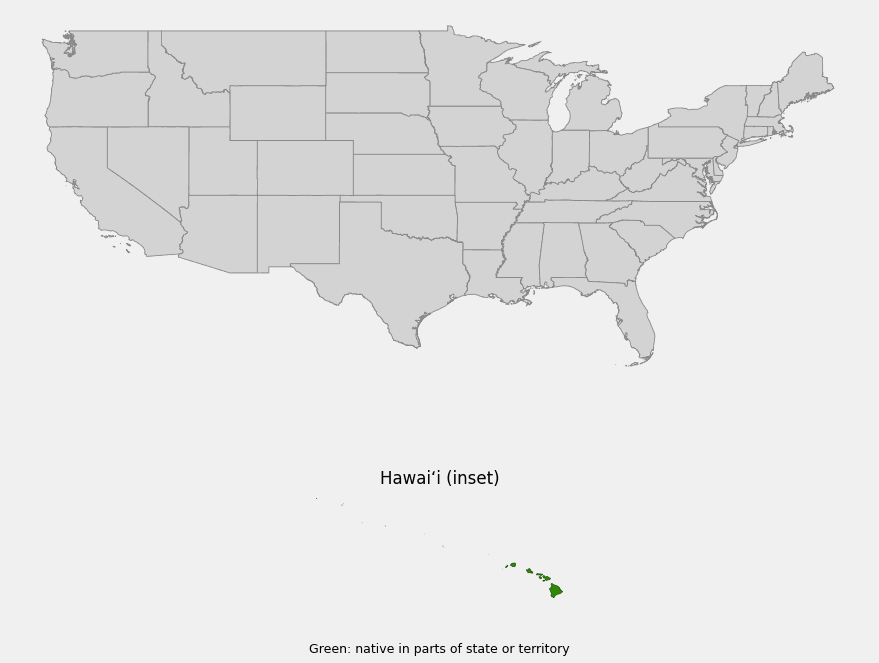
📋 Regional plant lists featuring Loulu: Hawaii
Growing & Care Guide
The Alakaʻi Swamp pritchardia is a graceful, slim palm for cool, wet gardens. It is one of the better loulu for upland Hawaiʻi, where many lowland palms sulk, and it has proven adaptable in cultivation, growing in botanical gardens on Oʻahu and even in mild, humid Auckland, New Zealand. Buy only nursery-propagated plants from a Hawaiʻi native plant nursery, never collect seed or seedlings from wild trees, and do not move plants between islands without checking current rules. Hawaiʻi also restricts bringing plants in from other states, so gardeners in the islands should source plants locally.
Light
Full sun to part shade. Young plants do best with some shade, as they would get under the forest canopy. Established palms tolerate full sun in cool, cloudy upland areas, but in hot lowland gardens give them light shade in the afternoon to prevent leaf scorch.
Soil & Water
Plant in moist, well-drained soil rich in organic matter; volcanic loam amended with compost works well. This palm comes from one of the wettest places on Earth and does not like to dry out. Water regularly and deeply, especially in dry spells and in leeward gardens, and keep a thick mulch over the root zone. Even so, avoid stagnant, waterlogged soil, which can rot the roots.
Planting Tips
Choose a sheltered spot with room for a crown about 6 to 10 feet wide. It is best suited to cooler, wetter gardens, roughly above 1,000 feet in Hawaiʻi or on windward sides; in hot, dry lowland gardens it needs extra water and shade. Plant at the same depth it grew in the container. Outside Hawaiʻi, it is suitable for frost-free, humid climates (roughly USDA zones 10 to 12) or a large, cool greenhouse.
Pruning & Maintenance
Remove only fully dead leaves; green leaves still feed the palm. Never cut into the growing point. A slow-release palm fertilizer with magnesium and potassium helps prevent yellowing of older leaves. Watch for scale insects and protect young plants from slugs and, in rural areas, from pigs.
Propagation
Propagation is by seed from cultivated trees. Clean fresh seed and sow it in a warm, moist, well-drained mix; germination usually takes one to several months and can be uneven. Seedlings grow slowly and take several years to form a visible trunk. Collecting seed from wild trees in protected areas requires state permits, and wild seed is needed for natural regeneration.
Landscape Uses
- Upland native gardens: a slim native palm for cool, wet gardens in Hawaiʻi
- Specimen tree: an elegant focal point with fan leaves and a slender trunk
- Conservation plantings: helps preserve a rare single-island endemic in cultivation
- Botanical and educational gardens: illustrates the high-elevation loulu of Kauaʻi
- Cultural plantings: loulu leaves were traditionally used for thatch and plaiting
Wildlife & Ecological Value
In Kauaʻi’s upland forests, the Alakaʻi Swamp pritchardia is one of many endemic plants that support native insects and, historically, native birds.
For Pollinators
The fragrant yellow flowers produce pollen and nectar and are visited by insects, including native bees and flies as well as introduced honeybees. Native nectar-feeding birds may once have visited loulu flowers as well.
For Birds
The fruits were probably eaten and dispersed by native birds, some of which are now extinct or very rare. Kauaʻi’s remaining native forest birds, such as the ʻapapane and ʻamakihi, forage in the same forests, which are their last stronghold on the island.
For Mammals
Hawaiʻi has only two native land mammals, the Hawaiian hoary bat and the Hawaiian monk seal, and neither depends on loulu. Introduced mammals are a major threat: rats eat fruits and seeds, and pigs and goats destroy seedlings.
Ecosystem Role
Loulu are host plants for the native palm leaf moth (Omiodes blackburni), whose caterpillars feed on the leaves. As a canopy and subcanopy palm in the wet forest, the Alakaʻi Swamp pritchardia adds structure to a forest otherwise dominated by ʻōhiʻa, and its dead leaves and fallen fruits feed the forest floor.
Cultural & Historical Uses
The genus Pritchardia honors William Thomas Pritchard, a nineteenth-century British consul in Fiji. Pritchardia minor was described by the Italian palm specialist Odoardo Beccari in the early twentieth century; the name minor means smaller, a reference to its modest size compared with other loulu.
Hawaiians call all native fan palms loulu, a name often linked to the word for umbrella, because the large leaves could be held overhead for shelter from sun and rain. Loulu leaves were used for thatch and for plaiting hats, fans and baskets, and the soft, immature seeds (hāwane) of loulu were eaten.
Today the Alakaʻi Swamp pritchardia is a familiar sight to hikers on the Alakaʻi Swamp and Pihea trails in Kōkeʻe. Conservation groups and state agencies on Kauaʻi fence and protect upland forest from pigs and remove invasive plants, and botanical gardens in Hawaiʻi keep the species in cultivation.
Frequently Asked Questions
Is the Alakaʻi Swamp pritchardia endangered?
It is not federally listed under the Endangered Species Act; the U.S. Fish and Wildlife Service lists Pritchardia minor as a resolved taxon. It is still a rare palm that grows wild only on Kauaʻi, so wild trees and seeds should never be collected.
Where can I see Pritchardia minor in the wild?
It grows in the upland wet forests of central Kauaʻi, around the Alakaʻi Swamp. Trees can be seen along trails in Kōkeʻe State Park and the Alakaʻi Wilderness Preserve. Stay on the boardwalks and trails to protect the fragile bog and forest.
Can I grow this loulu in a lowland garden?
It can be grown in lowland Hawaiʻi with steady water, rich soil and some afternoon shade, but it does best in cool, wet upland or windward gardens. Buy only nursery-propagated plants from a Hawaiʻi native plant nursery.
What does loulu mean?
Loulu is the Hawaiian name for all native fan palms in the genus Pritchardia. It is often linked to umbrellas, because the fan leaves were used for shade and shelter from rain.
How big does Pritchardia minor get?
In the wild it can reach about 30 to 40 feet, but many trees are shorter. It has a slender trunk and a crown about 6 to 10 feet wide, and it grows slowly, so garden trees stay small for many years.

Looking for a nursery that carries Loulu?
Browse our native plant nursery directory: Hawaii

