
Maryland Goldenaster (Chrysopsis mariana)

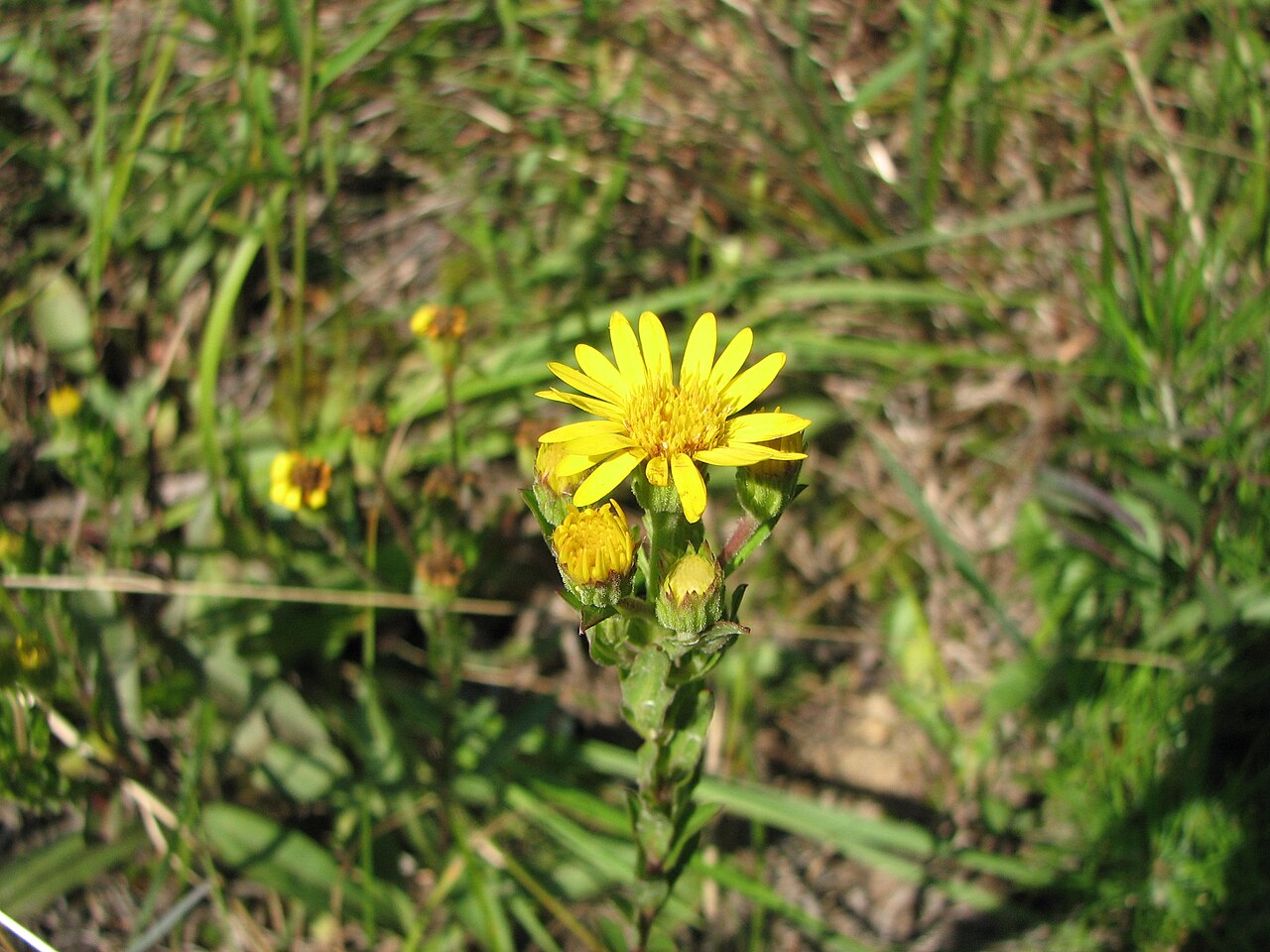
Chrysopsis mariana, known as Maryland Goldenaster or Maryland golden aster, is a late-season wildflower of dry, sandy, open ground across the eastern United States. It forms a low clump of soft, silky-hairy leaves, and from late summer into fall it carries clusters of bright golden-yellow, daisy-like flower heads about an inch across. Its rounded buds and flower stalks are covered with sticky glandular hairs, a useful clue for identification.
Maryland goldenaster is a member of the aster family (Asteraceae). Unlike most asters, both its ray flowers and its central disk flowers are yellow, which gives the genus its name: Chrysopsis means “golden appearance” in Greek. The species name mariana refers to Maryland, one of the colonies where early specimens were gathered. Some references place it in the related genus Heterotheca as Heterotheca mariana.
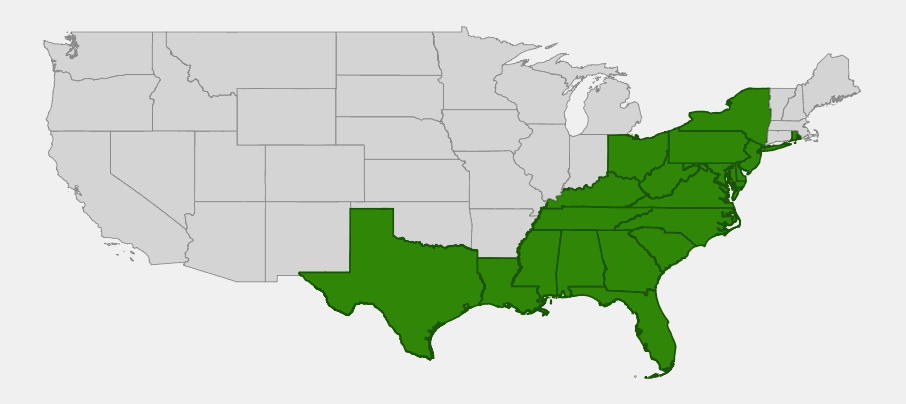
Its range runs from southern New York and Ohio south to Florida and west to Louisiana and eastern Texas. It is a tough, drought-tolerant perennial that thrives in poor, sandy or rocky soil where many garden plants struggle, and it provides late nectar for pollinators. This guide covers how to identify it, where it grows, and how to use it in dry native gardens and meadows.
Identification
Several golden asters grow in the eastern United States, especially in Florida. Maryland goldenaster is recognized by its broad, silky leaves, its sticky, glandular buds and flower stalks, and its flat-topped clusters of yellow heads in late summer and fall.
Leaves & Stems
In spring and early summer the plant forms a basal rosette of oblong to spoon-shaped leaves, 2 to 6 inches long, covered at first with long, soft, silky hairs that give them a grayish cast. The hairs wear off as the season goes on. The flowering stems are 1 to 2½ feet tall, often several from one crown, and carry alternate, elliptic leaves that become smaller toward the top. The upper stems and flower stalks are covered with short, sticky glandular hairs.
Flowers
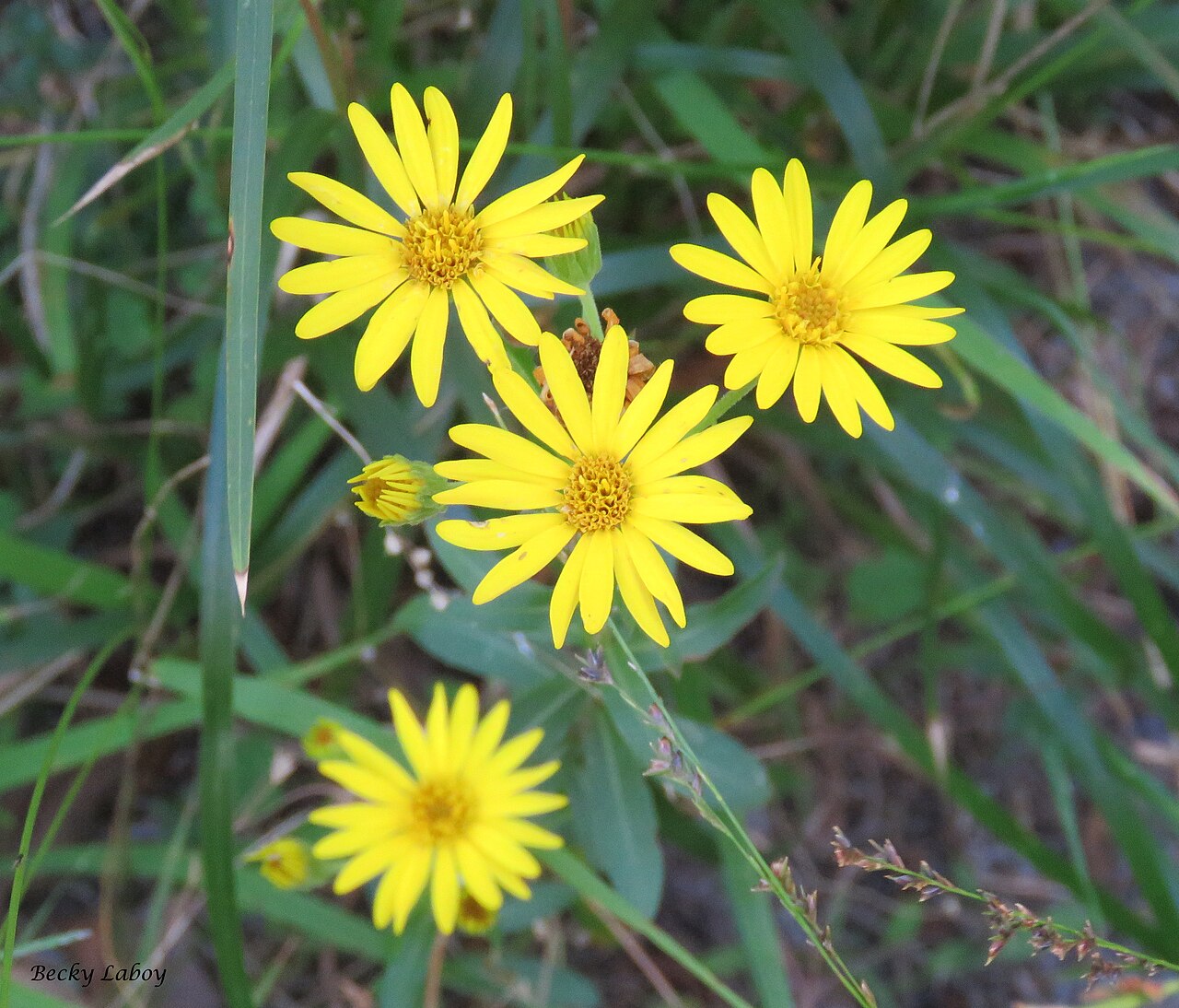
The flower heads are about 1 to 1½ inches across and are carried in a loose, flat-topped cluster at the top of the stems. Each head has about 13 to 21 bright yellow rays around a yellow central disk. The bracts that cup the head are narrow, green and glandular. Maryland goldenaster blooms mainly from August to October, often continuing until frost.
Fruit & Seeds
Each floret produces a small achene with a double row of tawny bristles (pappus), which carries it on the wind. The seed heads look like small, fluffy balls in late fall.
Similar Species
Golden Aster (Pityopsis graminifolia) has narrow, grass-like, silvery leaves. In Florida, several other Chrysopsis species occur, including the widespread Chrysopsis scabrella and Chrysopsis gossypina (cottony goldenaster), which is densely woolly. Camphorweed (Heterotheca subaxillaris) is a weedy annual with a strong camphor smell and much smaller heads.
Quick Facts
| Scientific Name | Chrysopsis mariana (syn. Heterotheca mariana, Inula mariana) |
| Family | Asteraceae (aster family) |
| Plant Type | Herbaceous perennial wildflower |
| Mature Height | 1–2½ ft |
| Mature Spread | 1–1½ ft |
| Growth Rate | Moderate |
| Sun Exposure | Full sun to light shade |
| Water Needs | Low; drought tolerant once established |
| Soil Type | Dry, sandy, gravelly or rocky soil |
| Soil pH | About 4.5–6.5 (acidic) |
| Bloom Time | August–October |
| Flower Color | Golden yellow rays and disk |
| Fall Color | None; basal leaves often persist into winter |
| Fruit | Small achene with a tawny bristly pappus |
| Deer Resistant | Moderately; hairy, glandular foliage is not a preferred browse |
| USDA Hardiness Zones | 5–9 |
Native Range
Maryland goldenaster has a broad eastern range. USDA PLANTS and the Lady Bird Johnson Wildflower Center record it from southern New York, Rhode Island, New Jersey, Pennsylvania and Ohio south through the Atlantic states and the Appalachians to Florida, and west to Kentucky, Tennessee, Mississippi, Louisiana and eastern Texas, as well as the District of Columbia.
It is most common on the Atlantic Coastal Plain, from the New Jersey Pine Barrens to the Carolinas and Georgia, and in dry, sandy or rocky places of the Piedmont and Appalachians. In Florida it grows mainly in the Panhandle and northern part of the state, in sandhills, dry pine and oak woods and along sandy roadsides. Typical habitats include pine barrens, dry open woods, sandy fields, shale barrens, rock outcrops and powerline cuts.
It is a plant of open, disturbed or fire-maintained ground and tolerates poor soil, so it often turns up along road banks, railroad edges and old fields as well as in natural habitats. It becomes uncommon to rare near the northern edge of its range.
📋 Regional plant lists featuring Maryland Goldenaster: North & South Florida · Alabama, Georgia & Mississippi · North & South Carolina · Maryland, Virginia & West Virginia · Kentucky & Tennessee · Arkansas, Louisiana, Eastern Oklahoma & Eastern Texas · Ohio & Indiana · New York, Pennsylvania & Northern New Jersey · Delaware, Southern New Jersey & Long Island · Connecticut, Massachusetts & Rhode Island
Growing & Care Guide
Maryland goldenaster is a dependable, low-care perennial for dry, sunny spots, and it is offered by native plant nurseries in much of the East. It is especially useful where soils are too poor or dry for many other wildflowers.
Light
Give it full sun for the best flowering and a compact habit. It tolerates light shade, such as under scattered pines, but becomes taller and floppier there.
Soil & Water
Plant it in well-drained, sandy, gravelly or rocky soil. It does not need fertilizer or compost, and rich, moist soil makes it lanky and short-lived. Water new plants during their first summer; established plants are very drought tolerant.
Planting Tips
Plant in spring or fall, 12 to 18 inches apart. It works well at the front or middle of a dry meadow, along a sunny slope, in a rock garden, or mixed with little bluestem and other short grasses. Its silky rosettes add texture early in the season, and its yellow flowers combine well with late asters and goldenrods.
Pruning & Maintenance
Little care is needed. If plants flop, cut the stems back by about a third in early summer to encourage a bushier habit. Leave seed heads for birds and self-sowing, and cut old stems back in late winter. Plants may be short-lived in rich soil, but they usually reseed.
Propagation
Grow it from seed collected in late fall. Sow the seed outdoors in fall or give it a short cold, moist stratification before sowing in spring. Clumps can also be divided in early spring.
Landscape Uses
- Dry meadows and prairies: late-season yellow flowers in poor, sandy soil
- Rock gardens and slopes: tolerant of drought and thin soils
- Pollinator gardens: late summer and fall nectar for bees and butterflies
- Pine barrens and sandhill restoration: a typical forb of dry, open, fire-maintained habitats
- Roadside and low-maintenance plantings: thrives with little water or care
Wildlife & Ecological Value
Maryland goldenaster flowers late in the season, when pollinators are building reserves for winter or migration.
For Pollinators
The flowers are visited by many native bees, including bumblebees, sweat bees and mining bees, as well as butterflies, skippers, flower flies and beetles. Its fall bloom makes it valuable for late-season bees and for migrating butterflies.
For Birds
Goldfinches and other small seed-eating birds feed on the seeds in fall and winter, especially when stems are left standing.
For Mammals
Its hairy, sticky foliage is not a preferred food for deer or rabbits, though it is occasionally browsed.
Ecosystem Role
As a perennial of dry, open, often fire-maintained habitats, it contributes to the late-season flowering of pine barrens, sandhills and barrens communities. It also helps cover and stabilize bare, sandy soil on disturbed sites.
Cultural & Historical Uses
Linnaeus described this species in 1753 as Inula mariana, naming it for Maryland. Stephen Elliott, an early botanist of South Carolina and Georgia, moved it to Chrysopsis in the early 1800s. Some later botanists combined Chrysopsis with Heterotheca, which is why the name Heterotheca mariana appears in some references.
There is little recorded use of Maryland goldenaster by Native Americans or settlers. It is valued today mainly as a long-blooming, low-maintenance native wildflower and as a part of the pine barrens and sandhill flora.
Gardeners and land managers increasingly use it in dry meadow plantings, roadside wildflower projects and pollinator gardens, where its late golden flowers and drought tolerance fill a niche few other natives cover.
Frequently Asked Questions
When does Maryland goldenaster bloom?
Mainly from August through October, often lasting until the first frost.
Is Maryland goldenaster drought tolerant?
Yes. Once established it tolerates long dry spells and poor, sandy or rocky soil. Too much water and rich soil are more likely to cause problems than drought.
Why are the buds sticky?
The buds, bracts and upper stems are covered with glandular hairs that secrete a sticky substance. This helps identify the species and may discourage some small insects from feeding on the buds.
Is Maryland goldenaster the same as golden aster?
Not exactly. “Golden aster” is used for several related plants. Pityopsis graminifolia is often called golden aster or silkgrass and has narrow, grass-like leaves, while Maryland goldenaster has broad, oval leaves.
Does Maryland goldenaster spread?
It forms slowly enlarging clumps and reseeds in open, sandy soil, but it is not aggressive.

Looking for a nursery that carries Maryland Goldenaster?
Browse our native plant nursery directory: Alabama · Delaware, Florida & Georgia · Kentucky, Louisiana, Maryland & Mississippi · New Jersey, New York, North Carolina & Ohio · Pennsylvania, Rhode Island, South Carolina, Tennessee, Texas & Virginia · West Virginia