
Maryland Senna (Senna marilandica)
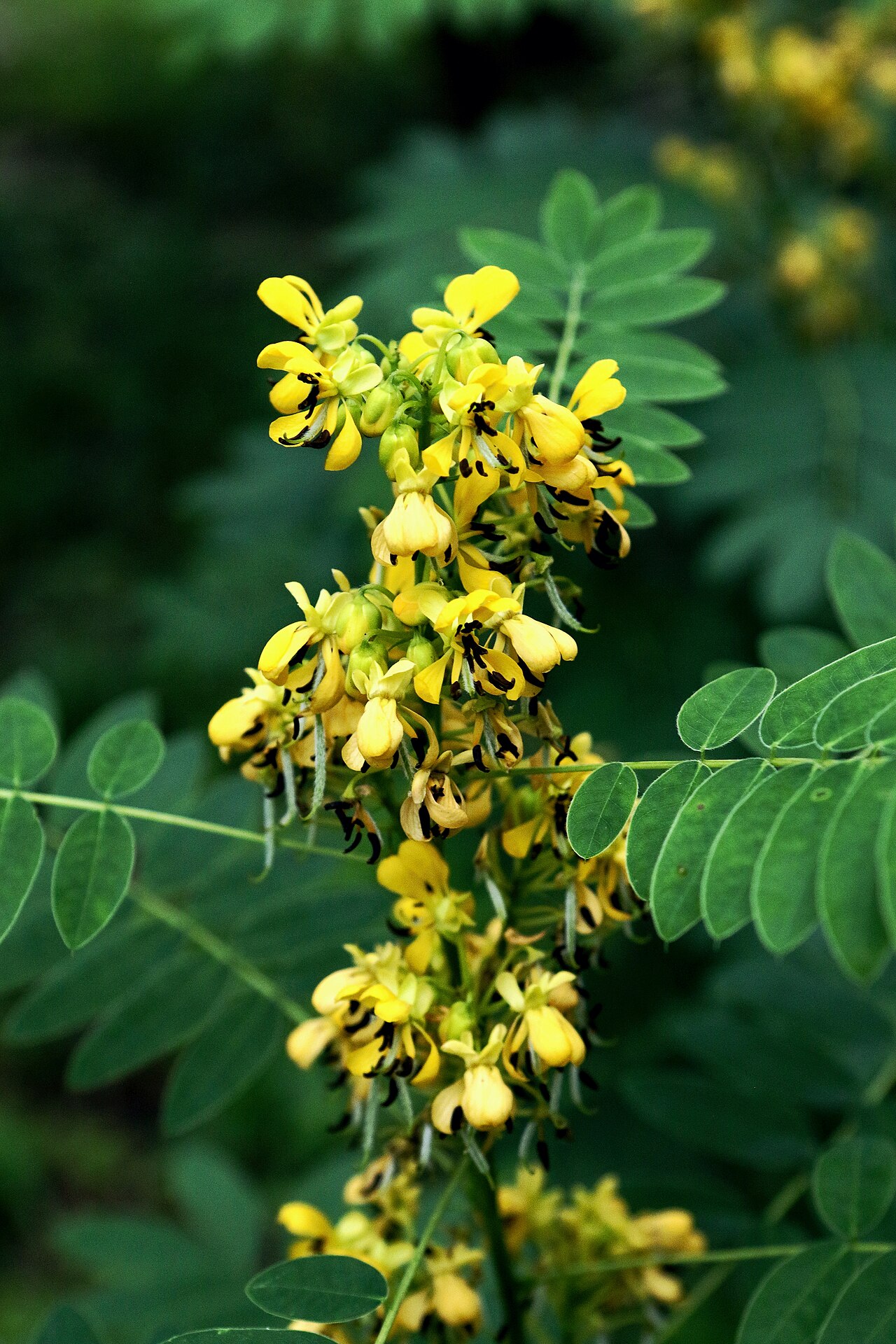
Senna marilandica, known as Maryland Senna or Maryland wild senna, is a bold native perennial of the pea family (Fabaceae) that brings tropical-looking foliage and bright yellow flowers to sunny, moist places across the eastern and central United States. Each year it sends up several sturdy stems 3 to 6 feet tall, clothed in feathery compound leaves, and from midsummer into late summer the upper leaf axils fill with clusters of yellow flowers marked by dark brown anthers.
It grows wild along streams and rivers, in floodplain thickets, wet meadows and prairies, open woods, roadsides and the edges of fields, from Pennsylvania and New Jersey south to Florida and west to Wisconsin, Nebraska, Kansas, Oklahoma and Texas. Maryland senna is often confused with American senna (Senna hebecarpa), a very similar northern species, and older books list both under Cassia, as Cassia marilandica and Cassia hebecarpa.
In gardens Maryland senna is a tough, long-lived and nearly pest-free plant for rain gardens, pond edges, meadows and the back of a sunny border. Bumble bees work its flowers, ants patrol its leaves for nectar, and several sulphur butterflies raise their caterpillars on it. Its leaves and seeds are strongly laxative and mildly toxic, so read the safety note before growing it where children or livestock graze.
Identification
Maryland senna is distinctive in summer, when its shrub-like clumps of pinnate leaves and yellow flowers stand out in a meadow or along a riverbank. Telling it from American senna takes a closer look at the leaves and pods.
Stems & Habit
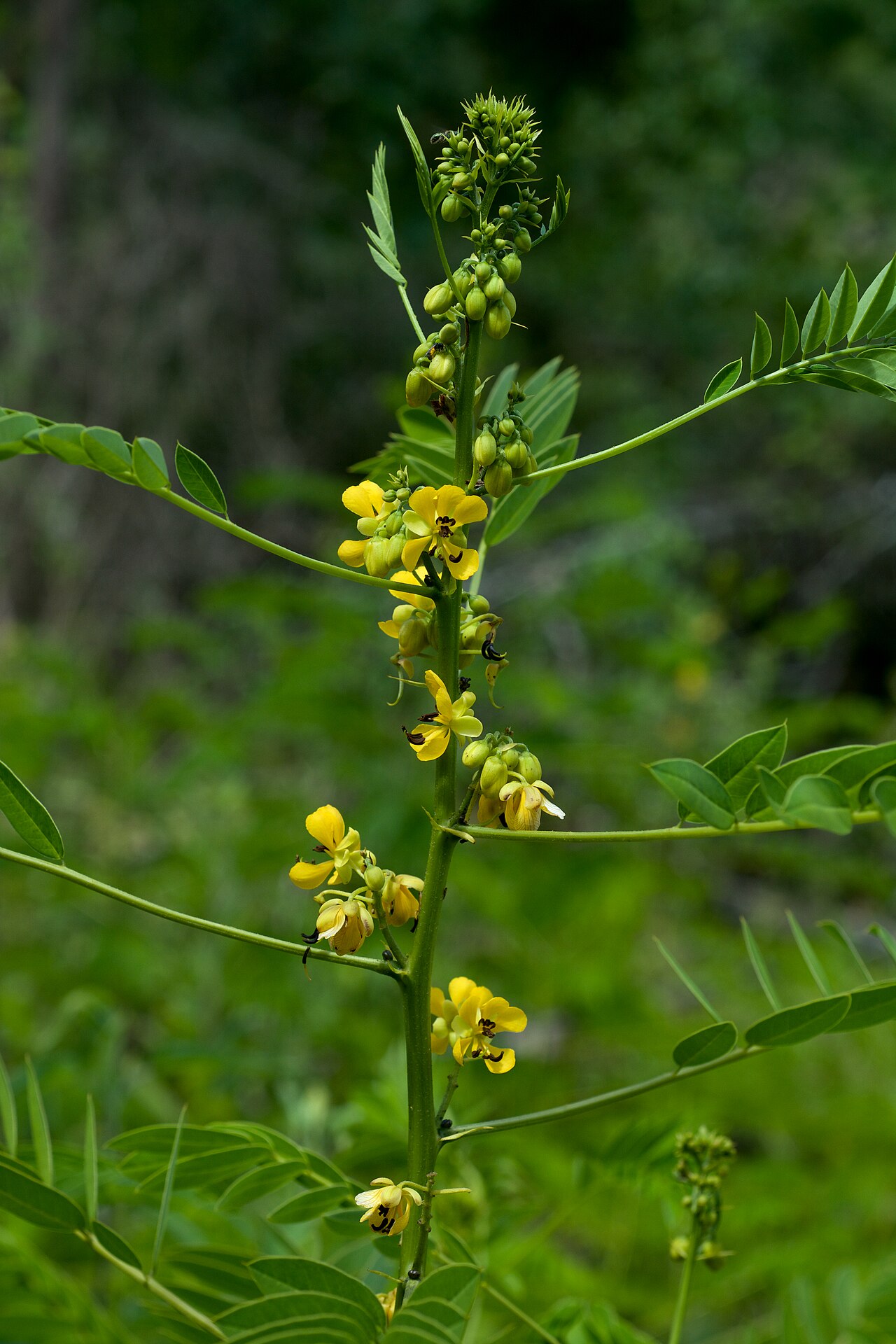
Plants form upright clumps of several unbranched or sparingly branched stems, 3 to 6 feet tall, from a woody crown and deep roots. The stems are green, smooth to slightly hairy, and die back to the ground each winter. In bloom a mature clump can look like a small, airy shrub.
Leaves
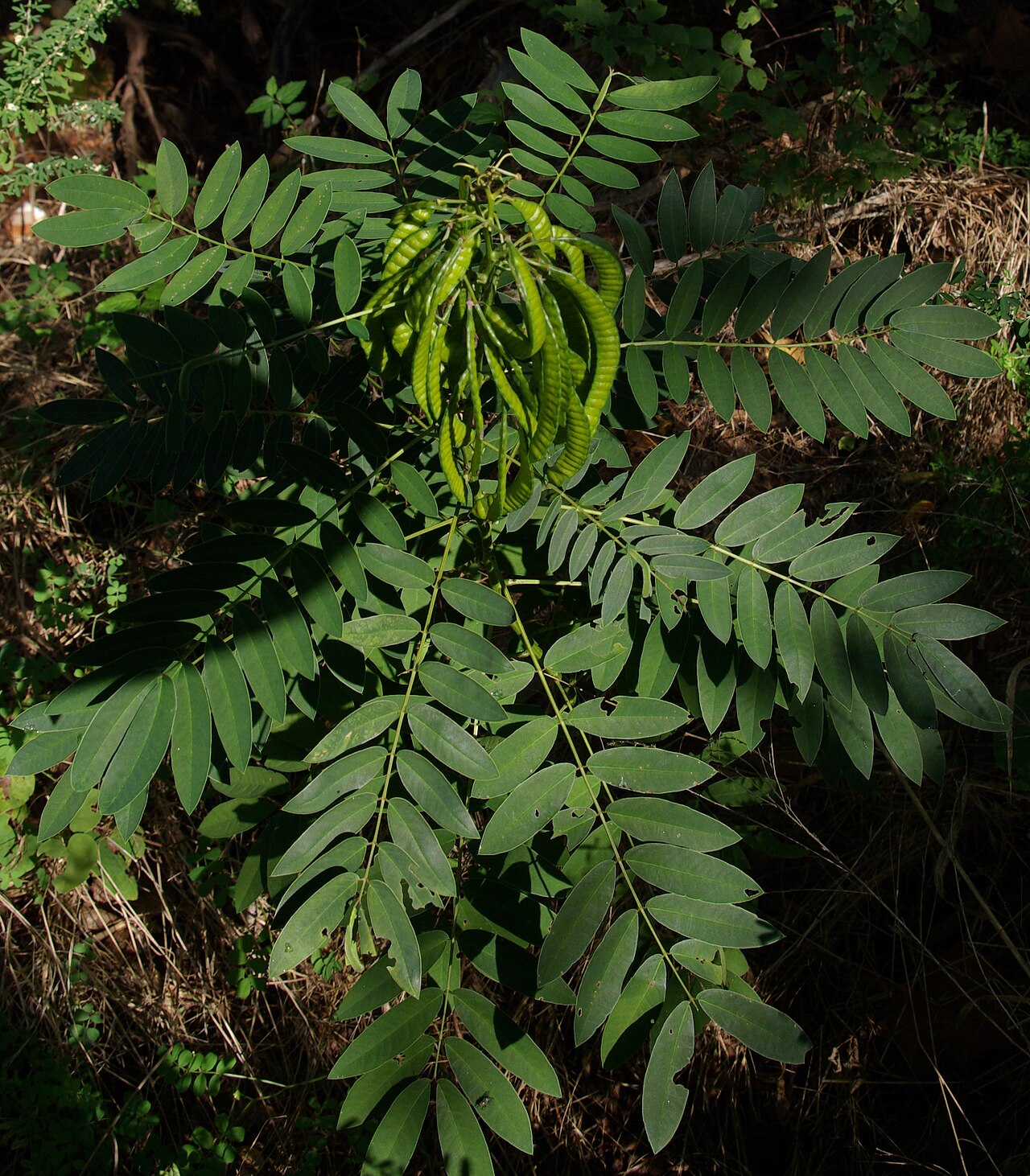
The leaves are alternate and evenly pinnately compound, 6 to 12 inches long, with about 4 to 8 pairs of oblong to elliptic leaflets, each 1 to 2 inches long with a small point at the tip. There is no terminal leaflet. A small, dome-shaped nectar gland sits on the upper side of the leaf stalk near its base; ants visit it for sugary nectar. The leaflets fold together at night and in heavy shade.
Flowers
Short clusters (racemes) of 5 to 10 or more flowers arise from the upper leaf axils from July to August, and sometimes into September. Each flower is about ¾ inch across, with five slightly unequal yellow petals and a set of conspicuous dark brown to nearly black anthers in the center. The flowers have no nectar. Instead the anthers release pollen through small pores at their tips when bumble bees grab them and vibrate their flight muscles, a technique known as buzz pollination.
Fruit & Seeds
The flowers develop into flat, slightly curved pods 2½ to 4 inches long that hang in clusters. They are green at first and ripen to dark brown or black in fall. The segments between the seeds are generally wider than long, and the pods are smooth to sparsely hairy. Each pod contains a row of flat, dark seeds, and the dried pods often stay on the stems into winter.
Look-alikes
American Senna (Senna hebecarpa), also called northern wild senna, is very similar. It usually has more leaflets (often 5 to 10 pairs), a club-shaped rather than dome-shaped gland on the leaf stalk, and noticeably hairy pods whose segments are about as long as they are wide or longer. It is the common wild senna of New England, New York and the northern Appalachians, while Maryland senna is more southern and western. Partridge Pea (Chamaecrista fasciculata) is a related annual with similar foliage but much smaller leaflets, larger single flowers and a height of only 1 to 3 feet.
Quick Facts
| Scientific Name | Senna marilandica (syn. Cassia marilandica) |
| Family | Fabaceae (pea family) |
| Plant Type | Herbaceous perennial |
| Mature Height | 3–6 ft |
| Mature Spread | 2–3 ft |
| Growth Rate | Moderate to fast |
| Sun Exposure | Full sun to part shade |
| Water Needs | Moderate; tolerates both moist soil and dry spells |
| Soil Type | Loam, sand or clay; alluvial soils along streams |
| Soil pH | About 5.5–7.5 |
| Bloom Time | July–August (into September) |
| Flower Color | Yellow with dark brown anthers |
| Fall Color | Leaves turn yellow before frost |
| Fruit | Flat, dark brown to black pods 2½–4 in long |
| Deer Resistant | Yes; rarely browsed |
| USDA Hardiness Zones | 4–9 |
Native Range
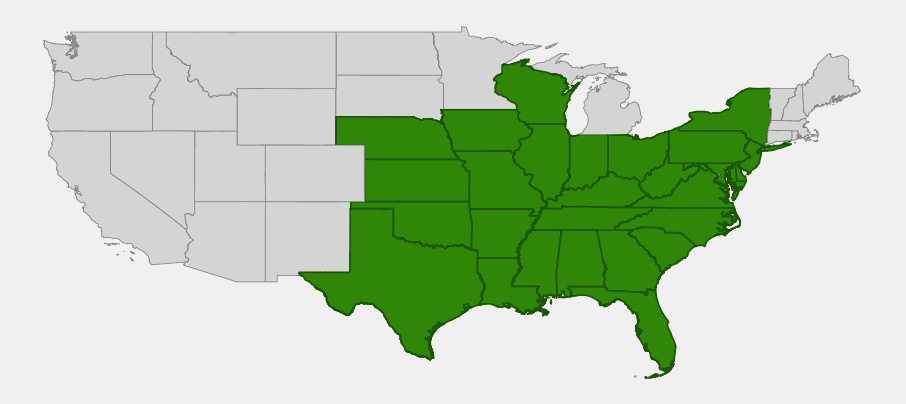
Maryland senna is native to the eastern and central United States. USDA PLANTS records it from Pennsylvania, New Jersey and New York south through the Atlantic states to Florida, west through the Ohio Valley to Wisconsin, Iowa, Nebraska and Kansas, and south to Oklahoma, Arkansas, Louisiana and eastern Texas. It is most common in the Ohio and Mississippi valleys, the Ozarks and the upper South. Records from New York, New Jersey and the far northern edge of the range are scattered, outlying ones.
USDA PLANTS also shows records from Connecticut and Massachusetts. Go Botany, the Native Plant Trust’s flora of New England, treats only American senna as part of the region’s flora, and the Lady Bird Johnson Wildflower Center omits New England from Maryland senna’s range, so those two states are not shown on the map on this page.
Across its range it grows in sunny or lightly shaded places with moist to average soil: floodplain forests and their edges, streambanks and gravel bars, wet meadows, moist prairies, open woods, thickets, glades, roadsides and fence rows. It handles periodic flooding well and is a characteristic plant of riverbanks in the Ozarks and Appalachian foothills.
📋 Regional plant lists featuring Maryland Senna: New York, Pennsylvania & Northern New Jersey · Ohio & Indiana · Michigan, Wisconsin & Eastern Minnesota · Kentucky & Tennessee · Nebraska, Kansas & Eastern Colorado · Maryland, Virginia & West Virginia · Delaware, Southern New Jersey & Long Island · Illinois, Iowa & Missouri · Alabama, Georgia & Mississippi · North & South Florida · North & South Carolina · Arkansas, Louisiana, Eastern Oklahoma & Eastern Texas · South & West Texas
Growing & Care Guide
Maryland senna is one of the easiest native perennials to grow. It adapts to a wide range of soils, shrugs off heat, humidity and occasional flooding, and has few pests. Its main needs are sun and room: a mature clump takes up as much space as a small shrub.
Light
Full sun gives the strongest stems and the most flowers. It also grows in part shade, especially in the hot South, but plants in shade lean and flower less.
Soil & Water
It does best in moist, well-drained loam but tolerates sand, clay and the alluvial soils of streambanks. It handles wet spells and brief flooding, and its deep roots let established plants ride out summer drought. Like other legumes it does not need fertilizer; rich soil only makes it floppy.
Planting Tips
Plant container-grown plants in spring or fall, 2 to 3 feet apart. Choose the location with care, because the deep, woody root system makes established clumps hard to move. Use it at the back of a border, along a pond or stream, in a rain garden, or massed in a meadow.
Pruning & Maintenance
Cut stems to the ground in late winter or early spring, or leave them standing through winter for their dark pods and for overwintering insects. If plants flop in rich soil, cut them back by about a third in late spring to encourage shorter, bushier growth. Maryland senna self-sows modestly; remove pods before they split if you do not want seedlings.
Propagation
Grow it from seed. The seed coat is hard, so nick it with a file or soak the seeds in hot water overnight before sowing, or sow outdoors in fall and let winter weather do the work. Seedlings grow quickly and often bloom in their second year. Clumps can be divided in early spring when young, but older plants have deep roots and divide poorly.
Landscape Uses
- Rain gardens and pond edges: tolerates periodic flooding and moist soil and holds its shape through summer
- Meadows and prairie plantings: adds height, fine-textured foliage and midsummer yellow among grasses and other wildflowers
- Back of the border: a shrub-sized perennial that forms a soft green backdrop and blooms in midsummer
- Streambank and floodplain restoration: its deep roots help hold soil along streams within its native range
- Butterfly and bee gardens: a larval host for sulphur butterflies and a key buzz-pollinated flower for bumble bees
Wildlife & Ecological Value
Maryland senna supports a surprising number of insects, from bumble bees and ants to the caterpillars of several sulphur butterflies, and its seeds feed birds into winter.
For Pollinators
The flowers have no nectar, but they are an important pollen source for bumble bees, which buzz-pollinate them by vibrating the anthers. The Xerces Society notes the plant’s special value to bumble bees. Ants, wasps and other insects visit the nectar glands on the leaf stalks, and the ants may help protect the plant from leaf-eating insects.
For Birds
The hard seeds are eaten in small amounts by bobwhite quail, wild turkey and some songbirds, especially in winter after other foods are scarce. Dense clumps also provide cover for ground-feeding birds.
For Mammals
Deer and rabbits rarely browse it, probably because the foliage contains bitter, laxative compounds.
Ecosystem Role
Maryland senna is a larval host for the cloudless sulphur and the sleepy orange, two yellow butterflies whose caterpillars feed on sennas. As a legume, it hosts nitrogen-fixing bacteria in its roots, helping to enrich the soils of floodplains and meadows where it grows. Along streams its deep roots help stabilize banks.
Cultural & Historical Uses
Linnaeus described the plant in 1753 as Cassia marilandica, naming it for the colony of Maryland, and it was moved to Senna in the 1800s. Many older field guides, herbals and nursery catalogs still use the Cassia name. The common name “senna” comes from Arabic and was first applied to related Old World plants long used as laxatives.
Maryland senna has a long history in American folk medicine. Its leaves were used as a domestic substitute for imported Alexandrian senna, and it was illustrated as “American senna” in Jacob Bigelow’s American Medical Botany (1817–1820). Several Native American peoples, including the Cherokee, used the plant medicinally. Today it is grown almost entirely for its ornamental and wildlife value.
Safety note: the leaves, pods and seeds contain anthraquinones, compounds with a strong laxative effect, and are mildly toxic. Eating them can cause cramping, vomiting and diarrhea. Do not use the plant as a home remedy, keep children and pets from chewing on pods and seeds, and avoid planting it where livestock graze.
Frequently Asked Questions
What is the difference between Maryland senna and American senna?
They are close relatives and look alike. American senna (Senna hebecarpa) is more northern, usually has more leaflets, a club-shaped gland on the leaf stalk and hairy pods with segments as long as or longer than wide. Maryland senna has a dome-shaped gland and smooth to sparsely hairy pods with segments wider than long.
Is Maryland senna toxic?
Yes, mildly. The leaves, pods and seeds contain strong laxatives that can cause cramping and diarrhea, and the seeds can be harmful to livestock. Keep children and pets from eating any part of the plant.
Does Maryland senna attract butterflies?
Yes. It is a larval host for the cloudless sulphur and the sleepy orange. Its flowers are mostly visited by bumble bees, since they offer pollen rather than nectar.
Does Maryland senna spread?
It forms slowly expanding clumps and reseeds modestly in open soil. It is not aggressive, and unwanted seedlings are easy to pull while young.
Will Maryland senna grow in wet soil?
Yes. It grows naturally on streambanks and floodplains and tolerates periodic flooding, but it also handles average garden soil and dry spells once established.

Looking for a nursery that carries Maryland Senna?
Browse our native plant nursery directory: Alabama & Arkansas · Delaware, Florida & Georgia · Illinois, Indiana, Iowa & Kansas · Kentucky, Louisiana, Maryland, Mississippi & Missouri · Nebraska, New Jersey, New York, North Carolina, Ohio & Oklahoma · Pennsylvania, South Carolina, Tennessee, Texas & Virginia · West Virginia & Wisconsin

