
Swamp Saxifrage (Saxifraga pensylvanica)
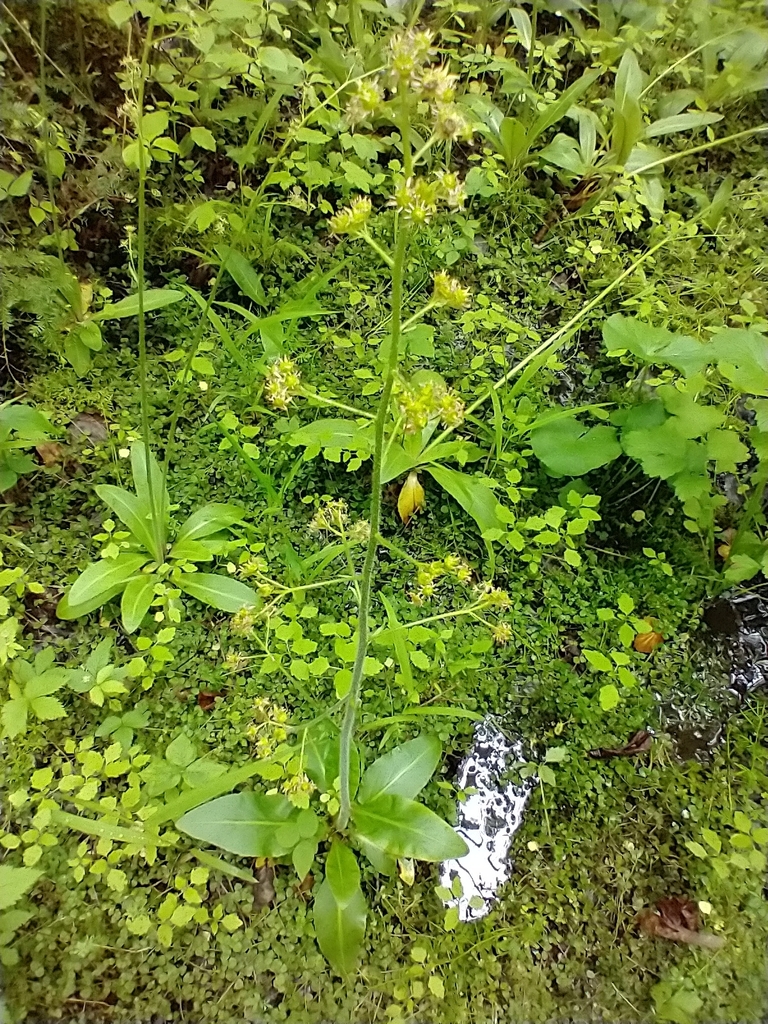
Saxifraga pensylvanica, known as Swamp Saxifrage or eastern swamp saxifrage, is a wetland wildflower of the northeastern and north-central United States and southern Canada. Many botanists now place it in the genus Micranthes, as Micranthes pensylvanica, but the older name is still used by USDA PLANTS and many nurseries.
In early spring it forms a flat rosette of large, smooth, lance-shaped leaves. From April to June a single sticky-hairy, leafless stalk rises 1 to 3 feet or more and branches into an airy cluster of many small greenish-white, yellowish or purplish flowers. It is not showy, but it is a distinctive early plant of wet places.
It grows in wet meadows, fens, seeps, swamps, bogs, wet prairies and streambanks, often in places that stay wet all year. It is a good choice for rain gardens, pond edges and wet meadow restorations in its native range, where it offers early-season pollen and nectar to small native bees and flies.
Identification
Look in spring wetlands for a rosette of large, smooth, lance-shaped basal leaves and a tall, leafless, sticky-hairy stalk with a branched, loose cluster of small, greenish-white flowers.
Leaves
All the leaves are basal, in a rosette. They are lance-shaped to oblong, about 4 to 10 inches long and 1 to 3 inches wide, smooth or slightly hairy, with smooth or faintly toothed edges, and taper to a broad, winged base. They are somewhat fleshy and pale to bright green.
Stem
The single flowering stalk (scape) is leafless, stout and hollow, usually 1 to 3 feet tall, sometimes taller, and covered with sticky, glandular hairs, especially above.
Flowers
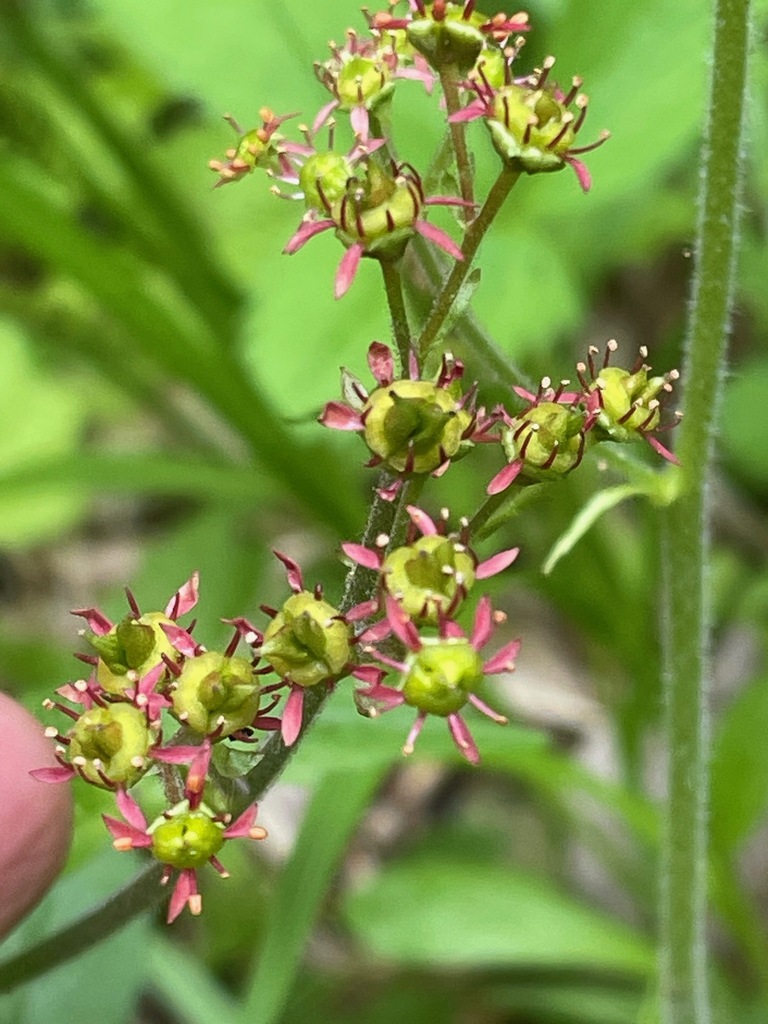
The flowers are small, about 1/4 inch across, in a loose, branched cluster that starts compact and opens out as it ages. Each has five narrow petals, which may be greenish-white, pale yellow or purplish, ten stamens, and a two-lobed green or reddish ovary in the center. Bloom is mainly from April to June.
Fruit
The fruit is a small capsule with two spreading beaks, splitting to release many tiny seeds in early summer.
Look-alikes
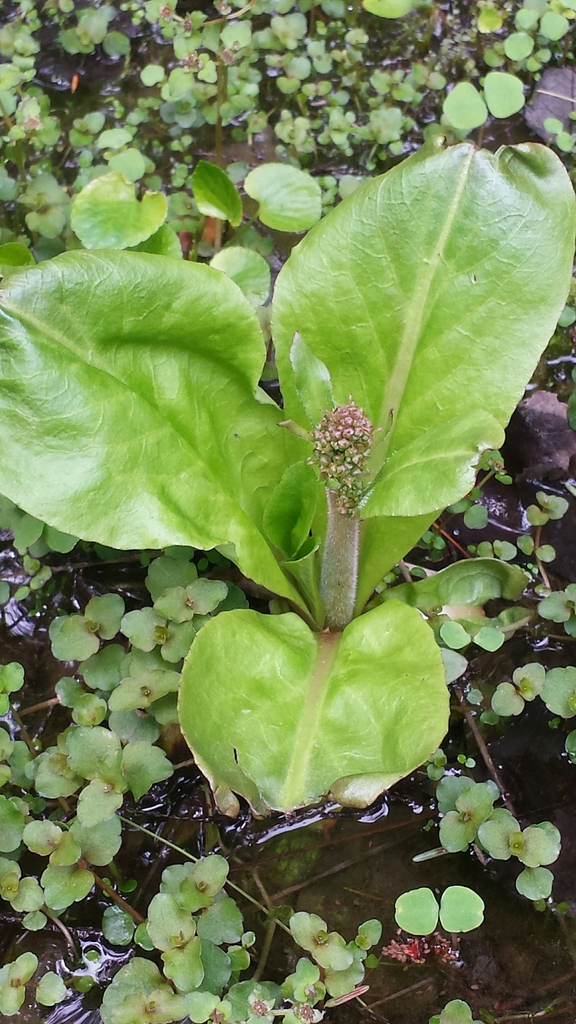
Early saxifrage (Micranthes virginiensis) is much smaller, grows on dry rocky slopes, and has toothed leaves and white flowers. Skunk cabbage and false hellebore share the same wet habitats, but skunk cabbage has huge round leaves and hooded flowers, and false hellebore has pleated leaves on a tall leafy stem.
Quick Facts
| Scientific Name | Saxifraga pensylvanica (syn. Micranthes pensylvanica) |
| Family | Saxifragaceae (saxifrage family) |
| Plant Type | Herbaceous perennial wildflower |
| Mature Height | 1–3 ft (rarely to 4 ft) in bloom |
| Mature Spread | 8–18 in |
| Growth Rate | Moderate |
| Sun Exposure | Full sun to part shade |
| Water Needs | High; wet to saturated soil |
| Soil Type | Wet, mucky, peaty or loamy soil |
| Soil pH | Slightly acidic to neutral; tolerates calcareous fens (about 5.5–7.5) |
| Bloom Time | Spring (April–June) |
| Flower Color | Greenish-white, pale yellow or purplish |
| Fall Color | None notable |
| Fruit | Small two-beaked capsule |
| Deer Resistant | Moderately |
| USDA Hardiness Zones | 3–7 |
Native Range
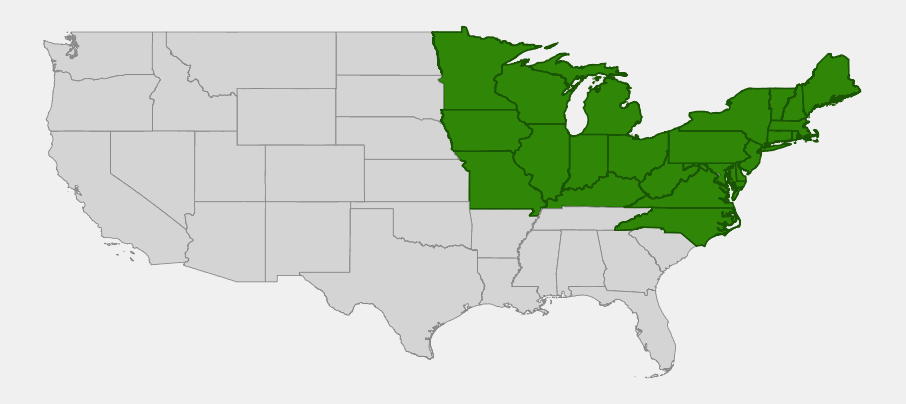
Swamp saxifrage is native to the northeastern and north-central United States and southern Ontario. USDA PLANTS records it in 23 states, from Maine and the New England states west through New York, Pennsylvania, Ohio, Michigan and Wisconsin to Minnesota, Iowa and Missouri, and south to Maryland, Virginia, West Virginia, Kentucky and northwestern North Carolina.
It is most common in the Great Lakes region and the Northeast. Toward the south it becomes scattered and is mostly found in mountain bogs, fens and seeps, and it is rare in some southern and border states.
It grows in wet meadows, sedge meadows, calcareous fens, bogs, seepage slopes, swamps, wet woods, wet prairies and streambanks, mostly at low to moderate elevations. It is an obligate wetland plant that grows almost only in wetlands.
📋 Regional plant lists featuring Swamp Saxifrage: New York, Pennsylvania & Northern New Jersey · Ohio & Indiana · Michigan, Wisconsin & Eastern Minnesota · Kentucky & Tennessee · Connecticut, Massachusetts & Rhode Island · New Hampshire, Maine & Vermont · Maryland, Virginia & West Virginia · Delaware, Southern New Jersey & Long Island · Illinois, Iowa & Missouri · North & South Carolina · North Dakota, South Dakota & Western Minnesota
Growing & Care Guide
Swamp saxifrage is easy to grow if you have a spot that stays wet. It is best for rain gardens, pond and stream edges, bog gardens and wet meadow plantings in the Northeast and Great Lakes region.
Light
Full sun to part shade. It grows well in open wet meadows and in the light shade of swamp edges, as long as the soil stays wet.
Soil & Water
Plant in consistently wet to saturated soil: mucky, peaty or loamy. It tolerates shallow standing water in spring. It does not tolerate drying out in summer, so avoid ordinary garden beds unless they are irrigated.
Planting Tips
Plant nursery-grown plants in spring or early fall at the same depth they grew in the pot, in groups so the airy flower stalks show up. Mix with sedges, marsh marigold, turtlehead and blue flag iris for a natural wet-meadow look.
Pruning & Maintenance
Little care is needed. Cut down the old flower stalks after seed drops if they look untidy. Keep aggressive wetland grasses and invasive plants such as reed canary grass from crowding it out.
Propagation
Grow from fresh seed surface-sown in fall outdoors, or after 30 to 60 days of cold, moist stratification. The seeds are tiny and need light to germinate. Plants can also be divided carefully in early spring. Collect seed only with permission and never dig plants from the wild.
Landscape Uses
- Rain gardens: thrives in low, wet spots
- Pond and stream edges: grows in saturated soil and shallow water
- Wet meadow restoration: a characteristic native of sedge meadows and fens
- Early spring interest: bold rosettes and early flower stalks
- Pollinator support: early pollen and nectar for small bees and flies
Wildlife & Ecological Value
Swamp saxifrage is an early-blooming member of wetland plant communities and a food source for insects active in spring.
For Pollinators
Its small, open flowers are visited by small native bees, including sweat bees and mining bees, and by flies and small beetles, which feed on nectar and pollen early in the season.
For Birds
It is not a major bird food, but it is part of the wetland plant community that supports insect-eating birds, and the tiny seeds may be eaten by small birds.
For Mammals
The leaves are sometimes grazed by deer and rabbits in spring, but it is not a preferred food.
Ecosystem Role
It is an indicator of high-quality wet meadows and fens in parts of its range. Its persistent rosettes help hold mucky soil along wetland edges.
Cultural & Historical Uses
The genus name Saxifraga comes from the Latin saxum (rock) and frangere (to break). It refers to the rock crevices where many saxifrages grow, and to an old belief that the plants could break stones. Swamp saxifrage is an exception, growing in wetlands rather than on rocks.
Linnaeus named the species in 1753, using the spelling pensylvanica, which is also used for several other plants first described from Pennsylvania. Molecular studies show that it belongs to a separate lineage from the classic rock saxifrages, which is why many recent floras use Micranthes pensylvanica.
It varies a good deal across its range in hairiness, leaf size and flower color, and botanists have described several varieties and forms over the years.
Frequently Asked Questions
Is swamp saxifrage a Saxifraga or a Micranthes?
Both names are in use. USDA PLANTS lists it as Saxifraga pensylvanica, while many recent floras, including Flora of North America and Go Botany, call it Micranthes pensylvanica.
When does swamp saxifrage bloom?
From about April to June, among the earliest wetland wildflowers to bloom.
Can swamp saxifrage grow in a normal garden bed?
Only if the soil stays wet. It is a wetland plant and does best in rain gardens, bog gardens and pond edges.
Are swamp saxifrage flowers showy?
Not very. The flowers are small and greenish-white to purplish, but the tall, airy flower stalks over bold leaf rosettes are attractive in a wetland planting.
Where does swamp saxifrage grow wild?
In wet meadows, fens, bogs, seeps and swamps from Maine to Minnesota, south to Missouri, Kentucky, Virginia and northwestern North Carolina, and in southern Ontario.

Looking for a nursery that carries Swamp Saxifrage?
Browse our native plant nursery directory: Connecticut & Delaware · Illinois, Indiana & Iowa · Kentucky, Maine, Maryland, Massachusetts, Michigan, Minnesota & Missouri · New Hampshire, New Jersey, New York, North Carolina & Ohio · Pennsylvania, Rhode Island, Vermont & Virginia · West Virginia & Wisconsin

