
Missouri Gooseberry (Ribes missouriense)
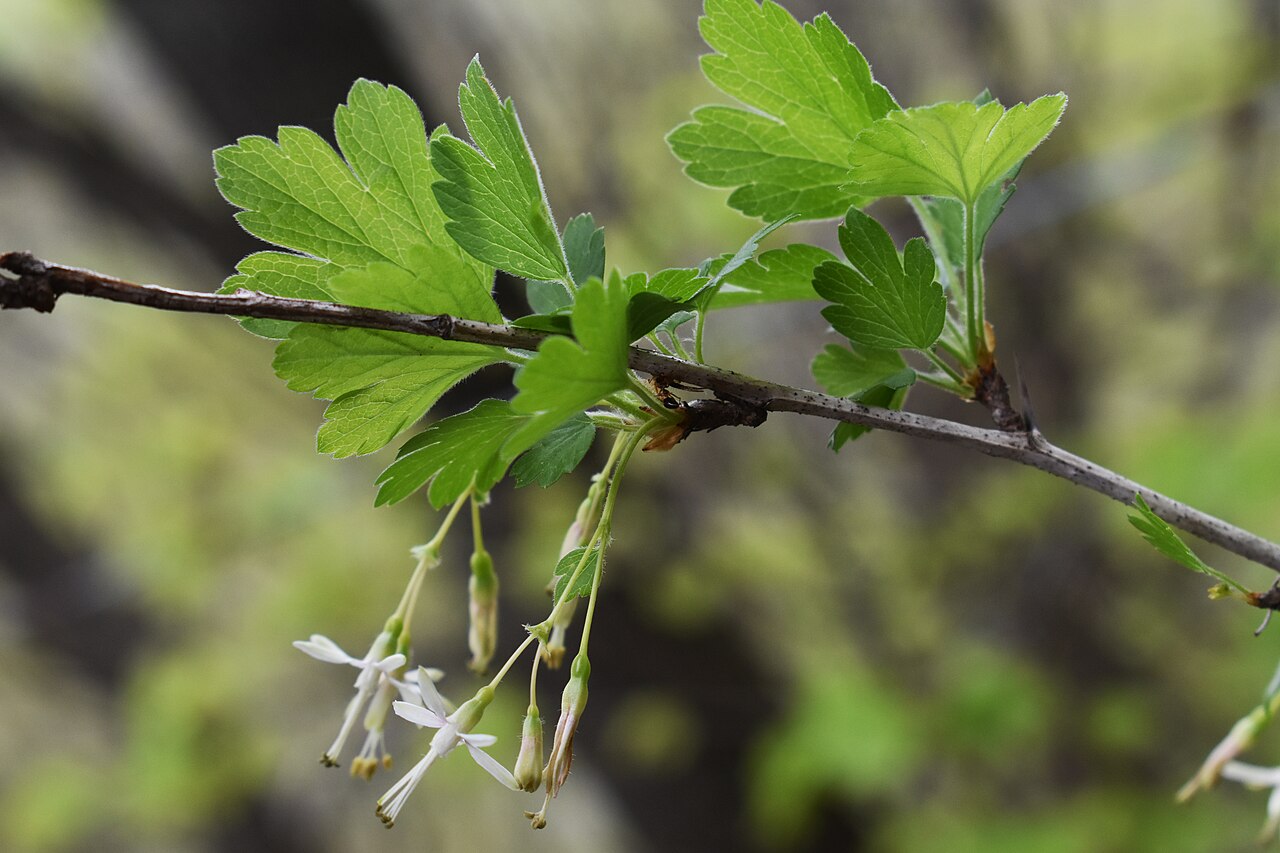
Ribes missouriense, known as Missouri Gooseberry or wild gooseberry, is a spiny, deciduous shrub of the currant family (Grossulariaceae) native to the Midwest, the eastern Great Plains and the Ohio Valley. It is one of the first shrubs to leaf out in spring, often greening up the understory of woods and thickets weeks before the trees.
It grows 3 to 5 feet tall with arching stems armed with stout spines at the nodes. In April and early May, small, white to greenish-white flowers hang beneath the leaves, each with swept-back sepals and long, protruding stamens. By midsummer the smooth berries ripen from green to reddish purple or purplish black and are tart, edible and excellent in pies and jams.
Missouri gooseberry grows in open woods, woodland edges, thickets, fencerows, floodplains and rocky hillsides. In gardens it is a tough, adaptable shrub for wildlife hedges and woodland edges, providing early nectar for bees, fruit for birds and people, and dense, prickly cover for nesting birds.
Identification
Look for a small, spiny shrub that leafs out very early, with small, lobed leaves, dangling white flowers with long stamens in spring and smooth, round berries in summer.
Growth Habit
Missouri gooseberry is a multi-stemmed, deciduous shrub 3 to 5 feet tall, occasionally to 6 feet, with arching or spreading stems that can root where they touch the ground. Older bark is gray to reddish brown and peels in thin strips. Each node usually carries one to three sharp spines up to about 3/4 inch long; the stems between the nodes are smooth or have a few bristles.
Leaves
The leaves are alternate or clustered on short spur shoots, about 1 to 2 1/2 inches wide, and rounded with three to five toothed lobes, much like a small maple leaf. They are dark green and smooth to slightly hairy, and in fall they turn yellow, orange or reddish purple.
Flowers
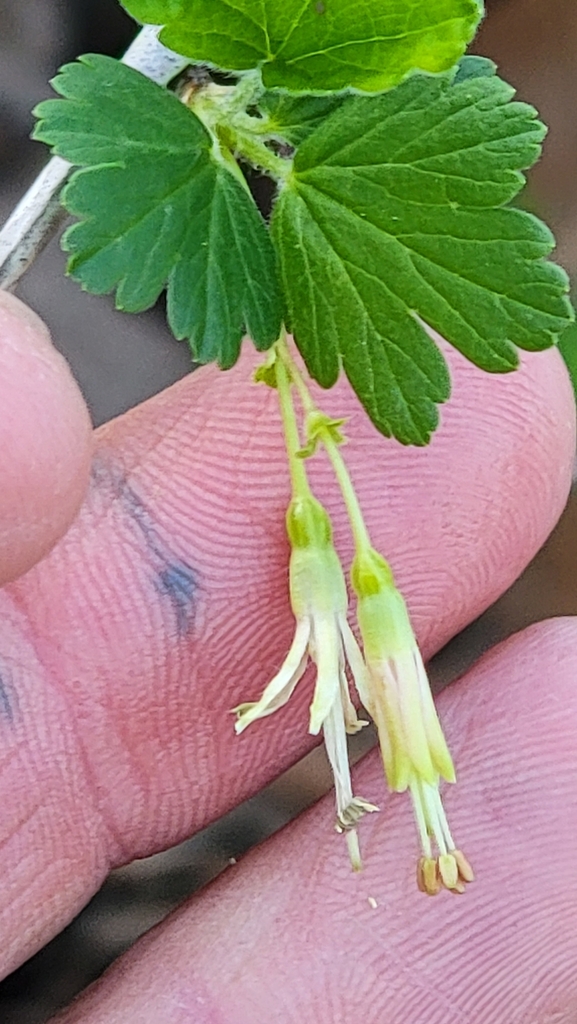
Flowers appear in April and May as the leaves expand, hanging in clusters of one to four on slender stalks. Each flower is about 1/2 inch long, with a short tube, five narrow, white to greenish-white sepals that curve sharply backward, small white petals and long stamens that stick out about twice the length of the sepals.
Fruit & Seeds
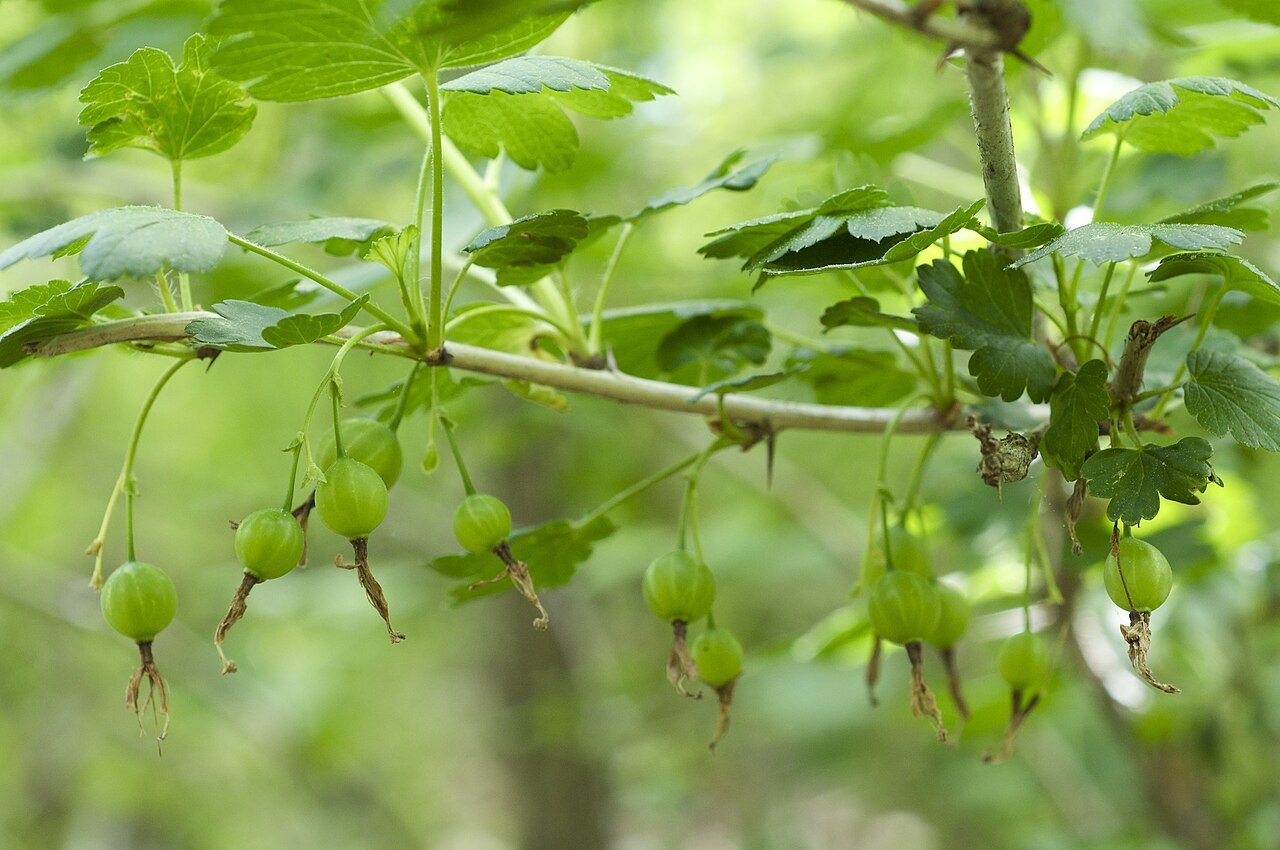
The fruit is a smooth, round berry about 1/3 to 1/2 inch across, with the dried flower remains at its tip. It ripens in July and August from green to reddish purple or purplish black and contains many small seeds in juicy pulp.
Look-alikes
Prickly gooseberry (Ribes cynosbati) has fruits covered in prickles and short stamens. American gooseberry (Ribes hirtellum), more northern and eastern, has shorter stamens that barely protrude from the flower and often no spines. The cultivated European gooseberry (Ribes uva-crispa) has larger, often hairy fruit and short stamens. Buffalo currant (Ribes odoratum) has no spines and fragrant yellow flowers.
Safety Notes
The ripe berries are edible and widely used for pies and preserves. Wear gloves when picking, since the spines are sharp. Like other Ribes, it can be an alternate host of white pine blister rust, a disease of five-needle pines; check local guidance before planting near white pines.
Quick Facts
| Scientific Name | Ribes missouriense |
| Family | Grossulariaceae (currant family) |
| Plant Type | Deciduous shrub |
| Mature Height | 3–5 ft |
| Mature Spread | 3–6 ft |
| Growth Rate | Moderate |
| Sun Exposure | Part shade to full sun |
| Water Needs | Low to medium |
| Soil Type | Loam, clay or rocky soil |
| Soil pH | About 6.0–7.5 |
| Bloom Time | April–May |
| Flower Color | White to greenish white |
| Fall Color | Yellow, orange to reddish purple |
| Fruit | Smooth berries ripening reddish purple to purplish black |
| Deer Resistant | Yes; spiny stems |
| USDA Hardiness Zones | 3–7 |
Native Range
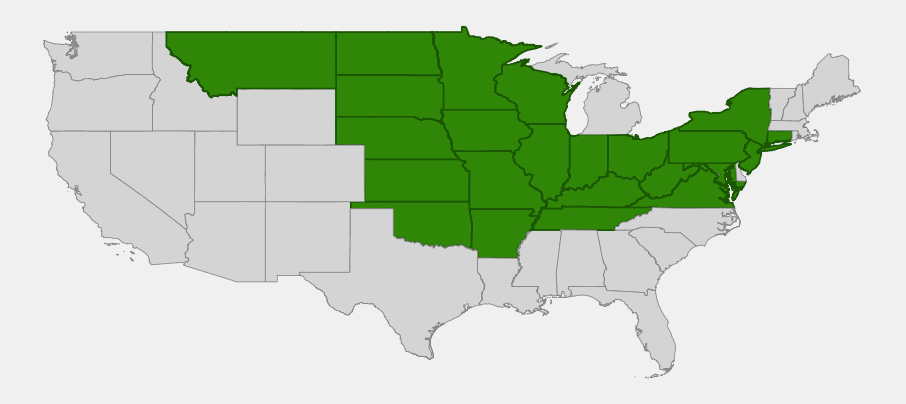
Missouri gooseberry is native to the central and eastern United States. USDA PLANTS lists it as native in Arkansas, Connecticut, Illinois, Indiana, Iowa, Kansas, Kentucky, Maryland, Minnesota, Missouri, Montana, Nebraska, New Jersey, New York, North Dakota, Ohio, Oklahoma, Pennsylvania, South Dakota, Tennessee, Virginia, West Virginia and Wisconsin. In Canada, USDA treats it as introduced in Ontario.
Its core range is the Midwest and the eastern Plains, from Minnesota, Wisconsin and the Dakotas south through Iowa, Illinois, Missouri, Nebraska and Kansas to Oklahoma, Arkansas, Kentucky and Tennessee, and east through Indiana and Ohio. It becomes scattered farther east, and the records from Connecticut and Montana are outlying.
Typical habitats are open deciduous woods and woodland edges, thickets, fencerows, floodplain and riverbank woods, wooded ravines, rocky hillsides, savannas and old pastures.
📋 Regional plant lists featuring Missouri Gooseberry: Arkansas, Louisiana, Eastern Oklahoma & Eastern Texas · Illinois, Iowa & Missouri · Ohio & Indiana · Kentucky & Tennessee · Nebraska, Kansas & Eastern Colorado · North Dakota, South Dakota & Western Minnesota · Michigan, Wisconsin & Eastern Minnesota · Maryland, Virginia & West Virginia · New York, Pennsylvania & Northern New Jersey · Delaware, Southern New Jersey & Long Island
Growing & Care Guide
Missouri gooseberry is sold by some native plant nurseries in the Midwest and is easy to grow. It is a low-care shrub for wildlife plantings, hedgerows and woodland edges.
Light
It grows in part shade to full sun. Plants in sun produce more fruit; those in shade make a looser, more open shrub.
Soil & Water
It adapts to loam, clay and rocky soil and tolerates both dry and seasonally moist conditions. Water during its first summer; established plants are quite drought-tolerant.
Planting Tips
Plant it along a woodland edge, in a wildlife hedge or in a shrub border with dogwoods, hazelnut and wild plum. Keep it away from paths because of the spines. Space plants about 4 feet apart for a hedge.
Pruning & Maintenance
Wear heavy gloves. Remove a few of the oldest stems at the base in late winter to keep the shrub vigorous and fruitful, and cut out stems that root where you do not want them. Watch for powdery mildew and leaf spot in humid summers; good air circulation helps.
Propagation
Sow seeds cleaned from ripe fruit outdoors in fall; they need a winter of cold, moist stratification. Stems that touch the ground often root and can be cut off and moved in early spring. Hardwood cuttings taken in late winter also root.
Landscape Uses
- Wildlife hedges: dense, spiny cover for nesting birds
- Edible landscaping: tart berries for pies, jams and sauces
- Woodland edge plantings: early spring leaves and flowers under trees
- Pollinator gardens: very early nectar for queen bumblebees and other bees
- Restoration: savanna, floodplain and woodland edge shrub layer
Wildlife & Ecological Value
Missouri gooseberry is valuable to wildlife for its early flowers, summer fruit and protective spiny cover.
For Pollinators
The early flowers are visited by queen bumblebees, mining bees and other spring bees, which can reach the nectar in the short floral tubes. The leaves feed the caterpillars of the gray comma butterfly (Polygonia progne) and several moths that use currants and gooseberries.
For Birds
Many birds, including American robins, gray catbirds, brown thrashers and cedar waxwings, eat the berries. The dense, spiny stems make safe nesting and roosting sites for small birds.
For Mammals
Raccoons, opossums, foxes, chipmunks and other mammals eat the fallen fruit. The spines discourage browsing by deer and rabbits.
Ecosystem Role
As an early-leafing understory shrub, Missouri gooseberry provides spring food and year-round cover in open woods and thickets, and its fruit is a summer food source for many animals.
Cultural & Historical Uses
Thomas Nuttall named Ribes missouriense in 1818 from plants he found along the Missouri River. The genus name Ribes comes from an old Arabic name for a sour-tasting plant.
Wild gooseberries were gathered by Native American peoples and by settlers in the Midwest, who cooked them with sugar or honey in pies, preserves and sauces. Green, unripe berries are especially sour and are traditionally used for pies.
In the early 1900s, many Ribes plants were destroyed in parts of the United States to protect white pines from white pine blister rust, a disease brought from Europe that needs both pines and currants or gooseberries to complete its life cycle. Some local restrictions on planting Ribes still exist.
Frequently Asked Questions
Are Missouri gooseberries edible?
Yes. The ripe berries are tart and are used in pies, jams and sauces; green berries are even more sour. Wear gloves, since the stems are spiny.
When does Missouri gooseberry bloom?
It blooms in April and May, about the time its leaves open, and is one of the earliest native shrubs to leaf out.
How do I tell Missouri gooseberry from other gooseberries?
Its stamens stick far out beyond the flower, and its fruit is smooth. Prickly gooseberry has spiny fruit, and American gooseberry has short stamens.
Does Missouri gooseberry grow in shade?
Yes. It grows in part shade at woodland edges and under open trees, though it fruits best with more sun.
Is it safe to plant gooseberries near pine trees?
Gooseberries can host white pine blister rust, which harms five-needle pines such as eastern white pine. Check local guidance before planting near white pines.

Looking for a nursery that carries Missouri Gooseberry?
Browse our native plant nursery directory: Arkansas · Connecticut · Illinois, Indiana, Iowa & Kansas · Kentucky, Maryland, Minnesota, Missouri & Montana · Nebraska, New Jersey, New York, North Dakota, Ohio & Oklahoma · Pennsylvania, South Dakota, Tennessee & Virginia · West Virginia & Wisconsin

