
Whiskerbrush (Leptosiphon ciliatus)
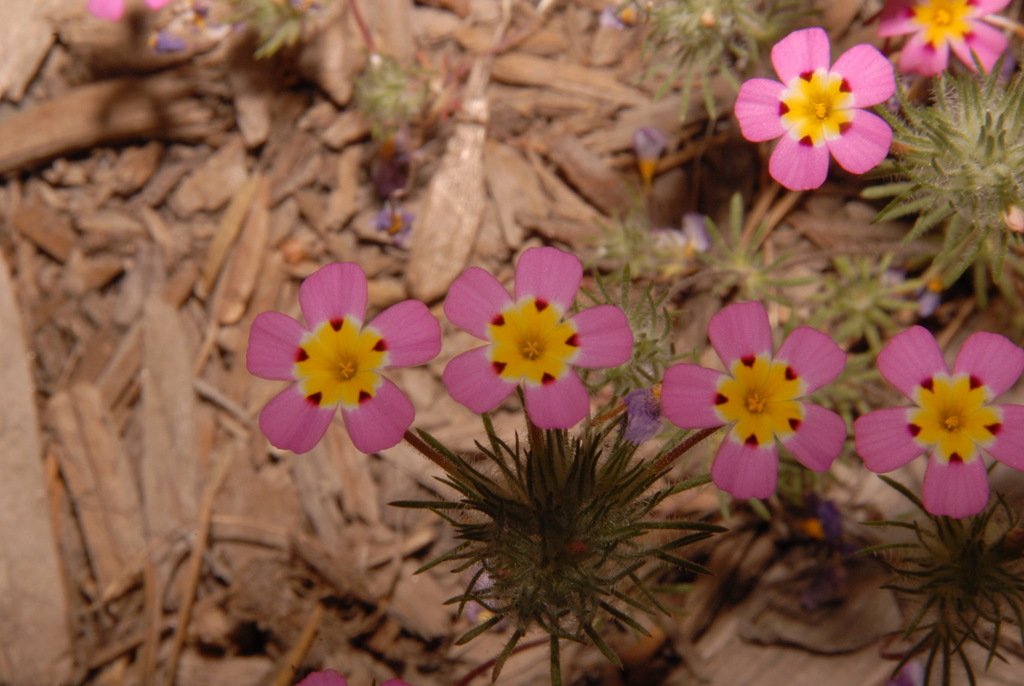
Leptosiphon ciliatus, known as Whiskerbrush, is a tiny native annual wildflower of the phlox family (Polemoniaceae). It was long known as Linanthus ciliatus. Each plant is usually only 2 to 8 inches tall, with one or a few wiry stems topped by a dense, bristly head of narrow, deeply divided leaves and bracts. From this head, small pink flowers with yellow centers open on long, slender tubes from spring into midsummer.
Whiskerbrush is common in the mountains and foothills of California, from the Coast Ranges and the Sierra Nevada to the mountains of southern California, and extends into western Nevada, southern Oregon and northern Baja California. It grows in open, sunny spots with sandy or gravelly soil: openings in pine and mixed conifer forests, chaparral clearings, grassy slopes and meadow edges. Where it is common, it forms pink carpets among the grasses and pine needles.
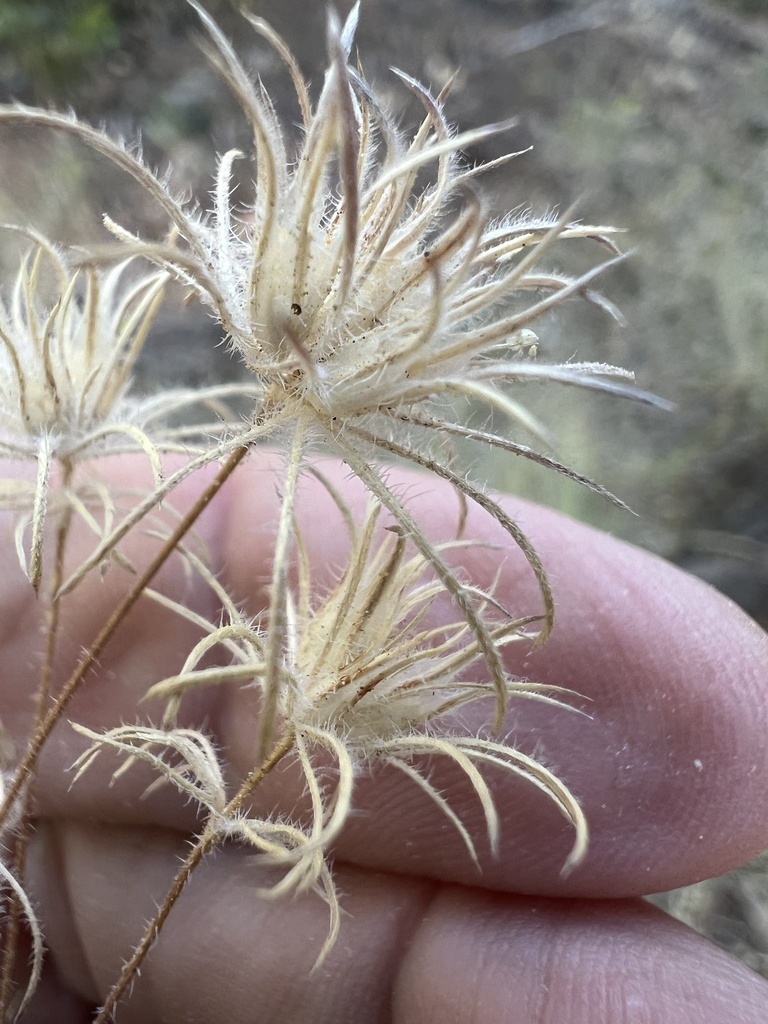
The name comes from the long, stiff hairs (cilia) on the leaf and bract edges, which make the flower heads look like tiny brushes, especially after the flowers fade. Whiskerbrush is rarely sold, but it can be grown from wild-collected or purchased seed in a sunny, well-drained native garden.
Identification
Look for a very small annual with a dense, bristly head of narrow, hairy-edged leaves at the top of the stem, and pink flowers with yellow centers on long, thin tubes.
Growth Habit
Whiskerbrush is a small, upright annual, usually 2 to 8 inches tall and occasionally to about 12 inches. It has a single stem or a few branches from the base. The stems are thin and often reddish.
Leaves
The leaves are opposite and palmately divided into 5 to 9 narrow, needle-like lobes about 1/4 to 3/4 inch long, so each pair of leaves looks like a whorl of needles. The edges of the leaf lobes and bracts are lined with long, stiff, white hairs. The uppermost leaves and bracts are crowded into a dense, bristly head.
Flowers
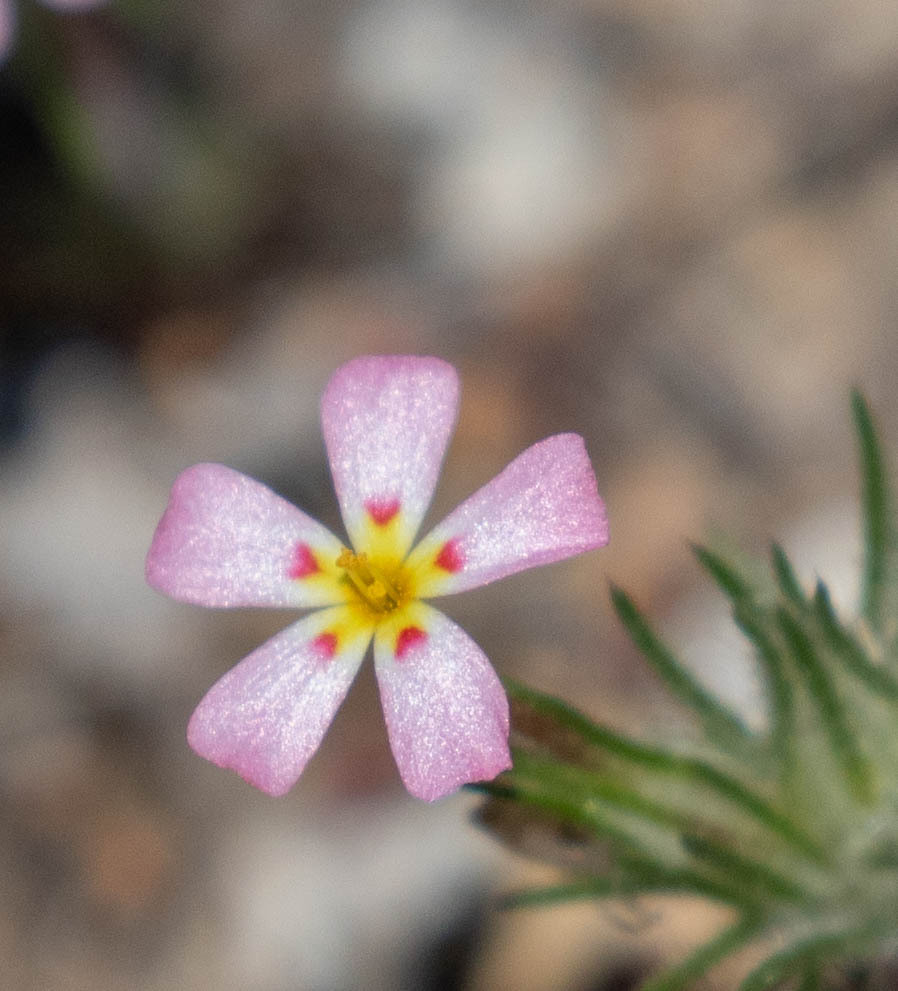
The flowers emerge from the head on a long, very slender tube, about 1/2 to 1 inch long, that is held mostly within the bracts. The flaring part of the flower is about 1/2 inch across, with five rounded lobes that are usually pink to rose-pink, sometimes white, with a yellow throat and often small red or purple marks at the base of each lobe. Several flowers may open from one head. Flowering runs from about April to July, later at higher elevations.
Fruit & Seeds
The fruit is a small capsule hidden among the bracts that splits to release a few tiny seeds. After flowering, the dry, straw-colored, bristly heads remain on the plant into late summer.
Look-alikes
Variable linanthus (Leptosiphon parviflorus) of the Coast Ranges has similar flowers but is often taller, with the flower tube extending well beyond the bracts and bracts that are not as bristly. Bicolored linanthus (Leptosiphon bicolor) has white to pink flowers with a yellow throat and less hairy leaves. Ground pink (Linanthus dianthiflorus) of southern California has larger, fringed petals.
Quick Facts
| Scientific Name | Leptosiphon ciliatus (syn. Linanthus ciliatus) |
| Family | Polemoniaceae (phlox family) |
| Plant Type | Annual wildflower |
| Mature Height | 2–8 in (rarely to 1 ft) |
| Mature Spread | 1–3 in |
| Growth Rate | Fast |
| Sun Exposure | Full sun to light shade |
| Water Needs | Low; spring moisture, dry summer |
| Soil Type | Sandy, gravelly or granitic, well-drained soils |
| Soil pH | Slightly acidic to neutral (about 5.5–7.0) |
| Bloom Time | April–July |
| Flower Color | Pink to rose, occasionally white, with yellow throat |
| Fall Color | None; dry, straw-colored heads |
| Fruit | Small capsule hidden in the bracts |
| Deer Resistant | Yes; too small and bristly to attract browsing |
| USDA Hardiness Zones | Annual; grows in zones 5–10 |
Native Range
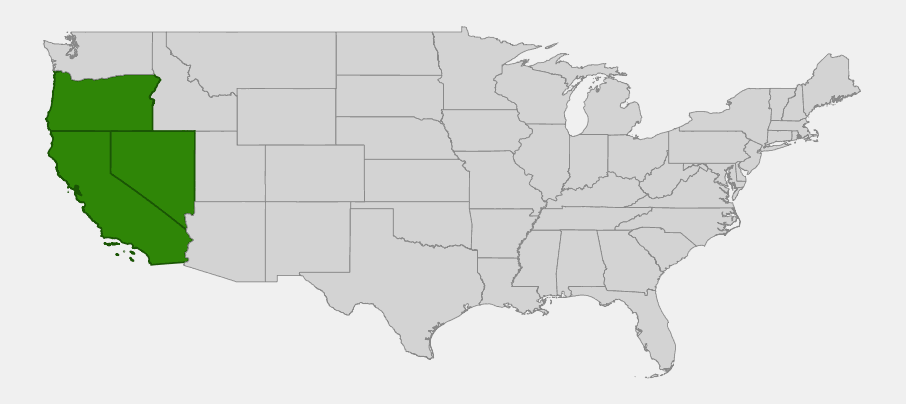
Whiskerbrush is native to the far western United States and northern Baja California. Most of its range is in California, where it grows in the Klamath and Cascade ranges, the Coast Ranges, the Sierra Nevada and its foothills, and the Transverse and Peninsular Ranges of southern California.
In Nevada it is found mainly in the Carson Range and the eastern slopes of the Sierra Nevada around Reno, Carson City and Lake Tahoe. In Oregon it grows in the southwestern mountains around the Rogue and Umpqua valleys and east of the Cascades in Klamath and Lake counties, reaching north into the western Cascades.
It grows in open, sunny places with sandy, gravelly or granitic soil: clearings in ponderosa pine, Jeffrey pine and mixed conifer forests, chaparral and oak woodland openings, grassy slopes, meadow edges and roadsides. It is found from the foothills at about 1,000 feet to about 10,000 feet in the high Sierra.
📋 Regional plant lists featuring Whiskerbrush: Idaho, Eastern Oregon & Eastern Washington · Western Oregon & Western Washington · California & Nevada
Growing & Care Guide
Whiskerbrush is a wildflower to enjoy in the wild more often than in gardens, but it can be grown from seed in a sunny, well-drained native garden in the West. It is a small plant, so it is best sown in drifts where its pink flowers can be seen up close.
Light
Full sun to light shade, as in forest openings.
Soil & Water
It needs sandy, gravelly or decomposed granite soil with excellent drainage. It grows with winter and spring moisture and finishes its life cycle as the soil dries in summer. Do not water it in summer or fertilize it.
Planting Tips
Sow seed directly on bare, well-drained soil in fall, so winter rain and cold can prepare the seeds for spring germination. Rake it in lightly. It suits rock gardens, gravel gardens, sunny slopes and the front of native plantings, where taller plants will not shade it out.
Pruning & Maintenance
No pruning is needed. Leave the plants in place until the seeds have dropped, and avoid thick mulch, which prevents the seeds from germinating the next year.
Propagation
Only by seed. Collect the dry heads in summer and sow the seed in fall. Plants reseed modestly where the soil stays open.
Landscape Uses
- Rock and gravel gardens: a tiny pink annual for the foreground
- Native wildflower meadows: adds color in late spring among grasses
- Forest-edge plantings: suits sunny openings under pines
- Pollinator gardens: nectar for long-tongued bees, flies and butterflies
- Habitat restoration: part of native annual seed mixes for mountain sites
Wildlife & Ecological Value
Whiskerbrush may be small, but in large patches it is an important nectar source in mountain clearings in late spring and early summer.
For Pollinators
The long, narrow flower tube holds nectar that only long-tongued insects can reach, such as bee flies, butterflies, day-flying moths and some native bees.
For Birds
Its tiny seeds may be eaten by ground-feeding birds such as juncos and sparrows.
For Mammals
It is too small and bristly to be an important food for mammals.
Ecosystem Role
As a quick-growing annual, whiskerbrush fills openings in forests and chaparral after disturbance, such as fire or logging, adding to the diversity of native wildflowers on bare ground.
Cultural & Historical Uses
The genus name Leptosiphon means “slender tube” in Greek, describing the long, thin flower tube. The species name ciliatus refers to the hairs (cilia) on the leaves and bracts.
Whiskerbrush was long placed in the genus Linanthus as Linanthus ciliatus. DNA studies published around 2000 led botanists to move it and its close relatives to the genus Leptosiphon, although the older name still appears in many field guides.
In California, whiskerbrush is one of the many small annuals, sometimes called “belly flowers,” that are best appreciated by getting down close to the ground.
Frequently Asked Questions
Is whiskerbrush an annual?
Yes. It grows from seed each year, flowers in spring or early summer, and dies after setting seed.
Why is it called whiskerbrush?
The leaves and bracts at the top of the stem are lined with long, stiff hairs, so the flower heads look like tiny brushes.
Is whiskerbrush the same as Linanthus ciliatus?
Yes. Linanthus ciliatus is the older name for the same species.
Where does whiskerbrush grow?
In the mountains and foothills of California, western Nevada, southern Oregon and northern Baja California, in open, sunny spots with sandy or gravelly soil.
Can I grow whiskerbrush in my garden?
Yes, from seed sown in fall on bare, well-drained soil in full sun. Do not water it in summer.

Looking for a nursery that carries Whiskerbrush?
Browse our native plant nursery directory: California · Nevada · Oregon

