
Diamond Clarkia (Clarkia rhomboidea)
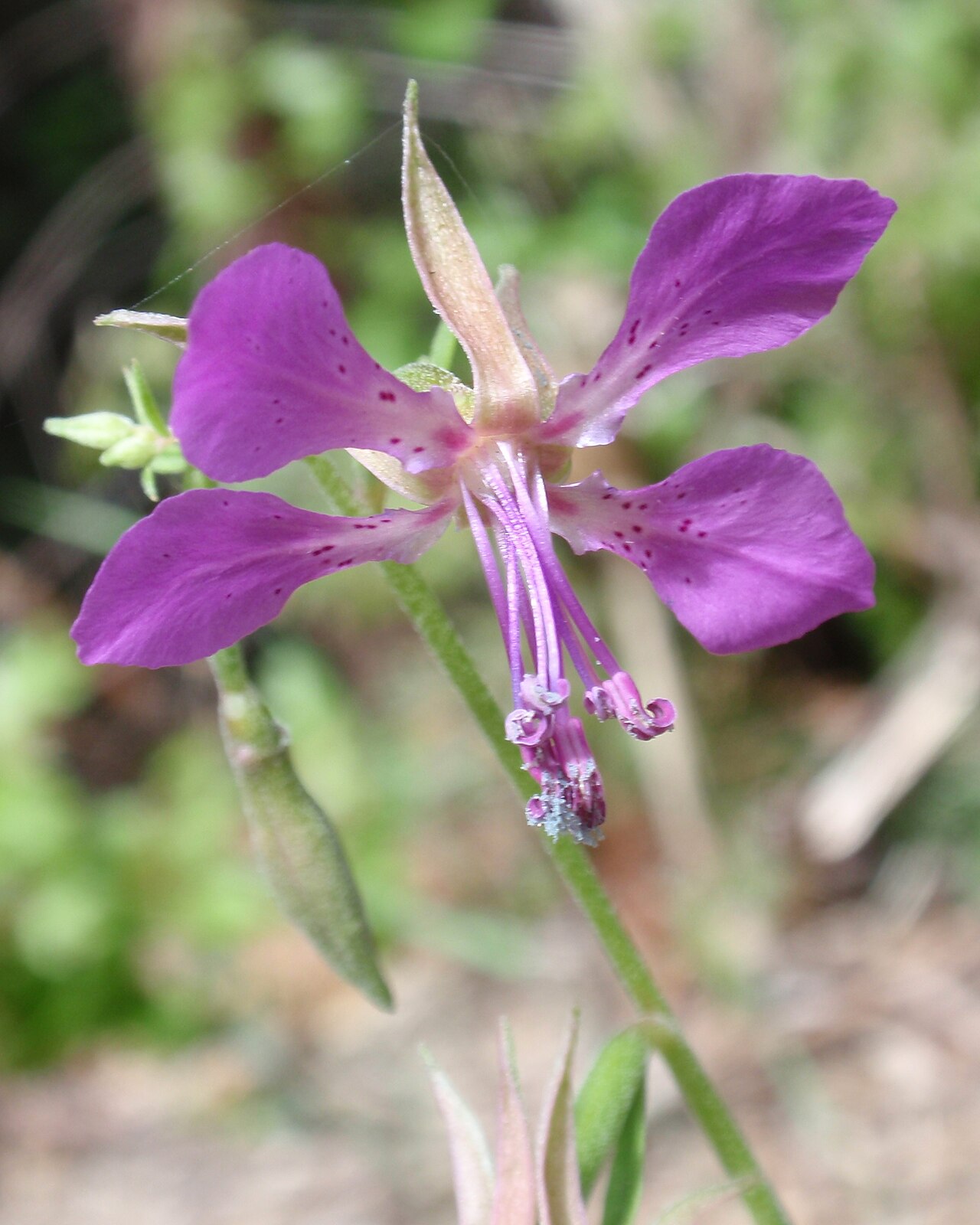
Clarkia rhomboidea, known as Diamond Clarkia, rhomboid clarkia or common clarkia, is a native annual wildflower in the evening primrose family (Onagraceae). On slender stems usually 1 to 3 feet tall, it bears pink to lavender-purple flowers with four widely spaced petals, each shaped like a small diamond on a narrow stalk. It blooms in late spring and early summer, after many other spring annuals have finished.
It is the most widespread clarkia in the interior West, native from southern British Columbia south through Washington, Oregon and California and east to Idaho, western Montana, Nevada, Utah and northern Arizona. It grows in open conifer and oak woodlands, forest edges, dry rocky slopes and the edges of sagebrush, from the foothills to mid-mountain elevations.
Diamond clarkia is easy to grow from seed in dry, sunny or lightly shaded sites, and it brings late-season color and pollen for native bees to woodland edges and wildflower meadows in the West.
Identification
Look for a slender, wiry annual with small, oval leaves, nodding buds and pink to lavender flowers with four separated, diamond-shaped petals, in open woods and dry slopes from May to July.
Growth Habit
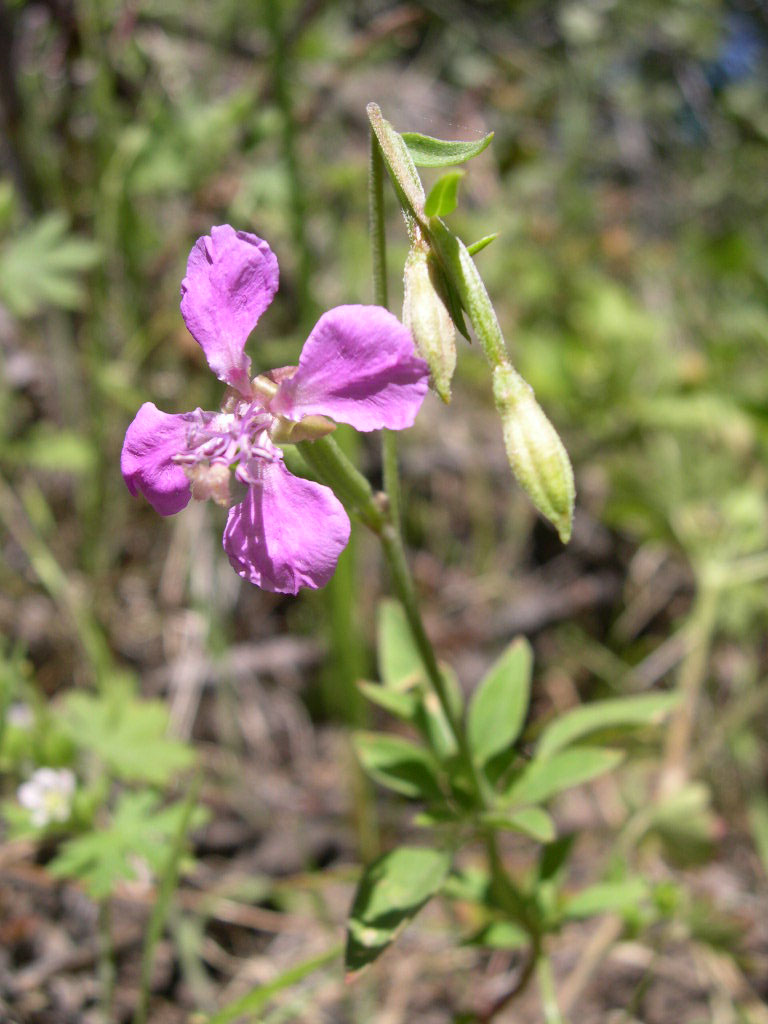
An erect annual, usually 1 to 3 feet tall and sometimes taller, with a single slender stem or a few branches. The stems often lean on or grow up through surrounding plants. The buds nod before opening.
Leaves
The leaves are alternate, lance-shaped to oval, about 1 to 2 1/2 inches long, with short stalks and smooth or slightly toothed edges. The lower leaves often wither by flowering time.
Flowers
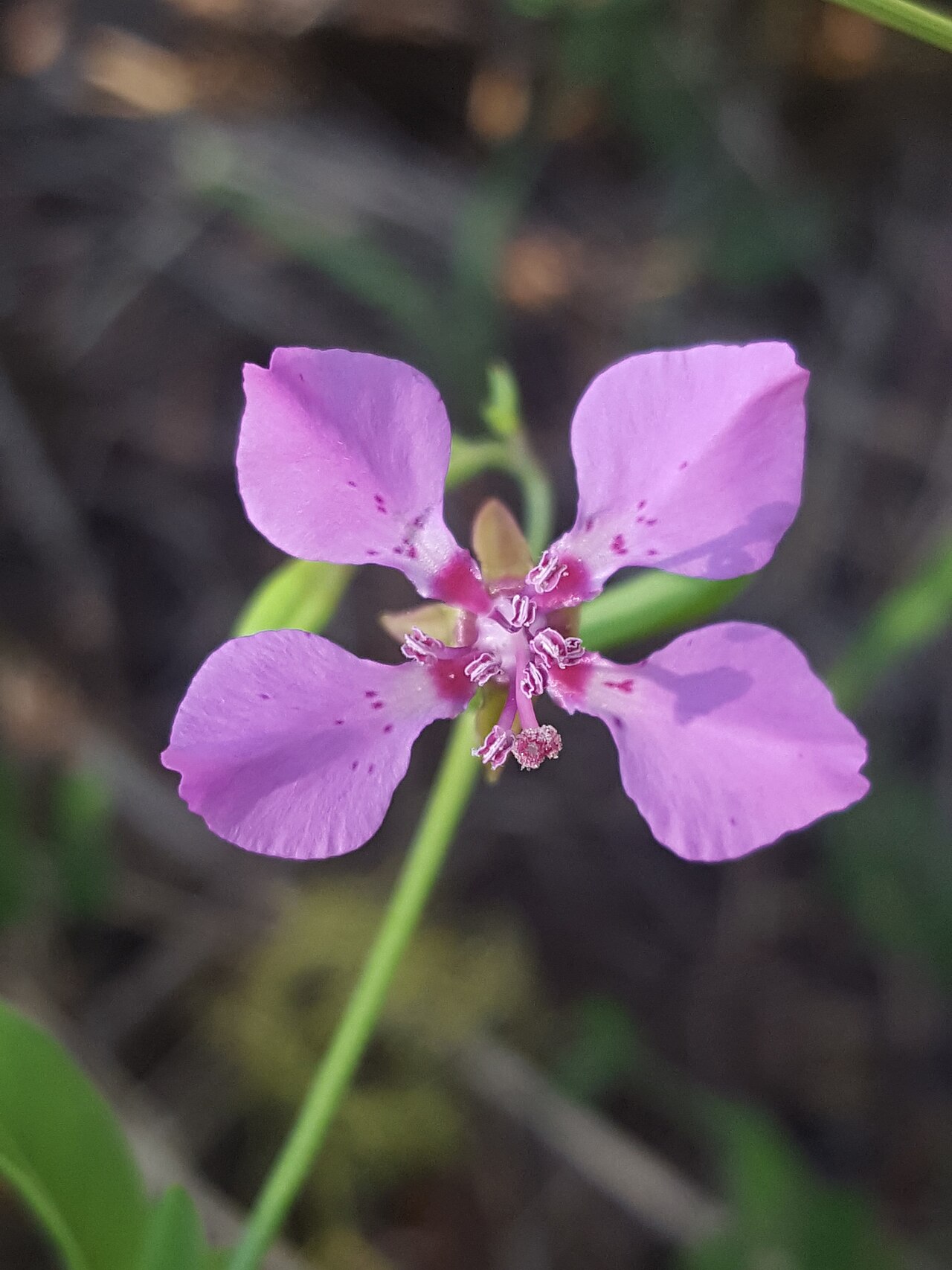
Each flower has four pink to lavender-purple petals, about 1/4 to 1/2 inch long. Each petal has a broad, diamond-shaped (rhombic) blade on a narrow claw, with a pair of small teeth or lobes where the blade meets the claw, and is often speckled with darker purple near the base. The four petals spread widely apart, giving the flower an open, cross-like look. There are eight stamens and a four-lobed stigma. Flowering is from about May to July, later at higher elevations.
Fruit
The fruit is a long, slender, four-angled capsule, about 1/2 to 1 inch long, that splits open to release many small seeds. The dry capsules often stay on the plant into fall.
Look-alikes
Elegant clarkia (Clarkia unguiculata) also has clawed petals but lacks the small teeth at the base of the blade and is found mostly in California. Farewell-to-spring (Clarkia amoena) has broad, fan-shaped petals without a claw, forming a cup.
Quick Facts
| Scientific Name | Clarkia rhomboidea |
| Family | Onagraceae (evening primrose family) |
| Plant Type | Annual wildflower |
| Mature Height | 1–3 ft |
| Mature Spread | 6–12 in |
| Growth Rate | Fast (one season) |
| Sun Exposure | Full sun to partial shade |
| Water Needs | Low; dry summer soil |
| Soil Type | Well-drained sandy, gravelly or rocky loam |
| Soil pH | Slightly acidic to neutral (about 5.5–7.5) |
| Bloom Time | Late spring to summer (May–July) |
| Flower Color | Pink to lavender-purple |
| Fall Color | None; dies after setting seed |
| Fruit | Slender, four-angled capsule |
| Deer Resistant | Partly; deer occasionally browse it |
| USDA Hardiness Zones | Annual; grows wild in zones 4–9 |
Native Range
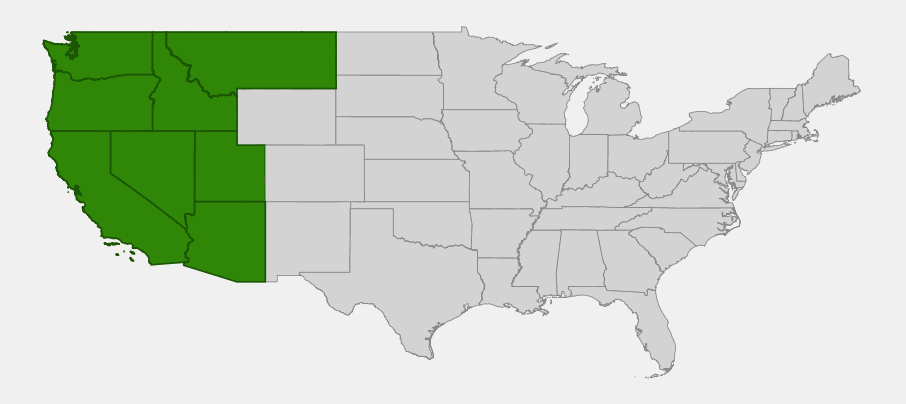
Diamond clarkia is native to western North America. USDA PLANTS records it as native in eight western states: Arizona, California, Idaho, Montana, Nevada, Oregon, Utah and Washington, and in British Columbia in Canada. USDA also lists Massachusetts, but that record comes from a single collection at the waste area of a nineteenth-century wool-carding mill (Go Botany), not from a native population, so it is not shown on the map.
It grows on both sides of the Cascades in Washington and Oregon, including the dry forests of the eastern slopes and the Siskiyou region of southwestern Oregon. In California it is widespread in the Klamath Ranges, Cascades, Sierra Nevada, and the Transverse and Peninsular Ranges. East of the Sierra and Cascades it ranges through the mountains of Idaho, western Montana, Nevada, Utah and northern Arizona.
Its habitats include open ponderosa pine, Douglas-fir and mixed conifer forests, oak woodlands, forest edges and clearings, dry rocky or gravelly slopes, and the edges of sagebrush and juniper woodland, mostly from the foothills to mid-mountain elevations.
📋 Regional plant lists featuring Diamond Clarkia: Idaho, Eastern Oregon & Eastern Washington · Montana & Wyoming · Utah & Western Colorado · Arizona & New Mexico · Western Oregon & Western Washington · California & Nevada
Growing & Care Guide
Diamond clarkia is an easy annual from seed. Like other western wildflowers, it germinates with fall or winter moisture, grows through spring and blooms as the soil dries in early summer.
Light
Full sun to partial shade. It is one of the more shade-tolerant clarkias and does well at the edges of open woodland or under high tree canopy.
Soil & Water
Plant it in well-drained, sandy, gravelly or rocky loam. It needs moisture in winter and spring but tolerates dry soil as it blooms. Avoid heavy watering and rich soil, which can make plants floppy and short-lived.
Planting Tips
Sow seed directly in fall in mild-winter regions, or in late fall to very early spring in cold regions, on raked, weed-free soil. Cover lightly. Sow it in drifts at woodland edges, under open trees, or among bunchgrasses and other wildflowers, where its slender stems can lean on neighbors.
Pruning & Maintenance
No pruning is needed. Leave the plants standing until the capsules have opened and dropped their seed, then pull them. Keep some open ground nearby for seedlings.
Propagation
It grows only from seed. Collect the slender capsules as they turn tan and begin to split in summer, and sow the seed in fall.
Landscape Uses
- Woodland edges: late spring color in light shade under open trees
- Wildflower meadows: extends bloom into early summer after earlier annuals
- Pollinator gardens: pollen and nectar for native bees
- Dry gardens: needs no summer water
- Restoration: native seed mixes for forest openings and burned areas
Wildlife & Ecological Value
Diamond clarkia provides flowers in open western forests and woodlands in late spring and early summer, when fewer annuals are in bloom.
For Pollinators
Clarkias are an important pollen source for native bees, including several solitary bees that collect pollen mainly from clarkia flowers. Bumble bees, other native bees, bee flies and butterflies also visit diamond clarkia.
For Birds
Seed-eating birds such as finches, juncos and sparrows feed on clarkia seeds after the capsules open.
For Mammals
Deer and other browsers occasionally eat the stems and flowers, and small rodents gather the seeds.
Ecosystem Role
As an annual that comes up readily in open, disturbed and recently burned ground, it helps cover bare soil in forest openings and adds to the variety of flowers available to pollinators through the season.
Cultural & Historical Uses
The genus Clarkia honors William Clark of the Lewis and Clark Expedition, which collected the first specimens of the genus (Clarkia pulchella) in Idaho in 1806. The species name rhomboidea refers to the diamond-shaped (rhombic) petals.
Indigenous Californians reportedly sowed clarkia species and harvested the seeds to grind for food, according to the Lady Bird Johnson Wildflower Center.
Clarkias are a classic group in the study of plant evolution, because many closely related species in California differ in flower shape, color and chromosome number. Diamond clarkia belongs to a group of species with clawed, toothed petals.
Frequently Asked Questions
Why is it called diamond clarkia?
Because each of its four petals has a diamond-shaped (rhombic) blade on a narrow stalk.
When does diamond clarkia bloom?
From about May to July, later at higher elevations.
Is diamond clarkia an annual?
Yes. It grows from seed each year, blooms in late spring or summer and dies after setting seed.
Can diamond clarkia grow in shade?
It tolerates partial shade better than most clarkias and does well at woodland edges.
Where is diamond clarkia native?
In the western United States, from Washington and Montana south to California, Nevada, Utah and Arizona, and in British Columbia.

Looking for a nursery that carries Diamond Clarkia?
Browse our native plant nursery directory: Arizona · California · Idaho · Montana · Nevada · Oregon · Utah · Washington