
Mountain Lady’s-slipper (Cypripedium montanum)
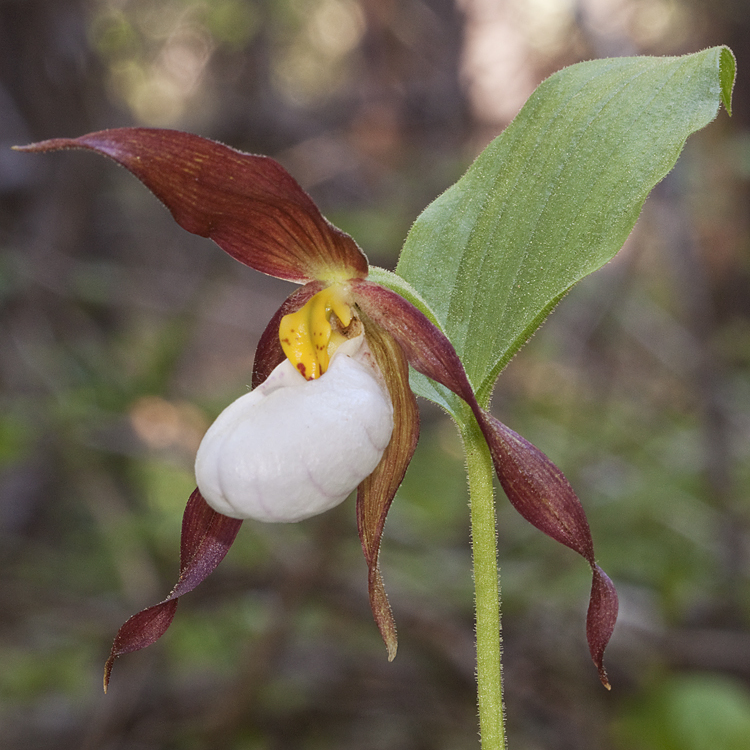
Cypripedium montanum, known as Mountain Lady’s-slipper, is one of the most elegant native orchids of western North America. In late spring and early summer, each leafy stem carries one to three fragrant flowers with a white, slipper-shaped pouch framed by long, twisted, maroon to brownish-purple petals and sepals.
It grows in the open shade of conifer and mixed forests, from the mountains of California north through Oregon, Washington, Idaho, Montana and Wyoming to British Columbia, Alberta and southeastern Alaska. Like all lady’s-slippers, it depends on soil fungi to germinate and grow, and individual plants can live for decades if left undisturbed.
Mountain lady’s-slipper is uncommon in many areas and has declined from collecting, logging and habitat change. Never dig it from the wild: wild-collected plants almost always die, and removing them harms local populations. This guide covers how to identify it, where it grows, how gardeners can responsibly enjoy it, and its role in western forests.
Identification
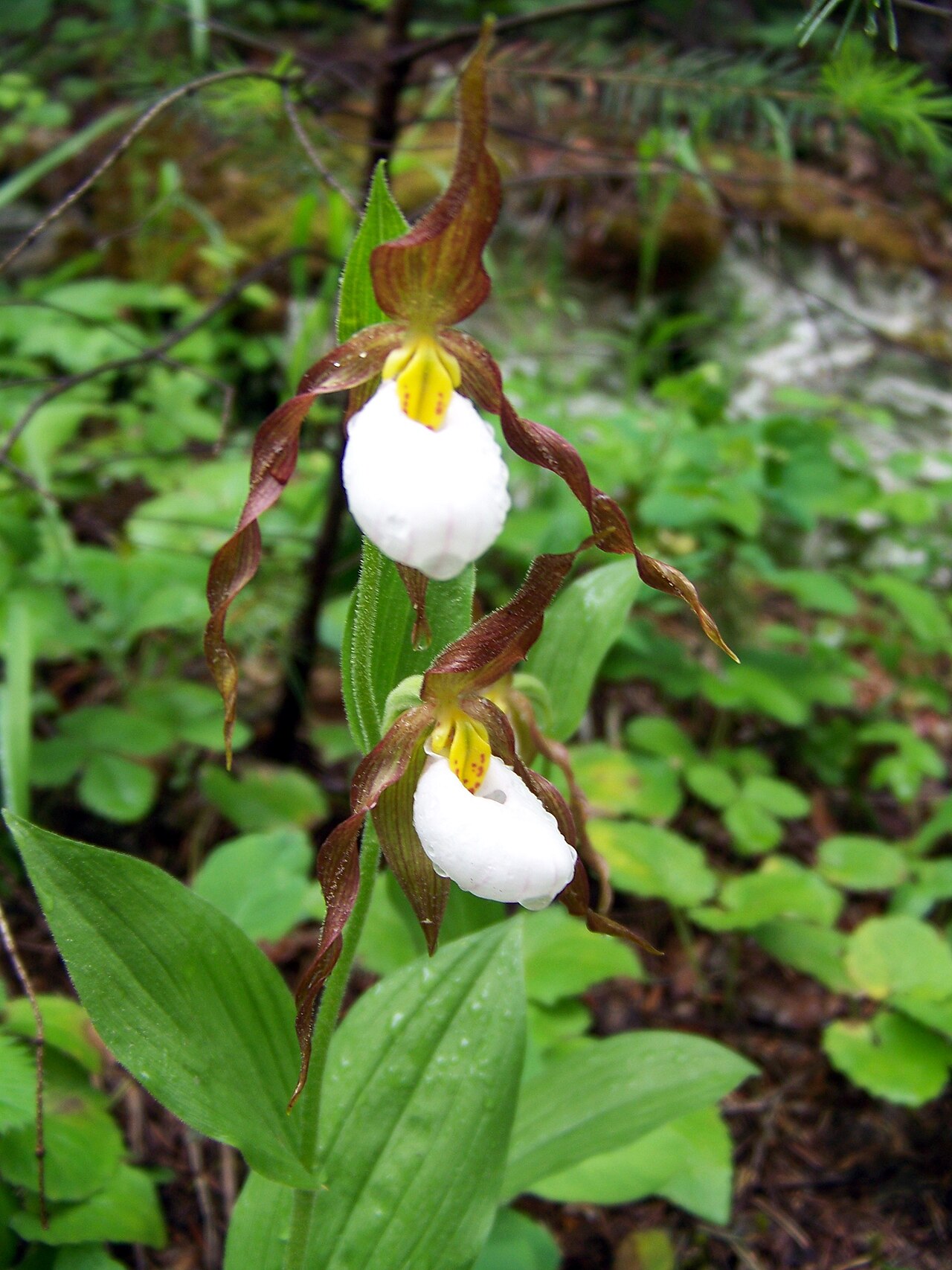
No other western orchid has the combination of a white pouch and long, spiraling, maroon-brown petals. Look for a leafy stem 10 to 28 inches tall in late spring or early summer in partly shaded forest.
Growth Habit
It is a perennial herb growing from a short rhizome with fibrous roots. Plants produce one to several upright, hairy stems, usually 10 to 28 inches tall, and older plants can form clumps of a dozen or more stems.
Leaves
Each stem has four to six alternate, broadly oval to lance-shaped leaves, 2 to 6 inches long, with prominent parallel veins and a pleated look. They clasp the stem and are slightly hairy.
Flowers
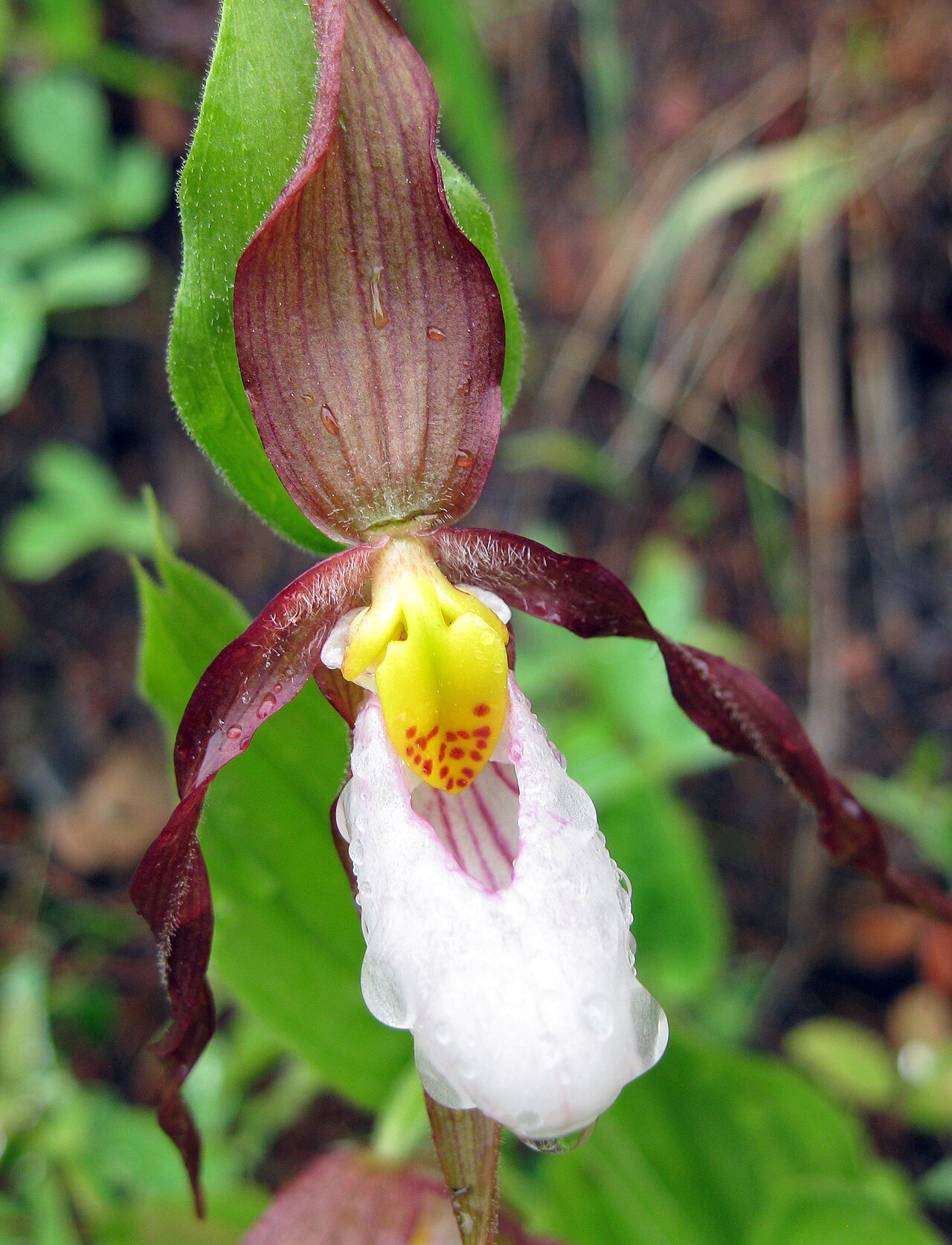
Each stem bears one to three flowers, each from the axil of a leafy bract. The lip is a white, egg-shaped pouch about 1 inch long, often with faint purple veins. The two lateral petals are long, narrow and spirally twisted, and the upper sepal is wavy; both are maroon, purplish brown or bronze. A yellow, red-spotted staminode sits above the opening of the pouch. The flowers have a sweet vanilla-like scent. Bloom time is May to July, depending on elevation and latitude.
Fruit & Seeds
A pollinated flower becomes an upright, ribbed capsule that releases thousands of dust-like seeds in late summer and fall. The seeds have almost no food reserve and need specific soil fungi to germinate.
Look-alikes
Yellow lady’s-slipper has similar twisted brownish petals but a yellow pouch. Clustered lady’s-slipper (Cypripedium fasciculatum) is much smaller, with greenish-brown flowers in a cluster at the top of the stem. Showy lady’s-slipper has a pink-and-white pouch and grows in eastern North America.
Quick Facts
| Scientific Name | Cypripedium montanum Douglas ex Lindl. |
| Family | Orchidaceae (orchid family) |
| Plant Type | Perennial terrestrial orchid |
| Mature Height | 10–28 in |
| Mature Spread | 6–18 in (older clumps wider) |
| Growth Rate | Slow; seedlings take years to flower |
| Sun Exposure | Part shade to dappled sun |
| Water Needs | Moderate; moist in spring, drier in late summer |
| Soil Type | Well-drained, humus-rich forest soils, often over gravel or rock |
| Soil pH | About 6.0–7.5 |
| Bloom Time | May–July |
| Flower Color | White pouch with maroon to brownish-purple petals and sepals |
| Fall Color | Leaves yellow and die back in late summer or fall |
| Fruit | Upright ribbed capsule with dust-like seeds |
| Deer Resistant | No; leaves and flowers are sometimes browsed |
| USDA Hardiness Zones | 4–8 |
Native Range
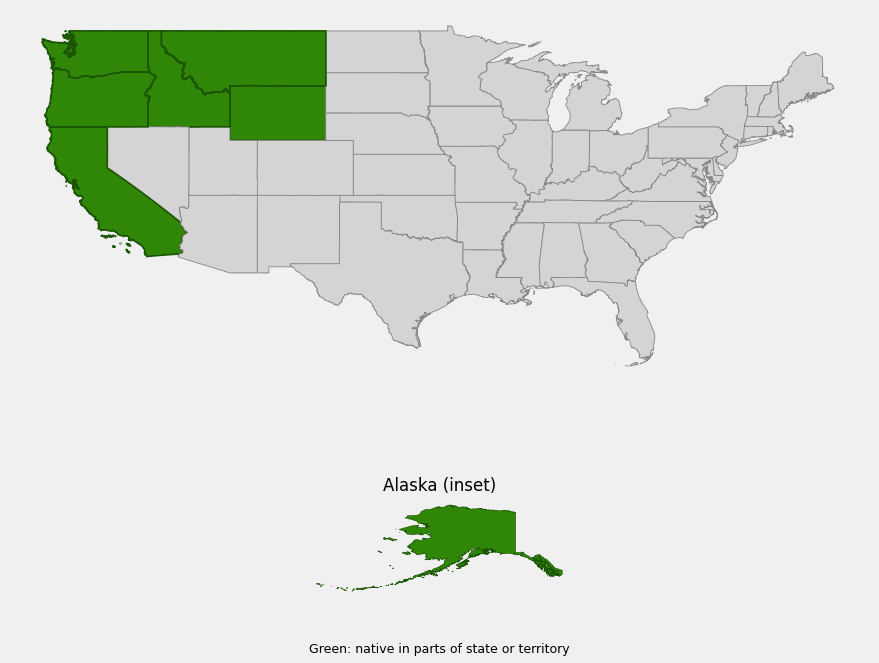
Mountain lady’s-slipper is native to western North America. USDA PLANTS lists it in Alaska, California, Idaho, Montana, Oregon, Washington and Wyoming, and in Alberta, British Columbia and Saskatchewan in Canada. The Alaska records are in the southeast of the state, at the northern edge of its range.
In California it grows in the Klamath Mountains, the northern Coast Ranges, the Cascades and the Sierra Nevada. In Oregon and Washington it occurs on both sides of the Cascades, with many populations east of the crest and in the Siskiyous, Blue Mountains and northeastern Washington. It is widespread in the mountains of northern and central Idaho and western Montana, and reaches northwestern Wyoming.
It grows in dry to moist conifer and mixed forests, open woodlands, forest edges and brushy slopes, often under Douglas-fir, ponderosa pine or grand fir, and sometimes on old disturbed ground such as road cuts. Its elevation range runs from near sea level in the north to about 7,000 feet.
📋 Regional plant lists featuring Mountain Lady’s-slipper: Idaho, Eastern Oregon & Eastern Washington · Montana & Wyoming · Alaska · Western Oregon & Western Washington · California & Nevada
Growing & Care Guide
Mountain lady’s-slipper is a challenging plant for experienced gardeners in cool, western climates. Buy only nursery-propagated plants (laboratory-raised from seed) from reputable orchid or native plant growers, and never dig plants from the wild or buy plants of unknown origin, since many have been collected illegally or unsustainably and rarely survive transplanting.
Light
Give it bright, dappled shade or morning sun with afternoon shade, similar to the open conifer forest where it grows.
Soil & Water
It needs a loose, very well-drained mix rich in leaf mold or conifer duff, often with grit or pumice added. Keep it evenly moist in spring while it is growing and flowering, then let it become drier in late summer, as in its native forests. Waterlogged soil and summer heat with wet soil quickly kill it.
Planting Tips
Plant nursery-propagated rhizomes in fall or early spring with the buds just below the surface, and mark the spot. Mulch with conifer needles or leaf litter. Choose a spot sheltered from slugs, foot traffic and competing roots, and avoid fertilizing heavily.
Pruning & Maintenance
Remove only dead foliage after it has withered. Protect emerging shoots from slugs and snails in spring. Undisturbed clumps improve over time; avoid moving or dividing them.
Propagation
Propagation from seed requires sterile laboratory culture and takes years, which is why legitimately propagated plants are expensive. Established clumps can occasionally be divided by experienced growers. Never collect plants or seed capsules from the wild.
Landscape Uses
- Woodland and shade gardens: a showpiece orchid for cool western gardens, from nursery-propagated stock only
- Native plant collections: a signature native orchid for experienced growers
- Forest wildflower viewing: one of the most admired spring wildflowers of western conifer forests
- Habitat stewardship: an indicator of intact, little-disturbed forest understory
- Nature photography: its striking flowers are a favorite subject for wildflower photographers
Wildlife & Ecological Value
Mountain lady’s-slipper is part of a web of relationships with insects and soil fungi in western forests, and healthy populations are a sign of an undisturbed understory.
For Pollinators
Like other lady’s-slippers, it offers no nectar reward. Bees, mainly small native bees, are drawn by scent and color and enter the pouch, then must climb out past the stigma and anthers, picking up or depositing pollen as they go. Fruit set is often low, and many flowers never form capsules.
For Birds
It has little direct food value for birds, but it grows in forest habitats rich in birdlife.
For Mammals
Deer, elk and other browsers sometimes eat the leaves and flowers, and heavy browsing can reduce flowering in some populations.
Ecosystem Role
It relies on mycorrhizal fungi for germination and early growth, and adult plants continue to associate with these fungi. That dependence on intact soil communities is one reason wild plants rarely survive being moved.
Cultural & Historical Uses
The species was first collected by the Scottish botanist David Douglas during his travels in the Pacific Northwest in the 1820s and was formally described by John Lindley. The genus name Cypripedium comes from Greek words meaning “Venus’s slipper”, and montanum means “of the mountains”.
Lady’s-slippers have long been prized by collectors, and many wild populations across North America were reduced by digging. Today, mountain lady’s-slipper is considered uncommon or rare in parts of its range, and land managers in several western states track and protect known populations. On public lands, collecting plants is generally prohibited.
For hikers in the northern Rockies and the eastern Cascades, finding a clump of mountain lady’s-slipper in bloom along a forest trail in June is a memorable event. Enjoy and photograph it in place, and stay on the trail to avoid trampling plants or compacting the soil around them.
Frequently Asked Questions
Can I dig up a mountain lady’s-slipper and move it to my garden?
No. Wild plants depend on specific soil fungi and almost always die after transplanting, and digging them damages wild populations and is often illegal on public land. Buy only nursery-propagated plants from reputable growers.
Where does mountain lady’s-slipper grow?
It grows in conifer and mixed forests from California north through Oregon, Washington, Idaho, Montana and Wyoming to British Columbia, Alberta and southeastern Alaska.
When does mountain lady’s-slipper bloom?
It blooms from May to July, earlier at low elevations and later in the mountains and farther north.
Is mountain lady’s-slipper fragrant?
Yes. The flowers have a sweet, vanilla-like fragrance, which helps attract the bees that pollinate them.
Is mountain lady’s-slipper hard to grow?
Yes. It needs cool conditions, partial shade, a well-drained humus-rich soil and steady spring moisture, and even experienced growers find it challenging. Laboratory-raised plants are the only responsible source.

Looking for a nursery that carries Mountain Lady’s-slipper?
Browse our native plant nursery directory: Alaska · California · Idaho · Montana · Oregon · Washington · Wyoming

