
Touristplant (Dimorphocarpa wislizeni)
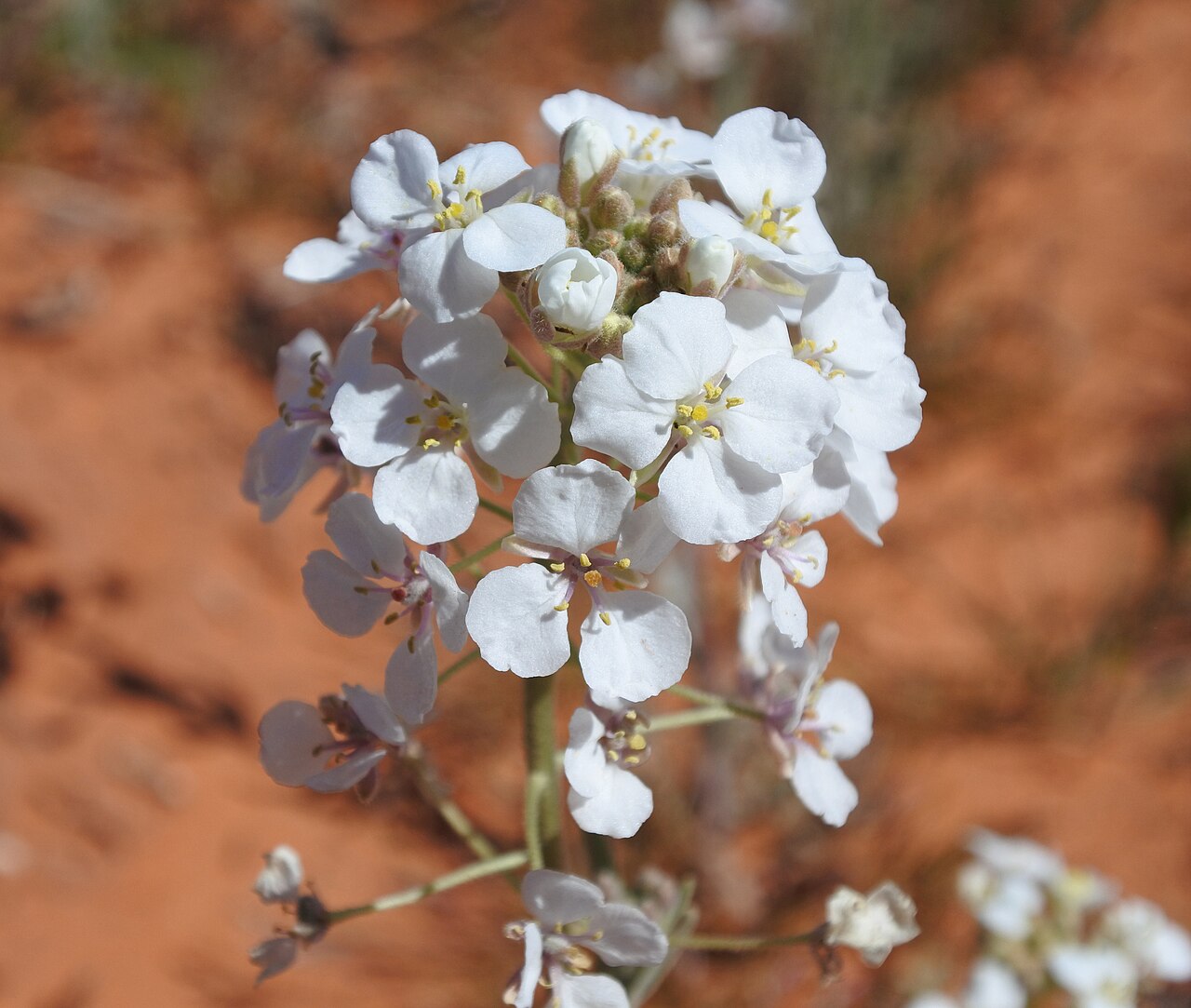
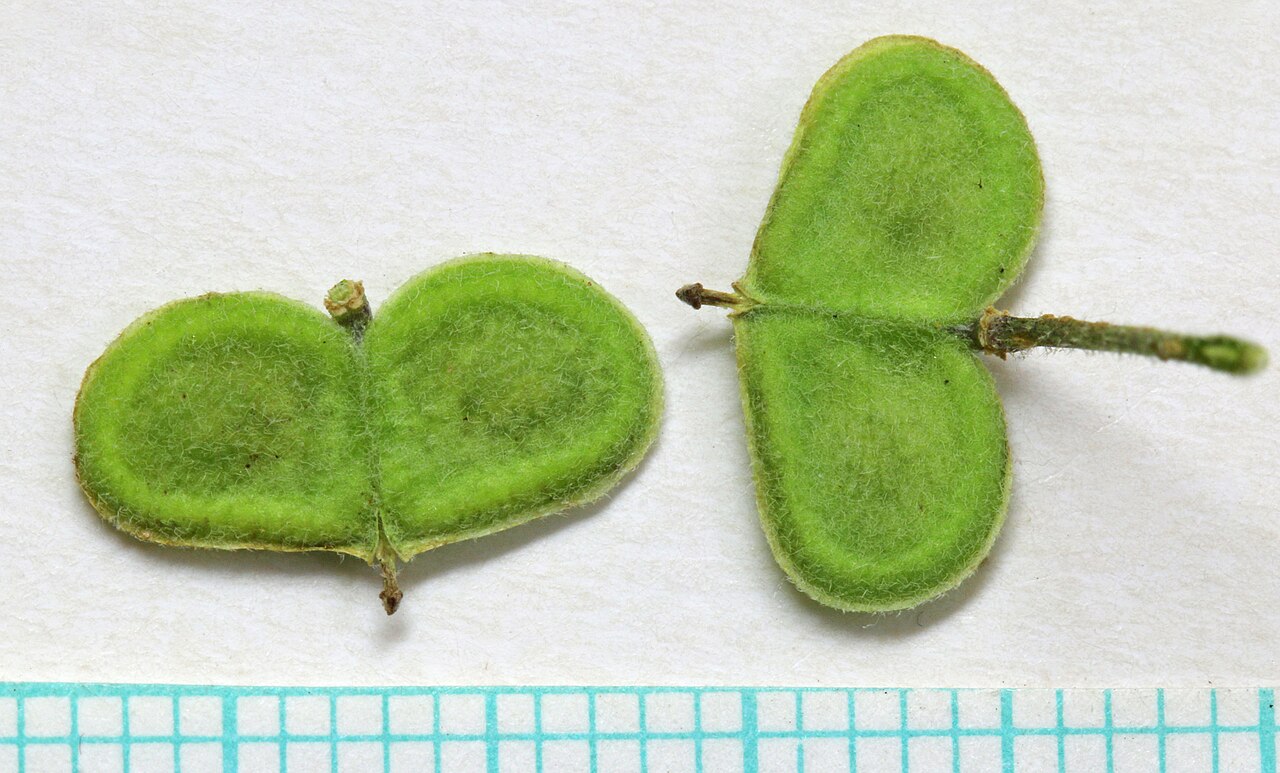
Dimorphocarpa wislizeni, known as Touristplant or spectacle pod, is an annual or short-lived wildflower of the desert Southwest in the mustard family (Brassicaceae). It forms grayish, hairy plants 6 inches to 2 feet tall with wavy-lobed leaves and dense, rounded clusters of fragrant, white to pale lavender, four-petaled flowers. Its most memorable feature is its fruit: a flat, two-lobed pod that looks like a tiny pair of spectacles.
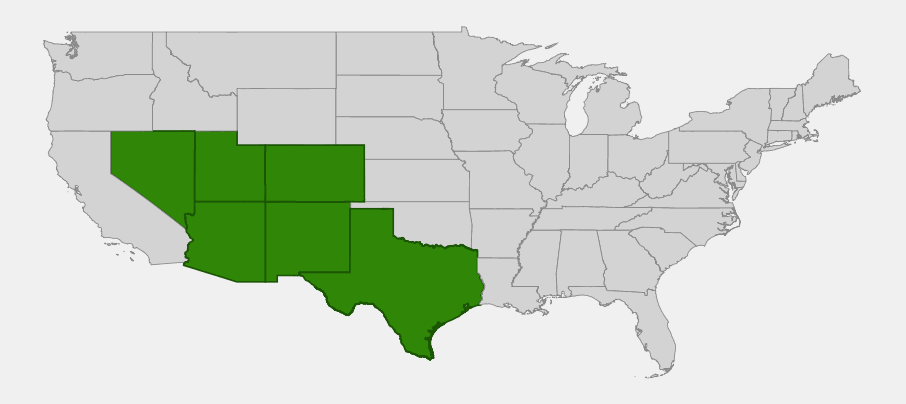
Touristplant grows from southern Nevada, Utah and western Colorado south through Arizona and New Mexico to western Texas and northern Mexico. It is a plant of deep sand: dunes, sandy washes, plains, desert grasslands and the sandy soils of pinyon-juniper country, usually below about 7,000 feet. After wet winters it can carpet sandy roadsides and dunes with white flowers in spring.
For gardeners in the arid Southwest, touristplant is an easy wildflower to sow on sandy, sunny ground. It needs no care, attracts small bees and butterflies, and reseeds itself in good years. It was long known as Dithyrea wislizeni, a name still used in many references.
Identification
Look for a grayish, hairy mustard on sand with lance-shaped, wavy-toothed leaves, a rounded cluster of white four-petaled flowers, and flat, paired, round pods like little eyeglasses below the flowers.
Growth Habit
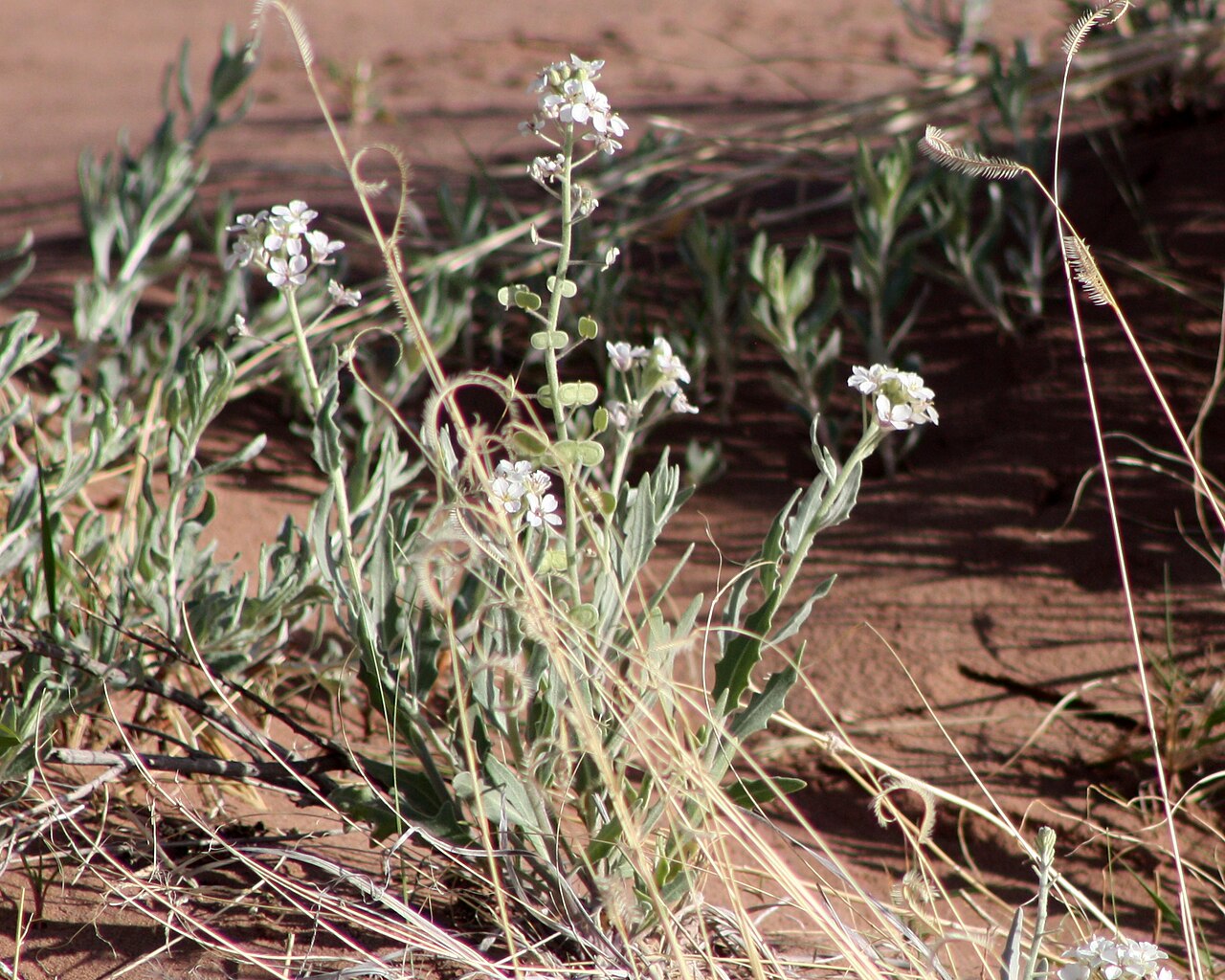
Touristplant is an annual or biennial (sometimes a short-lived perennial) with one to several upright or spreading stems, 6 to 24 inches tall. The whole plant is covered with fine, branched (star-shaped) hairs that give it a soft, gray-green look.
Leaves
The leaves are alternate, lance-shaped to oblong, 1 to 4 inches long, with wavy, toothed or shallowly lobed edges. The lower leaves are larger and more deeply lobed, and the upper ones become smaller and less toothed.
Flowers
The flowers grow in dense, rounded racemes at the ends of the stems that lengthen as the pods form. Each flower is about 1/2 inch across, with four white to pale lavender petals and a sweet scent. It blooms mainly from February to June, and again after summer rains in some years.
Fruit
The fruit is a flattened, two-lobed silicle about 1/2 inch wide, with two round, hairy halves joined at the middle, each containing a single seed. The pods are arranged along the stem below the flowers and turn tan as they dry.
Look-alikes
Other spectacle pods (Dimorphocarpa species) are very similar and are told apart by technical details of the hairs and pods. Bladderpods (Physaria) have yellow flowers and round, inflated pods. Peppergrasses (Lepidium) have much smaller flowers and small, round, notched pods. Sand verbenas such as desert sand verbena share its sandy habitat but have pink, trumpet-shaped flowers.
Quick Facts
| Scientific Name | Dimorphocarpa wislizeni |
| Family | Brassicaceae (mustard family) |
| Plant Type | Annual or biennial wildflower |
| Mature Height | 6–24 in |
| Mature Spread | 6–18 in |
| Growth Rate | Fast |
| Sun Exposure | Full sun to light shade |
| Water Needs | Very low; dry, sandy soil |
| Soil Type | Deep, well-drained sand or sandy loam |
| Soil pH | About 6.5–8.5 |
| Bloom Time | February–June; sometimes again after summer rains |
| Flower Color | White to pale lavender |
| Fall Color | Not applicable; dies after setting seed |
| Fruit | Flat, two-lobed “spectacle” pods |
| Deer Resistant | Moderately |
| USDA Hardiness Zones | 5–9 (grown as an annual) |
Native Range
Touristplant is native to the southwestern United States and northern Mexico. USDA PLANTS lists it from six states: Nevada, Utah, Colorado, Arizona, New Mexico and Texas. In Mexico it grows in the northern states, including Chihuahua and Sonora.
It is common across much of Arizona and New Mexico, on the Colorado Plateau of southern Utah and western Colorado, in southern Nevada, and in the Trans-Pecos and western Texas. It is especially abundant on the sand sheets and dunes of the Chihuahuan Desert, the Colorado Plateau and the lower Rio Grande valley of New Mexico.
Its habitat is deep sand: dunes, sandy plains, washes, desert grasslands, shrublands and open pinyon-juniper woodland, from about 2,000 to 7,000 feet. It often colonizes disturbed sandy soils along roads and trails, which may be one reason it is so noticeable to travelers.
📋 Regional plant lists featuring Touristplant: Arizona & New Mexico · Utah & Western Colorado · California & Nevada · South & West Texas
Growing & Care Guide
Touristplant is an easy wildflower for sandy, sunny sites in the Southwest. It is grown from seed and generally needs no care once it germinates.
Light
Full sun is best. It tolerates light shade but becomes leggy there.
Soil & Water
It needs deep, loose, well-drained sand or sandy loam. It grows on winter and spring rains and needs no irrigation in its native range. Too much water or heavy soil causes rot and weak, floppy plants.
Planting Tips
Scatter seed on bare, sandy soil in fall or early winter, so winter rains can trigger germination. Press the seed lightly into the surface; do not bury it deeply. It combines well with desert marigold, globemallows, sand verbenas and penstemons.
Pruning & Maintenance
Little care is needed. Cutting off the first flower clusters encourages side branches and a longer bloom. Leave some plants to set seed if you want it to return next year, then pull the dry plants in summer.
Propagation
Grow it from seed, which germinates after cool-season rains. Store dry seed in a cool place and sow it in fall or winter. It reseeds itself in sandy gardens in wet years.
Landscape Uses
- Desert wildflower gardens: fragrant white flowers in late winter and spring
- Sandy sites and dunes: thrives in loose sand where few plants grow
- Pollinator plantings: early nectar for small bees and butterflies
- Wildflower seed mixes: for southwestern meadows and roadsides
- Children’s gardens: the spectacle-shaped pods are fun to find
Wildlife & Ecological Value
Touristplant is an important early-season flower in the sandy deserts of the Southwest.
For Pollinators
Its fragrant flowers attract small native bees, flies, beetles and butterflies. Wild mustards like touristplant are larval host plants for white, marble and orangetip butterflies.
For Birds
Seed-eating birds such as sparrows, quail and doves eat its seeds.
For Mammals
Rodents eat the seeds and pods, and rabbits and other herbivores browse the young plants.
Ecosystem Role
As a fast-growing annual of sand, it helps stabilize loose sand after rains, and it supports desert food webs in spring when few other plants are active.
Cultural & Historical Uses
The genus name Dimorphocarpa means “two-shaped fruit.” The species is named for Frederick Adolph Wislizenus, a German-born physician and naturalist who explored New Mexico and northern Mexico in 1846 and collected many plants new to science. The older name Dithyrea means “two shields,” for the paired lobes of the pod.
The name “touristplant” is unusual, and its origin is not certain. One common explanation is that the plant is noticed by travelers because it blooms so conspicuously on sandy roadsides across the Southwest.
Spectacle pods are a favorite of desert wildflower watchers and photographers, and the dry pods are sometimes used in dried flower arrangements.
Frequently Asked Questions
Why is it called spectacle pod?
Its flat, two-lobed pods look like a tiny pair of eyeglasses (spectacles).
Is touristplant an annual?
It is usually an annual or biennial, though some plants live a few years. It grows from seed after cool-season rains.
When does touristplant bloom?
Mainly from February to June, and sometimes again after summer rains.
Where does touristplant grow?
On sand dunes, sandy plains, washes and desert grasslands in Arizona, New Mexico, Utah, Nevada, western Colorado, western Texas and northern Mexico.
Can I grow touristplant in my garden?
Yes, if you have sunny, sandy, well-drained soil in the Southwest. Sow seed in fall or winter and let it reseed.

Looking for a nursery that carries Touristplant?
Browse our native plant nursery directory: Arizona · Colorado · Nevada & New Mexico · Texas & Utah

