
Pinkfairies (Clarkia pulchella)
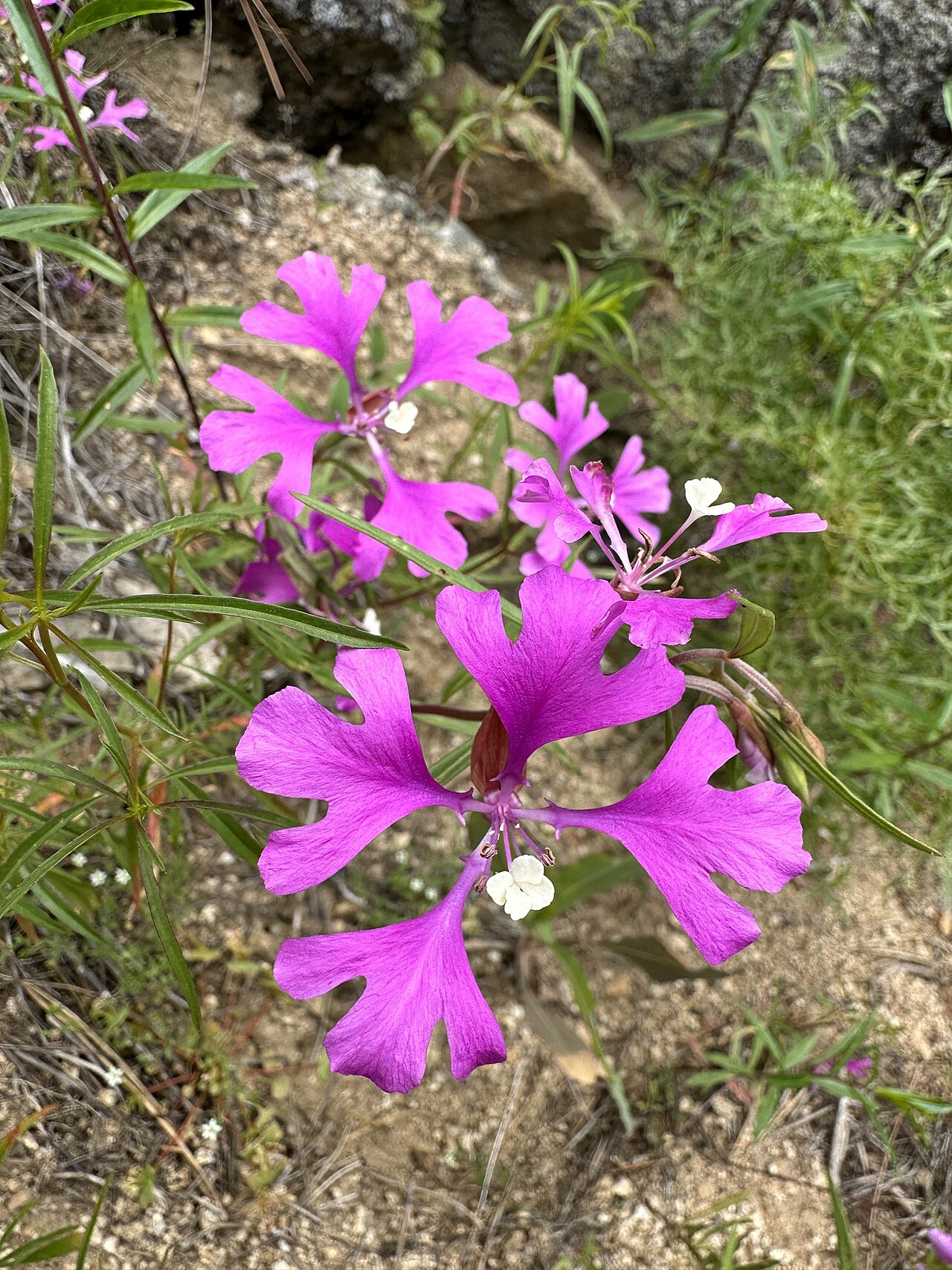
Clarkia pulchella, known as Pinkfairies (USDA: pinkfairies; also called large-flower clarkia, ragged robin and deerhorn clarkia), is a native annual wildflower in the evening primrose family (Onagraceae). It grows 4 to 20 inches tall and in late spring and early summer bears striking rose-pink to lavender flowers about 1 1/2 inches across, each of the four petals deeply cut into three lobes like a tiny antler.
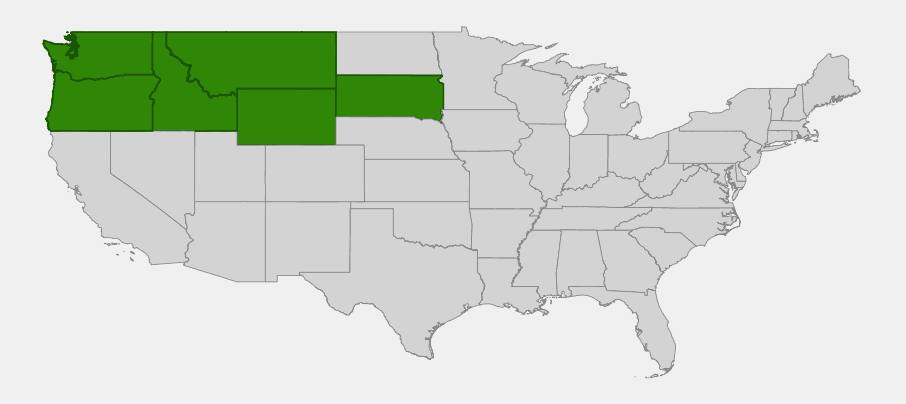
It is native to the interior Pacific Northwest, mainly east of the Cascade Range in Washington and Oregon, across Idaho and into western Montana and southern British Columbia. USDA PLANTS also has outlying records from Wyoming and South Dakota. It grows on dry, open slopes, rocky outcrops, grasslands and openings in ponderosa pine and Douglas-fir forests.
Pinkfairies is a botanical celebrity: Meriwether Lewis collected it in Idaho in 1806 during the Lewis and Clark Expedition, and the genus Clarkia was named for William Clark. It is an easy annual to grow from seed in dry, sunny gardens, where it feeds native bees, and it has been grown in European gardens since the 1820s.
Identification
No other wildflower in the interior Northwest has flowers quite like pinkfairies. The three-lobed, antler-like petals, with the middle lobe widest, are diagnostic.
Growth Habit & Stems
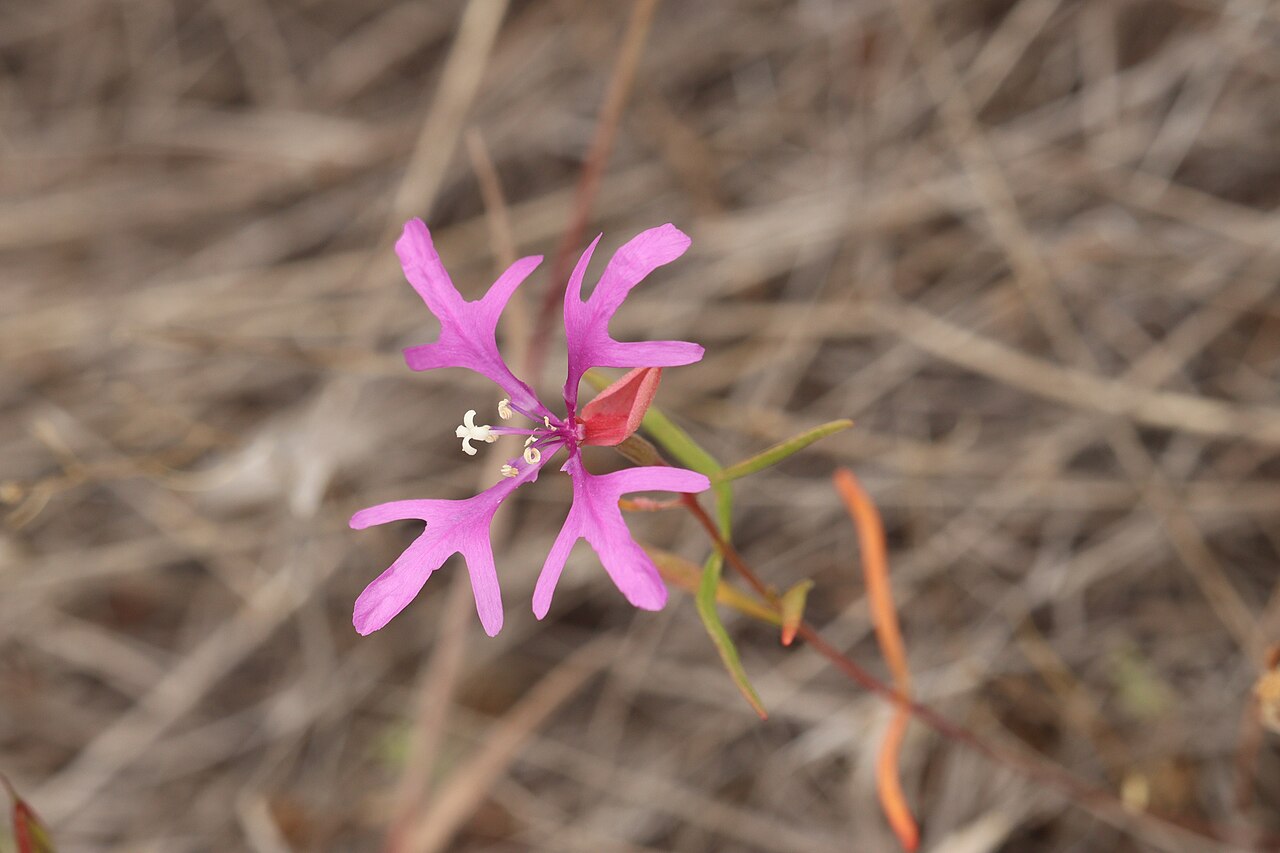
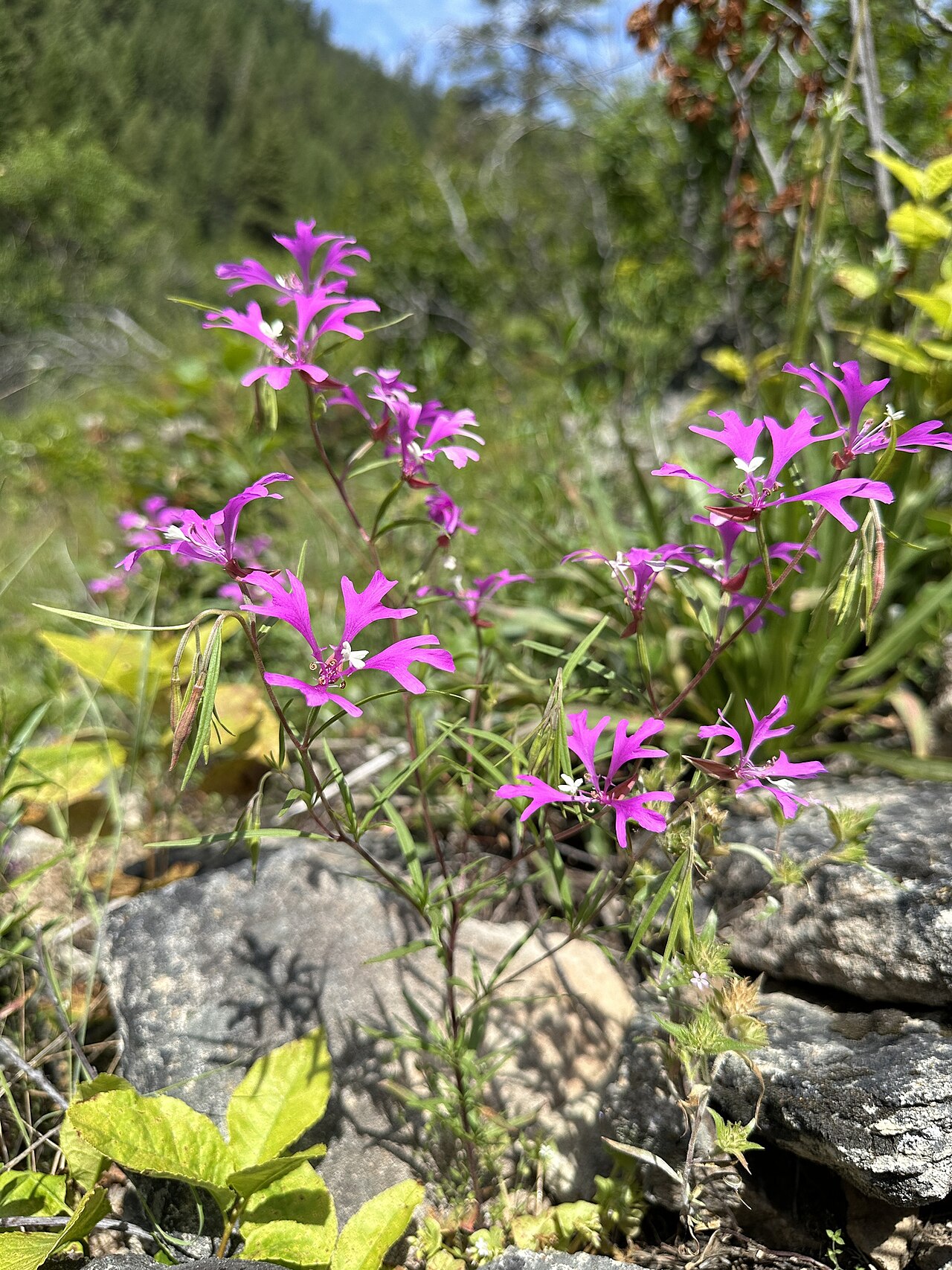
An erect annual, usually 4 to 20 inches tall, with a simple or few-branched, reddish stem covered in short hairs. The tips of the flowering stems often nod in bud and straighten as the flowers open.
Leaves
The leaves are alternate, linear to narrowly lance-shaped, about 1 to 3 inches long, smooth-edged or with a few small teeth. Small clusters of leaves often grow in the leaf axils.
Flowers
Flowers appear from about May to July, opening one after another up the stem. Each flower is 1 to 1 1/2 inches across, with four rose-pink to lavender (rarely white) petals on narrow stalks (claws). Each petal is deeply divided into three spreading lobes, the middle one widest. There are four longer stamens and four short ones, and the white stigma has four lobes that look like a tiny flower in the center.
Fruit
The fruit is a slender, four-sided capsule about 1/2 to 1 inch long that splits open in summer to release many small brown seeds.
Look-alikes
Other clarkias, such as Farewell-to-Spring (Clarkia amoena) and Winecup Clarkia (C. purpurea), have undivided, fan-shaped petals. Elegant Clarkia (C. unguiculata) has diamond-shaped petals on long claws but no three-lobed tips. Red Ribbons (C. concinna) has three-lobed petals too, but it grows in California, and its fan-shaped petals are redder.
Name Note
The name “ragged robin” is also used for the European campion Silene flos-cuculi (formerly Lychnis flos-cuculi), a garden plant and weed with similarly ragged pink petals. To avoid confusion, use pinkfairies or the scientific name.
Quick Facts
| Scientific Name | Clarkia pulchella Pursh |
| Family | Onagraceae (evening primrose family) |
| Plant Type | Annual wildflower |
| Mature Height | 4–20 in |
| Mature Spread | 6–12 in |
| Growth Rate | Fast (germinates in fall or spring, blooms in late spring) |
| Sun Exposure | Full sun to partial shade |
| Water Needs | Low; spring moisture, dry summers |
| Soil Type | Well-drained sandy, gravelly or rocky soil |
| Soil pH | About 6.0–7.5 |
| Bloom Time | May–July |
| Flower Color | Rose-pink to lavender (rarely white) |
| Fall Color | Not applicable (annual) |
| Fruit | Slender four-sided capsule with many small seeds |
| Deer Resistant | Moderately; occasionally browsed |
| USDA Hardiness Zones | Annual; grows wherever summers are dry, native to zones 4–8 |
Native Range
Pinkfairies is a wildflower of the interior Pacific Northwest. Its core range runs from the east slope of the Cascades in Washington and Oregon across the Columbia Basin foothills and the Blue Mountains to Idaho and western Montana, and north into southern British Columbia. It is common in northern and central Idaho, where Lewis first collected it.
USDA PLANTS also has records from Wyoming and South Dakota, which are outlying records at the eastern edge of the range. Records from Connecticut, Massachusetts, Ohio and Vermont reflect plants escaped from gardens, where it has been grown as an ornamental annual since the 1800s, and are not shown on our native range map.
It grows on dry, open slopes and ridges, in rocky grasslands and sagebrush steppe edges, on cliffs and outcrops, and in openings in ponderosa pine, Douglas-fir and mixed conifer forests, from about 1,000 to 6,000 feet, and is most common from about 2,000 to 5,000 feet.
📋 Regional plant lists featuring Pinkfairies: Idaho, Eastern Oregon & Eastern Washington · Montana & Wyoming · North Dakota, South Dakota & Western Minnesota
Growing & Care Guide
Pinkfairies is one of the easiest native annuals to grow from seed in dry, sunny gardens in the interior West. Sow it once, let it reseed, and it will return each spring in open, well-drained spots.
Light
Full sun gives the most flowers. It also tolerates light or partial shade, as in open pine woods, where plants grow a little taller and bloom less.
Soil & Water
Give it well-drained sandy, gravelly or rocky soil that is moist in spring and dry in summer. It does not need fertilizer; rich soil and summer watering make it lanky and short-lived. In the wild, plants germinate after fall or spring rains and finish blooming as the soil dries.
Planting Tips
Sow seed directly where you want it to grow, in fall (best in cold-winter areas) or very early spring, scattering it on raked soil and pressing it in lightly. Thin seedlings to about 6 inches apart. It does not transplant well because of its delicate roots. Combine it with native bunchgrasses and spring wildflowers in a meadow or rock garden.
Pruning & Maintenance
Little care is needed. Let plants set seed before removing them in midsummer so they can reseed. Keep weeds and aggressive grasses from crowding seedlings in their first spring.
Propagation
Grow only from seed. Collect capsules as they turn tan in summer and store the seeds dry until sowing. Seed germinates readily in cool, moist soil.
Landscape Uses
- Dry meadow and steppe gardens: a bright annual among native bunchgrasses and spring wildflowers
- Rock gardens: thrives in gravelly, fast-draining soil
- Pollinator gardens: attracts native bees, including clarkia specialist bees
- Ponderosa pine woodland edges: naturalizes in sunny openings
- Historic and Lewis and Clark gardens: a living link to the expedition’s botanical discoveries
Wildlife & Ecological Value
Pinkfairies brightens dry slopes in early summer and supports native bees, including some that specialize on clarkias.
For Pollinators
The flowers are visited mostly by native bees, including specialist bees that gather pollen mainly from clarkias and their relatives, along with bumble bees, flies and butterflies.
For Birds
Small seed-eating birds such as finches and sparrows pick seeds from the opened capsules and from the ground in late summer.
For Mammals
Deer and elk occasionally browse the plants, and rodents gather the seeds.
Ecosystem Role
As an annual that comes up from seed in open, disturbed and rocky ground, pinkfairies quickly fills gaps after fire or soil disturbance. Its pollination biology has made it a classic subject for research on how plant populations at the edge of a species’ range adapt and persist.
Cultural & Historical Uses
On June 1, 1806, while the Lewis and Clark Expedition was camped near present-day Kamiah, Idaho, Meriwether Lewis wrote a long, careful description of “a singular plant” with pale purple, three-lobed petals, and he pressed a specimen. That specimen, now at the Academy of Natural Sciences in Philadelphia, became the basis for the species.
The botanist Frederick Pursh named the plant Clarkia pulchella in 1813, creating the genus Clarkia in honor of William Clark. Pulchella means “beautiful” or “pretty little.” Pinkfairies is the type species of the genus, which now includes about 40 species, most of them in California.
Seeds reached Britain in the 1820s through the plant collector David Douglas, and pinkfairies quickly became a popular garden annual in Europe. It is still sold in seed catalogs today, sometimes in double-flowered or white forms.
Frequently Asked Questions
Is pinkfairies an annual or a perennial?
It is an annual. Plants grow from seed in fall or spring, bloom from about May to July, set seed and die by late summer.
Why is it called Clarkia?
The genus was named for William Clark of the Lewis and Clark Expedition. Meriwether Lewis collected this species in Idaho in 1806, and Frederick Pursh named it in 1813.
Where does pinkfairies grow?
Mainly east of the Cascades in Washington and Oregon, across Idaho and western Montana, and in southern British Columbia, on dry, open slopes and in pine forest openings.
How do I grow pinkfairies from seed?
Sow seed directly in fall or very early spring on well-drained, sunny ground, press it lightly into the soil and keep it moist until seedlings appear. Avoid transplanting.
Is pinkfairies the same as ragged robin?
“Ragged robin” is an old name for pinkfairies, but it more often refers to Silene flos-cuculi, a European campion. Use pinkfairies or Clarkia pulchella to be clear.

Looking for a nursery that carries Pinkfairies?
Browse our native plant nursery directory: Idaho · Montana · Oregon · South Dakota · Washington · Wyoming

