
Slimleaf Pawpaw (Asimina angustifolia)
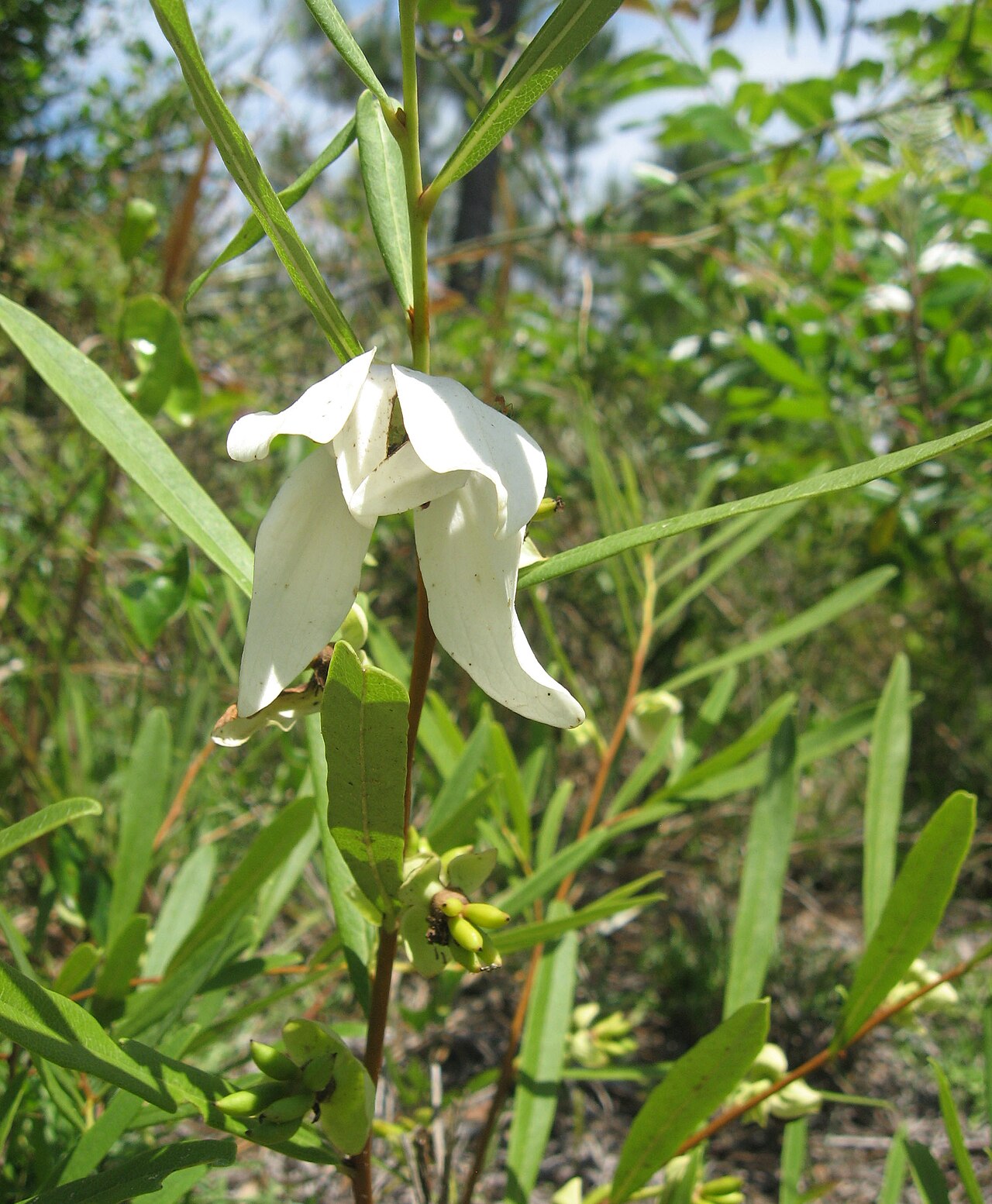
Asimina angustifolia, known as Slimleaf Pawpaw (also polecat bush and, in many references, Asimina longifolia), is a low native shrub of the sandy pinelands of the Deep South. It usually grows 1 to 3 feet tall, occasionally to about 5 feet, with long, strap-like leaves and large, nodding, creamy-white flowers that appear in spring and early summer. It belongs to the custard-apple family (Annonaceae), the same family as the familiar tree Paw Paw, and like its relatives it is a host plant for the zebra swallowtail butterfly.
The species name angustifolia means “narrow-leaved,” and the leaves are what set this pawpaw apart. They are often 4 to 8 inches long but less than an inch wide, so a non-flowering clump in wiregrass can look almost grass-like. The flowers are among the showiest in the genus, with three long, white outer petals that hang like a loose bell and three short inner petals stained maroon or purple at the base. They have a faint fruity or musky scent, and the old name polecat bush hints at the stronger odor of the crushed leaves.
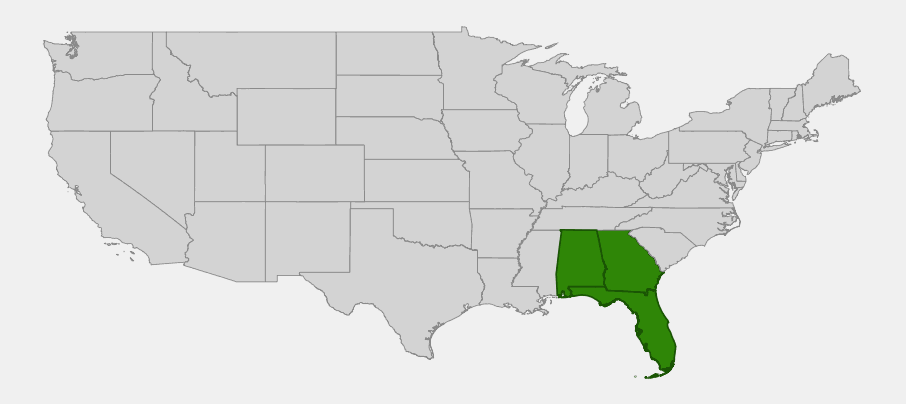
Slimleaf pawpaw grows in longleaf pine sandhills, dry flatwoods and scrubby pinelands across north and central Florida, southern Georgia and southeastern Alabama. It is a fire-adapted plant that resprouts from a deep, woody root after burns. This guide covers how to identify it, where it grows, how to grow it in a sandy native landscape, and its value to butterflies and wildlife.
Identification
The Southeast has several shrubby pawpaws, and they can be hard to tell apart without flowers. Slimleaf pawpaw is the narrowest-leaved of them, with long, linear to narrowly spoon-shaped leaves, flowers that arise from the new shoots of the season, and white outer petals much longer than the maroon-based inner petals.
Stems & Roots
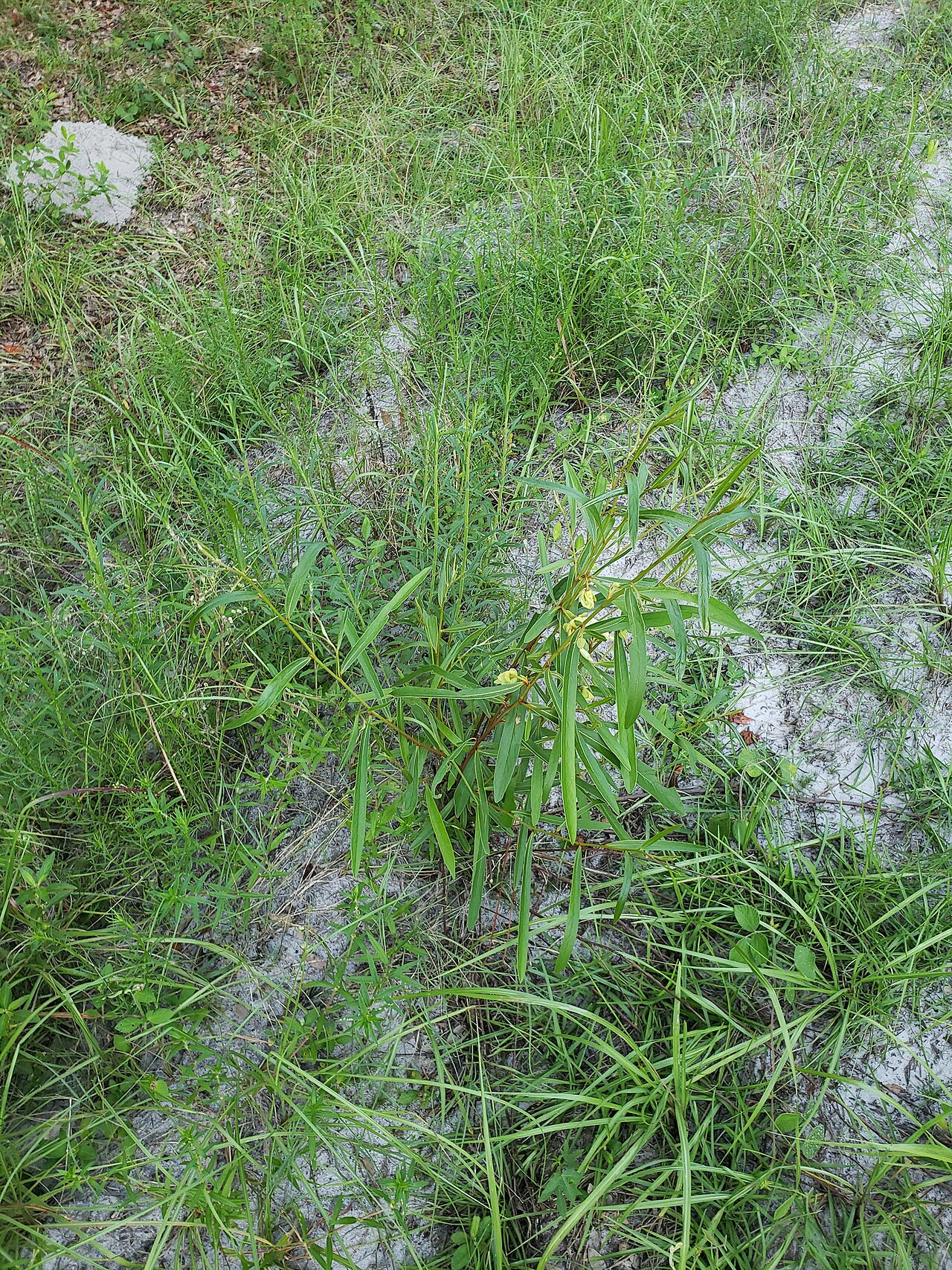
Slimleaf pawpaw is a small, sparsely branched deciduous shrub, usually 1 to 3 feet tall and occasionally taller. Several upright stems often rise from a long, deep, woody root, and plants can slowly form small clumps. Young twigs are reddish-brown and finely hairy at first, becoming smooth with age. After fire or cutting it resprouts readily from the root crown.
Leaves
The leaves are alternate, simple and entire, typically 3 to 8 inches long and only about ¼ to ¾ inch wide, linear to narrowly oblanceolate, with a prominent pale midrib. Plants of the variety formerly called spatulata have somewhat broader, spoon-shaped leaves. The leaves are thick, leathery and slightly bluish-green, and they emerge with or just after the first flowers in spring. They turn yellow before dropping in fall, and crushed leaves have a strong, unpleasant odor.
Flowers
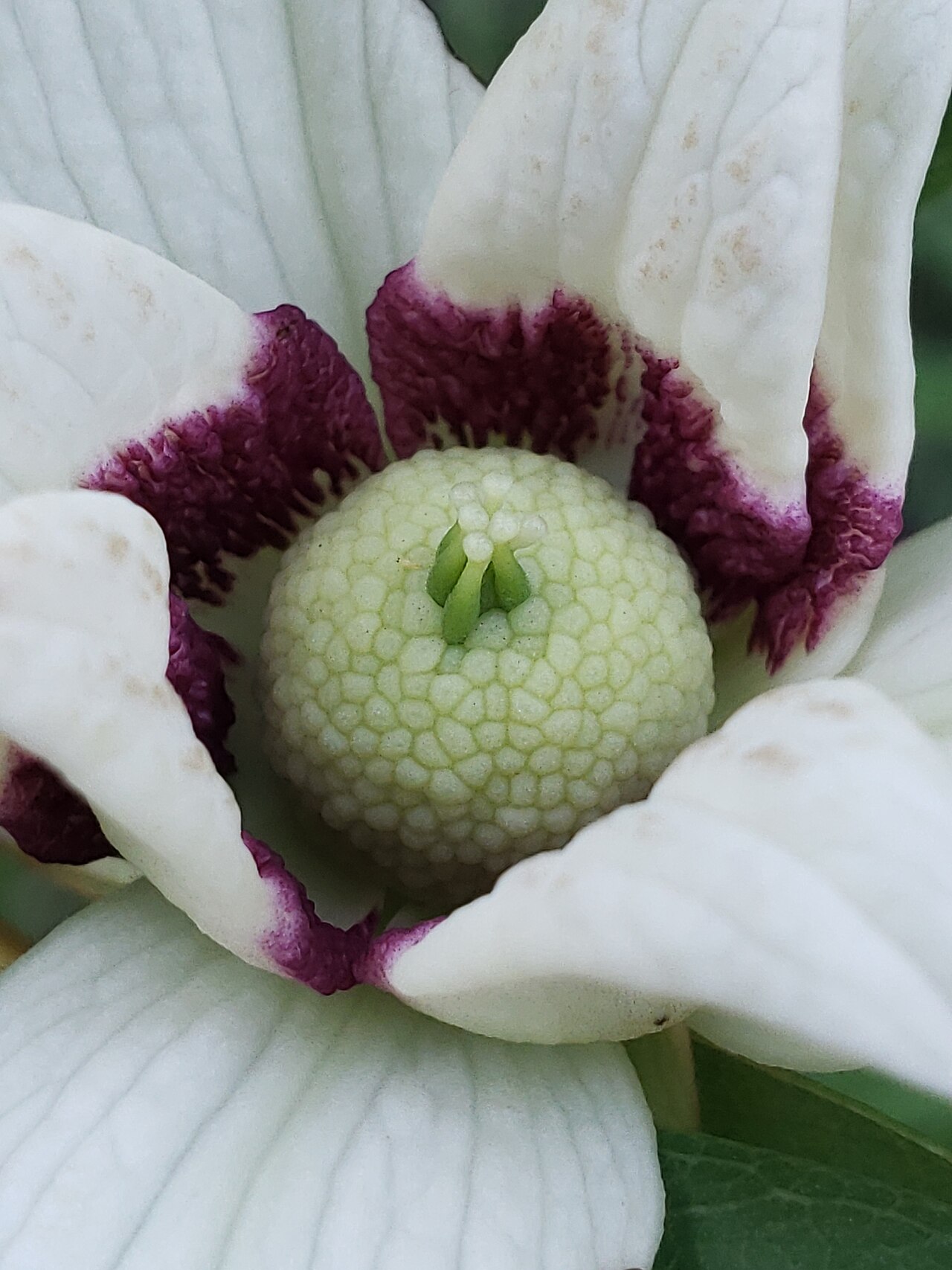
The flowers grow singly or in small groups from the leaf axils of the new season’s shoots, nodding on short stalks. The three outer petals are white to cream, 1½ to about 3 inches long, narrow and slightly curved, forming a loose, hanging bell. The three inner petals are much shorter and fleshy, white with a deep maroon to purple zone at the base. In the center is a green, button-like cluster of many stamens around a few pistils. The main bloom is from April to June, and plants may flower again after a fire.
Fruit & Seeds
Pollinated flowers develop into one or a few oblong, fleshy berries, about 2 to 4 inches long, that ripen from green to yellowish-green in summer. The soft, fragrant pulp is edible and tastes like a small, mild version of the common pawpaw, though it contains several large, flattened brown seeds. Fruits are produced sparingly in most years and are quickly taken by wildlife.
Quick Facts
| Scientific Name | Asimina angustifolia (syn. A. longifolia) |
| Family | Annonaceae (custard-apple family) |
| Plant Type | Low deciduous shrub |
| Mature Height | 1–3 ft (occasionally to about 5 ft) |
| Mature Spread | 1–3 ft; slowly forms small clumps |
| Growth Rate | Slow |
| Sun Exposure | Full sun to light shade |
| Water Needs | Low; drought tolerant once established |
| Soil Type | Deep, well-drained sand; dry to mesic sandy loam |
| Soil pH | About 4.5–6.5 (acidic) |
| Bloom Time | April–June (sometimes again after fire) |
| Flower Color | White to cream; inner petals maroon at the base |
| Fall Color | Yellow |
| Fruit | Oblong yellow-green berry, edible pulp, large seeds |
| Deer Resistant | Yes; foliage is rarely browsed |
| USDA Hardiness Zones | 8–10 |
Native Range
Slimleaf pawpaw is a southeastern Coastal Plain endemic. USDA PLANTS and the Lady Bird Johnson Wildflower Center record it as native in Alabama, Florida and Georgia, and the Atlas of Florida Plants lists it as native to Florida. Some references extend the broad-leaved form northward along the Coastal Plain, but the core of the range is north and central Florida, southern Georgia and southeastern Alabama.
In Florida it is most common in the northern counties and the central peninsula, in the sandhills and dry pinelands of the Panhandle, the Big Bend and the central ridges. In Georgia it occurs on the sandy Coastal Plain, and in Alabama it reaches the sandhills and pinelands of the southeastern corner of the state. It is a lowland plant, growing from near sea level to a few hundred feet.
Slimleaf pawpaw grows on deep, dry, acidic sands: longleaf pine and turkey oak sandhills, dry pine flatwoods, scrubby flatwoods and open, sandy pine-oak woods. It depends on frequent fire to keep these habitats open, and it is most abundant where prescribed burning or natural fires still maintain a grassy groundcover of wiregrass and wildflowers.
📋 Regional plant lists featuring Slimleaf Pawpaw: North & South Florida · Alabama, Georgia & Mississippi
Growing & Care Guide
Slimleaf pawpaw is a specialty plant for sandy, sunny native gardens in Florida and the coastal Southeast. It is slow to establish and dislikes being moved because of its long taproot, but once settled it is long-lived, drought tolerant and nearly carefree. Buy container-grown plants from native nurseries rather than digging plants from the wild, which rarely succeeds.
Light
Plant it in full sun or light, filtered shade under open pines. In dense shade it survives but flowers and fruits poorly.
Soil & Water
It needs deep, well-drained, acidic sand or sandy loam, the kind of soil found in sandhills and dry flatwoods. Avoid heavy clay, poorly drained sites and rich, amended beds. Water regularly during the first growing season while the root establishes, then only in severe drought. Do not fertilize.
Planting Tips
Plant small container-grown specimens, since the taproot makes larger plants hard to establish. Handle the root ball gently. Good places include sandhill and pineland gardens, dry borders with wiregrass and other native grasses, and butterfly gardens where zebra swallowtails can find it. Planting several near one another may improve fruit set, since pawpaw flowers often need pollen from another plant.
Pruning & Maintenance
Little pruning is needed. Remove dead stems in late winter. In the wild, fire periodically burns the tops back, and the plant resprouts vigorously; in a garden, cutting old stems to the ground every few years in late winter can mimic this. Leave the caterpillars alone: zebra swallowtail larvae eat the leaves but rarely harm established plants.
Propagation
Propagation is mainly from fresh seed. Clean the seeds from ripe fruit and sow them right away, or keep them moist and cool, because pawpaw seed loses viability if it dries out. Germination is slow and may take months, and seedlings grow slowly as they develop their taproot. Wild plants should not be dug; they rarely survive transplanting.
Landscape Uses
- Butterfly gardens: a larval host plant for the zebra swallowtail in sandy Southeastern gardens
- Sandhill and pineland gardens: a natural companion for wiregrass, longleaf pine and sandhill wildflowers
- Pine savanna restoration: used in longleaf pine and sandhill restoration within its native range
- Dry, sandy borders: drought-tolerant, low shrub for poor, well-drained soils
- Native fruit and wildlife plantings: small edible fruits for wildlife and curious gardeners
Wildlife & Ecological Value
Slimleaf pawpaw is a modest shrub, but it plays an important role in the ecology of Southeastern pinelands, especially for butterflies.
For Pollinators
Pawpaw flowers are pollinated mainly by beetles and flies, which are attracted by their color and faint, fruity scent. Small beetles crawl into the nodding flowers to feed on pollen and floral tissue. The flowers also provide early-season pollen for small native bees. Like all pawpaws, slimleaf pawpaw is a larval host for the zebra swallowtail (Eurytides marcellus), whose caterpillars feed only on Asimina, and for the pawpaw sphinx moth.
For Birds
Birds eat the ripe fruit when they can find it, but most fruits are eaten by mammals first. The shrub provides low cover for ground-nesting birds such as Bachman’s sparrow and northern bobwhite in open pinelands.
For Mammals
Gopher tortoises, box turtles, raccoons, opossums, foxes and other animals eat the fallen fruit and help disperse the large seeds. The bitter foliage is seldom browsed by deer.
Ecosystem Role
Slimleaf pawpaw is part of the diverse, fire-maintained groundcover of longleaf pine ecosystems. Its deep, woody root survives frequent fires, and it resprouts and often flowers vigorously after a burn. Where fire is excluded and shrubs and hardwoods take over, it declines along with the grasses and wildflowers it grows with.
Cultural & Historical Uses
The species was named by Constantine Rafinesque in the early nineteenth century, and the same plant was later described again under other names, including Asimina longifolia. As a result, the names A. angustifolia and A. longifolia are both widely used: USDA PLANTS and the Atlas of Florida Plants use A. angustifolia, while some manuals and websites still use A. longifolia, with the broader-leaved plants separated as var. spatulata. The group is still in need of taxonomic study.
The genus name Asimina comes from assimin, a Native American name for the pawpaw that was recorded by early French colonists. The common name polecat bush refers to the strong, skunky smell of the crushed leaves and twigs, a trait shared by several pawpaws.
Slimleaf pawpaw fruits are small and produced sparingly, so they have never been a significant food, but they were eaten when found. Safety note: pawpaw seeds, leaves and bark contain acetogenins, compounds that can cause nausea and vomiting; eat only the ripe pulp, never the seeds or skin, and some people react to the fruit or get a rash from handling the plants. Today the plant is valued mostly by butterfly gardeners and by land managers restoring longleaf pine sandhills.
Frequently Asked Questions
Is slimleaf pawpaw the same as Asimina longifolia?
Yes, in most current treatments. USDA PLANTS and the Atlas of Florida Plants use the name Asimina angustifolia, and A. longifolia is treated as a synonym. Many gardeners and nurseries still use A. longifolia.
Is slimleaf pawpaw fruit edible?
The ripe pulp is edible and tastes like a small, mild pawpaw, but fruits are small and scarce. Do not eat the seeds or skin, which contain compounds that can cause stomach upset, and try only a small amount the first time.
Does slimleaf pawpaw attract butterflies?
Yes. It is a host plant for the zebra swallowtail, whose caterpillars feed only on pawpaws. Females look for the tender young leaves in spring and summer.
Can I transplant slimleaf pawpaw from the wild?
No. Its long taproot makes it almost impossible to dig successfully, and taking plants damages wild populations. Buy nursery-grown plants or grow it from fresh seed.
How is slimleaf pawpaw different from other dwarf pawpaws?
Its leaves are much narrower and longer than those of Woolly Pawpaw, Netted Pawpaw or Dwarf Pawpaw Woolly and netted pawpaws also flower from the previous year’s wood, often before their leaves expand, while slimleaf pawpaw flowers on the new leafy shoots.

Looking for a nursery that carries Slimleaf Pawpaw?
Browse our native plant nursery directory: Alabama · Florida & Georgia

