
Southern Bayberry (Morella caroliniensis)
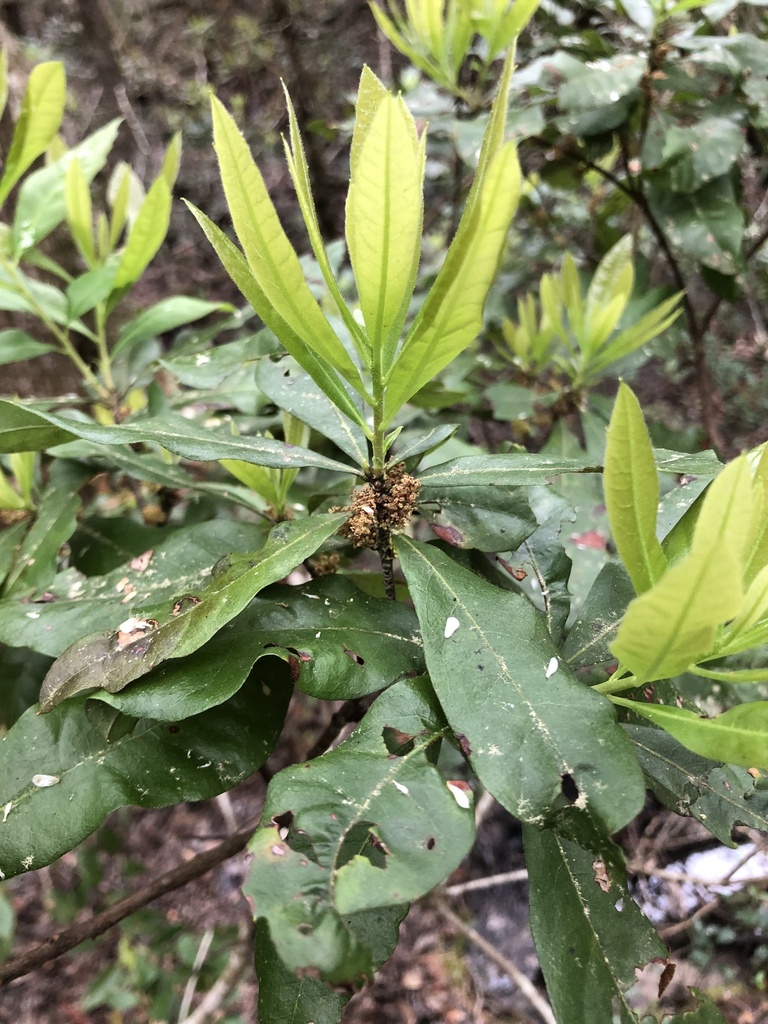
Morella caroliniensis, the Southern Bayberry, also called evergreen bayberry, is an aromatic shrub of bogs, pocosins and wet pinelands on the Atlantic and Gulf Coastal Plain. It belongs to the bayberry family (Myricaceae) and is a close relative of wax myrtle. Older books and many nurseries list it as Myrica caroliniensis or Myrica heterophylla; both USDA PLANTS and the Atlas of Florida Plants now use Morella caroliniensis.
Southern bayberry looks like a larger-leaved, less dense wax myrtle. Its broad, leathery leaves smell spicy when crushed, and in spring short catkins appear along the twigs. Female plants carry clusters of round, bumpy fruits coated in gray-white wax, the same wax that colonists once boiled off bayberries to make fragrant candles. The fruits stay on the branches into winter, when they feed yellow-rumped warblers, tree swallows and other birds.
Southern bayberry is easily confused with two other species that have their own pages on this site: Wax Myrtle (Myrica cerifera), a larger, denser shrub of drier as well as wet sites, and Northern Bayberry (Myrica pensylvanica), a deciduous shrub of the Northeast and Great Lakes. This guide explains how to tell them apart, where southern bayberry grows, and how to use it in wet, acid gardens.
Identification
Bayberries are told apart mainly by their leaves and fruit. Southern bayberry has the broadest leaves and the largest fruit of the three eastern evergreen and semi-evergreen species, and it is a plant of wetter, more acid ground than wax myrtle.
Growth Habit
Southern bayberry is a multi-stemmed shrub, usually 3 to 8 feet tall and occasionally up to about 12 feet. It spreads by underground runners into open colonies. It is less dense and less tree-like than wax myrtle, which often reaches 15 to 25 feet. The bark is smooth and gray, and young twigs are often hairy and dotted with resin glands.
Leaves
The leaves are alternate, leathery, evergreen to semi-evergreen, generally 2 to 4 inches long and ¾ to 1½ inches wide, broadest above the middle and tapering to the base. The margins are smooth or have a few coarse teeth toward the tip. The upper surface is dark green with few or no visible glands, while the underside is paler with scattered amber resin dots. Wax myrtle leaves are narrower and densely dotted with glands on both surfaces. Crushed leaves have a pleasant, spicy bayberry scent.
Flowers
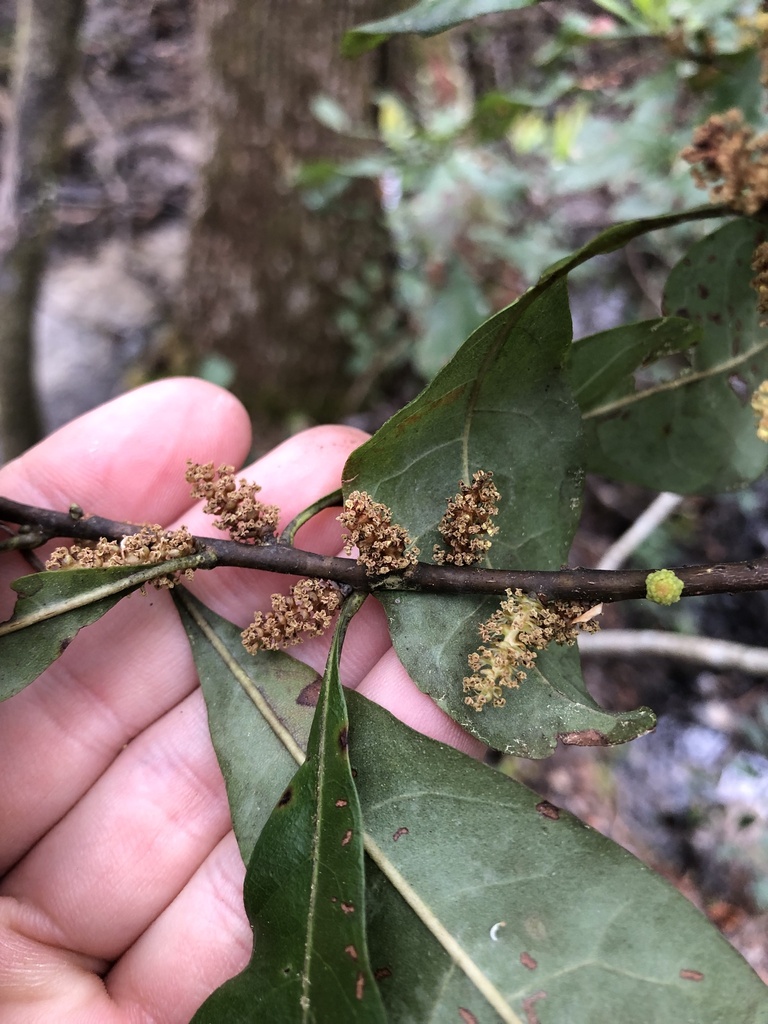
The plants are dioecious: males and females are separate plants. Both produce small, petal-less flowers in short catkins about ½ inch long, along the twigs of the previous year, from late winter to spring (often March to May, earlier in Florida). The flowers are wind-pollinated and inconspicuous.
Fruit
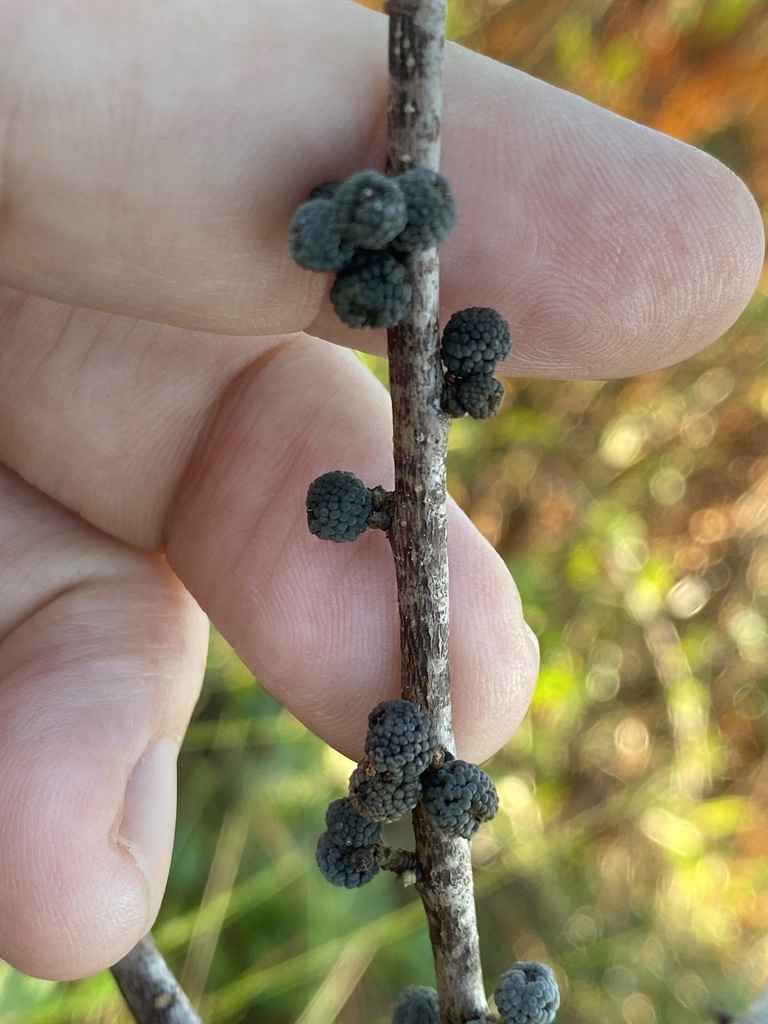
Female plants produce round drupes about 3.5 to 5.5 mm across, larger than wax myrtle’s 2 to 3.5 mm fruits. Their bumpy, black surface is coated with gray-white to bluish wax. They ripen in late summer and fall and persist on the twigs through winter.
Quick Facts
| Scientific Name | Morella caroliniensis (syn. Myrica caroliniensis, Myrica heterophylla) |
| Family | Myricaceae (bayberry family) |
| Plant Type | Evergreen to semi-evergreen shrub |
| Mature Height | 3–8 ft (occasionally to about 12 ft) |
| Mature Spread | 4–8 ft; spreads by runners |
| Growth Rate | Moderate |
| Sun Exposure | Full sun to part shade |
| Water Needs | High; moist to wet soils |
| Soil Type | Acid sands, peaty soils, clay and loam |
| Soil pH | About 4.0–6.0 (acid) |
| Bloom Time | March–May (catkins) |
| Flower Color | Yellowish-green to brown catkins |
| Fall Color | None; evergreen or partly evergreen |
| Fruit | Waxy gray-white drupes on female plants, fall–winter |
| Deer Resistant | Yes; aromatic foliage is rarely browsed |
| USDA Hardiness Zones | 7–9 |
Native Range
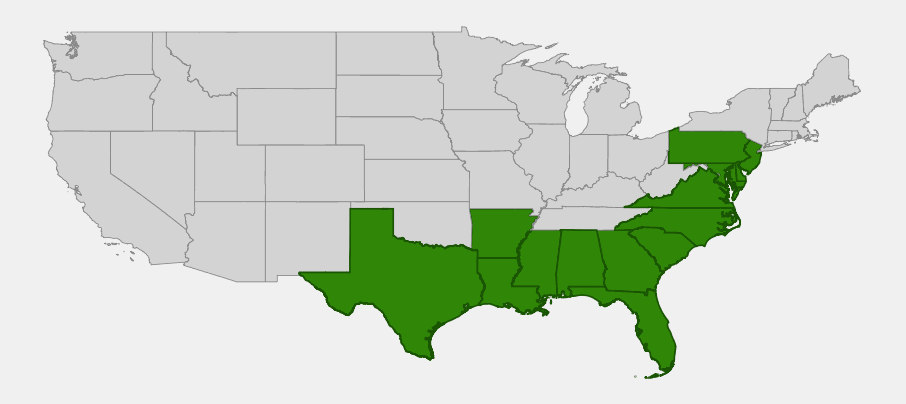
Southern bayberry is a plant of the Atlantic and Gulf Coastal Plain. USDA PLANTS lists it as native to Alabama, Arkansas, Delaware, Florida, Georgia, Louisiana, Maryland, Mississippi, New Jersey, North Carolina, Pennsylvania, South Carolina, Texas and Virginia. Its range runs from the New Jersey Pine Barrens south along the coastal plain to Florida, and west along the Gulf to Louisiana, southern Arkansas and eastern Texas.
It is most common in the Carolinas and along the Gulf Coast, where pocosins, bay swamps and wet pine savannas provide plenty of habitat. In Florida it occurs mainly in the Panhandle and the northern part of the state. In the north, records are few and local, and some northern specimens once called Myrica caroliniensis are now treated as northern bayberry, so the northern edge of its range is not sharply defined.
Its typical habitats are acid wetlands: pocosins and bay forests, bogs and seepage slopes, wet pine flatwoods and savannas, and the edges of swamps and ponds. Like many Coastal Plain shrubs it is adapted to fire and resprouts quickly from its roots and runners after burning.
📋 Regional plant lists featuring Southern Bayberry: North & South Florida · Alabama, Georgia & Mississippi · North & South Carolina · Maryland, Virginia & West Virginia · Arkansas, Louisiana, Eastern Oklahoma & Eastern Texas · New York, Pennsylvania & Northern New Jersey · Delaware, Southern New Jersey & Long Island
Growing & Care Guide
Southern bayberry is an adaptable, low-maintenance shrub for wet, acid soils where many ornamentals fail. It is less common in nurseries than wax myrtle, but native plant nurseries in the Southeast sometimes offer it, often as Myrica caroliniensis or Myrica heterophylla.
Light
It grows in full sun to part shade. Plants in sun are denser and fruit more heavily. In shade they become open and leggy.
Soil & Water
Southern bayberry prefers moist to wet, acid soil and tolerates seasonal flooding, poorly drained clay and nutrient-poor sands. Like other bayberries it has root nodules with nitrogen-fixing bacteria (Frankia), so it needs no fertilizer and can grow in very infertile soil. Once established it tolerates short dry periods, but it is not as drought tolerant as wax myrtle.
Planting Tips
Plant in fall or winter. To get fruit, you need at least one female plant and a male plant nearby. Nurseries rarely label plants by sex, so planting a small group raises the chances of both. Space plants 4 to 6 feet apart for a loose hedge or screen.
Pruning & Maintenance
It needs little pruning. Remove suckers if you want to limit spread, or let them fill in for a naturalistic thicket. Old, leggy plants can be cut back hard in late winter and will resprout from the base.
Propagation
Grow from seed: rub off the wax, then cold-stratify the seeds for about two to three months before sowing. Germination may be slow and uneven. Suckers can be dug and replanted in winter, and softwood cuttings sometimes root under mist.
Landscape Uses
- Wet and acid sites: low spots, rain gardens, and pond and ditch edges
- Informal hedges and screens: an aromatic, mostly evergreen screen smaller than wax myrtle
- Wildlife gardens: winter fruit for warblers, swallows and other birds
- Pocosin and wet savanna restoration: within its native Coastal Plain range
- Poor soils: nitrogen-fixing roots allow it to grow in very infertile sand
Wildlife & Ecological Value
Bayberries are some of the most important winter bird foods along the Atlantic and Gulf coasts. The fat-rich wax that coats their fruit is hard for most birds to digest, but a few species are specialists that can live on it for weeks.
For Pollinators
The flowers are wind-pollinated and offer little to pollinators, though bees sometimes collect pollen from the male catkins. Bayberries are larval host plants for several moths, and the aromatic foliage hosts a variety of other insects that feed birds in turn.
For Birds
The yellow-rumped warbler, once called the myrtle warbler, can digest bayberry wax and relies heavily on the fruit in winter. Tree swallows also eat bayberries during migration and winter along the coast, which lets them winter farther north than other swallows. Northern bobwhite, wild turkey, eastern bluebird, gray catbird and other birds also eat the fruit, and the dense shrubs give cover and nesting sites.
For Mammals
Because of its aromatic leaves, deer rarely browse it heavily. Small mammals use bayberry thickets for cover, and some eat fallen fruit.
Ecosystem Role
As a nitrogen-fixing shrub, southern bayberry adds nitrogen to nutrient-poor wetland soils. It is part of the shrub layer of pocosins and bay swamps, where it resprouts after fire and helps hold soil along streams and pond edges.
Cultural & Historical Uses
Philip Miller described this plant in 1768 as Myrica caroliniensis (the name is now typified by an illustration in Mark Catesby’s Natural History of Carolina). Constantine Rafinesque later named it Myrica heterophylla, and John Kunkel Small transferred it to Morella in 1903. For much of the twentieth century the name Myrica heterophylla was used for it, while some northern manuals applied Myrica caroliniensis to the northern bayberry. That history explains why the Atlas of Florida Plants lists “northern bayberry” among its common names, even though that name normally refers to Myrica pensylvanica.
In colonial America, settlers boiled bayberry and wax myrtle fruit and skimmed off the floating wax to make candles. Bayberry candles burn with little smoke and a pleasant scent, and they became a holiday tradition that continues today. It takes a large quantity of fruit to make a single candle.
Native Americans and early settlers used bayberry leaves, root bark and wax in folk medicine. These uses mostly involved wax myrtle and northern bayberry, which are more abundant, but southern bayberry has the same aromatic qualities.
Frequently Asked Questions
Is southern bayberry the same as wax myrtle?
No. They are close relatives. Southern bayberry has broader leaves with few glands on the upper surface, larger fruit, and usually grows only 3 to 8 feet tall in wet, acid sites. Wax myrtle has narrower, gland-dotted leaves, smaller fruit, and often grows into a large shrub or small tree on a wide range of soils.
Is southern bayberry the same as northern bayberry?
No. Northern bayberry (Myrica pensylvanica) is a mostly deciduous shrub of the Northeast and Great Lakes coast. Southern bayberry is a mostly evergreen shrub of the southeastern Coastal Plain. The two were sometimes confused because older manuals used the name Myrica caroliniensis for northern bayberry.
What is the correct scientific name?
USDA PLANTS and the Atlas of Florida Plants use Morella caroliniensis. You will also see Myrica caroliniensis and Myrica heterophylla in older books and nursery catalogs. All three refer to the same species.
Why doesn’t my bayberry have berries?
Only female plants produce fruit, and they need a male plant nearby for pollination. If your shrub never fruits, it may be a male, or there may be no male within range.
Can I make candles from southern bayberry?
Yes, in principle. Boiling the fruit in water releases the wax, which floats and can be skimmed off. It takes a large amount of fruit for a small amount of wax, so it is a project for patient gardeners with many female plants.

Looking for a nursery that carries Southern Bayberry?
Browse our native plant nursery directory: Alabama & Arkansas · Delaware, Florida & Georgia · Louisiana, Maryland & Mississippi · New Jersey & North Carolina · Pennsylvania, South Carolina, Texas & Virginia