
Swamp Agrimony (Agrimonia parviflora)
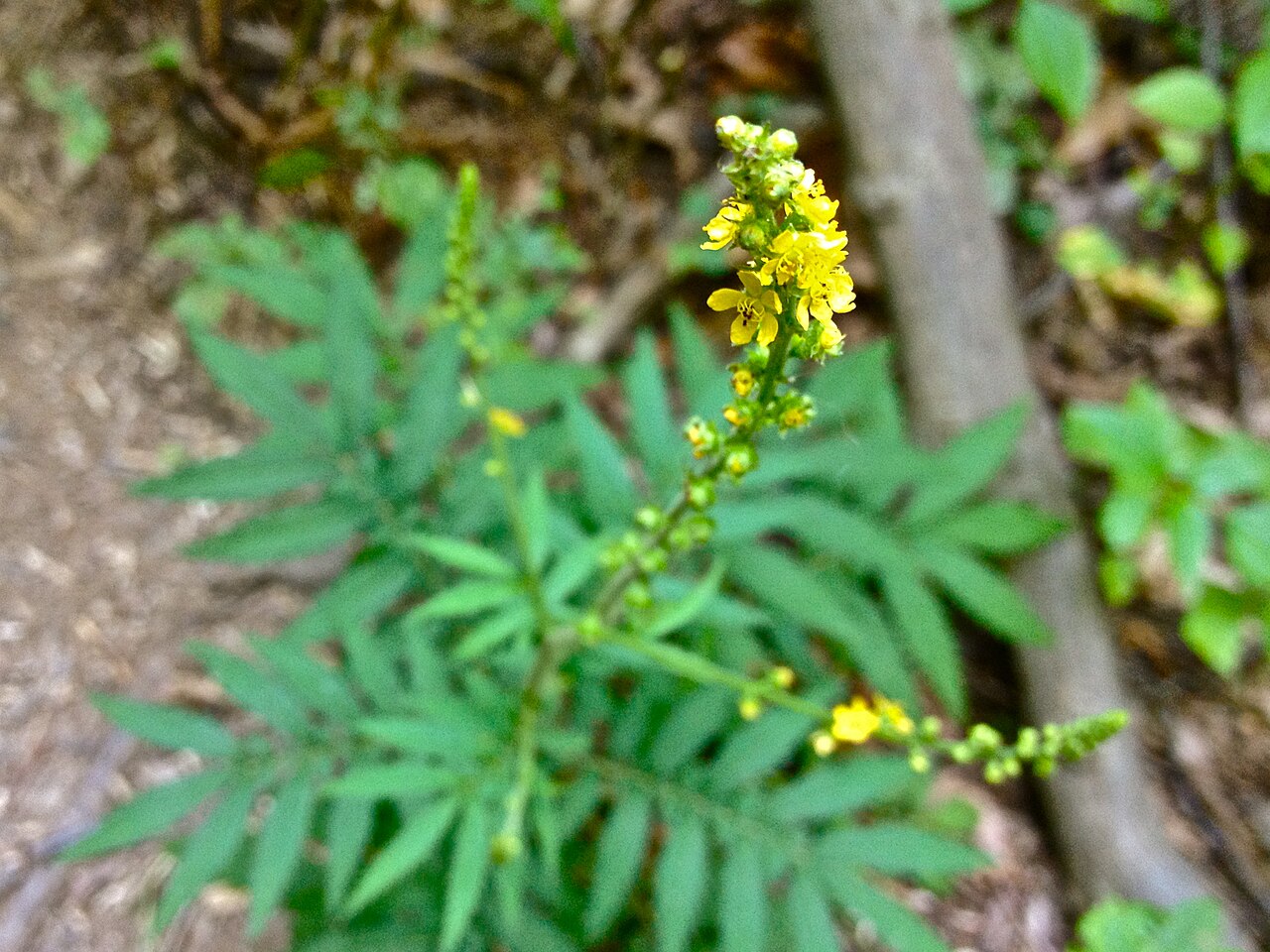
Agrimonia parviflora, known as Swamp Agrimony, harvestlice, many-flowered agrimony or southern agrimony, is a tall, leafy perennial of moist meadows, thickets and wet woodland edges in the eastern and central United States. It is easy to recognize by its large, feathery, compound leaves, which have more and narrower leaflets than any other agrimony, and its hairy stems. In mid to late summer, slender spikes of small, bright yellow, five-petaled flowers rise above the foliage.
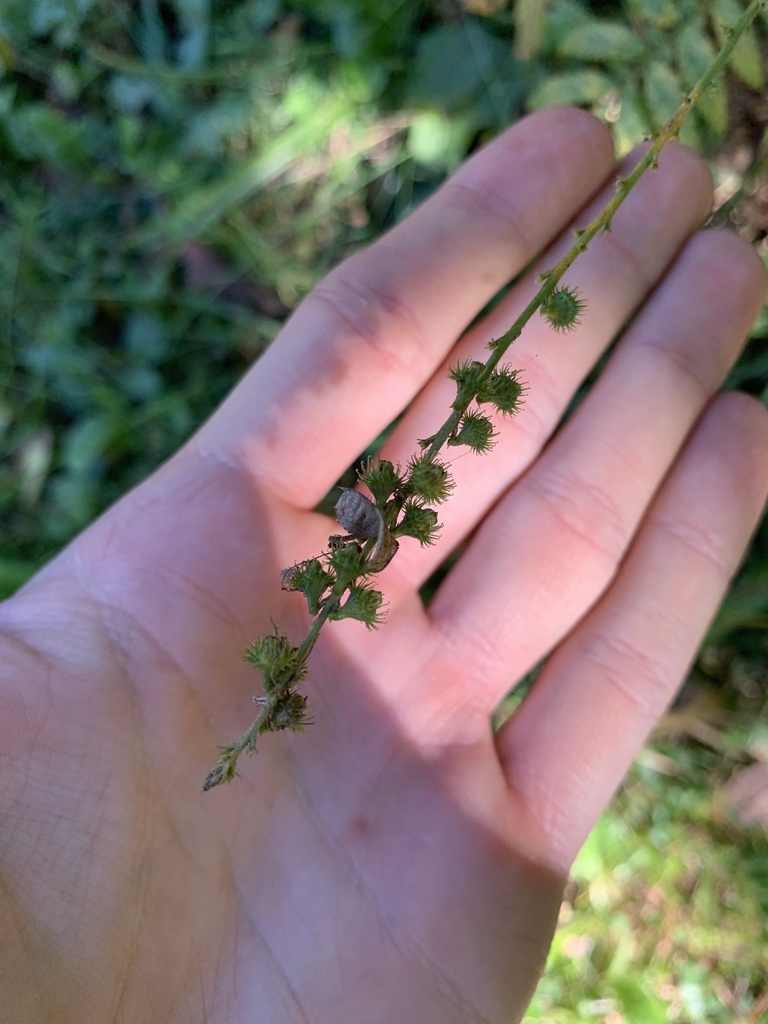
Swamp agrimony belongs to the rose family (Rosaceae). After flowering, each flower develops into a small, top-shaped bur ringed with hooked bristles. These burs catch on fur, feathers, socks and trouser legs, which is how the plant spreads its seeds and why farmers who walked through it at harvest time called it harvestlice. USDA PLANTS uses that name.
It is not a showy plant, but it is a dependable native for wet meadows, rain gardens and the edges of ponds and woods, with attractive, fern-like foliage and a long season of small yellow flowers for bees and flies. Gardeners should simply be aware of the burs and place it away from paths and pets with long coats.
Identification
Several agrimonies grow in eastern North America, and all have yellow flowers in spikes and burry fruits. Swamp agrimony stands out for its leaves, which are packed with many narrow leaflets, and its densely hairy stems.
Stems
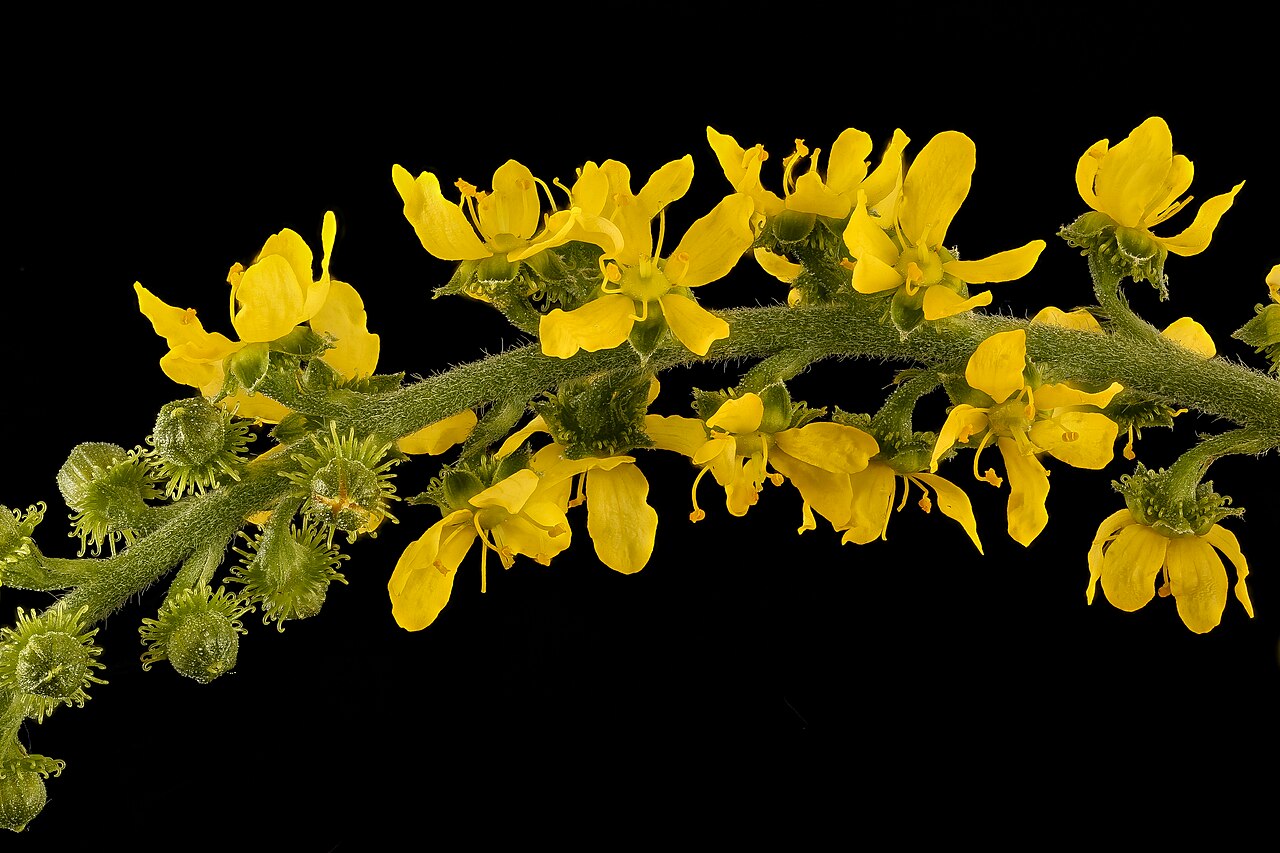
Plants grow from short rhizomes and fibrous roots, usually sending up one stem 2 to 6 feet tall that may branch near the top. The stem is densely covered with long, spreading, brownish hairs and shorter glandular hairs, giving it a shaggy look.
Leaves
The leaves are alternate and pinnately compound, up to about a foot long on the lower stem. Each leaf has roughly 11 to 23 main leaflets, more than other eastern agrimonies, with tiny leaflets in between them. The main leaflets are narrowly lance-shaped, about 1 to 3 inches long, sharply toothed, and covered underneath with small resin dots and soft hairs. The overall effect is a feathery, almost fern-like leaf. At the base of each leaf is a pair of leafy, toothed stipules.
Flowers
Flowers appear from about July to September on long, slender, spike-like racemes at the top of the stem and its branches. Each flower is about ¼ inch across, with five rounded, bright yellow petals and 5 to 15 stamens. They open a few at a time, from the bottom of the spike upward, so the spike can show buds, flowers and young burs together.
Fruit & Seeds
The fruit is a small, top-shaped cup (hypanthium) about ⅛ inch long, ribbed and topped by a ring of hooked bristles. It contains one or two seeds. The burs ripen in late summer and fall, turn brown, and detach easily to hitchhike on passing animals and people.
Similar Species
Tall agrimony (Agrimonia gryposepala) and woodland agrimony (A. striata) have only 5 to 9 broader main leaflets per leaf. Downy agrimony (A. pubescens) has softly hairy stems without long spreading hairs and fewer, broader leaflets. Small-flowered agrimony (A. microcarpa) of the Southeast is smaller, with few leaflets.
Quick Facts
| Scientific Name | Agrimonia parviflora Aiton |
| Family | Rosaceae (rose family) |
| Plant Type | Herbaceous perennial |
| Mature Height | 2–6 ft (usually 3–5 ft) |
| Mature Spread | 1–2 ft |
| Growth Rate | Moderate |
| Sun Exposure | Full sun to partial shade |
| Water Needs | Moderate to high; moist to wet soil |
| Soil Type | Moist loam, clay or alluvial soil |
| Soil pH | Slightly acidic to slightly alkaline (about 5.5–7.5) |
| Bloom Time | July–September |
| Flower Color | Bright yellow |
| Fall Color | Leaves may turn yellowish to reddish brown |
| Fruit | Small, top-shaped bur with hooked bristles |
| Deer Resistant | Moderately; the hairy foliage is not a preferred browse |
| USDA Hardiness Zones | 4–9 |
Native Range
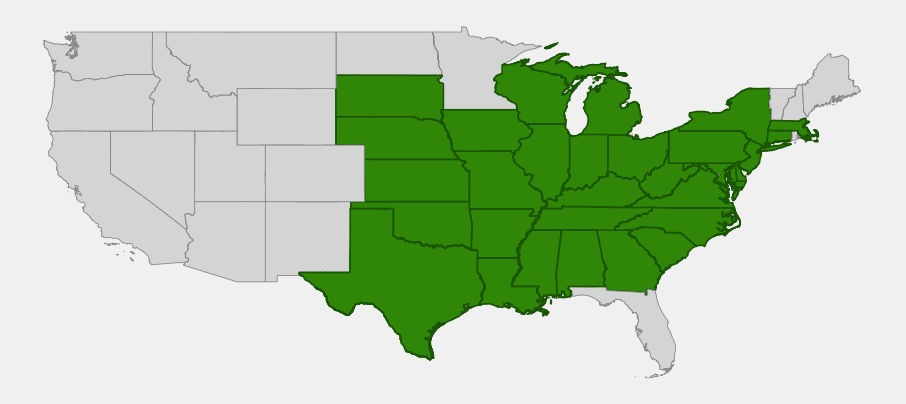
Swamp agrimony is native to the eastern and central United States and southern Ontario. USDA PLANTS lists it in 30 states, from Massachusetts, Connecticut and New York south to Georgia and west through the Ohio Valley and Great Lakes states to Wisconsin, Iowa, southeastern South Dakota, Nebraska, Kansas and Oklahoma, and south to Arkansas, Louisiana and eastern Texas.
It is most common in the Midwest and the Ohio and Mississippi valleys, especially in Illinois, Indiana, Ohio, Missouri, Kentucky and Tennessee, and it is frequent in the Mid-Atlantic Piedmont. It becomes uncommon toward the edges of its range, including New England, the Great Plains states, the Deep South and eastern Texas.
It grows in moist to wet meadows and prairies, swamp and marsh margins, wet thickets, floodplain forest openings, stream banks, ditches and wet roadsides. It is often found along the boundary between wetland and woodland, where it gets several hours of sun but stays moist.
📋 Regional plant lists featuring Swamp Agrimony: New York, Pennsylvania & Northern New Jersey · Ohio & Indiana · Michigan, Wisconsin & Eastern Minnesota · Kentucky & Tennessee · Nebraska, Kansas & Eastern Colorado · Connecticut, Massachusetts & Rhode Island · New Hampshire, Maine & Vermont · Maryland, Virginia & West Virginia · Delaware, Southern New Jersey & Long Island · Illinois, Iowa & Missouri · Alabama, Georgia & Mississippi · North & South Carolina · Arkansas, Louisiana, Eastern Oklahoma & Eastern Texas · North Dakota, South Dakota & Western Minnesota
Growing & Care Guide
Swamp agrimony is a low-maintenance native for moist, sunny to partly shaded places. It does not demand attention, and it blends well with other tall wetland and meadow wildflowers.
Light
Full sun to partial shade. It flowers best with at least half a day of sun, but it tolerates light shade along woodland edges.
Soil & Water
Give it moist to wet, fertile soil, such as loam, clay or rich alluvial soil. It tolerates short periods of flooding and also average garden soil that does not dry out completely. In dry, sandy soil it struggles.
Planting Tips
Plant container-grown plants in spring or fall, about 18 to 24 inches apart, in a wet meadow, rain garden, pond edge or the back of a moist border. It looks best mixed with Joe-Pye weed, ironweed, boneset, sneezeweed and native grasses and sedges. Because the burs cling to clothing and pet fur, place it away from the edges of paths and play areas.
Pruning & Maintenance
Little care is needed. If you want to limit burs and self-seeding, cut the flowering spikes after the flowers fade and before the burs ripen in late summer. Otherwise, leave the stems standing over winter and cut them back in early spring.
Propagation
Sow seeds (burs) outdoors in fall, or give them about 60 days of cold, moist stratification before sowing in spring. Germination is generally good. Established clumps can be divided in early spring.
Landscape Uses
- Wet meadows and prairie restorations: a reliable native forb for moist sites
- Rain gardens and bioswales: tolerates periodic flooding and heavy soils
- Pond and woodland edges: fern-like foliage softens transitions between habitats
- Pollinator plantings: a long summer season of small yellow flowers
- Naturalistic back-of-border plantings: tall, airy flower spikes among larger wildflowers
Wildlife & Ecological Value
Swamp agrimony is a modest but useful member of wet meadow and thicket communities, supporting small pollinators in summer and hitchhiking with animals in fall.
For Pollinators
The flowers offer mostly pollen and little nectar. They are visited by small bees such as sweat bees, by syrphid flies and other flies, and occasionally by small butterflies. Because the flowers open a few at a time over several weeks, they provide a steady, if modest, food source in mid to late summer.
For Birds
The burs are not a major food for birds, but some seed-eating birds may take the seeds. The tall stems and foliage add cover in wet meadows and thickets used by nesting sparrows, yellowthroats and other birds.
For Mammals
Deer occasionally browse the foliage. The burs travel on the fur of deer, raccoons, foxes and other mammals, which carry the seeds to new places.
Ecosystem Role
Swamp agrimony is a typical member of the diverse plant communities along wetland edges, and its hooked fruits are a classic example of seed dispersal by animals (epizoochory). Agrimonies are also food plants for the caterpillars of some small moths. Its fibrous roots help hold soil along stream banks and ditches.
Cultural & Historical Uses
The genus name Agrimonia is an old name that goes back to the Greek argemone, a name used for plants thought to heal eye ailments. The species name parviflora means “small-flowered.” The Scottish botanist William Aiton described the species in 1789 in Hortus Kewensis, his catalogue of the plants grown at the Royal Botanic Gardens, Kew.
European agrimony (Agrimonia eupatoria) has a long history as a medicinal herb and tea plant, and North American agrimonies were used in similar ways by Indigenous peoples and settlers, mostly as astringent teas and washes. These uses are of historical interest, and the plant is not recommended for home remedies.
The name harvestlice is a colorful bit of farm history: walking through fields and fencerows in late summer and fall, farmers and their dogs came back covered in the small, clinging burs. Anyone who has walked a wet meadow in September will understand the name.
Frequently Asked Questions
Why is it called harvestlice?
Its small, hooked burs ripen in late summer and fall and cling to clothing and animal fur, much like lice. Farmers walking through fields at harvest time picked them up by the handful.
How do I tell swamp agrimony from other agrimonies?
Count the leaflets. Swamp agrimony has about 11 to 23 narrow main leaflets per leaf, many more than other eastern agrimonies, and its stems are covered with long, spreading hairs.
Does it need wet soil?
It prefers moist to wet soil and tolerates short flooding, but it also grows in average garden soil that stays reasonably moist. It does poorly in dry, sandy soil.
Will the burs be a problem in my garden?
They can be, if the plant grows next to a path or where long-haired pets roam. Plant it in the back of a bed or in a wet meadow, or cut off the flower spikes after blooming to prevent burs.
Is it good for pollinators?
Yes, in a modest way. Small bees and flies visit the flowers for pollen from July to September, when it fills the gap between early summer flowers and fall asters and goldenrods.

Looking for a nursery that carries Swamp Agrimony?
Browse our native plant nursery directory: Alabama & Arkansas · Connecticut, Delaware & Georgia · Illinois, Indiana, Iowa & Kansas · Kentucky, Louisiana, Maryland, Massachusetts, Michigan, Mississippi & Missouri · Nebraska, New Jersey, New York, North Carolina, Ohio & Oklahoma · Pennsylvania, South Carolina, South Dakota, Tennessee, Texas & Virginia · West Virginia & Wisconsin