
Wild Chives (Allium schoenoprasum)
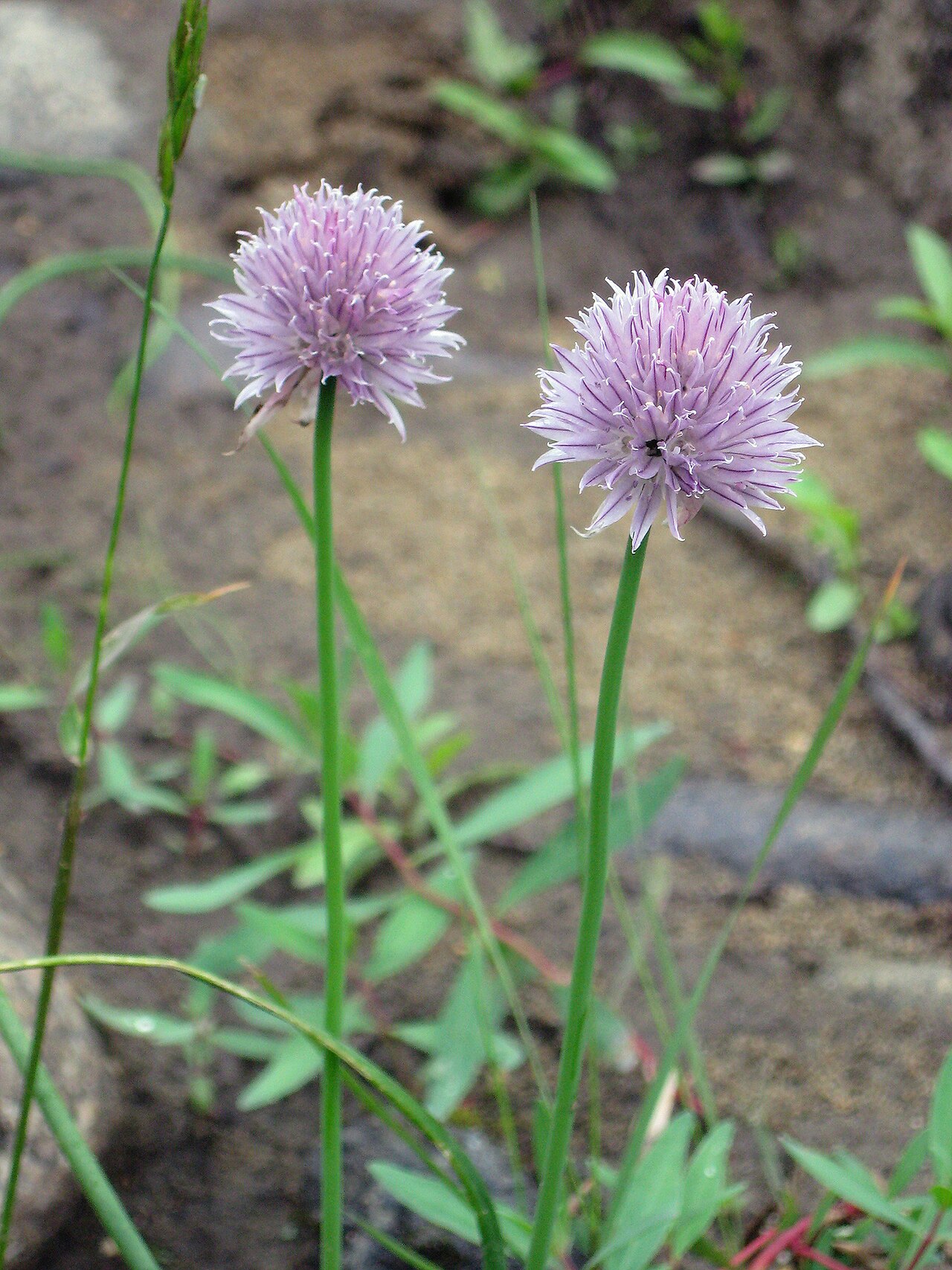
Allium schoenoprasum, known as Wild Chives, is the only chive native to North America. The native populations are often separated as var. sibiricum, or as the older species A. sibiricum. It is a clump-forming perennial onion with hollow, grass-like leaves and dense, round heads of lilac to rose-purple flowers in early to late summer. It belongs to the onion subfamily of the Amaryllidaceae (older references place it in the Alliaceae or Liliaceae), and it is circumboreal: wild populations ring the northern hemisphere from Scandinavia and Siberia across Alaska and Canada to the northern edge of the United States.
It is the same species as the chives in your kitchen garden. Garden chives sold in nurseries and grocery stores mostly come from Eurasian stock that European settlers brought over and planted. That stock has escaped widely onto roadsides, old homesteads, vacant lots and lawns. The Flora of North America describes the species as “extremely polymorphic.” It also says botanists cannot reliably separate many native populations from escaped garden plants by herbarium specimens alone, and that recognizing varieties is unsound until the variation is better understood. In practice, habitat is the best clue. Native wild chives grow on cold, rocky river shores, wet mountain meadows, Great Lakes bedrock ledges and alvar grasslands. Garden escapes turn up in disturbed, human-made places.
That distinction matters for gardeners. In Alaska, Montana, Wyoming and the mountains of Idaho, wild chives are common, and planting them restores a familiar part of the flora. In New England, New York and the western Great Lakes, the native populations are rare and legally tracked. Wild chives are ranked critically imperiled (S1) in New Hampshire, Vermont, New York, Minnesota and Wisconsin, and are state-threatened in Michigan. There, the plant is worth growing from responsibly sourced stock and never worth digging from the wild. This guide covers how to identify the native plant, where it truly belongs, and how to grow it as a hardy, edible, pollinator-friendly native perennial. For a seed-starting walkthrough of the culinary herb, see our guide to growing chives from seed.
Identification
Wild chives form tight clumps of several to many stems. Each stem rises from a slender, elongated bulb, and the bulbs cluster together on short rhizomes. Flowering stems (scapes) reach 8 to 20 inches (20–50 cm), and the leaves can be nearly as long. The plant smells strongly of onion when bruised, which is the single most useful field test. Any onion-like plant without that smell should be treated as a possible toxic look-alike.
Bulbs & Stems
The bulbs are cylindrical and slim, about ¼ to ⅓ inch (0.5–0.9 cm) wide and up to ¾ inch (1.5–2 cm) long, with grayish or brownish outer coats that persist as a fibrous net. The inner coats are whitish or pinkish. The scapes are round, hollow and smooth, about ⅛ to 3/16 inch (3–5 mm) thick. Several to a dozen or more scapes rise from a single clump. A leaf sheath wraps the lower third to half of each scape.
Leaves
Each scape usually carries two leaves. They are round in cross-section, hollow (fistulose) and 2–7 mm wide, and they stay green while the plant flowers. This is a useful contrast with many western wild onions, whose leaves wither by bloom time. Leaves run 8 to 24 inches (20–60 cm) long. In native plants they are often a little shorter than the scape, while many garden strains have leaves that equal or overtop the flowers. Go Botany cautions that this difference is clinal and not a reliable way to tell the two apart.
Flowers
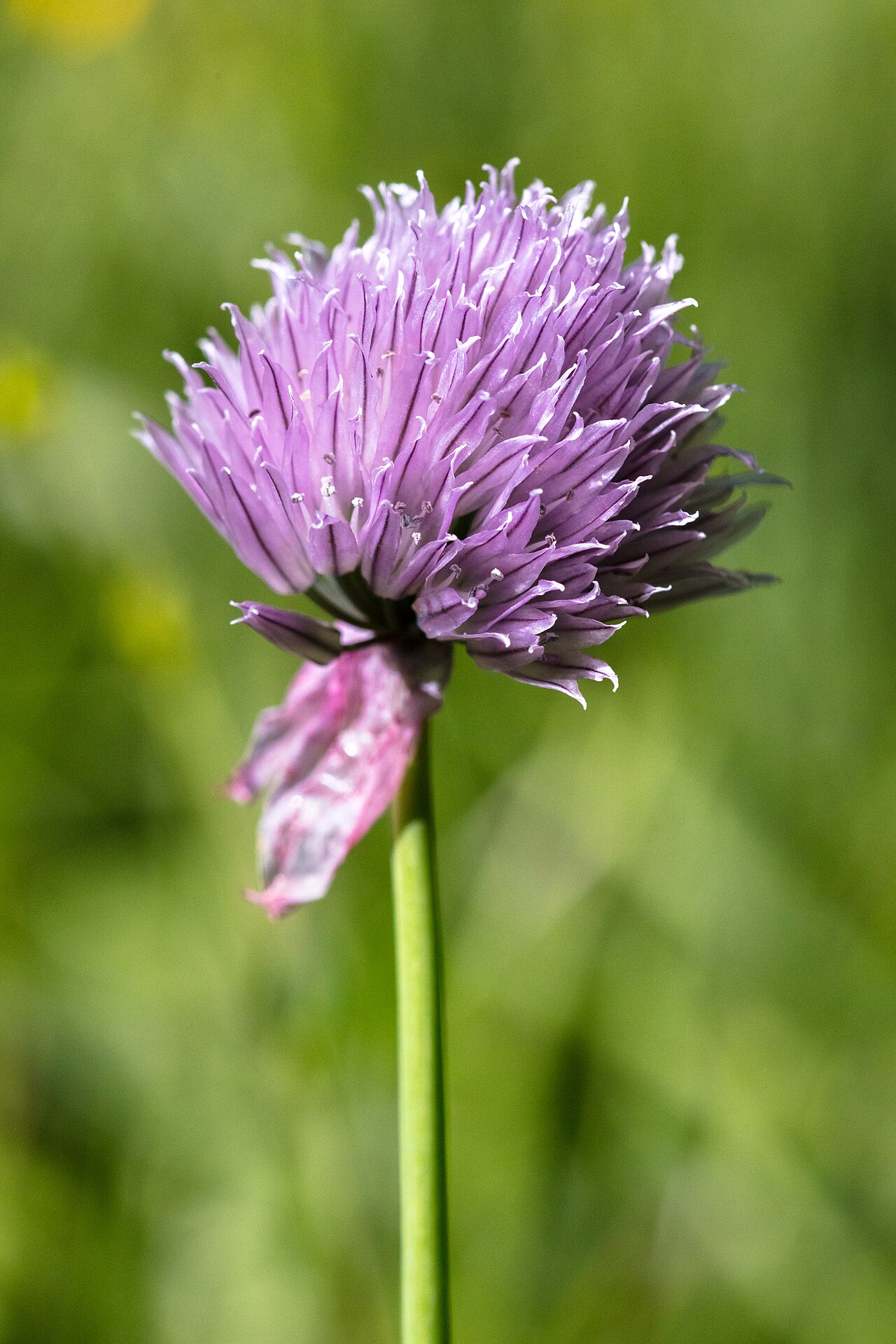
The flowers form a compact, upright, nearly globe-shaped umbel of 30 to 50 flowers, about ⅝ to 2 inches (15–50 mm) across. Two persistent, papery spathe bracts sit at its base. Each flower is bell-shaped, 8–12 mm long, with six erect, pointed tepals. The tepals range from pale purple to deep lilac, often with a darker midrib, and occasionally white. They dry pinkish and stay on the developing fruit like a papery husk. The six stamens are shorter than the tepals and have purple anthers. Unlike some wild onions, the umbel never carries bulblets. Flowering runs June through August, earlier at low elevations and later on Arctic and alpine sites.
Fruit & Seeds
The fruit is a small, three-chambered capsule about ⅛ inch across. It stays hidden inside the dried, papery tepals and ripens in late summer. Each chamber releases a few glossy, jet-black seeds that are typical of onions. Seed falls close to the parent plant, so wild chive colonies on river gravels and lake shores spread slowly, by seed and by clump division.
Quick Facts
| Scientific Name | Allium schoenoprasum (native populations often treated as var. sibiricum; syn. A. sibiricum) |
| Family | Amaryllidaceae (onion subfamily; formerly Alliaceae) |
| Plant Type | Clump-forming bulbous perennial herb |
| Mature Height | 8–20 in (20–50 cm) in flower |
| Mature Spread | 6–12 in per clump, slowly widening |
| Growth Rate | Moderate |
| Sun Exposure | Full Sun to Part Shade |
| Water Needs | Wet to average (consistently moist) |
| Soil Type | Gravelly, sandy or loamy; rock crevices; tolerates seasonal flooding |
| Soil pH | 6.0–7.5 (slightly acidic to neutral; also on limestone) |
| Bloom Time | June – August |
| Flower Color | Pale purple to deep lilac, occasionally white |
| Fall Color | None; foliage yellows and dies back |
| Fruit | Small 3-chambered capsule with glossy black seeds |
| Deer Resistant | Yes (strong onion scent deters most browsers) |
| USDA Hardiness Zones | 3–9 (wild northern populations reach the Arctic) |
Native Range
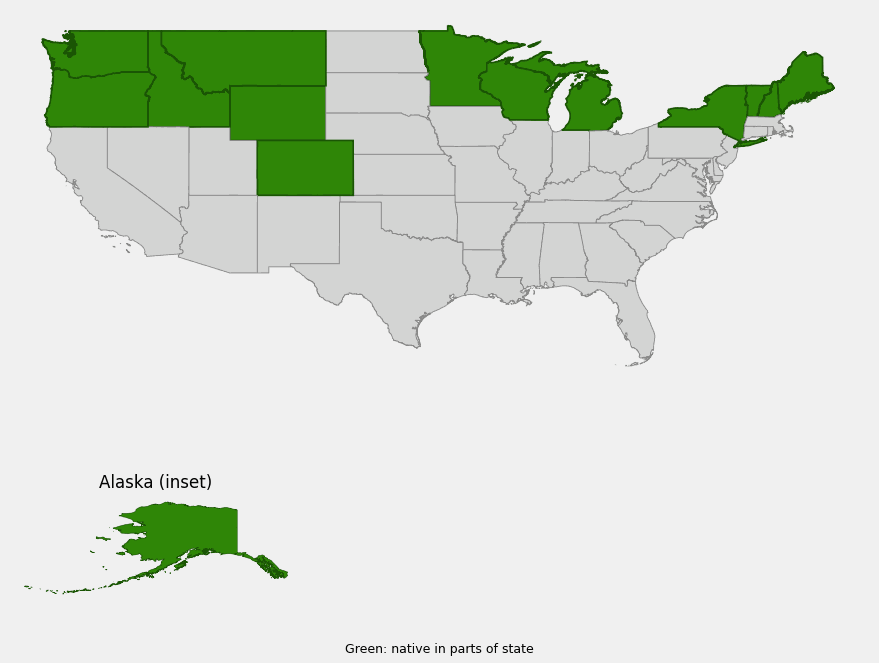
Across North America, wild chives grow in the cool north and in the mountains. The Flora of North America records the species in every Canadian province and territory: Alberta, British Columbia, Manitoba, New Brunswick, Newfoundland and Labrador, the Northwest Territories, Nova Scotia, Nunavut, Ontario, Prince Edward Island, Quebec, Saskatchewan and Yukon. Its listed elevation range runs from sea level to about 11,500 feet (3,500 m). In the United States, the species is spread across Alaska, the northern Rockies and the northern tier of the East. Because the same species has also escaped from gardens nearly everywhere, the map on this page shows only the states where state floras and natural heritage programs treat wild populations as native: Alaska, Washington, Oregon, Idaho, Montana, Wyoming, Colorado, Minnesota, Wisconsin, Michigan, New York, Vermont, New Hampshire and Maine.
In the West, wild chives are a plant of wet meadows and cold streams. In Idaho, herbarium collections come from wet meadows and creek banks in the Centennial and Henrys Lake Mountains of the Targhee National Forest, at roughly 6,400 to 9,800 feet. Others come from the Pioneer Mountains. Montana and Wyoming rank the species apparently secure (S4), and it blooms in Yellowstone’s moist meadows. In Washington, the Burke Herbarium places native populations east of the Cascade crest, especially on the gravel shores and benches of the free-flowing Columbia River. Oregon’s few records come mainly from the same Columbia River country around Umatilla. Colorado’s populations are scarce (S2), and most herbarium records come from the wet meadows of North Park. In Alaska, wild chives are a common sight on river gravel bars, lakeshores and wet tundra margins.
In the East, wild chives are a rare relict of cold, rocky shorelines. In Minnesota (state-endangered) and Michigan (state-threatened), they are documented only from the rocky Lake Superior shore, from rocky terraces along nearby rivers, and from thin-soiled alvar grasslands over limestone, such as those along the Escanaba River. Wisconsin’s native plants grow on rocky riverside cliffs in the north. New York tracks them as critically imperiled (S1), with most vouchered records from northern counties such as Jefferson. Native plants in New England grow on river banks, shoreline outcrops and meadows. The U.S. Forest Service notes that they grow abundantly along rivers and streams in northern Maine, while New Hampshire lists them as endangered and Vermont ranks them S1. Records from Connecticut, Rhode Island, Massachusetts, Pennsylvania, New Jersey, Ohio, Indiana, Illinois, Utah and other states are treated by state sources as introduced or as garden escapes, so those states are not shaded here.
📋 Regional plant lists featuring Wild Chives: Alaska · Montana & Wyoming · Idaho, Eastern Oregon & Eastern Washington · Michigan, Wisconsin & Eastern Minnesota · New Hampshire, Maine & Vermont · New York, Pennsylvania & Northern New Jersey
Growing & Care Guide
Wild chives are among the easiest native perennials to grow. The cultivated form has been a kitchen-garden staple for centuries, and the wild form needs the same basics with a little more moisture. The main difference in a native planting is where the plants come from. Choose seed or divisions of regional, wild-origin stock where you can find them, especially if you garden near a native population. Plain garden chives are the same species but usually come from European or Asian stock.
Light
Full sun gives the densest clumps and the most flowers. Wild chives also flower reasonably well in part shade, the kind of light you find on a north-facing rock shelf or at the edge of willow thickets along a stream. In hot-summer climates outside the plant’s natural range, afternoon shade helps keep the foliage from scorching and going dormant early.
Soil & Water
In the wild, this plant has its roots in cold, moving water or in seepy gravel, so consistent moisture matters more than rich soil. Garden loam, sandy soil, gravel and rock crevices all work as long as they do not dry out completely during bloom. Wild chives tolerate spring flooding and briefly saturated soil well, which makes them a natural fit for rain-garden rims, pond margins and streamside plantings. In average garden beds, water during dry spells in late spring and early summer. Once the seed has ripened, established clumps can handle a drier late summer and fall. Soil pH from slightly acidic to neutral suits them, and Great Lakes alvar populations show they are comfortable over limestone.
Planting Tips
Set out nursery plants or divisions in spring or early fall, 8 to 12 inches apart, with the bulb bases just below the soil surface. Wild chive seed germinates readily without special treatment. Sow it in spring at about ¼ inch deep, or sow outdoors in fall to mimic nature. Seedlings look like fine grass and reach flowering size in the second year. Because native populations are rare and protected in Minnesota, Michigan, Wisconsin, New York, New Hampshire and Vermont, never dig plants from the wild. Buy from nurseries or collect a little seed only where it is legal and the plant is plentiful.
Pruning & Maintenance
This plant needs very little care. Snip leaves as needed for the kitchen, cutting no more than a third of a clump at once. If you want to limit self-seeding, deadhead after flowering. If you are growing seed for wildlife, restoration or next year’s plants, leave a few heads to ripen. Cut back yellowing foliage in late summer if it looks untidy, and new leaves will often emerge in cool fall weather. Divide crowded clumps every three to four years in spring. Wild chives are rarely bothered by pests or disease. The most common problems are rot in heavy, stagnant soil and rust in crowded, humid plantings.
Propagation
Division is the fastest method. Lift a clump in early spring or early fall, tease apart the slender bulbs into groups of five to ten, and replant them right away. Seed works just as well and preserves more genetic diversity, which matters for restoration plantings. Collect capsules when the papery heads turn tan in late summer, dry them in a paper bag, and store the black seeds cool and dry until sowing.
Landscape Uses
- Edible native gardens: a perennial native herb that replaces store-bought chives
- Rain gardens and pond edges: tolerates spring flooding and wet soils
- Rock gardens and gravel beds: thrives in crevices and stony soil like its shoreline habitat
- Pollinator borders: compact purple globes draw bumblebees all summer
- Streamside and lakeshore restoration: in regions where it is native, using local-origin stock
- Edging: neat clumps line paths alongside native grasses such as Tufted Hairgrass
- Deer-resistant plantings: the onion scent keeps most browsers away
Wildlife & Ecological Value
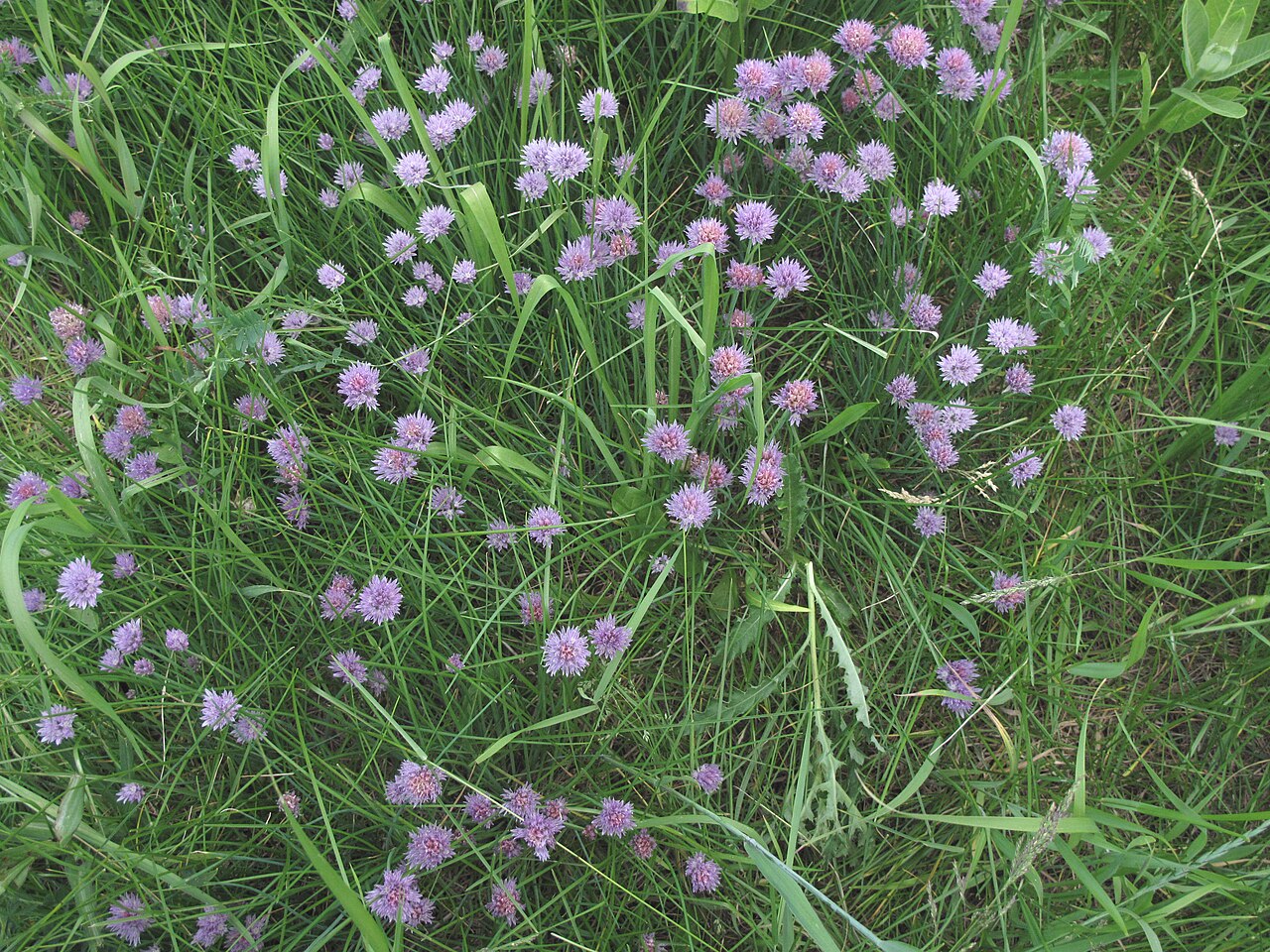
Wild chives offer a lot of value for a small plant. On northern shores and mountain meadows, they flower in a short season when nectar can be scarce.
For Pollinators
The Burke Herbarium lists bumblebees, other bees, flies and hummingbirds as pollinators of wild chives. The open, upright, bell-shaped flowers are packed 30 to 50 to a head, so a foraging bumblebee can work an entire umbel without flying. On Arctic and alpine sites, where flies are important pollinators, the long bloom from June into August bridges the gap between early spring flowers and late-season asters and goldenrods. In gardens, honeybees, small native bees and butterflies also visit the flowers often.
For Birds
Birds rarely eat the hard black seeds, but wild chives still support birds indirectly. The insects drawn to the flowers feed warblers, swallows and shorebird chicks that forage on the same riverbanks and lakeshores. Clumps of chives also mix with sedges and grasses to make the low, dense cover that ground-nesting sparrows use in wet meadows.
For Mammals
The sulfur compounds that give onions their bite make wild chives unappealing to most browsers. Deer, rabbits and voles usually leave them alone, which is a real advantage in gardens. In the wild, some grazers do nibble wild onions in spring, but the plant’s hardy bulbs regrow quickly. Note that all Allium species, including chives, are toxic to dogs, cats and horses if eaten in quantity.
Ecosystem Role
On gravel bars, rocky shorelines and alvars, wild chives are part of a specialized community that survives ice scour, spring floods, summer drought on bare rock and very cold winters. Their clustered bulbs and fibrous roots help hold gravel and thin soil in place. In the Great Lakes region, the plant is one of the signature species of rare alvar and bedrock-shore communities. Its presence often marks a high-quality natural area that deserves protection.
Cultural & Historical Uses
Indigenous peoples across the north have long gathered wild chives. Go Botany notes that Native Americans used the bulbs and leaves to flavor fish, soups and salads. In northern Maine, the U.S. Forest Service lists wild chives among the region’s culturally important non-timber forest products, noting that they grow abundantly along the area’s rivers and streams.
The scientific name has a simple meaning. Allium is the classical Latin name for garlic, and schoenoprasum combines Greek words for “rush” and “leek,” describing the plant’s hollow, rush-like leaves. Linnaeus named Allium schoenoprasum in 1753 and also described a separate A. sibiricum. That second name survives as var. sibiricum, which many North American references, including USDA PLANTS (symbol ALSCS), still use for the larger-flowered native plants.
The chives in nearly every herb garden belong to the same species. Their ancestors were selected over centuries in Europe and Asia and later carried around the world. That shared identity is why wild chives need careful handling. A gardener can plant European chives in Michigan or Vermont with no idea that a rare native form of the same species grows on a nearby shoreline. Where native populations exist, botanists encourage planting local-origin stock, or at least not planting garden chives right next to wild sites, to avoid blurring the line between the two.
Frequently Asked Questions
Are wild chives the same as garden chives?
Yes. Both are Allium schoenoprasum. Garden chives usually come from Eurasian stock, while the native North American populations are often called var. sibiricum. The two look very similar and can interbreed. Habitat is the best clue: rocky river shores, wet mountain meadows and alvars suggest native plants, while roadsides, lawns and old homesteads suggest garden escapes.
Can you eat wild chives?
Yes. The leaves, flowers and small bulbs are all edible and taste like mild garden chives. Harvest only from plants you have grown yourself or from abundant populations where collecting is allowed. Wild chives are rare and protected in several eastern states. Always confirm the onion smell before eating any wild onion-like plant. Toxic death camas looks similar, but it has flat, solid leaves and no onion odor.
How do I tell wild chives from other native onions?
Look for hollow, round leaves that stay green at flowering, together with a dense, upright, globe-shaped head of lilac flowers and no bulblets. Nodding Wild Onion has a drooping flower cluster and flat leaves. Prairie Onion has flat, solid leaves and grows in dry prairie and barrens. Wild Garlic usually carries bulblets in its flower head.
Are wild chives invasive?
No. Where they are native, wild chives are a slow-spreading, well-behaved part of the flora. Garden chives self-sow readily and escape from cultivation, but they are not considered seriously invasive. Deadheading after bloom keeps seedlings in check.
Do wild chives need a wet site?
They grow best in soil that stays moist through early summer, like their native stream banks and wet meadows, but they adapt to ordinary garden beds with occasional watering. Avoid soils that stay dry all season, and avoid stagnant, poorly drained clay, where the bulbs can rot.

Looking for a nursery that carries Wild Chives?
Browse our native plant nursery directory: Alaska · Washington · Oregon · Idaho · Maine, Michigan, Minnesota & Montana · Wisconsin & Wyoming · Colorado · New Hampshire & New York · Vermont