
Yellow Mountain-avens (Dryas drummondii)
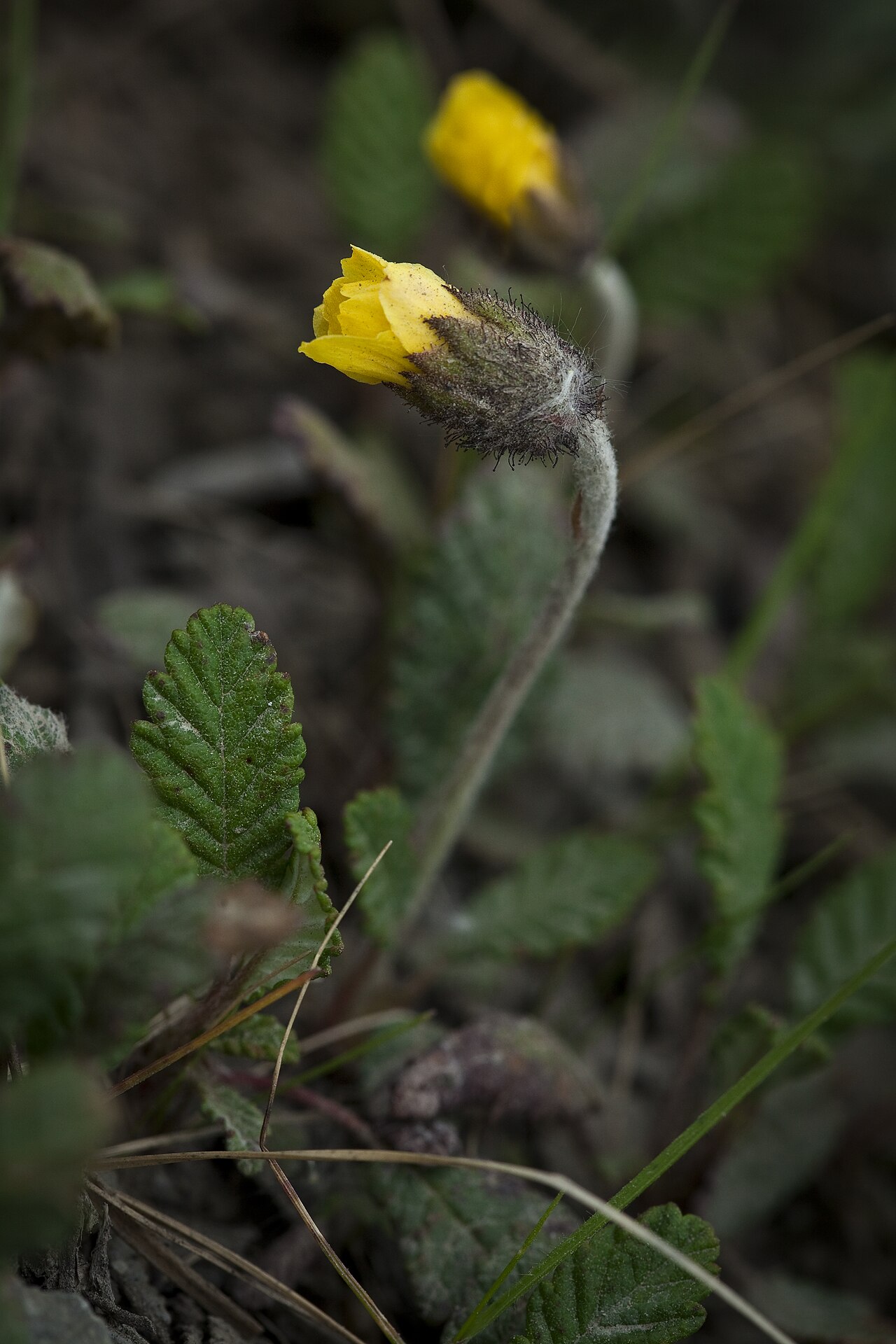
Dryas drummondii, known as Yellow Mountain-avens, Drummond’s mountain-avens or yellow dryad, is a low, mat-forming evergreen subshrub of gravel bars, glacial moraines, rocky slopes and mountain ridges in Alaska, Canada and the northern Rocky Mountains. It is a member of the rose family (Rosaceae). From woody, creeping stems it forms dense carpets of leathery, scalloped leaves, and in early summer it holds nodding, bell-shaped yellow flowers on slender stalks above them.
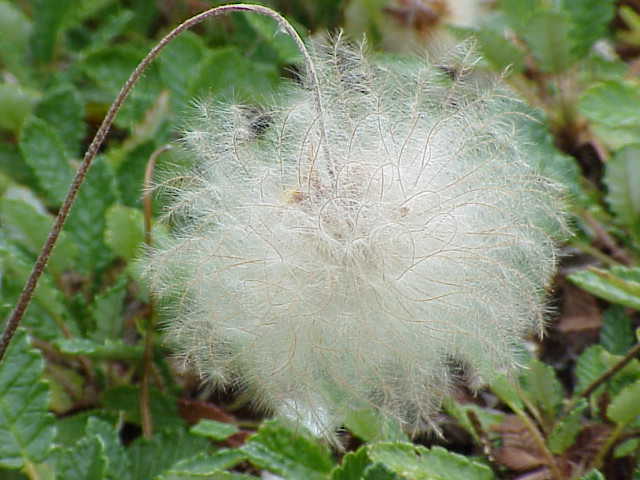
Unlike its white-flowered relatives, whose flowers open flat to the sun, yellow mountain-avens keeps its petals cupped and its flowers hanging. After flowering, each one becomes a striking tuft of long, feathery, silky plumes that shine silver in low light and carry the seeds on the wind.
Yellow mountain-avens is famous among ecologists as a pioneer of land newly uncovered by retreating glaciers. Its roots host nitrogen-fixing bacteria, so it can colonize raw gravel with almost no soil and build up nitrogen for the shrubs and trees that follow. This guide covers how to identify it, where it grows, how to grow it, and its role in northern landscapes.
Identification
Yellow mountain-avens is the only native Dryas in our area with yellow, nodding flowers, which makes it easy to recognize in bloom.
Leaves & Growth Habit
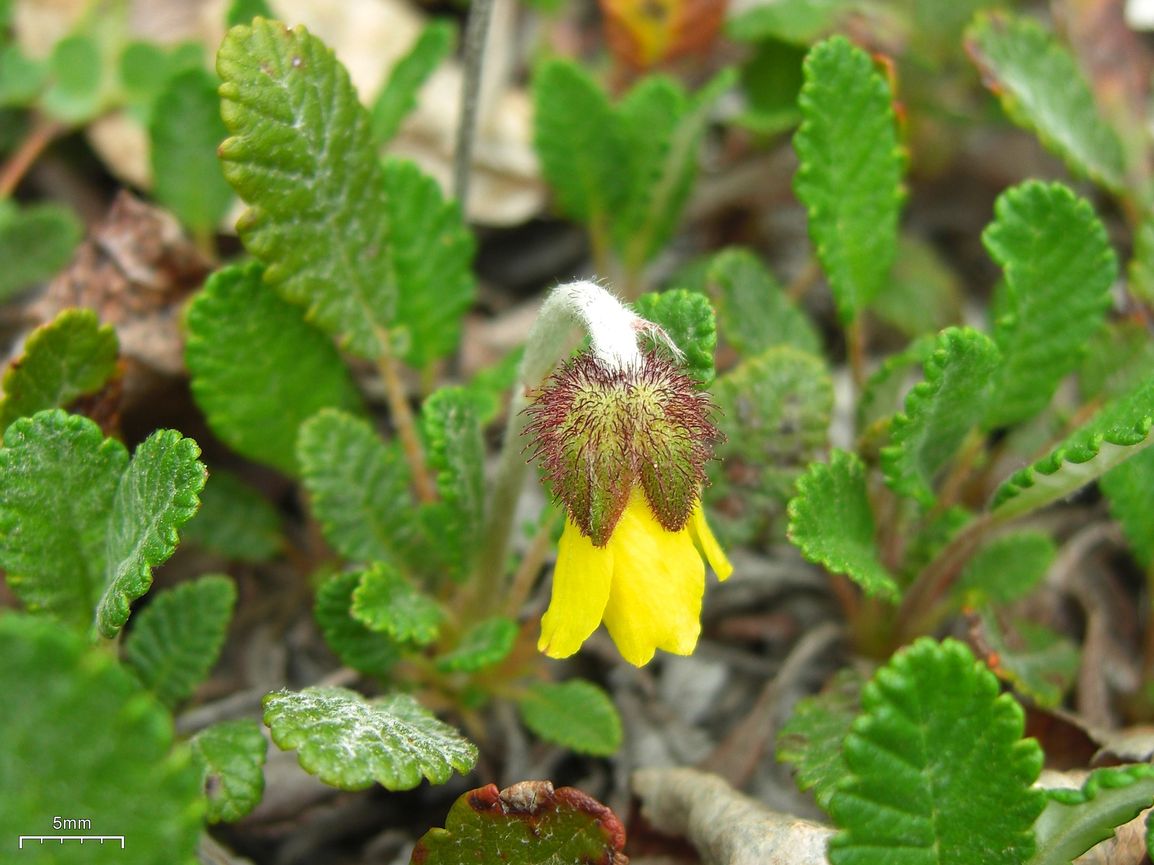
A prostrate, evergreen subshrub, rarely more than 4 to 9 inches tall, with trailing, rooting woody stems that form mats up to 3 feet or more across. The leaves are oval to elliptic, ½ to 1½ inches long, leathery, with rounded teeth along the margins. They are dark green and wrinkled above and densely white-woolly beneath, with the edges slightly rolled under.
Flowers
Flowers open from late May to July, one per stalk, on leafless stalks 2 to 8 inches tall that are covered in woolly and dark glandular hairs. Each flower is about ¾ to 1 inch long, with 8 to 10 bright yellow petals that stay erect and never spread fully, so the flower stays bell-shaped and nods. The sepals are covered with dark, gland-tipped hairs.
Fruit
The fruit is a cluster of small achenes, each tipped by a persistent style 1 to 1½ inches long and covered with silky hairs. The styles first twist together into a spindle and then spread into a fluffy, silvery seed head in mid to late summer, much like those of Geum and pasqueflowers.
Look-alikes
Entireleaf Mountain-avens (Dryas integrifolia) and eightpetal mountain-avens (Dryas octopetala) have upright, open, white to cream flowers; entireleaf mountain-avens also has narrow leaves with smooth or few-toothed margins. Hybrids between yellow and white species occur where they grow together. Before flowering, mats of Dryas can be confused with Kinnikinnick, which has smooth, shiny, untoothed leaves.
Quick Facts
| Scientific Name | Dryas drummondii (syn. Dryadaea drummondii) |
| Family | Rosaceae (rose family) |
| Plant Type | Mat-forming evergreen subshrub |
| Mature Height | 4–9 in (flower stalks) |
| Mature Spread | 1–3 ft or more |
| Growth Rate | Slow |
| Sun Exposure | Full sun |
| Water Needs | Low to moderate; sharply drained soil |
| Soil Type | Gravel, sand, rocky and calcareous soils; poor soils |
| Soil pH | Neutral to alkaline |
| Bloom Time | May–July |
| Flower Color | Bright yellow |
| Fall Color | Evergreen; some leaves bronze in fall |
| Fruit | Achenes with long feathery plumes |
| Deer Resistant | Yes; seldom browsed |
| USDA Hardiness Zones | 2–6 |
Native Range
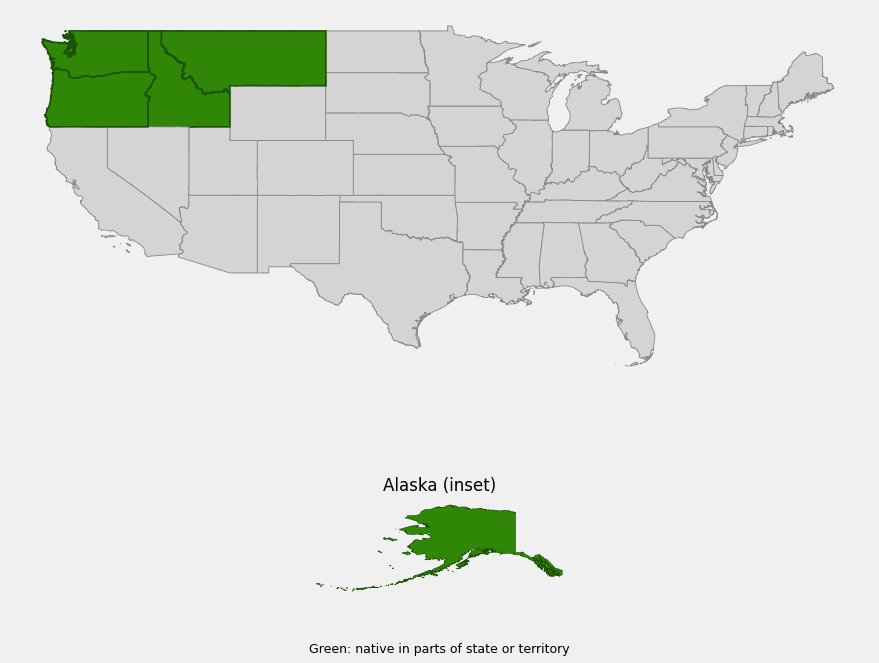
Yellow mountain-avens is a northern and western North American species. USDA PLANTS lists it in Alaska, Washington, Oregon, Idaho and Montana, and in Canada in Yukon, the Northwest Territories, British Columbia, Alberta, Saskatchewan, Ontario, Quebec and Newfoundland. It is widespread in interior and southern Alaska and through most of British Columbia and the Canadian Rockies.
In the lower 48 it reaches its southern limit in the northern Rocky Mountains of Montana and Idaho, with isolated outlying populations in northeastern Washington (Pend Oreille County) and in the Wallowa Mountains of northeastern Oregon. In eastern Canada it is scattered on limestone gravels and shores, notably around the Gulf of St. Lawrence, Anticosti Island and western Newfoundland.
It grows on gravel bars and river floodplains, glacial moraines and outwash, talus and scree slopes, rocky ridges and roadcuts, from foothill river valleys up to alpine elevations. It favors open, unstable, often calcareous ground with little competition, and is one of the first plants to cover gravel left by glaciers and floods.
📋 Regional plant lists featuring Yellow Mountain-avens: Alaska · Idaho, Eastern Oregon & Eastern Washington · Montana & Wyoming
Growing & Care Guide
Yellow mountain-avens is grown by rock garden enthusiasts and is sometimes offered by alpine plant specialists. It is happiest in cold-winter climates with cool summers and needs sharp drainage. Buy nursery-grown plants or grow it from seed rather than digging it from the wild.
Light
Full sun. In shade it becomes sparse and flowers poorly.
Soil & Water
Give it lean, gritty, very well-drained soil: gravel, scree or a sandy loam amended with grit. It tolerates and often prefers limestone or alkaline soils. Water during establishment and in prolonged summer drought, but avoid wet soil, especially in winter. Do not fertilize; it supplies its own nitrogen through its root nodules.
Planting Tips
Plant in spring in a rock garden, crevice garden, gravel bed, scree or trough, or let it trail over a stone wall. Mulch with gravel rather than bark to keep the crown dry. It struggles in hot, humid summers and is best suited to northern gardens and mountain regions.
Pruning & Maintenance
Very little is needed. Remove any dead patches in spring and keep weeds and taller neighbors from overrunning the mat. Leave the feathery seed heads in place to enjoy through summer.
Propagation
Sow fresh seed in fall on the surface of a gritty mix and leave it outdoors for winter cold, or stratify it in the refrigerator for a few weeks before spring sowing. Rooted pieces of the trailing stems can be separated in early spring, and cuttings of new growth root in summer in a sandy mix.
Landscape Uses
- Rock and crevice gardens: an evergreen mat with yellow bells and silky seed heads
- Gravel gardens and slopes: groundcover for lean, well-drained ground
- Restoration: stabilizing gravel, mine spoils and roadcuts in the North
- Alpine troughs: for cold-climate container collections
Wildlife & Ecological Value
Yellow mountain-avens is a keystone pioneer in northern landscapes, more important for the ecosystem it builds than for any single animal it feeds.
For Pollinators
Its nodding flowers are visited mainly by bumblebees, which are strong enough to push into the cupped petals, along with flies and other insects in the short northern summer.
For Birds
Its mats give shelter to ground-nesting birds of gravel bars and tundra, and ptarmigan feed on Dryas leaves and buds.
For Mammals
Dall sheep, mountain goats, caribou and other grazers occasionally browse the foliage, but it is generally a minor food. Its dense mats shelter small mammals and insects.
Ecosystem Role
Its roots form nodules with the nitrogen-fixing actinobacterium Frankia. At Glacier Bay in southeast Alaska, classic studies of primary succession showed Dryas mats spreading across bare glacial till within a few decades of the ice retreating, enriching the soil with nitrogen and organic matter. Alders, willows and cottonwoods then establish, followed eventually by spruce forest.
Cultural & Historical Uses
The species is named for Thomas Drummond, the Scottish naturalist who collected plants across the Canadian Rockies and western Canada during John Franklin’s second Arctic land expedition in the 1820s. It was described by John Richardson and William Jackson Hooker from those collections.
The genus name Dryas comes from the Greek dryads, the nymphs of oak trees, because the leaves of the European species resemble small oak leaves. The common name “avens” is an old English name shared with the related Geum, which also has feathery seed heads.
Yellow mountain-avens became a textbook example of primary succession through long-term research at Glacier Bay, Alaska, where William S. Cooper began studying plant colonization of glacial moraines in 1916. In Alaska and northern Canada it is a familiar wildflower of gravel river bars along roads such as the Alaska Highway.
Frequently Asked Questions
Why are its flowers always half closed?
The petals of yellow mountain-avens naturally stay upright and cupped, so the flower remains bell-shaped and nodding. This is a key difference from the white-flowered Dryas species, whose flowers open flat.
Does it really fix nitrogen?
Yes. Its roots form nodules with the bacterium Frankia, which converts nitrogen from the air into a form plants can use. This lets it grow on bare gravel and enrich the soil for later plants.
Where does it grow in the lower 48?
Mainly in the northern Rocky Mountains of Montana and Idaho, with small outlying populations in northeastern Washington and the Wallowa Mountains of northeastern Oregon.
Can I grow it in my garden?
Yes, in cool, cold-winter climates with sharp drainage, such as a rock garden, gravel bed or trough in full sun. It dislikes hot, humid summers and wet soil.
What is the difference from white mountain-avens?
Entireleaf mountain-avens and eightpetal mountain-avens have upright, open white flowers. Yellow mountain-avens has nodding yellow flowers and broader, scalloped leaves.

Looking for a nursery that carries Yellow Mountain-avens?
Browse our native plant nursery directory: Alaska · Idaho · Montana · Oregon · Washington

