
Fire Pink (Silene virginica)
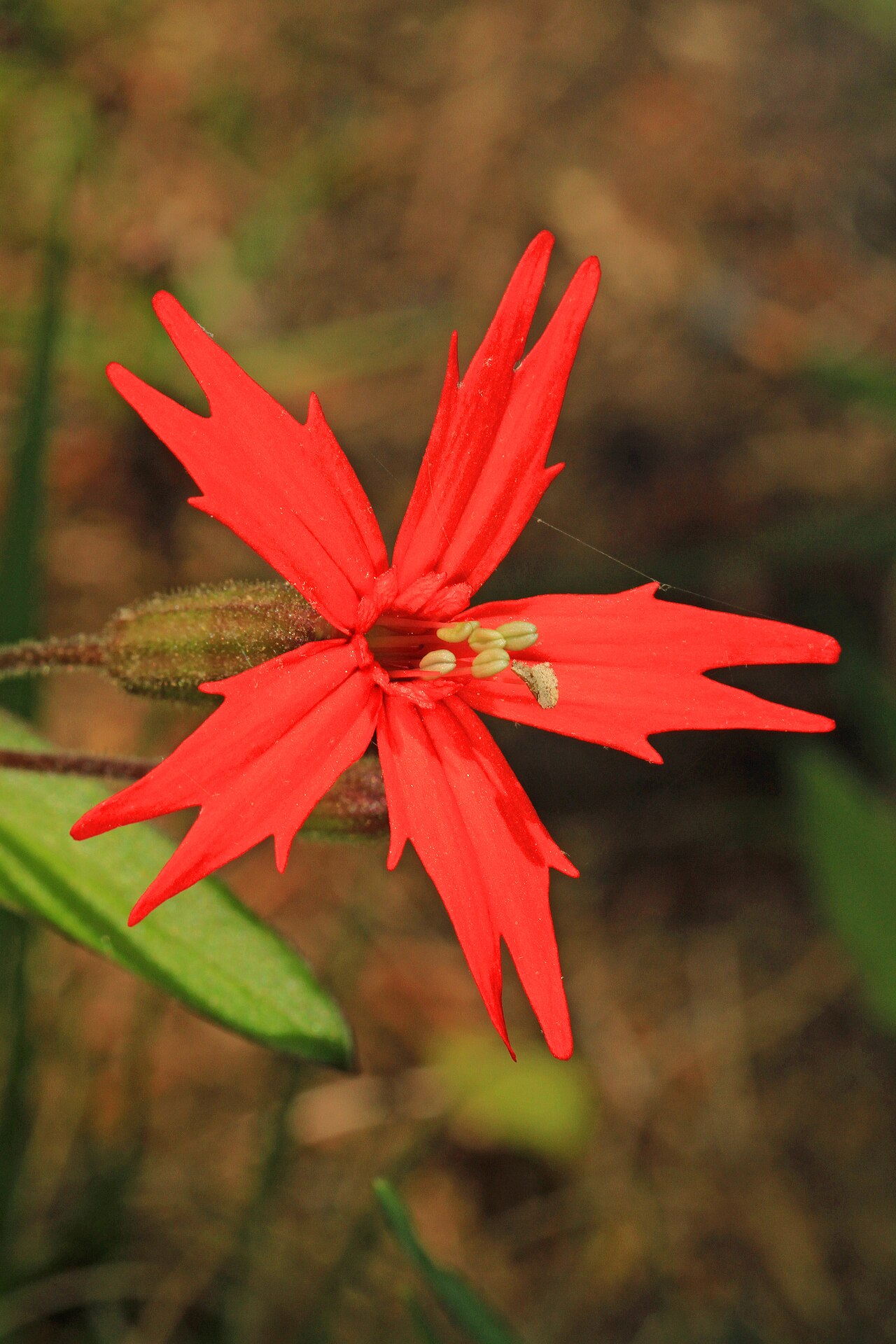
Silene virginica, commonly known as Fire Pink (also Scarlet Catchfly), is one of the most vivid wildflowers of the eastern woodlands, a slender, short-lived perennial that carries pure scarlet, star-shaped flowers above a tuft of narrow green leaves in mid-spring. It belongs to the Caryophyllaceae, the pink or carnation family, and although the color is anything but pink, the name is honest: it refers to the petal tips, which are cut into two sharp lobes as if trimmed with pinking shears. Few native plants in Alabama, Georgia and Mississippi pack this much color into so small a plant.
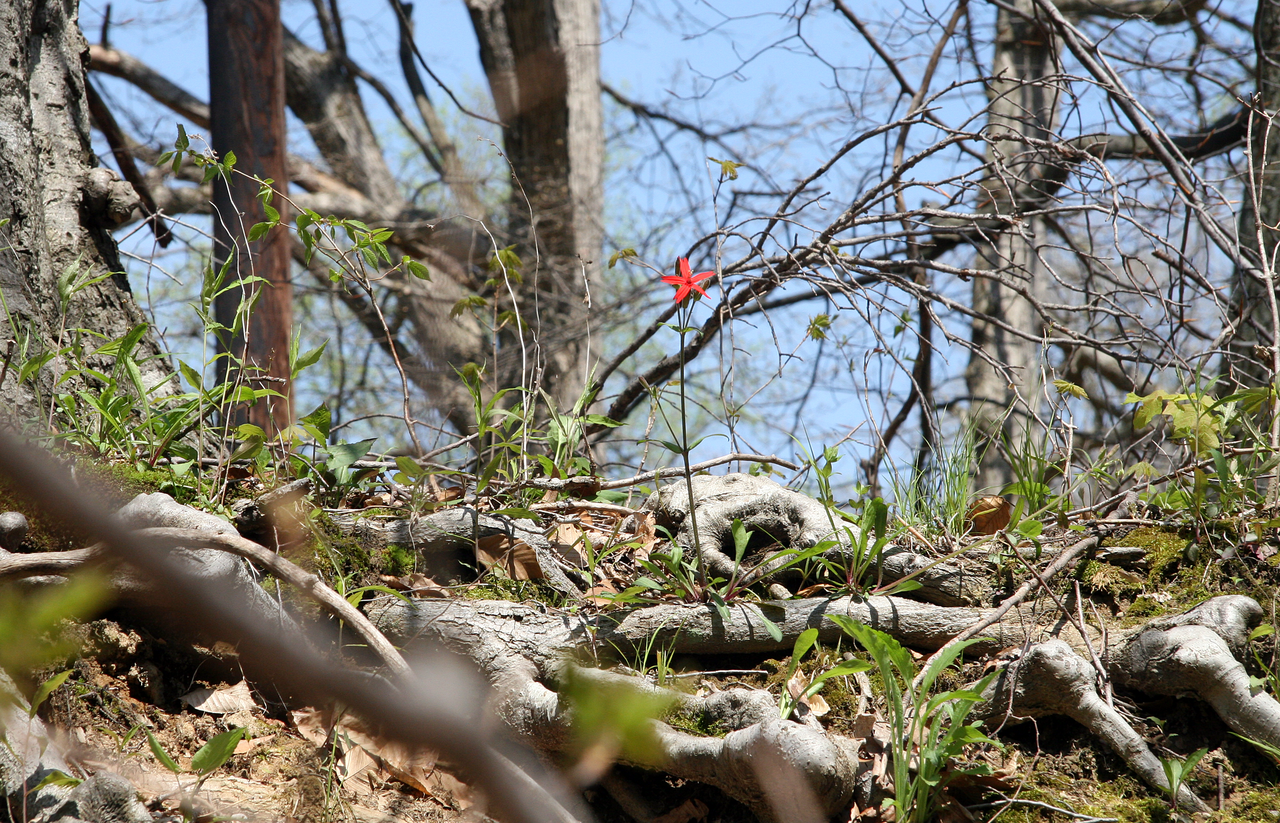
Fire Pink grows naturally on rocky, well-drained slopes, open oak and pine-hardwood woods, bluffs, cliff ledges and lightly disturbed road banks, usually in poor, acidic soil where taller, more competitive plants struggle. Its flowers are built for hummingbirds: long tubes, no scent, no landing platform and nectar held deep inside the corolla. The plant is the classic early nectar source for the ruby-throated hummingbirds that return to the Gulf and Piedmont states in spring, and it also draws swallowtails and other long-tongued butterflies. The sticky, glandular hairs that coat the upper stems and calyx are a passive defense that keeps crawling insects from robbing the nectar.
In the garden Fire Pink is a jewel rather than a workhorse. It is short-lived, typically lasting two to three years, but it reseeds politely where the soil is lean and the ground is not smothered by mulch, so a small colony can persist indefinitely. It thrives in dappled light, tolerates dry spells once established, and pairs beautifully with wild columbine, alumroot, phlox and ferns. Whether you are dressing up a dry woodland edge, a rock garden, or the front of a shady border, Fire Pink brings a hit of red that almost nothing else in the native palette delivers in April and May.
Identification
Fire Pink is a weak-stemmed, clump-forming herbaceous perennial that typically stands 10 to 20 inches tall, though leaning flowering stems can reach about 2 feet (reference floras give a range of roughly 8 to 31 inches). It grows from a stout taproot, which is why established plants resent transplanting. New growth begins in late winter to early spring as a basal rosette of leaves, and the flowering stems rise from the center of that rosette, at first arching outward and then bending upward as they mature.
Stems & Leaves
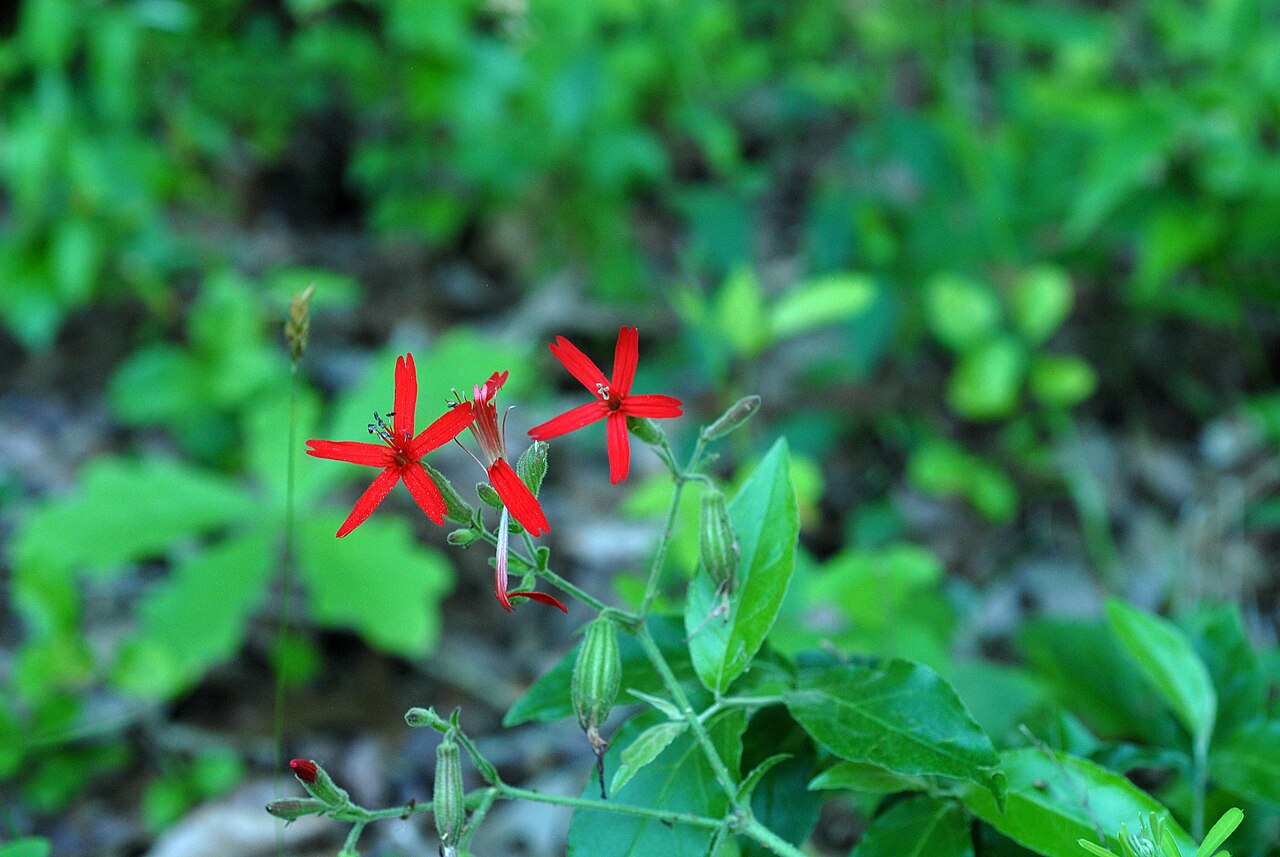
The stems are green to reddish (redder on the side facing the sun), erect to sprawling, and covered with short glandular hairs that feel distinctly sticky to the touch. Foliage comes in two forms. The basal leaves are lance-shaped to spatulate and medium to dark green, forming a loose winter rosette that often takes on a reddish-green tint in cold weather. Up the stem there are 2 to 8 pairs of opposite, narrowly oblong to lance-shaped leaves, 2 to 4 inches long, entire and pointed at the tip. The opposite arrangement, sticky stem and notched red petals together make Fire Pink easy to separate from other red-flowered woodland species.
Flowers
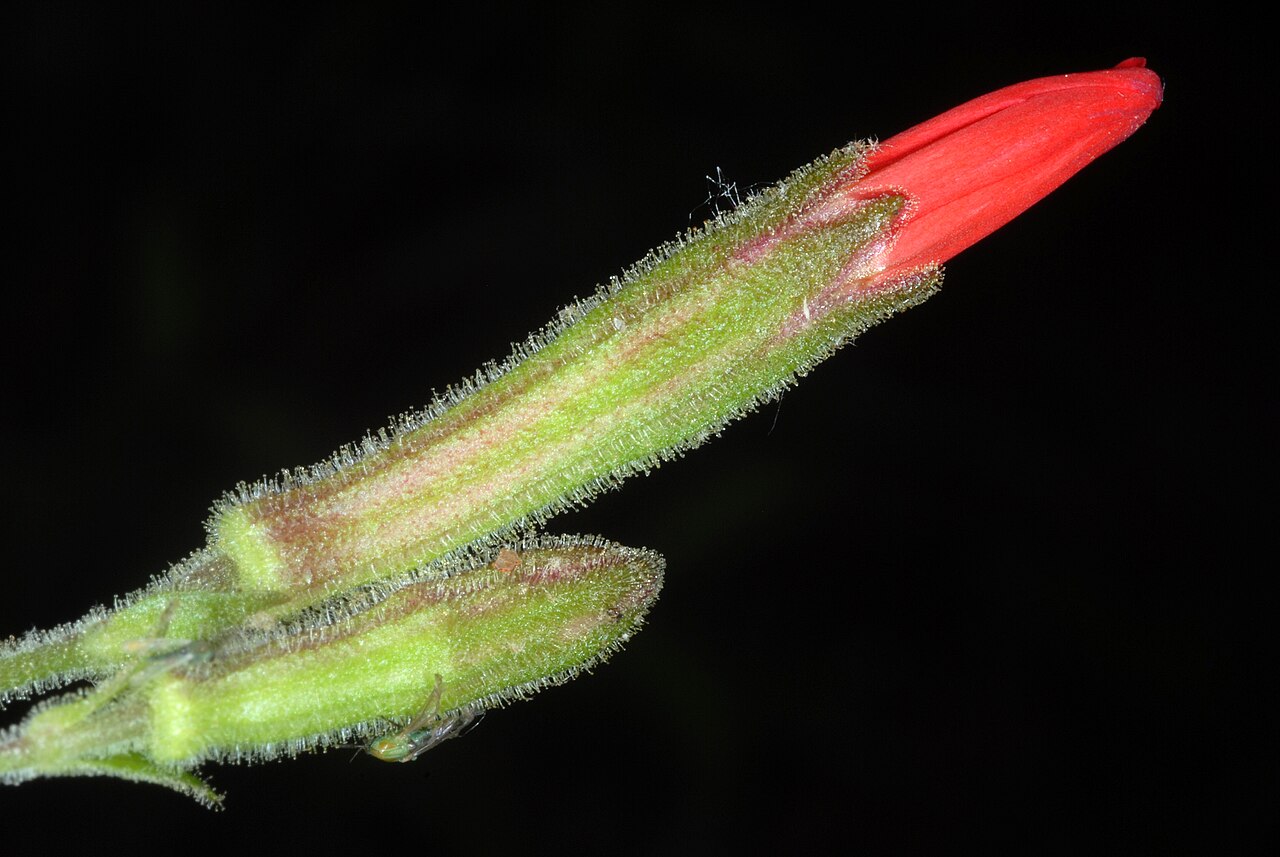
Each stem ends in a loose, open cyme of 3 to 10 flowers on slender stalks. The flowers are 1 to 1.5 inches across (occasionally larger in cultivation) and consist of five scarlet petals that flare outward from a narrow tube, each petal cut at the tip into two sharp lobes, with small scale-like appendages at the throat. The calyx is a ten-veined green tube covered with sticky hairs. Ten stamens with pale anthers ripen in two sets of five, followed by three slender styles, so a flower passes through a male phase and then a female phase, which strongly favors cross-pollination and makes hummingbird visits essential for good seed set.
Fruit & Seeds
Once pollinated, the flower is replaced by an oblong, tan capsule that opens at the top by small teeth. The seeds are gray, kidney-shaped and about 1.5 mm long. Capsules mature two to three weeks after flowering, and vigorous plants often show fresh flowers and split capsules at the same time. This is the moment to shake a few seeds into bare soil where you want new plants.
Quick Facts
| Scientific Name | Silene virginica L. |
| Family | Caryophyllaceae (Pink) |
| Plant Type | Short-lived herbaceous perennial wildflower |
| Mature Height | 10–16 in typical (flowering stems occasionally to about 2 ft) |
| Mature Spread | 6–12 in |
| Growth Rate | Moderate |
| Sun Exposure | Part shade to full sun (dappled light or afternoon shade preferred) |
| Water Needs | Low to moderate (dry to average soil; drought tolerant once established) |
| Soil Type | Well-drained sandy, gravelly, rocky or light loam; poor soils preferred |
| Soil pH | Acidic to slightly acidic (below about 6.8) |
| Bloom Time | April – June (into July in cooler upland sites) |
| Flower Color | Scarlet red |
| Fall Color | None (foliage stays green, reddish in winter) |
| Fruit | Tan, oblong seed capsule |
| Deer Resistant | Fairly (hairy, sticky foliage is not a favorite; not deer-proof) |
| USDA Hardiness Zones | 4–8 |
Native Range
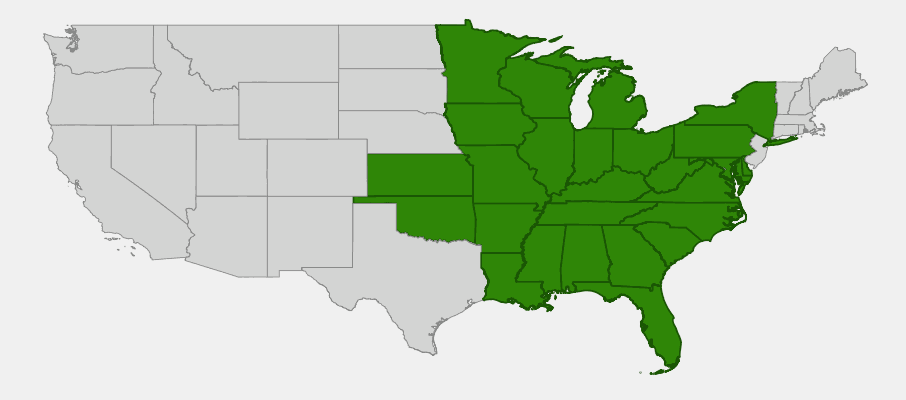
Fire Pink is native to the central and eastern United States and southern Ontario. It ranges from New York and Pennsylvania west across the Ohio Valley and Midwest to Minnesota, Iowa, Kansas and Oklahoma, and south through the Appalachians and Piedmont to Georgia, Alabama, Mississippi, Louisiana and northern Florida. It is a fairly common wildflower in the heart of that range but becomes uncommon toward its edges: it is listed as endangered in Florida, Michigan and Wisconsin and is considered imperiled in Louisiana. In Alabama, Georgia and Mississippi you are most likely to meet it on dry, rocky, wooded slopes and open woodland edges rather than in wet bottomlands or on deep coastal sands.
Within its range Fire Pink is a plant of dry to mesic upland woods. It shows up in oak-hickory and oak-pine woodlands, on rocky bluffs and ledges, along ridge trails and on lightly disturbed road cuts where the canopy is open enough to let dappled light reach the ground. Poor, acidic, thin soils are typical, and because the plant has little competitive ability it tends to disappear when shaded out by dense brush or thick leaf litter. A distinctive variety, Silene virginica var. robusta, is a larger, later-blooming form endemic to West Virginia and adjacent parts of Kentucky and Tennessee.
Fire Pink is also a Southern Appalachian favorite, chosen as the 2015 North Carolina Wildflower of the Year, and it blooms along mountain trails in late May and June. In the Gulf states it blooms earlier than in the mountains, often in April, which happens to coincide with the arrival of migrating ruby-throated hummingbirds.
📋 Regional plant lists featuring Fire Pink: Alabama, Georgia & Mississippi · Illinois, Iowa & Missouri · Maryland, Virginia & West Virginia
Growing & Care Guide
Fire Pink is easy to grow once you match its habitat: lean, sharply drained, slightly acidic soil, dappled light and no fuss. The mistakes that kill it are almost always rich soil, heavy mulch, wet feet or deep shade. If you think of it as a plant of rocky woodland edges and treat it that way, it will settle in, bloom for a few years and seed itself around.
Light
Part shade is ideal: morning sun with afternoon shade, or the shifting light beneath deciduous trees and open pines. Fire Pink tolerates full sun in cooler, upland gardens as long as the soil is not baked dry, but in the hot lowland summers of the Gulf states it appreciates afternoon relief, and it does poorly in deep shade, where it grows floppy, blooms sparsely and eventually fades out.
Soil & Water
Give it well-drained sand, gravel or light loam that is acidic to slightly acidic. Heavy clay that stays wet in winter is the biggest problem in much of Alabama, Georgia and Mississippi; amend with coarse sand and grit, or plant it on a slope, in a raised bed or in the crevices of a rock garden. Rich, moisture-retentive soil produces tall, weak stems that flop. Water new plants regularly through their first season, then let them go: established Fire Pink handles typical summer dry spells with little help, though a deep soak during a prolonged drought keeps the basal rosettes healthy.
Planting Tips
Fire Pink grows from a taproot and resents being moved, so plant small container-grown plants in fall or early spring, and set the crown level with the soil surface. Space plants 8 to 12 inches apart, or group them in threes to fives for impact. Because individual plants are short-lived, plan for succession: scatter some seed each year or let plants reseed, and skip heavy mulch around them (a thin layer of pine straw or leaf litter is fine, but bare, gritty patches are where seedlings appear). Buy from a reputable nursery that propagates its own plants rather than collecting from wild populations.
Pruning & Maintenance
Fire Pink needs almost no maintenance. It is generally free of serious pests and diseases; the only notable problem is anther-smut fungus, which blackens the anthers of infected plants and renders them sterile. Remove such plants if you see them. After bloom the stems decline quickly, so tuck the plant among companions that fill the gap, such as ferns, wild ginger or native sedges. Leave a few seed capsules to ripen and split if you want it to reseed, then cut spent stems back in summer or early fall. Do not cut down the winter rosette.
Propagation
Seed is the easiest route. Sow fresh seed outdoors in fall right after it ripens, or store it dry in the refrigerator and give it three to four weeks of cold, moist stratification before sowing in late winter. Seedlings are slow at first and usually bloom in their second spring. Mature plants can also be divided in late fall or early spring by removing outer rosettes with a share of root, and softwood cuttings root in spring. Because it is short-lived, start a few new plants every year so the colony never runs out.
Landscape Uses
Fire Pink is at its best in small, naturalistic plantings where its scarlet flowers can be seen up close:
- Hummingbird gardens – one of the earliest reliable native nectar plants for ruby-throated hummingbirds
- Dry woodland edges and open-canopy oak or pine plantings
- Rock gardens and wall crevices where drainage is sharp
- Front-of-border accents in part shade
- Naturalized meadows and slopes where it can reseed freely
- Companion plantings with wild columbine, alumroot, Carolina phlox and Indian pink
Combining Fire Pink
Red on red is bold but easy to overdo; Fire Pink looks best against soft blues, purples and greens. For a spring hummingbird bed in a lightly shaded spot, pair it with wild columbine (red and yellow, blooming at the same time), Carolina phlox (pink) and the early foliage of alumroot. For a longer season of hummingbird color, follow it with bee balm in summer and cardinal flower in late summer where soil moisture allows. Its close relative starry campion (Silene stellata) has a very different look, with white, fringed flowers on tall stems, and makes a good contrast in a woodland border.
Wildlife & Ecological Value
Fire Pink punches well above its weight ecologically, mainly through the specialized relationship it has with hummingbirds.
For Pollinators
The ruby-throated hummingbird is the principal pollinator. The flowers are bright red, odorless and tubular, with no landing platform and nectar tucked deep in the tube, all hallmarks of the hummingbird pollination syndrome. Swallowtail butterflies (such as the spicebush swallowtail) and other long-tongued insects also take nectar, but shorter-tongued bees mostly can’t reach it. The sticky glandular hairs on the calyx and upper stem are not carnivorous; they trap ants and other crawling insects so they cannot steal nectar without pollinating.
For Birds
Besides feeding hummingbirds, Fire Pink produces seeds that small songbirds eat, including juncos, pine siskins and sparrows, which also help disperse them. Leave the spent capsules in place rather than tidying them away.
For Mammals
The hairy, sticky stems and foliage make Fire Pink a less appealing browse plant than softer woodland wildflowers, though no plant is fully deer-proof, especially in spring when other food is scarce.
Ecosystem Role
As a woodland-edge wildflower, Fire Pink adds a scarce burst of early red nectar exactly when returning hummingbirds are looking for it, before most summer hummingbird plants bloom. Its taproot helps it persist in thin, rocky, drought-prone soils that few other flowers can use, and its winter rosette provides green cover on otherwise bare slopes. It is best used as an accent in the dry-woodland herb layer rather than as a mass-planted groundcover.
Cultural & Historical Uses
The scientific name tells much of the story. The genus name Silene is thought to come from the Greek sialon, meaning saliva, an allusion to the sticky substance on stems and calyces that gives the group its common name of catchflies. The species name virginica means “of Virginia,” the colony where the species was first identified. The word “pink” in the common name refers not to the color but to the “pinked” or jagged edges of the petals, the same sense as in pinking shears.
Native peoples used Fire Pink medicinally. The Cherokee used the root as a primary remedy for snakebite, and root decoctions were used as a treatment for intestinal worms. The Iroquois used it as an antibacterial medicine. Other groups regarded the plant as poisonous, and it should not be experimented with; nothing about this plant makes it a foraging candidate.
Today Fire Pink is grown in rock gardens, woodland borders and native meadow restorations, valued as a showy native alternative to red-flowered exotics for hummingbird gardens. Its selection as the 2015 North Carolina Wildflower of the Year drew fresh attention to it across the Southeast, and it remains a favorite subject of spring wildflower walks.
Frequently Asked Questions
Why is it called Fire Pink if the flowers are red?
The “pink” comes from the notched, saw-toothed edges of the petals, which look “pinked” as if cut with pinking shears, and from the plant’s membership in the pink family (Caryophyllaceae). “Fire” refers to the intense scarlet of the flowers.
How long does Fire Pink live, and will it come back every year?
It is a short-lived perennial, usually lasting about two to three years, sometimes a bit longer. Individual plants may fade, but if you let a few seed capsules ripen and keep the soil lean and free of heavy mulch, new seedlings will replace them. Start a few new plants each year to keep a colony going.
Can Fire Pink handle Deep South heat and full sun?
It tolerates heat and dry spells once established, but in the Gulf states it does best in dappled light or with afternoon shade, in very well-drained soil. Full sun works in cooler upland gardens with adequate drainage. Deep shade and wet, heavy clay are the real problems.
Will it attract hummingbirds?
Yes. Ruby-throated hummingbirds are its main pollinator, and the flowers open in April and May just as migrating hummingbirds arrive in Alabama, Georgia and Mississippi. Pair it with columbine and, later, bee balm and cardinal flower for continuous nectar.
How can I tell Fire Pink from other red native wildflowers?
Look for opposite leaves, sticky hairy stems and five spreading scarlet petals, each notched into two lobes. Royal catchfly (Silene regia) has nearly untoothed petals and thicker leaves; Indian pink (Spigelia marilandica) has a red-and-yellow tube; and cardinal flower and bee balm bloom in summer with very different flowers.

Looking for a nursery that carries Fire Pink?
Browse our native plant nursery directory: Alabama · Georgia · Mississippi