
Riverbank Grape (Vitis riparia)
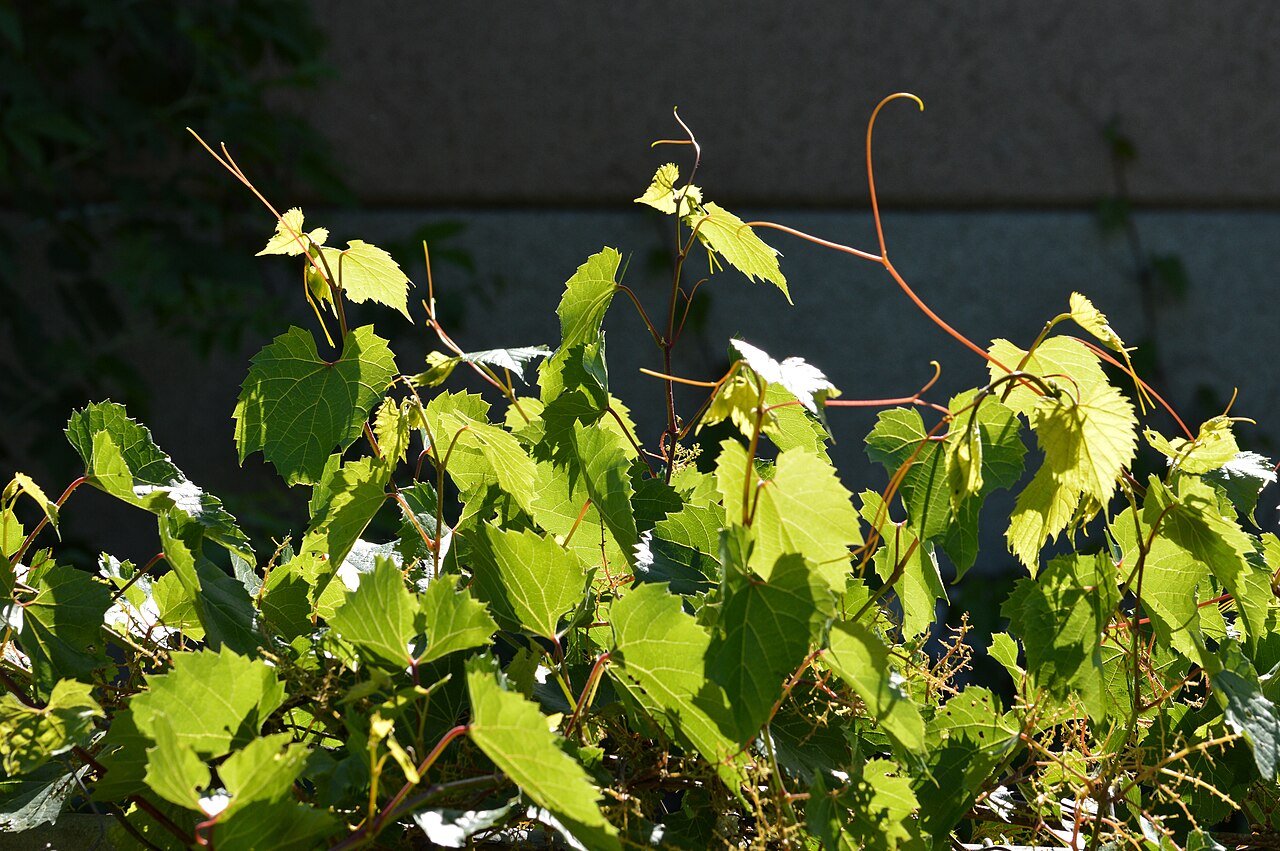
Vitis riparia Michx., commonly called Riverbank Grape or sometimes Frost Grape, is a fast-growing, cold-hardy woody vine native to streambanks, floodplains, and thicket edges across most of the central and eastern United States and southern Canada. A member of the grape family (Vitaceae), it is one of the most widely distributed wild grapes on the continent and the single most important parent species behind the modern cold-hardy and disease-resistant grape breeding programs that produced varieties such as Frontenac, Marquette, and the famous rootstock lines used worldwide to rebuild European vineyards after the phylloxera epidemic of the 1800s.
In the landscape, Riverbank Grape is a vigorous, high-climbing vine that uses forked, coiling tendrils to scramble 20 to 50 feet up trees, fences, and arbors, or to sprawl as a loose groundcover where nothing taller is available. Its three-lobed, coarsely toothed leaves are bright green above and paler beneath, turning soft yellow in autumn. Small, intensely fragrant greenish-yellow flowers open in late spring, followed by clusters of small, dark purple-black grapes that ripen in early fall — tart and seedy for fresh eating but excellent for jelly, juice, and wine, and an important food source for dozens of bird and mammal species.
Riverbank Grape is not a plant for a small, tidy border — it is a vigorous pioneer of disturbed, sunny edges and riparian corridors, and it will happily take over a weak tree or a neglected fence line. But given a sturdy structure and room to run, it is an outstanding, low-maintenance native vine for naturalized plantings, wildlife gardens, and streambank restoration, offering dense cover, fragrant bloom, fall fruit, and the cold-hardiness (surviving winters to -40°F) that no cultivated grape can match.
Identification
Riverbank Grape is a deciduous, woody, high-climbing vine with stems that can reach 2 to 4 inches in diameter at the base on old plants growing up large trees. It is dioecious to functionally so — most wild vines bear either male or female flowers, so fruiting vines are typically found growing near others.
Bark & Stems
Young stems are green to reddish and smooth, maturing to gray-brown bark that shreds into long, loose, papery strips — a classic wild-grape trait that separates it at a glance from woody look-alikes such as Virginia Creeper or Poison Ivy vines, neither of which has shredding bark. The pith of the stem is brown and continuous through the nodes (not interrupted by a diaphragm), and forked tendrils arise opposite the leaves at most nodes, coiling tightly around anything they touch to anchor the climbing vine.
Leaves
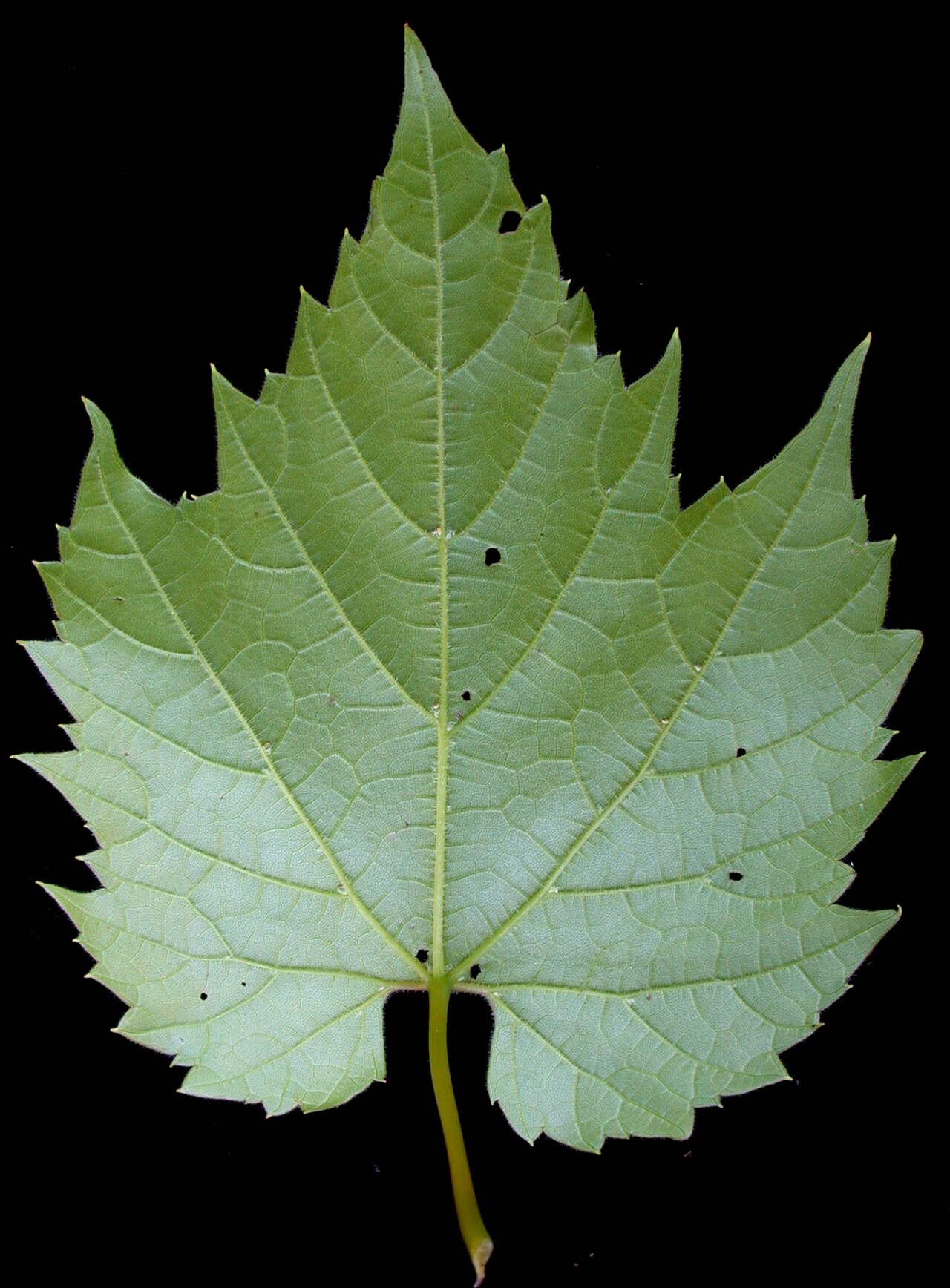
Leaves are alternate, simple, and broadly heart-shaped to three-lobed, 3 to 8 inches across, with coarse, sharp marginal teeth and a deep notch (sinus) where the leaf stalk meets the blade. The upper surface is bright to dark green and essentially hairless at maturity; the lower surface is paler and may carry fine hairs along the veins. Leaf shape is variable even on a single vine — some leaves are nearly unlobed, others distinctly three-lobed — which is normal for this species. Fall color is a clear, soft yellow.
Flowers
In May and June, small, fragrant, greenish-yellow flowers open in branched, cone-shaped clusters (panicles) opposite the leaves. Individual flowers are tiny, with five recurving petals that drop as a unit (a trait unique to grapes among native vines), and the sweet fragrance is strong enough to detect from several feet away on a warm evening.
Fruit & Seeds
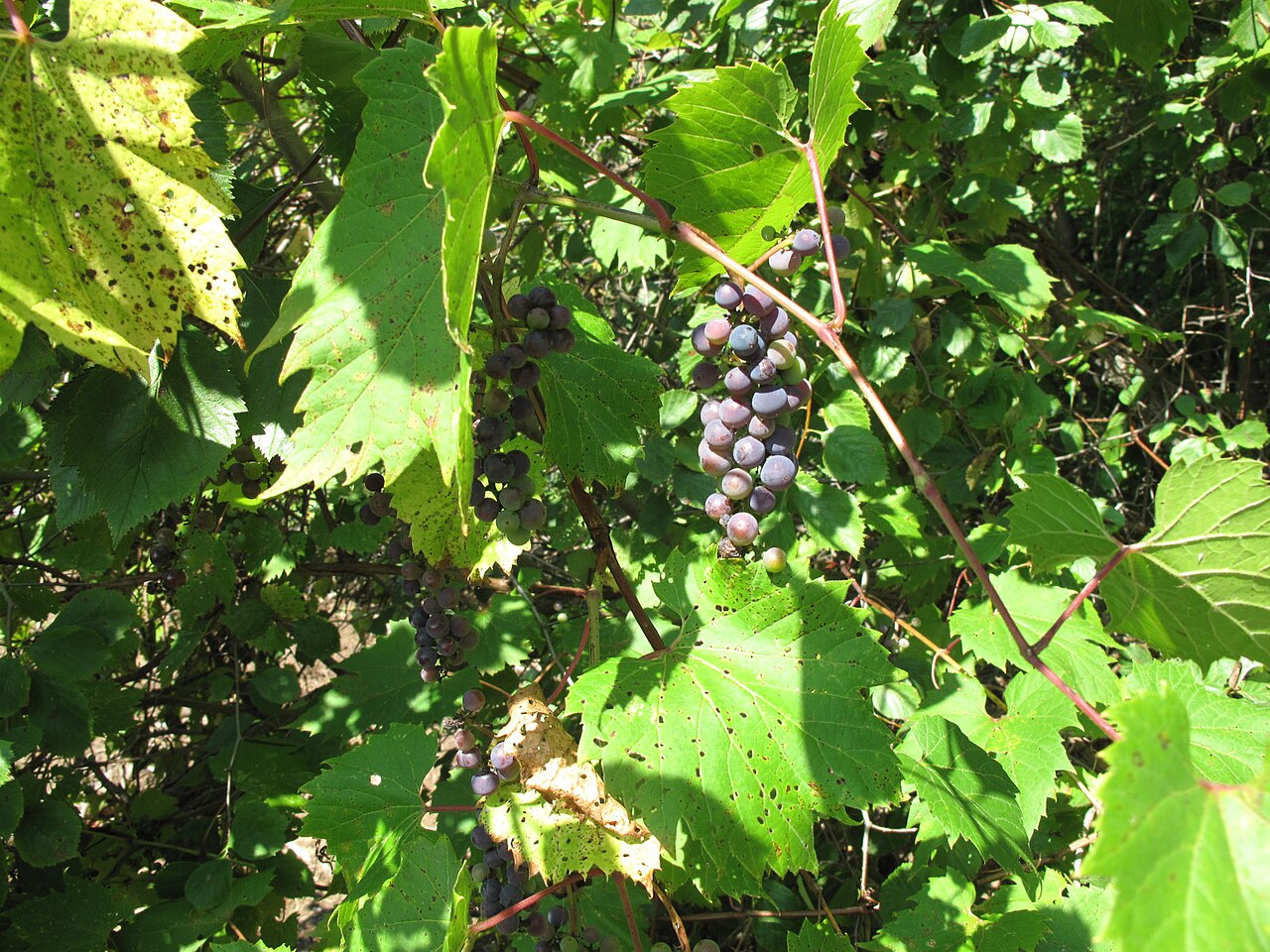
Fruit is a round, juicy grape 1/4 to 1/3 inch across, ripening from green to deep blue-black with a light waxy bloom, borne in loose, drooping clusters of 10 to 40 berries from late August into October depending on latitude. Each grape contains two to four hard seeds. Flavor is tart and acidic with noticeable seediness when eaten fresh — far better suited to jelly, juice, pie, and wine than to the table — and the high acidity and cold hardiness it contributes are exactly why it has been so valuable in grape breeding.
Quick Facts
| Scientific Name | Vitis riparia Michx. |
| Family | Vitaceae (Grape) |
| Plant Type | Deciduous woody climbing vine |
| Mature Height | 20–50 ft (climbing; sprawls lower without support) |
| Mature Spread | 10–20 ft or more |
| Growth Rate | Fast |
| Sun Exposure | Full Sun to Part Shade |
| Water Needs | Moderate to High; best with reliable moisture |
| Soil Type | Moist, well-drained; sandy, loamy, or gravelly riverbank soils |
| Soil pH | 6.0–7.5 |
| Bloom Time | May – June |
| Flower Color | Greenish-yellow, fragrant |
| Fall Color | Soft yellow |
| Fruit | Small blue-black grapes, tart; ripens late summer–fall |
| Deer Resistant | No — foliage is browsed |
| USDA Hardiness Zones | 2–7 |
Native Range
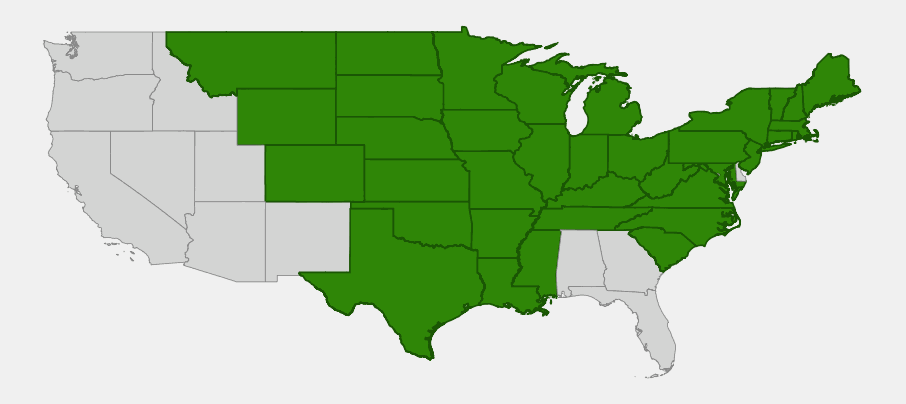
Riverbank Grape has one of the broadest native ranges of any North American grape species, spanning southern Canada from Quebec to Manitoba and a wide swath of the central and eastern United States — from New England and the Great Lakes south through the Appalachians to the Carolinas’ Piedmont, and west across the Great Plains to the Rocky Mountain front in Montana, Wyoming, and Colorado. It reaches south along river corridors into Texas, Louisiana, and Arkansas. It is absent as a native plant from the Deep South coastal plain and peninsular Florida, and from the arid and Mediterranean-climate West — it does not occur naturally in California, Arizona, Nevada, Utah, New Mexico, or most of Oregon, though it is sometimes grown there in vineyards and breeding programs.
True to its common name, Riverbank Grape is a plant of edges and disturbance: riverbanks, floodplain forests, lakeshores, fencerows, thickets, and the sunny margins of woods, where it climbs into the canopy of cottonwoods, willows, box elders, and other floodplain trees. It tolerates occasional flooding and the periodic scouring of riverbanks better than almost any other woody vine, which is part of why it has proven so useful as rootstock and a breeding parent for cold- and wet-tolerant grape cultivars.
Because it spreads readily by seed (birds are enthusiastic distributors) and roots easily from stem fragments along waterways, Riverbank Grape can look weedy in disturbed sites, but within its native range it is a natural and ecologically valuable component of floodplain and riparian plant communities rather than an invasive species.
📋 Regional plant lists featuring Riverbank Grape: Arkansas, Louisiana, Eastern Oklahoma & Eastern Texas · North Dakota, South Dakota & Western Minnesota · Maryland, Virginia & West Virginia · Montana & Wyoming · New Hampshire, Maine & Vermont · Connecticut, Massachusetts & Rhode Island · Georgia, Alabama & Mississippi · Illinois, Iowa & Missouri · Ohio & Indiana · Kentucky & Tennessee · Michigan, Wisconsin & Eastern Minnesota · North Carolina & South Carolina · Nebraska, Kansas & Eastern Colorado · New York, Pennsylvania & Northern New Jersey
Growing & Care Guide
Riverbank Grape rewards almost no effort once established — the challenge with this vine is rarely keeping it alive, but keeping it where you want it.
Light
Full sun produces the heaviest flowering and fruiting, but the vine tolerates part shade well, especially where it can climb up into sunnier tree canopy above a shaded understory. Deep, permanent shade will weaken flowering and fruit set.
Soil & Water
This species is adapted to the moist, periodically flooded soils of riverbanks and floodplains, and it performs best with reliably moist, well-drained soil. It is remarkably tolerant of a wide pH range and of sandy, loamy, or gravelly textures, and established vines handle occasional flooding far better than drought. In drier upland gardens, supplemental water during establishment and in prolonged dry spells keeps the vine vigorous.
Planting Tips
Give Riverbank Grape a sturdy, permanent structure from day one — a stout arbor, pergola, chain-link fence, or large tree — since mature vines become heavy and woody. Plant container stock in spring or fall, 10 to 15 feet from neighboring structures or trees it should not overwhelm. Because wild vines are often either male or female, plant more than one seedling, or a known fruiting (female) selection, if a grape harvest is the goal.
Pruning & Maintenance
Prune in deep winter dormancy only — cutting in spring causes heavy “bleeding” of sap from the wounds. Annual dormant-season pruning keeps the vine within bounds and encourages better fruiting on the current season’s new growth; without it, vines quickly engulf whatever they are growing on. Riverbank Grape has few serious pest or disease problems in the landscape, though it can host the same insects and fungal issues (black rot, powdery mildew) that affect cultivated grapes.
Propagation
Propagates easily from hardwood cuttings taken in winter, from softwood cuttings in summer, or from seed that has been cold-stratified over winter; wild vines also layer naturally where a trailing stem touches moist soil.
Landscape Uses
Riverbank Grape earns its keep in the right setting:
- Streambank and floodplain restoration, where few other native vines tolerate periodic flooding as well
- Wildlife plantings — fragrant spring bloom and heavy fall fruit crop
- Screening a chain-link fence, utility structure, or unsightly view
- Arbor or pergola cover on a structure built to carry real weight
- Naturalized woodland edges where it can climb into mature trees
- Breeding and rootstock stock for gardeners experimenting with cold-hardy grape crosses
Wildlife & Ecological Value
Few native vines match Riverbank Grape’s value to wildlife across the growing season, from spring bloom through the fruit crop that often persists into winter.
For Pollinators
The small but intensely fragrant flowers draw native bees, honeybees, and a range of flies and small beneficial insects during the May–June bloom window, at a time when floodplain habitats can otherwise be light on nectar sources.
For Birds
The fall grape crop is a major food source for dozens of species, including American Robins, Cedar Waxwings, Gray Catbirds, Northern Cardinals, Wood Thrushes, Ruffed Grouse, Wild Turkey, and many migrating songbirds that depend on fruit to fuel fall migration. The dense tangle of vines also provides excellent cover and nesting sites.
For Mammals
Raccoons, foxes, black bears, and squirrels all eat the fruit, and white-tailed deer and rabbits browse the foliage and young stems — enough that deer pressure can slow establishment of young vines. The shredding bark is sometimes used by birds and small mammals as nesting material.
Ecosystem Role
As a dominant vine of floodplain forests, Riverbank Grape helps stabilize streambank soils with its extensive root system and contributes structural complexity to riparian habitat. Its tolerance of flooding and disturbance lets it colonize bare, scoured riverbanks quickly, providing an early foothold of vegetation that stabilizes soil until slower-growing trees and shrubs establish.
Cultural & Historical Uses
Riverbank Grape has long been gathered by Indigenous peoples across its range for food — the tart fruit was eaten fresh, dried, or cooked into sauces — and the young leaves were historically used, wrapped around other foods for cooking, in the same tradition as cultivated grape leaves. Early European settlers likewise made use of the abundant wild fruit for jelly, juice, pie, and homemade wine, and the vine’s tough, flexible stems saw informal use for rough cordage and basketry.
The species’ greatest historical significance, however, is horticultural rather than culinary. In the late 1800s, European wine grapes (Vitis vinifera) were devastated by phylloxera, a root-feeding insect accidentally introduced from North America. Because Vitis riparia and other American grape species had co-evolved with phylloxera and developed resistance, grafting European vinifera varieties onto Riverbank Grape rootstock saved the European wine industry — a practice still standard in vineyards worldwide today. Its extreme cold tolerance has also made it the key parent species behind cold-climate hybrid wine grapes such as Frontenac, Marquette, and St. Croix, bred for regions too cold for traditional wine grapes.
Today, Riverbank Grape is grown far more often as a genetic resource and landscape vine than as a fruit crop in its own right, but foragers throughout its native range still gather the wild fruit each fall, and the species remains a living link to the rootstock that quietly rescued the world’s vineyards.
Frequently Asked Questions
Is Riverbank Grape fruit edible?
Yes — the ripe grapes are edible and safe, though tart, seedy, and better suited to jelly, juice, or wine than fresh eating. Fruit should be fully ripe (deep blue-black, soft) for the best flavor; unripe green grapes are very sour.
How can I tell Riverbank Grape apart from Virginia Creeper or Poison Ivy vines?
Riverbank Grape has shredding, papery bark and single, forked tendrils opposite the leaves, with simple (not compound) three-lobed leaves. Virginia Creeper has compound leaves of five leaflets and adhesive tendril discs; Poison Ivy climbs by aerial rootlets, not tendrils, and has compound leaves of three leaflets. Neither Virginia Creeper nor Poison Ivy has grape’s shredding bark.
Will Riverbank Grape kill the tree it climbs?
A heavy, mature vine can shade out and weaken a small or already-stressed tree over time, and the added weight can increase storm damage risk, but the vine itself is not parasitic — it does not tap into the tree’s vascular tissue. On large, healthy trees it is rarely a serious problem; on small ornamentals, prune it back or give it its own structure instead.
Is Riverbank Grape the same as the grapes used to make wine?
Not directly — most wine is made from Vitis vinifera or modern hybrids. But Riverbank Grape is one of the most important genetic parents behind cold-hardy hybrid wine grapes, and its roots are widely used as phylloxera-resistant rootstock for grafting vinifera vines.
Is this vine invasive?
Within its native range, Riverbank Grape is a natural, beneficial part of floodplain plant communities, not an invasive species. It can spread vigorously by seed and root readily where stems touch soil, so in a garden setting it benefits from a sturdy structure and occasional pruning to keep it in bounds — but this is vigor, not invasiveness, since the species belongs in these ecosystems.

Looking for a nursery that carries Riverbank Grape?
Browse our native plant nursery directory: Arkansas · Colorado & Connecticut · Illinois, Indiana, Iowa & Kansas · Kentucky, Louisiana, Maine, Maryland, Massachusetts, Michigan, Minnesota, Mississippi, Missouri & Montana · Nebraska, New Hampshire, New Jersey, New York, North Carolina, North Dakota, Ohio & Oklahoma · Pennsylvania, Rhode Island, South Carolina, South Dakota, Tennessee, Texas, Vermont & Virginia · West Virginia, Wisconsin & Wyoming