
Twinflower (Linnaea borealis)
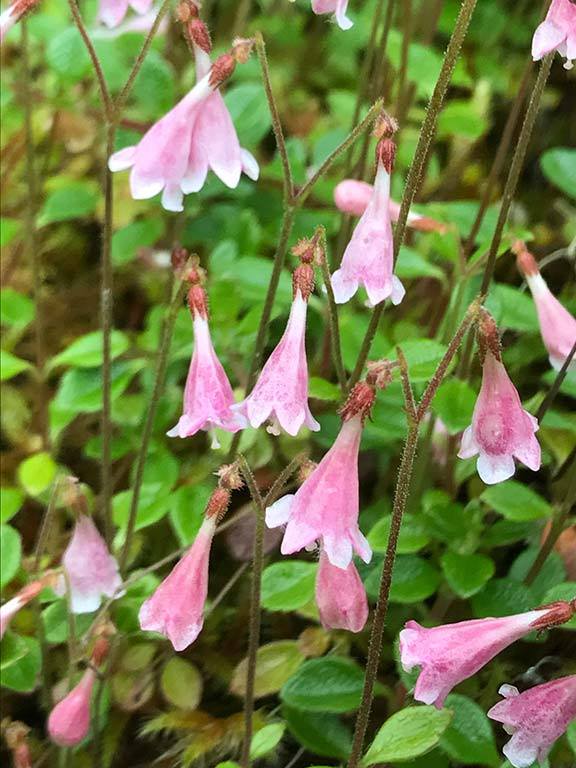
Linnaea borealis, commonly called Twinflower, is a small, trailing evergreen subshrub of cool northern and montane forests, named for its matched pairs of pink-and-white, bell-shaped flowers that nod from the tips of slender, upright stalks. It forms a low, wiry mat of rounded, glossy leaves just an inch or two tall, creeping quietly across the forest floor in the deep shade of spruce, fir and northern hardwoods.
Twinflower was the favorite plant of Carl Linnaeus, the Swedish botanist who founded modern plant naming, and the genus was named for him in his own lifetime; he is often portrayed in portraits holding a twinflower sprig. In the wild it spreads slowly by trailing stems that root as they go, gradually weaving a carpet under conifers across the far north, with scattered outlying populations in cool, high-elevation forests farther south.
For gardeners in cold, shaded sites, twinflower is a charming, low-maintenance native groundcover that asks for little beyond consistent moisture, acidic soil and shade. It is not a plant for hot, dry or sunny gardens, but where conditions suit it, its tiny paired flowers and sweet, faint fragrance reward a close look each early summer.
Identification
Twinflower is easy to overlook until it blooms, since the trailing mat of small leaves hugs the ground and the flower stalks are thin and often hidden among taller plants.
Stems & Growth Habit
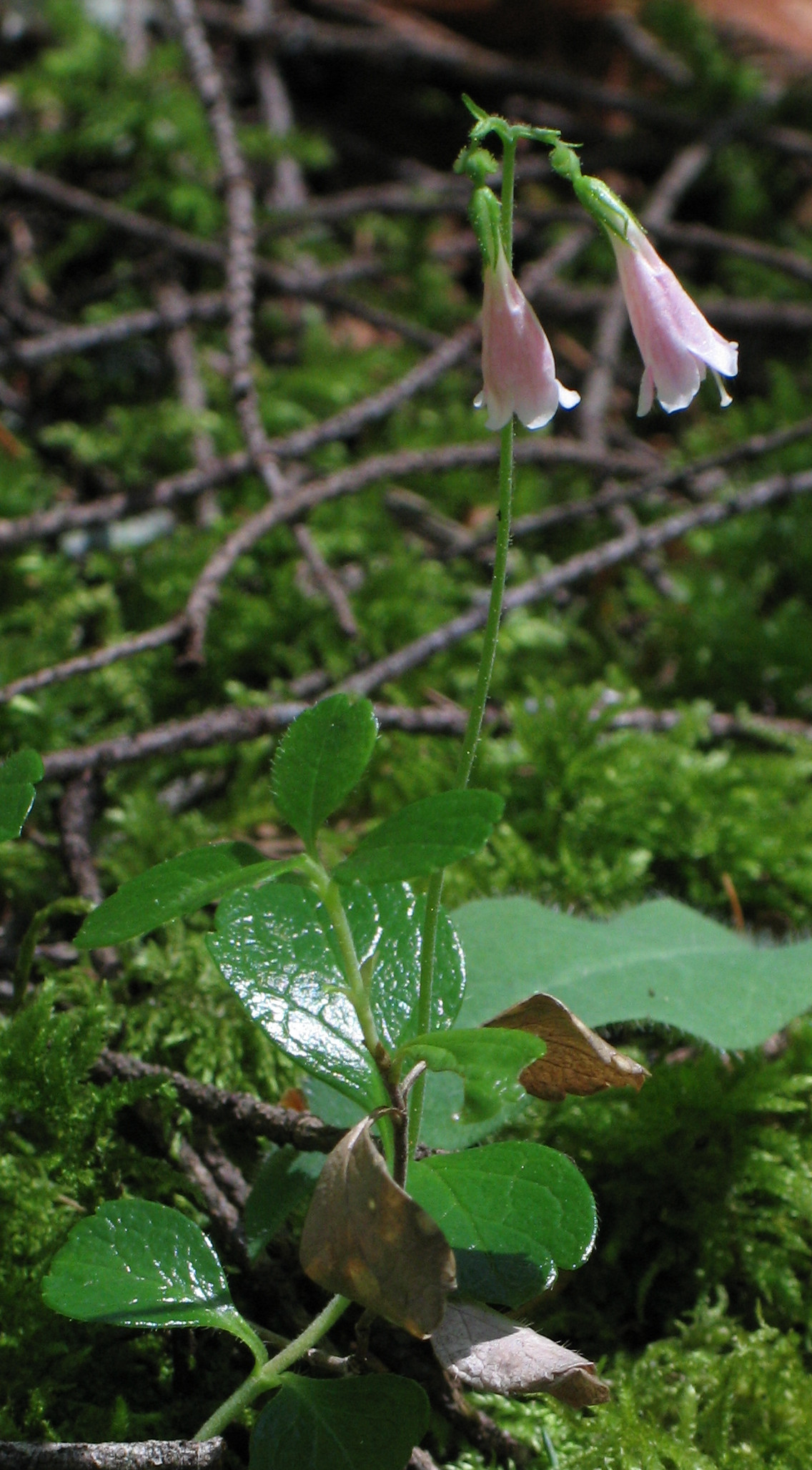
Twinflower grows as a creeping, mat-forming subshrub, with slender, woody, trailing stems that run along or just under the moss and leaf litter, rooting at the nodes as they spread. Upright flowering stalks rise just 2 to 4 inches above the mat, each topped with the paired blossoms that give the plant its name.
Leaves
The leaves are small, opposite, rounded to oval, roughly 1/2 to 1 inch long, with a few shallow teeth near the tip and a glossy, slightly leathery texture. They are evergreen, staying green through winter under snow cover, which makes twinflower a welcome spot of color on an early spring forest floor.
Flowers & Fruit
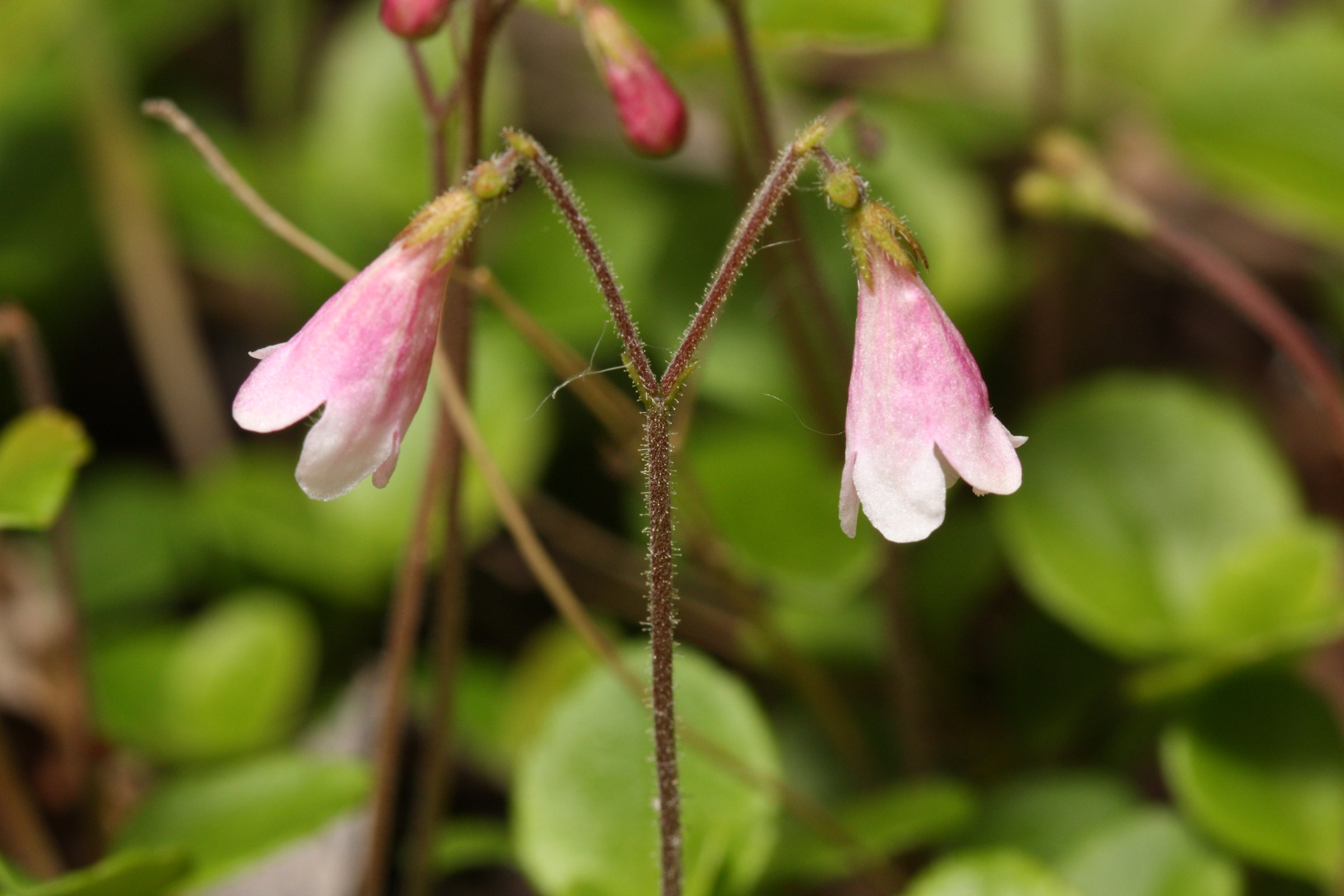
Each thin, upright flower stalk forks at the top into two short pedicels, each bearing one nodding, bell-shaped flower about 1/3 to 1/2 inch long, pale pink to rose on the outside and whitish within, often with darker pink veining. The flowers are sweetly fragrant, especially in the evening, and bloom from late spring into midsummer depending on elevation and latitude. They are followed by small, dry, bristly fruits that cling to fur and clothing for dispersal.
Quick Facts
| Scientific Name | Linnaea borealis |
| Family | Caprifoliaceae (Honeysuckle) |
| Plant Type | Evergreen trailing subshrub / groundcover |
| Mature Height | 2–4 in (flowering stalks) |
| Mature Spread | Indefinite; spreads slowly by rooting stems |
| Growth Rate | Slow |
| Sun Exposure | Part Shade to Shade |
| Water Needs | Average to moist; does not tolerate drought |
| Soil Type | Humusy, moist, well-drained forest soil; tolerates moss and duff |
| Soil pH | Acidic (about 4.5–6.0) |
| Bloom Time | Late spring – midsummer |
| Flower Color | Pale pink to rose, fading white within |
| Fall Color | None (evergreen) |
| Fruit | Small, dry, bristly nutlets |
| Deer Resistant | Moderate |
| USDA Hardiness Zones | 2–6 |
Native Range
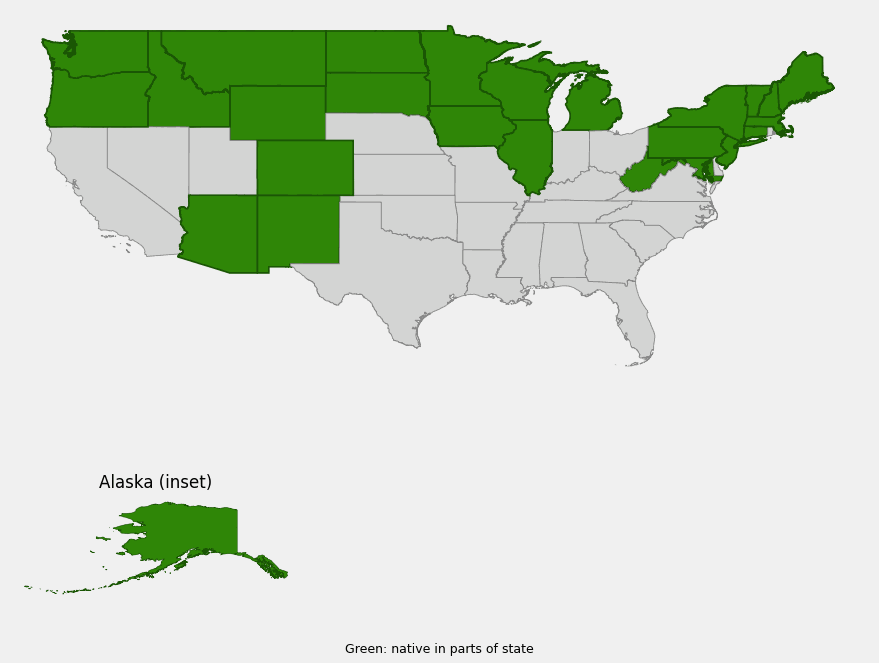
Twinflower is circumboreal, growing across the cool forests of the Northern Hemisphere, and in North America it is widespread through Alaska and Canada. In the Lower 48 it ranges across the northern tier and extends south at higher, cooler elevations through the Rocky Mountains to Arizona and New Mexico, along the Pacific Coast ranges into northern California (no dedicated California list exists on this site), through the northern Great Lakes states, and down the Appalachians to West Virginia and Maryland.
Twinflower is genuinely rare or very local at the southern edge of its range. It is uncommon in Connecticut and Massachusetts, and current state botanical surveys list it as extirpated or presumed extirpated in Ohio, Indiana and Rhode Island and possibly extirpated in Tennessee, so gardeners in those states should not expect to find it growing wild today even though historical records exist. In the Southwest it survives only in a few high, cool mountain pockets of Arizona and New Mexico.
Typical habitat is the deep, acidic duff of coniferous and mixed forests: spruce-fir woods, moist Douglas-fir and hemlock forests, peaty bogs and mossy hummocks, usually in constant shade with cool, steady moisture. It associates with bunchberry, wintergreen, mosses and other acid-loving forest-floor plants, and with conifers such as spruce, fir, hemlock and paper birch forming the canopy above.
📋 Regional plant lists featuring Twinflower: Alaska · Montana & Wyoming · Idaho, Eastern Oregon & Eastern Washington · Western Oregon & Western Washington · Utah & Western Colorado · Arizona & New Mexico · North Dakota, South Dakota & Western Minnesota · Michigan, Wisconsin & Eastern Minnesota · Illinois, Iowa & Missouri · New Hampshire, Maine & Vermont · Connecticut, Massachusetts & Rhode Island · New York, Pennsylvania & Northern New Jersey · Maryland, Virginia & West Virginia
Growing & Care Guide
Twinflower is simple to please once you match its narrow preferences: cool roots, steady moisture, acidic soil and shade. Outside of those conditions it struggles, so site selection matters more than ongoing maintenance.
Light
Give twinflower part shade to full shade, as under conifers or north-facing woodland edges. It is naturally an understory plant and will scorch or dry out in strong, direct sun, especially in warmer parts of its range.
Soil & Water
Plant in humusy, acidic, well-drained soil that stays consistently cool and moist, much like a conifer forest floor built up with needles and moss. Twinflower does not tolerate drought or compacted clay; a soil amended with pine needle duff, chopped leaves or peat moss mimics its natural bed. Keep the root zone moist through dry spells, especially the first two seasons, and maintain a steady organic mulch rather than letting the surface dry and crust.
Planting Tips
Set out nursery-grown plants or rooted cuttings in spring or fall into prepared, humus-rich soil in shade. Because twinflower spreads by trailing, rooting stems, give it room to creep rather than crowding it with aggressive neighbors. It is best used as a small-scale groundcover in a shaded rock garden, conifer bed or woodland path edge rather than as a large-area lawn substitute, since establishment and spread are both slow.
Pruning & Maintenance
Twinflower needs essentially no pruning. Leave the evergreen mat alone through winter, and simply trim back any dead or tattered growth in early spring if it looks ragged after a hard winter. It has few pests or diseases when grown in the cool, moist, shaded conditions it prefers; stress from heat or drought is the main threat to its health.
Propagation
The easiest way to propagate twinflower is by division or by rooting stem cuttings, since the trailing stems root naturally at the nodes; a rooted section can simply be cut free and transplanted. Seed propagation is possible but slow and often erratic, requiring cold, moist stratification over winter and patience through an uneven germination period.
Landscape Uses
- Shaded woodland groundcover under spruce, fir, hemlock or other conifers
- Acidic rock gardens and shaded rockeries in cold-winter climates
- Native plant collections paired with bunchberry and other boreal forest-floor species
- Northern bog garden edges where soil stays consistently moist and acidic
- Small-scale path or stepping-stone borders in a shaded, cool woodland setting
Wildlife & Ecological Value
Though diminutive, twinflower plays a steady supporting role in the cool forests where it grows.
For Pollinators
The fragrant, nectar-rich flowers attract a range of small bees, flies and occasionally butterflies and moths, including some specialist bumblebee visits, making twinflower a modest but reliable nectar source in the generally flower-poor conifer forest understory.
For Birds
The low, evergreen mat offers ground-level cover for small birds foraging through the forest floor, though twinflower is not a major food source for birds; its ecological value lies more in habitat structure than in seeds or fruit.
For Mammals
Small mammals move through and shelter in twinflower’s dense mats, and the bristly fruits cling to fur, hitching a ride to new patches of forest floor. Deer and other browsers generally leave the evergreen foliage alone, which helps twinflower persist in areas with heavy browsing pressure.
Ecosystem Role
As a slow-spreading evergreen groundcover, twinflower helps stabilize the thin organic layer on forest floors and contributes structure and moisture retention to the understory. Its presence is often considered an indicator of an undisturbed, long-established conifer forest, since it colonizes slowly and does not quickly recover once an area is heavily disturbed.
Cultural & Historical Uses
Twinflower holds a special place in the history of botany: it was reportedly Carl Linnaeus’s favorite plant, and the genus Linnaea was named in his honor during his own lifetime by his mentor, the Dutch botanist Jan Frederik Gronovius. Linnaeus is frequently depicted in portraits holding a sprig of twinflower, cementing its association with the founder of modern taxonomy.
Some northern Indigenous and First Nations communities used twinflower in traditional medicine, including as a treatment for colds, rheumatism and related ailments; these are historical ethnobotanical uses, not modern medical advice, and no part of the plant should be regarded as an herbal remedy without professional guidance.
Beyond its historical and symbolic importance, twinflower has long been valued simply as a woodland curiosity, prized by foragers and forest walkers in the North for its surprising, sweet fragrance drifting up from a plant easily missed underfoot.
Frequently Asked Questions
Why is it called twinflower?
Each upright flower stalk forks into two stems, with one nodding, bell-shaped flower on each, so the blossoms always appear in matched pairs. That paired arrangement is the source of both the common name and the connection to Linnaeus, who treasured the plant.
Can I grow twinflower in a sunny garden?
No. Twinflower is a shade-loving forest-floor plant and will struggle or scorch in full sun, especially with any drought stress. It needs the cool, shaded, consistently moist conditions of a woodland setting.
Is twinflower native to my state?
It depends on your local climate and elevation. Twinflower is native across Alaska and Canada and much of the northern and mountainous United States, but it is absent, rare or historically extirpated across most of the warmer central and southeastern states; check the range map and regional lists above before planting it as a native in your area.
How fast does twinflower spread?
Slowly. Its trailing stems root as they creep, gradually widening a patch over several years rather than filling in quickly, so it suits small, patient plantings better than fast groundcover needs.
Does twinflower need acidic soil?
Yes, it performs best in acidic, humus-rich soil similar to a conifer forest floor. Alkaline or heavy clay soils are generally unsuitable without significant amendment.

Looking for a nursery that carries Twinflower?
Browse our native plant nursery directory: Alaska & Arizona · Washington · Oregon · Idaho, Illinois & Iowa · Montana, Minnesota, Michigan, Maine, Massachusetts & Maryland · Wyoming, Wisconsin & West Virginia · Colorado & Connecticut · New Mexico, North Dakota, New York, New Hampshire & New Jersey · South Dakota, Vermont & Pennsylvania · California