
Swamp Loosestrife (Decodon verticillatus)
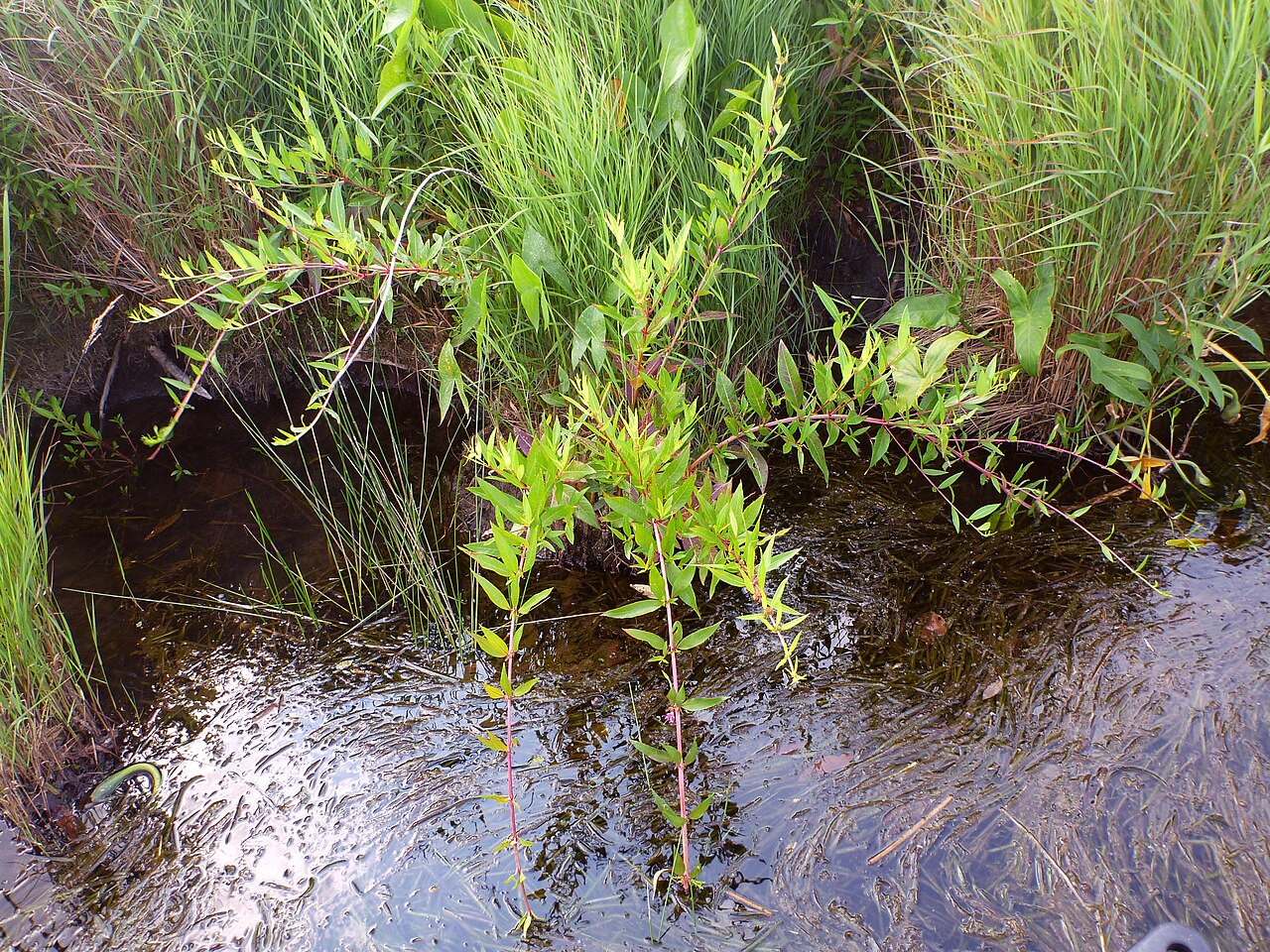
Decodon verticillatus, commonly called swamp loosestrife or water willow, is a native wetland shrub of the eastern United States and eastern Canada, found arching gracefully over the shallow water of ponds, swamps, and marsh edges from Maine to Florida and west to Minnesota, Louisiana, and eastern Texas. It is easily confused by name with purple loosestrife (Lythrum salicaria), an aggressive Eurasian invasive — but the two are unrelated in behavior: swamp loosestrife is a well-mannered native that belongs in restoration and rain garden plantings, not a plant to control or remove.
The defining feature of swamp loosestrife is its growth habit: long, arching, woody-based stems bow out over the water and root wherever the tips touch mud or shallow water, forming dense, looping thickets at the margins of ponds and sluggish streams. In mid- to late summer, clusters of star-shaped rose-pink flowers line the leaf axils, drawing a steady traffic of native bees. By autumn the foliage often turns a rich burgundy-red, adding late-season color to wetland edges that few other native shrubs can match.
Swamp loosestrife is an excellent choice for pond margins, rain gardens, and bioswales where standing or seasonally saturated water is a given rather than a problem. It tolerates wet feet that would kill most ornamental shrubs, stabilizes soft banks with its rooting stems, and asks for almost nothing once established in the right spot.
Identification
Swamp loosestrife is a clump-forming, shrubby perennial typically 3 to 8 feet tall, with long, angular, arching stems that are smooth and reddish when young, becoming woody and somewhat corky-barked near the base with age. The overall form is loose and fountain-like rather than upright and dense, especially where stem tips have rooted and sent up new growth some distance from the original clump.
Stems
Stems are four- to five-angled, smooth, and often reddish to purplish, arching outward and downward under their own weight. Where a stem tip bows over and touches mud or shallow water, it readily roots and can produce a new shoot, which is the main way a single plant spreads into a broad colony over time.
Leaves
Leaves are lance-shaped, 3 to 5 inches long and up to an inch wide, arranged in opposite pairs or whorls of three to four along the stem. They are smooth and dark green above with fine hairs on the underside, tapering to a point, and turn shades of burgundy to wine-red in fall before dropping.
Flowers & Fruit
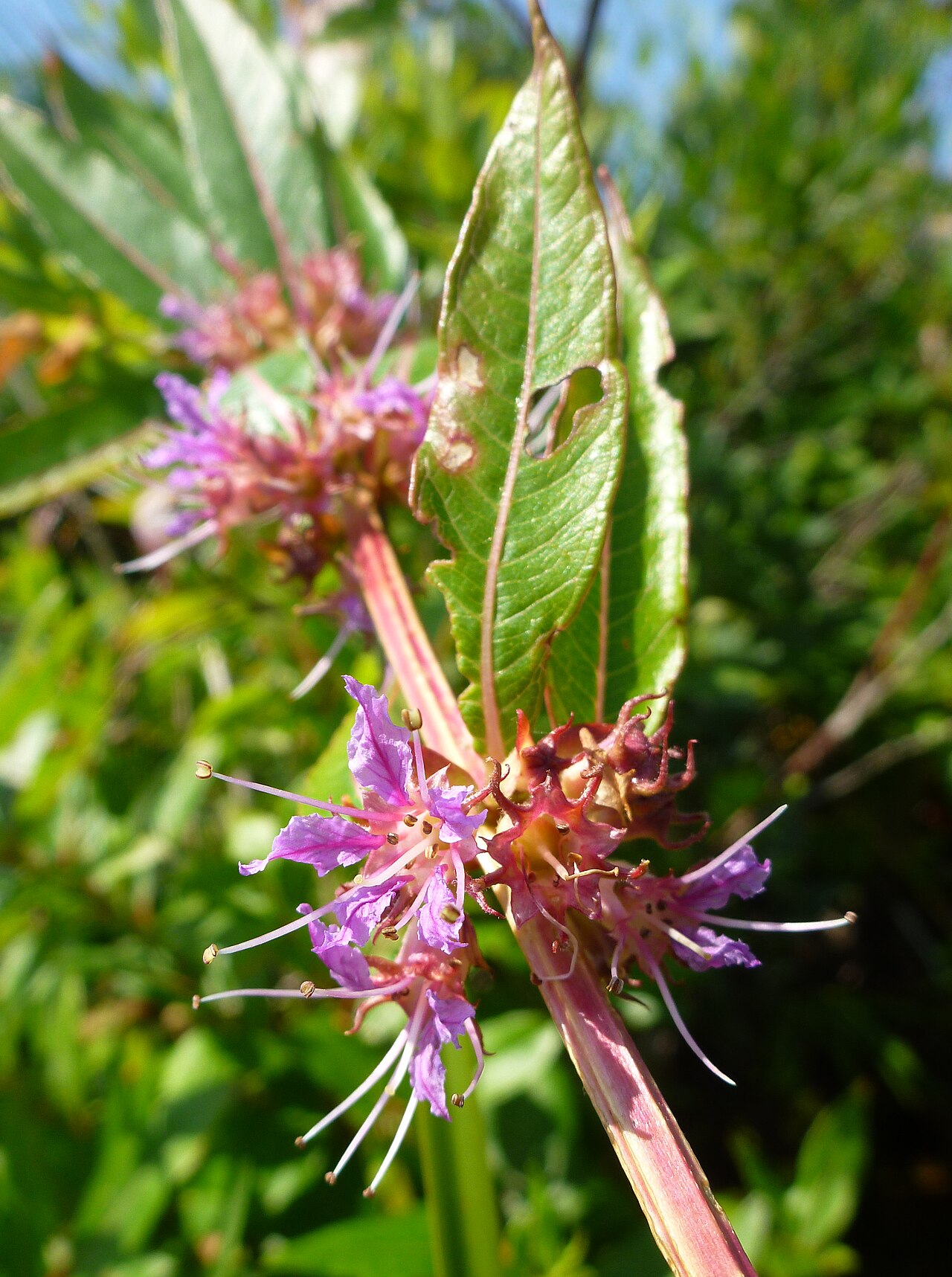
From July through September, clusters of small, star-shaped, rose-pink to magenta flowers emerge from the leaf axils along the arching stems, each with five narrow, often wavy-edged petals and prominent, unequal stamens that give the bloom a slightly shaggy look. The fruit that follows is a small, rounded, dark brown capsule packed with numerous reddish seeds, persisting into winter after the leaves have fallen.
Quick Facts
| Scientific Name | Decodon verticillatus |
| Family | Lythraceae (Loosestrife) |
| Plant Type | Deciduous wetland shrub |
| Mature Height | 3–8 ft |
| Mature Spread | 4–8 ft, often wider via rooting stem tips |
| Growth Rate | Moderate to fast in saturated soil |
| Sun Exposure | Full sun to part shade |
| Water Needs | High; tolerates standing water |
| Soil Type | Wet, mucky, or peaty; pond and stream margins |
| Soil pH | 5.0–7.0 (acidic to neutral) |
| Bloom Time | July – September |
| Flower Color | Rose-pink to magenta |
| Fall Color | Burgundy to wine-red |
| Fruit | Small brown capsule with reddish seeds |
| Deer Resistant | Moderate |
| USDA Hardiness Zones | 4–9 |
Native Range
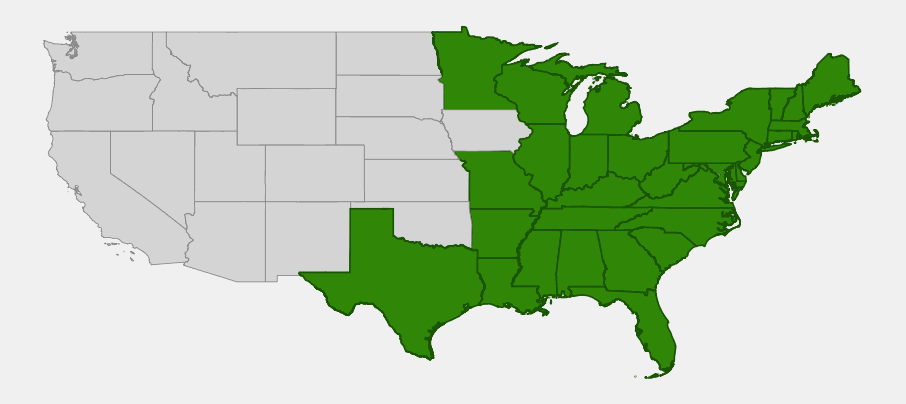
Swamp loosestrife is native to the eastern United States and adjoining Canada, occurring from Maine south through the Atlantic and Gulf coastal states to Florida, west through the Ohio and Tennessee Valleys, and along the Mississippi River drainage into Minnesota, Missouri, and Illinois. It reaches its western native limit in eastern Texas and Louisiana, and extends north into Ontario and other parts of eastern Canada.
Within this range it is a specialist of still or slow-moving fresh water: pond and lake margins, marsh edges, swamp hummocks, oxbow sloughs, and roadside ditches with consistently wet or saturated soil. It often grows alongside buttonbush, swamp rose, and various sedges, forming the shrubby fringe between open water and surrounding wetland vegetation.
Because swamp loosestrife needs reliably wet to saturated soil, it is naturally absent from the arid and semi-arid West and much of the Great Plains, where suitable wetland habitat of this type is scarce; it should not be expected to perform outside a genuinely wet planting site even within states where it is native.
📋 Regional plant lists featuring Swamp Loosestrife: New Hampshire, Maine & Vermont, Connecticut, Massachusetts & Rhode Island, New York, Pennsylvania & Northern New Jersey, Delaware, Southern New Jersey & Long Island, Maryland, Virginia & West Virginia, North Carolina & South Carolina, Georgia, Alabama & Mississippi, Arkansas, Louisiana, Eastern Oklahoma & Eastern Texas, Kentucky & Tennessee, Ohio & Indiana, Illinois, Iowa & Missouri, Michigan, Wisconsin & Eastern Minnesota
Growing & Care Guide
Swamp loosestrife is built for the one condition that frustrates most shrub choices: reliably wet soil. If a planting site stays soggy or holds standing water for part of the year, this is a plant that will reward the challenge rather than fight it.
Light
Full sun produces the densest form and best flowering and fall color, but swamp loosestrife tolerates part shade well, making it useful along the dappled edges of wooded wetlands and shaded pond margins.
Soil & Water
This shrub wants consistently wet to saturated soil and tolerates shallow standing water at the base — conditions that would rot most garden shrubs outright. Rich, mucky, or peaty wetland soils are ideal; it does poorly in soil that dries out for extended periods. Once sited correctly, it needs no supplemental care beyond what the wetland provides.
Planting Tips
Plant along pond edges, in rain garden basins, bioswales, or any low spot that collects and holds water seasonally. Space plants 4 to 6 feet apart to allow for the arching, spreading habit, and expect a single plant to expand its footprint over several years as stem tips root into the surrounding mud. Container-grown stock establishes readily when planted in spring or early fall.
Pruning & Maintenance
Little pruning is required. Cut back winter-killed or overly sprawling stems in late winter to maintain a tidier form, or let the plant arch and spread naturally for a more informal wetland look. Rooted stem tips can be separated and transplanted if a more compact single clump is preferred over a spreading colony.
Landscape Uses
- Pond and lake margin plantings where the shoreline stays consistently damp
- Rain gardens and bioswales that handle periodic standing water
- Wetland and shoreline restoration for soft-bank stabilization
- Native wildlife garden — summer flowers and dense cover near water
- Naturalized plantings at the edges of constructed stormwater ponds
Wildlife & Ecological Value
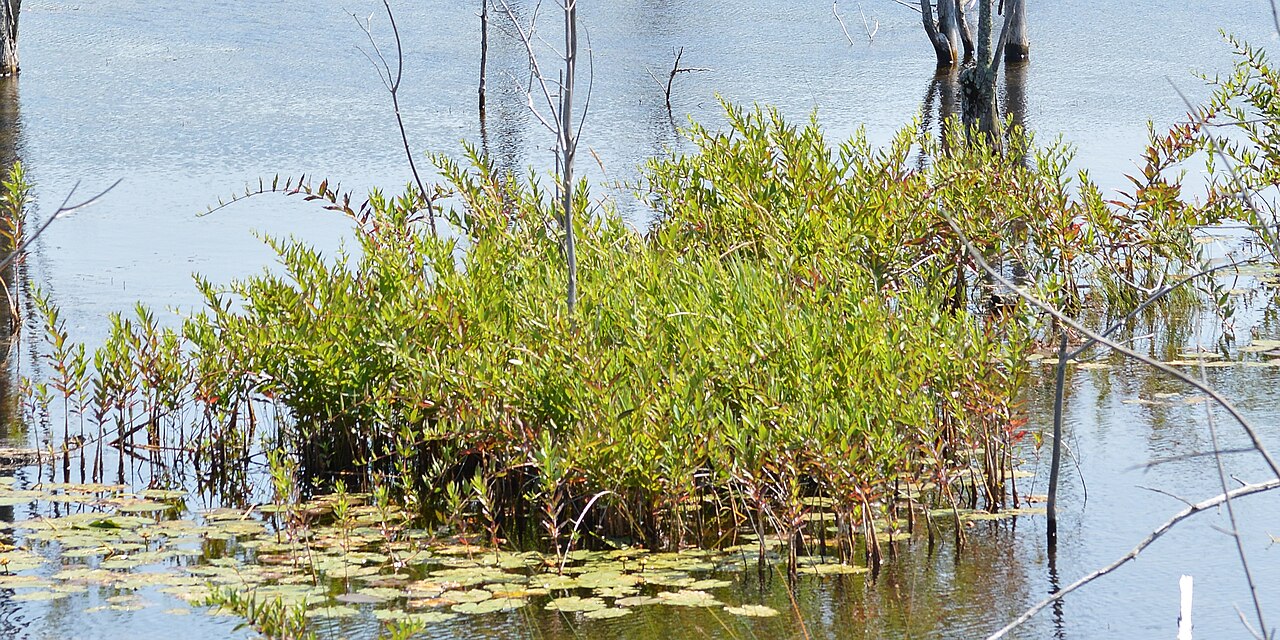
Swamp loosestrife plays a quiet but steady ecological role at the water’s edge, offering both food and physical structure in a habitat zone that is often squeezed between open water and dry land.
For Pollinators
The summer flowers are a significant nectar and pollen source for native bees, including specialist and generalist species that work the star-shaped blooms through the peak of the growing season, when many other wetland plants have finished flowering.
For Birds
The dense, arching thickets provide nesting cover and predator refuge for marsh-edge birds, while the persistent seed capsules offer a modest winter food source after other seed sources have been exhausted.
For Insects
Swamp loosestrife is a larval host plant for the hydrangea sphinx moth and the water willow stem borer moth, both of which depend specifically on this and closely related wetland plants to complete their life cycle.
Ecosystem Role
The rooting, arching stems help stabilize soft, saturated pond and marsh margins against erosion, while the dense thickets slow water movement at the shoreline and trap sediment, gradually building and protecting the wetland edge over time.
Cultural & Historical Uses
Swamp loosestrife has a long history of informal use in traditional wetland plant knowledge among Indigenous peoples of the eastern United States and Canada, generally as a minor component of regional plant lore rather than a major food, medicine, or material source; detailed documented traditional uses are sparser for this species than for many other wetland natives.
In more recent horticultural history, swamp loosestrife has sometimes been confused with the unrelated and highly invasive purple loosestrife (Lythrum salicaria) simply because of the shared common name “loosestrife.” This confusion has occasionally led well-meaning restoration volunteers to mistakenly remove the native swamp loosestrife during invasive purple loosestrife control efforts — a mix-up worth avoiding, since the two plants have very different leaves, flower arrangement, and ecological behavior.
Today swamp loosestrife’s primary recognized value is ecological and horticultural: a reliable native shrub for wetland restoration, pond landscaping, and rain garden design in regions where standing or seasonally saturated water limits other planting choices.
Frequently Asked Questions
Is swamp loosestrife related to the invasive purple loosestrife?
No. They share part of a common name and both grow in wet habitats, but they are different genera. Swamp loosestrife (Decodon verticillatus) is a well-behaved native shrub, while purple loosestrife (Lythrum salicaria) is an aggressive, non-native invasive that should be removed where found. Do not confuse the two when doing wetland restoration or control work.
Can swamp loosestrife handle standing water?
Yes. It is one of the relatively few native shrubs that actively tolerates shallow standing water at its base and even roots readily where its arching stem tips touch the water’s surface.
Will it grow in a regular garden bed that isn’t wet?
Not well. Swamp loosestrife is a true wetland specialist and will struggle or fail in soil that dries out during the growing season. It is best reserved for pond margins, rain gardens, and other consistently damp sites.
Does swamp loosestrife spread aggressively?
It spreads locally by rooting its arching stem tips, which can expand a single plant’s footprint over several seasons, but it is not considered weedy or invasive within its native range and stays within the wet habitat it needs rather than colonizing dry upland areas.
What gives swamp loosestrife its fall color?
The lance-shaped leaves typically shift to burgundy and wine-red tones in autumn before dropping, adding seasonal interest to pond and marsh-edge plantings after the summer flowers have finished.

Looking for a nursery that carries Swamp Loosestrife?
Browse our native plant nursery directory: ME/MA/MD/MS/LA/KY/MO/MI/MN · NH/NY/NJ/NC/OH · VT/RI/PA/VA/SC/TX/TN · CT/DE/GA/FL · WV/WI · AL/AR · IN/IL