Sego Lily (Calochortus nuttallii)
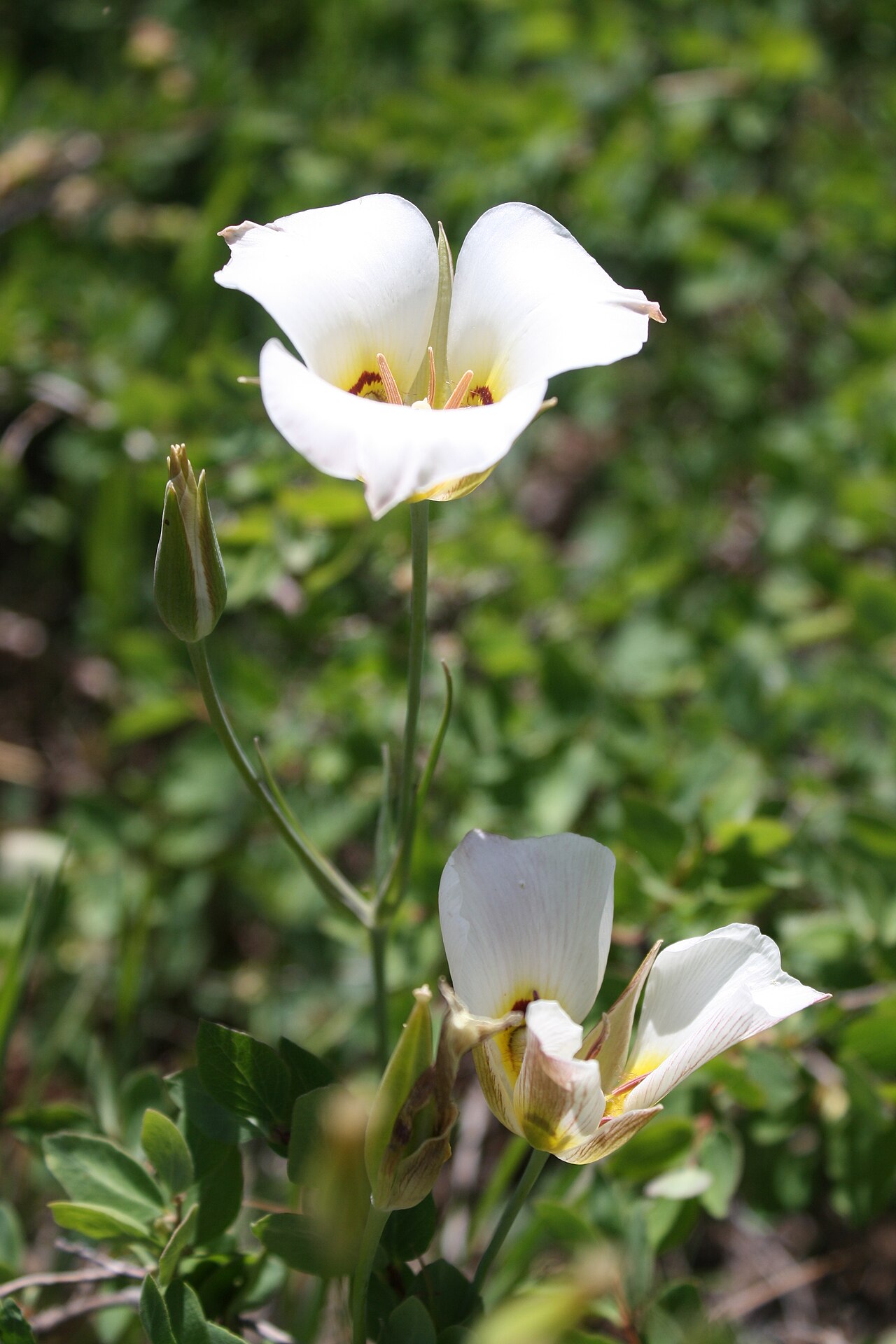
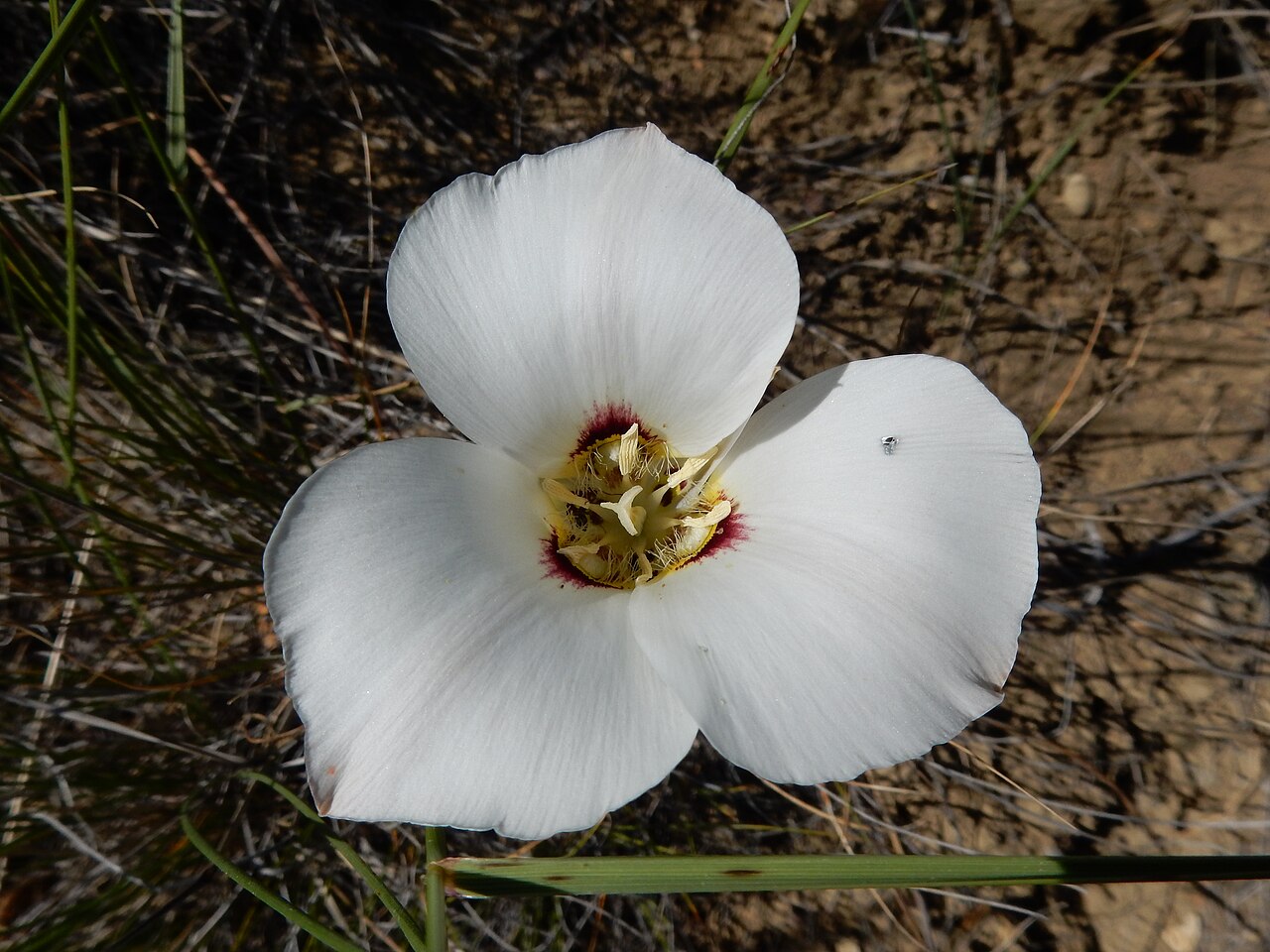
Calochortus nuttallii, commonly called sego lily, is the delicate, three-petaled wildflower that became the official state flower of Utah in 1911 — chosen in part for the role its bulb played in helping Mormon pioneers survive a food shortage in 1848. The genus name Calochortus comes from Greek for “beautiful grass,” a fitting description for a plant whose narrow, grass-like leaves give little hint of the striking flower that rises above them for a few weeks each early summer.
Sego lily grows from a small, deep bulb and sends up a slender, 6-to-18-inch stem topped by one to several cup-shaped flowers, usually white to pale lavender with a bold maroon-and-yellow band at the base of each petal. It is a plant of dry, open country — sagebrush flats, piñon-juniper woodlands, and high desert grasslands across the Intermountain West — and it has adapted to exactly the boom-and-bust rainfall pattern of that landscape, sometimes blooming in great abundance after a wet winter and sitting dormant underground through dry years.
For gardeners in the Mountain West, sego lily is a reward for patience: slow to establish from seed and best left undisturbed once planted, but unmatched for bringing an authentic piece of high-desert wildflower country into a dry, sunny rock garden or native meadow planting.
Identification
Sego lily is a perennial, bulb-forming herb in the lily family, typically 6 to 18 inches tall, though plants can reach nearly 2 feet in favorable sites. Each plant grows from a small, deep-seated bulb that allows it to persist underground through drought, fire, and winter cold, resprouting each spring from stored reserves.
Leaves
The leaves are narrow, linear, and grass-like, usually one per stem arising near the base, 4 to 10 inches long, with additional smaller leaves scattered up the flowering stem. They are easy to overlook among surrounding grasses until the flowers appear.
Flowers
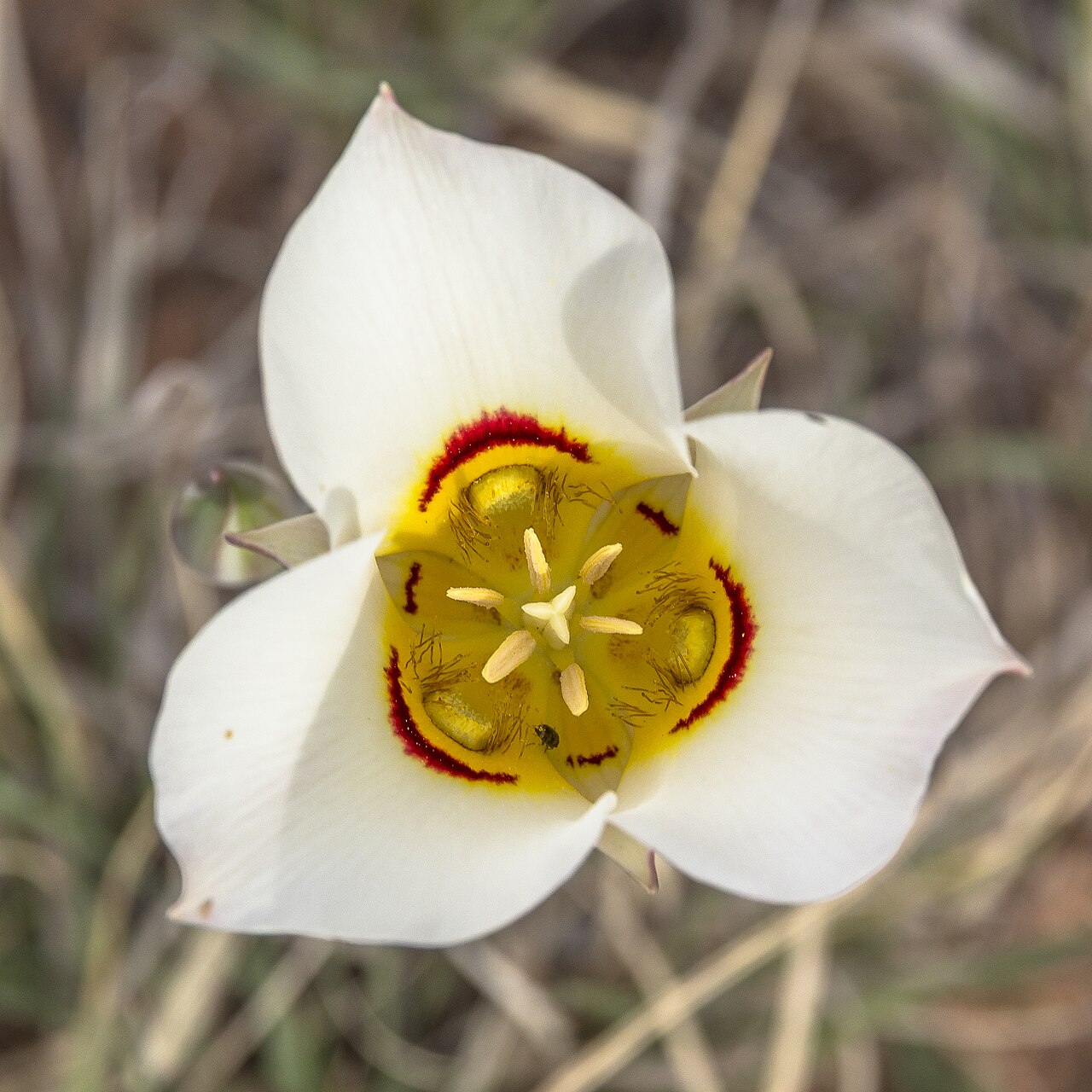
Each stem carries one to five, more often one to three, upward-facing or slightly nodding flowers, 1½ to 2½ inches across. The three broad, rounded petals are usually white to pale lavender or pale pink, each marked near the base with a distinctive crescent of deep maroon-purple above a patch of yellow, and often fringed with fine hairs — a combination that functions as a nectar guide for pollinating insects. Occasional populations produce flowers with little or no purple, appearing nearly pure white or pale yellow. Flowers bloom from late May through July depending on elevation, generally later at higher, cooler sites.
Fruit & Seeds
After flowering, sego lily produces a narrow, three-angled seed capsule that splits open when ripe, releasing numerous small, flat seeds. The capsule and the rest of the above-ground plant dry and disappear by mid-to-late summer as the bulb goes dormant for the remainder of the year.
Quick Facts
| Scientific Name | Calochortus nuttallii |
| Family | Liliaceae (Lily) |
| Plant Type | Perennial bulb (herbaceous wildflower) |
| Mature Height | 6–18 in |
| Mature Spread | 4–8 in |
| Growth Rate | Slow (from seed); established bulbs persist for years |
| Sun Exposure | Full Sun |
| Water Needs | Low; dry summer dormancy is essential |
| Soil Type | Well-drained sandy, gravelly or rocky soil |
| Soil pH | 6.5–8.0 (neutral to alkaline) |
| Bloom Time | Late May – July |
| Flower Color | White to pale lavender, with maroon and yellow base markings |
| Fall Color | None; plant is dormant and dried back by summer’s end |
| Fruit | Narrow, three-angled seed capsule |
| Deer Resistant | Moderate (bulbs are dug by rodents, not typically browsed by deer) |
| USDA Hardiness Zones | 4–8 |
Native Range
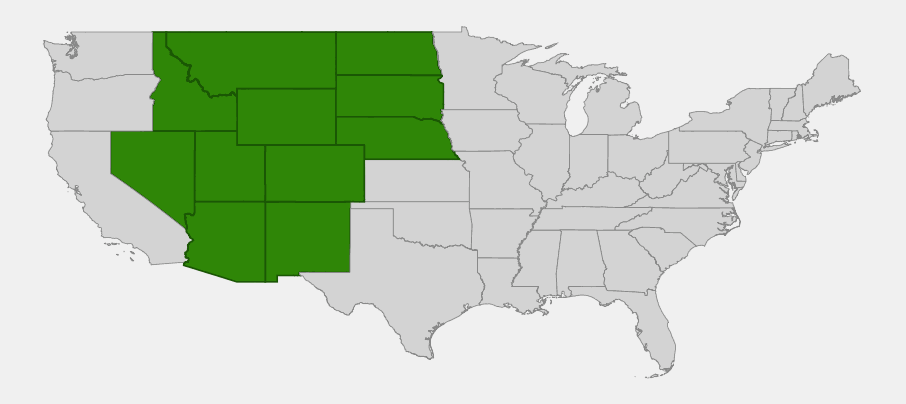
Sego lily is widespread across the Intermountain West and southern Rocky Mountains, native to Arizona, Colorado, Idaho, Montana, Nebraska, New Mexico, Nevada, North Dakota, South Dakota, Utah and Wyoming. It is especially abundant across Utah, where it grows from the Great Basin ranges to the Colorado Plateau, and it is the state flower there. It is not native to California or the Pacific Coast.
Within this broad range sego lily favors dry, open habitats: sagebrush steppe, piñon-juniper woodland, mountain grassland, and open ponderosa pine forest, typically between about 3,500 and 9,000 feet elevation. It tends to be most conspicuous on gravelly or sandy soils derived from limestone, sandstone or other well-drained parent material, and it is strongly adapted to a climate of cold, snowy winters and hot, dry summers, with its underground bulb allowing it to disappear entirely during the driest months.
Sego lily populations can vary dramatically from year to year, with many bulbs skipping a season and remaining dormant underground when conditions are unfavorable, then blooming in large numbers following a wet winter. This boom-and-bust pattern is a defining feature of the species across its range and is part of why wild bloom displays can look completely different from one year to the next at the same site.
📋 Regional plant lists featuring sego lily: Utah & Western Colorado · Nebraska, Kansas & Eastern Colorado · Arizona & New Mexico · Montana & Wyoming · Idaho, Eastern Oregon & Eastern Washington · North Dakota, South Dakota & Western Minnesota · California & Nevada
Note: sego lily is native to Nevada but is not native to California, despite both states sharing a regional plant list; in the Idaho/Eastern Oregon/Eastern Washington region it is native only in Idaho.
Growing & Care Guide
Sego lily rewards gardeners who can replicate its high-desert conditions: sharp drainage, full sun, and a long, bone-dry summer rest. It is not a plant for rich garden soil or regular irrigation.
Light
Plant sego lily in full sun. It is adapted to open, unshaded sites and will not thrive or flower well under trees or in deep shade.
Soil & Water
Excellent drainage is essential — sego lily bulbs rot quickly in soil that stays wet, especially during summer dormancy. Sandy, gravelly or rocky soils that mimic its native habitat work best; raised beds or rock gardens are ideal in heavier garden soils. Water during the spring growing season if rainfall is scarce, but withhold water almost entirely once the foliage yellows in early summer, allowing the bulb its natural dry rest.
Planting Tips
Sego lily is slow to establish from seed, often taking three to five years to reach flowering size, so gardeners in a hurry should seek out nursery-propagated bulbs from reputable native plant suppliers rather than collecting from the wild. Plant bulbs in fall, 4 to 6 inches deep, in a spot that will stay dry over summer. Because the plant resents disturbance, choose a permanent location rather than a bed that will be dug or replanted regularly.
Pruning & Maintenance
No pruning is needed. Allow the foliage to yellow and die back naturally after bloom before removing it, since the leaves are feeding the bulb for next year’s flowers. Avoid summer irrigation nearby, including from adjacent lawn or garden beds, as excess summer moisture is the most common cause of bulb loss in cultivation.
Propagation
Propagation is by seed, sown in fall and left to stratify over winter, or by offsets (small bulblets) that some clumps produce slowly over time. Seed-grown plants take several years to flower, reflecting the same patient pace at which wild populations persist through variable desert rainfall.
Landscape Uses
- Rock gardens and raised beds with sharp drainage
- Dry native wildflower meadows mixed with bunchgrasses and sagebrush
- Xeriscaping for low-water, high-elevation gardens
- Naturalistic plantings that showcase Utah and Intermountain West native flora
Wildlife & Ecological Value
Sego lily plays a modest but genuine role in the ecology of dry Intermountain West plant communities, where its bulbs, foliage and flowers interact with a range of wild animals.
For Pollinators
Flowers are visited by native bees and other insects drawn to the contrasting maroon-and-yellow nectar guides at the base of each petal, which direct pollinators toward the flower’s center. The relatively large, showy blooms stand out against the muted colors of surrounding sagebrush-steppe vegetation, making sego lily a locally important nectar source during its brief early-summer bloom.
For Mammals
The starchy bulbs are a historic food source for rodents such as ground squirrels and pocket gophers, which dig and cache them, incidentally helping disperse bulblets to new locations. Pronghorn and other grazing animals occasionally browse the foliage, though the plant is not a primary forage species.
Ecosystem Role
As a geophyte (bulb-forming plant) adapted to fire- and drought-prone landscapes, sego lily can persist underground through disturbances that kill above-ground vegetation, resprouting from its bulb once conditions improve. This life history makes it a resilient, low-key component of sagebrush-steppe and piñon-juniper plant communities, contributing to the diversity of understory wildflowers in landscapes often dominated by shrubs and grasses.
Cultural & Historical Uses
Sego lily holds a central place in Utah’s pioneer history. According to long-standing accounts, early Mormon settlers facing crop failure and food shortages in 1848 learned from Shoshone and Ute peoples, who had long harvested the starchy bulbs as a traditional food, to dig and eat sego lily bulbs to supplement their diet during that difficult period. The word “sego” itself is believed to derive from a Shoshone term for the plant.
In recognition of this history, the Utah State Legislature designated sego lily the official state flower in 1911, and it remains a widely used symbol across the state, appearing in place names, institutional emblems, and civic art.
This history of bulb use is significant chiefly as a record of indigenous knowledge and pioneer survival, not a modern foraging recommendation — sego lily is a protected wildflower in parts of its range, and digging wild bulbs removes a slow-to-recover plant from the landscape.
Frequently Asked Questions
Is sego lily Utah’s state flower?
Yes. The Utah Legislature designated sego lily the official state flower in 1911, honoring both its beauty and its role in pioneer history.
Can I dig up wild sego lily bulbs to grow at home?
No — wild sego lily populations recover slowly, and digging bulbs can be restricted or prohibited depending on land ownership. Buy nursery-propagated bulbs or seed from reputable native plant sources instead.
Why didn’t my sego lily bloom this year?
Sego lily bulbs can skip flowering in dry years, remaining dormant underground rather than spending energy on a bloom they can’t support. This boom-and-bust pattern is normal and mirrors how wild populations behave after dry versus wet winters.
How long does it take sego lily to bloom from seed?
Expect three to five years from seed to first flower. The plant builds up bulb reserves gradually before it can support blooming, which is part of why nursery-grown bulbs are the faster route to a flowering plant.
Is sego lily native to California?
No. Despite being included on some regional plant lists that pair California with Nevada, sego lily’s native range does not reach California; it is native to Nevada and ten other Intermountain West and Rocky Mountain states.

Looking for a nursery that carries Sego Lily?
Browse our native plant nursery directory: Arizona · Colorado · Idaho · Montana · Nebraska, North Dakota, New Mexico & Nevada · South Dakota & Utah · Wyoming