
Sand Post Oak (Quercus margarettae)
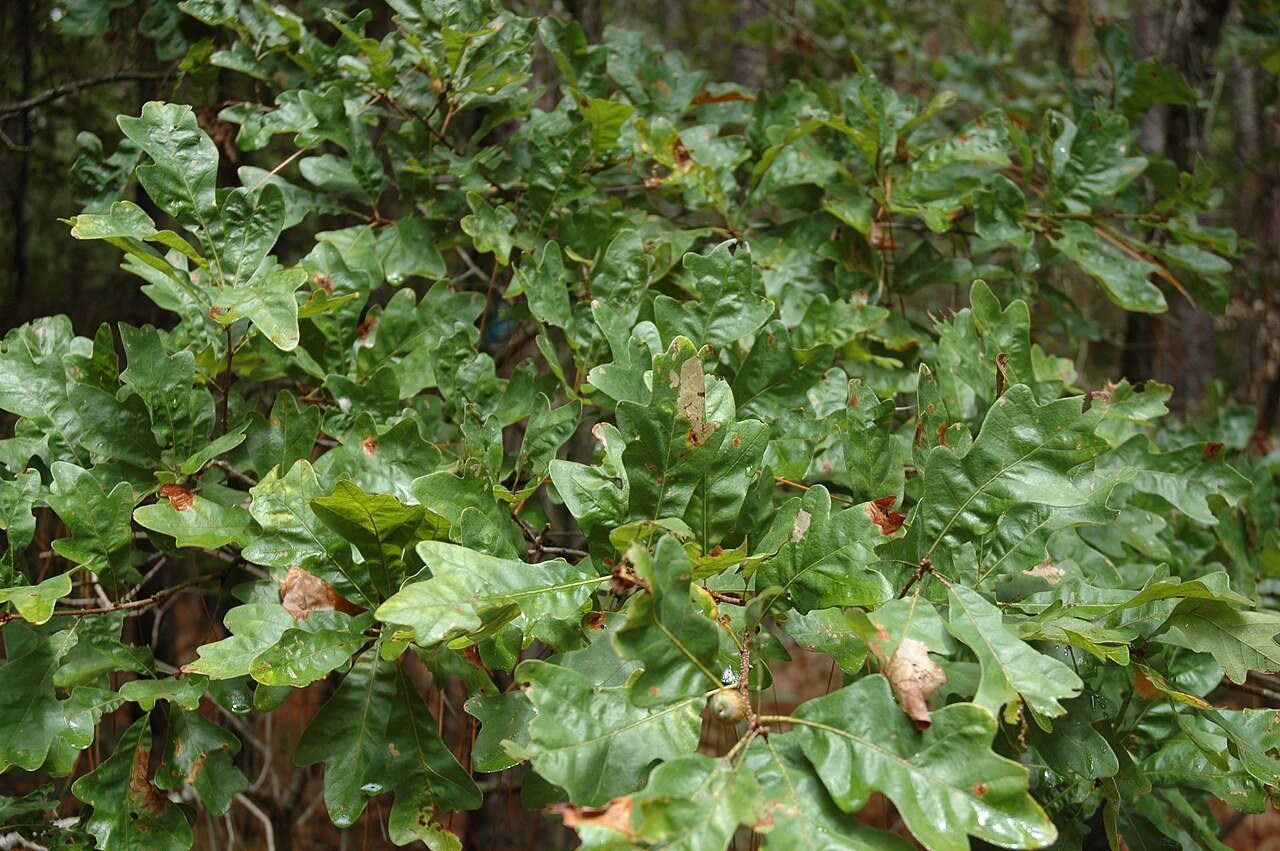
Quercus margarettae (also spelled Q. margaretta), commonly called Sand Post Oak or Dwarf Post Oak, is a small, tough, drought-defying oak of the deep sandy soils of the southeastern and south-central United States. It belongs to the white oak group and is closely related to — and often confused with — the larger Post Oak (Quercus stellata), sharing that species’ distinctive cross-shaped leaf but on a smaller scale and a notably smaller, often shrubby, tree.
Where ordinary post oak forest soils give way to deep, excessively drained sand — old dune ridges, sandhills, river terraces, and pine barrens — Sand Post Oak takes over as the dominant or co-dominant oak, often growing as a dense multi-stemmed shrub thicket rather than a single-trunked shade tree. Mature trees in favorable sites can reach 40 feet, but most wild specimens stay well under that, shaped by the harsh, droughty conditions of their sandy home ground.
For gardeners working with deep sandy or gravelly soil in the Southeast or south-central states, Sand Post Oak is an outstanding, nearly maintenance-free native tree that asks for almost nothing once established — no irrigation, no fertilizer, no pampering — while still providing the acorn crop, cover, and structure that oaks are famous for in the wildlife garden.
Identification
Sand Post Oak is most reliably told apart from the closely related Post Oak by its smaller overall size, smaller leaves, and strong association with deep, excessively drained sandy soils rather than the clay hardpans and rocky uplands Post Oak favors. Where the two species’ ranges and habitats overlap — notably in the East Texas Cross Timbers — intermediate populations occur that blur the distinction.
Bark & Stems
Bark is gray to gray-brown, initially scaly and becoming more deeply furrowed and blocky with age, similar in texture to other white oaks but typically thinner given the tree’s smaller stature. Twigs are moderately stout, gray, and glabrous to sparsely hairy, with a cluster of terminal buds noticeably larger than those of true Post Oak. Many wild plants grow as multi-stemmed shrubby thickets rather than single-trunked trees, especially on the driest sand ridges.
Leaves
Leaves are deciduous, alternate, and leathery, typically 2 to 5 inches long with the classic post-oak “cross” shape: three to five rounded lobes, with the two widest lobes positioned roughly opposite each other partway up the blade to form a cruciform outline. The upper surface is shiny dark green; the underside is paler and finely hairy. Leaves are noticeably smaller than those of Post Oak, and the whole plant often reads as a scaled-down version of its larger relative.
Flowers
Like all oaks, Sand Post Oak is monoecious, with inconspicuous wind-pollinated male catkins and tiny female flowers appearing on the same tree as new leaves emerge in spring. The flowers are not ornamental and are easy to miss entirely.
Fruit & Seeds
Acorns mature in a single season (annual), with one to three acorns borne singly or on a short stalk. The cup is bowl- to goblet-shaped, gray and downy, enclosing roughly a third to three-quarters of the light brown, ovoid nut, which runs about ½ to 1 inch long. Trees are notoriously slow to begin bearing — often 20 to 30 years from planting — a patience test that is part of the bargain with most oaks in the white oak group.
Quick Facts
| Scientific Name | Quercus margarettae (syn. Q. margaretta, Q. stellata var. margaretta) |
| Family | Fagaceae (Beech) |
| Plant Type | Deciduous Tree / Large Shrub |
| Mature Height | 15–40 ft (shrubbier on poor sand ridges) |
| Mature Spread | 15–30 ft |
| Growth Rate | Slow |
| Sun Exposure | Full Sun |
| Water Needs | Low |
| Soil Type | Deep sand or sandy gravel; excessively drained |
| Soil pH | Acidic to neutral |
| Bloom Time | Early spring (with leaf-out) |
| Flower Color | Green (not showy) |
| Fall Color | Yellow-brown, often retaining dried leaves into winter |
| Fruit | Small acorns, ½–1 in, maturing in one season |
| Deer Resistant | No (deer browse young growth and relish acorns) |
| USDA Hardiness Zones | 7–9 |
Native Range
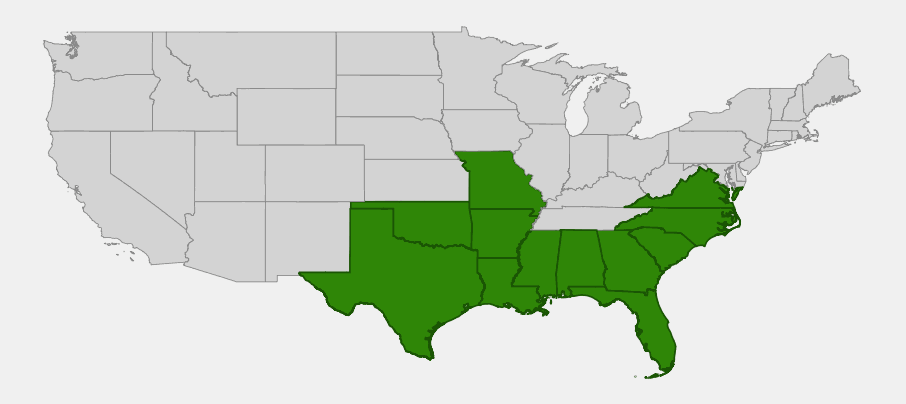
Sand Post Oak occupies a broad but patchy native range across the southeastern and south-central United States, from eastern Virginia and the Carolinas south through Georgia, Florida, Alabama, and Mississippi, and west through Louisiana, Arkansas, eastern Oklahoma, and much of Texas, with a disjunct presence recorded in Missouri. Its distribution tracks deep sandy substrates rather than any single climate band — wherever ancient dune fields, river terraces, or sandhill formations occur within this broad region, Sand Post Oak is likely to turn up.
In east Texas, where its range overlaps that of Post Oak in the Cross Timbers region, populations on sandy, gravelly ground show characteristics intermediate between the two species, and botanists still debate exactly where to draw the taxonomic line in that zone. Elsewhere — on the deep sand ridges of the Carolina Sandhills, Florida scrub, and Gulf Coastal Plain sandhills — Sand Post Oak is a clean, recognizable, much smaller-statured relative of Post Oak.
Typical habitat includes dry pine-oak sandhills, sand ridges along rivers, old dune systems, and open scrubland or pine barrens, often growing as understory or co-dominant canopy in open, fire-maintained longleaf pine woodlands. Because it is so tightly tied to deep, nutrient-poor sand, it is rarely found on richer clay or loam soils even within its broader native range.
📋 Regional plant lists featuring Sand Post Oak: Arkansas, Louisiana, Eastern Oklahoma & Eastern Texas · Georgia, Alabama & Mississippi · North Carolina & South Carolina · Maryland, Virginia & West Virginia · Illinois, Iowa & Missouri
Growing & Care Guide
Sand Post Oak rewards gardeners with truly sandy, infertile ground — the kind of site that frustrates most other trees. Give it the lean, well-drained conditions it evolved for, and it needs almost nothing from you afterward.
Light
Plant in full sun. In the wild, Sand Post Oak grows in open sandhills and scrub with little canopy shade, and it performs best — forming the sturdiest trunk and fullest crown — in a sunny, open site.
Soil & Water
This is a specialist for deep, excessively drained sand or sandy gravel; it does not perform well in clay, compacted, or consistently moist soils, where root rot and poor vigor are likely. Once established, it is extremely drought tolerant, drawing on deep root systems adapted to droughty sand, and needs no supplemental irrigation beyond the first year or two after planting.
Planting Tips
Plant small container stock in fall or early spring; like most oaks, Sand Post Oak develops a long taproot early and transplants best when young. Avoid amending the planting hole with rich organic matter, which can work against the tree’s adaptation to lean, fast-draining sand. Give it plenty of room — even where it grows shrubbier, old specimens can spread considerably at the base.
Pruning & Maintenance
Little pruning is needed beyond removing dead or damaged wood. Where a single-trunked tree form is preferred over the species’ natural multi-stemmed shrubby habit, select and favor one leader while the plant is young; mature plants resent heavy pruning and are best left to their naturally irregular, picturesque form.
Propagation
Propagate from fresh acorns collected in fall and planted promptly, since oak acorns lose viability quickly if allowed to dry out. Expect slow early growth and a long wait — often two to three decades — before a young tree begins bearing its own acorn crop.
Landscape Uses
Sand Post Oak fills a narrow but valuable niche in native landscaping:
- Xeriscaping on deep sandy soils where few other trees thrive without irrigation
- Sandhill and scrub restoration plantings alongside Turkey Oak and Longleaf Pine
- Wildlife gardens — acorns are valuable mast for many species
- Naturalistic hedgerows or thickets on dry, infertile sites where its multi-stemmed habit is an asset rather than a flaw
- Low-maintenance specimen tree for coastal plain and sandhill properties
Wildlife & Ecological Value
Like other oaks, Sand Post Oak plays an outsized ecological role relative to its modest stature, anchoring one of the toughest, most specialized habitat types in the Southeast.
For Birds
Acorns provide fall and winter mast for wild turkeys, blue jays, woodpeckers, and other acorn-eating birds, while the dense, often shrubby growth form offers excellent nesting cover in open sandhill habitats where tall trees are scarce.
For Mammals
White-tailed deer browse young foliage and stems and relish the acorns, as do squirrels, foxes, and other mast-dependent mammals. In sandhill ecosystems with few other hard-mast trees, Sand Post Oak acorns can be a locally important food source.
For Pollinators & Insects
Though wind-pollinated, oaks as a genus support an exceptional number of caterpillar and insect species — among the highest of any native tree genus in North America — which in turn feed breeding songbirds. Sand Post Oak contributes to this web even in the harshest, sandiest sites where few other host-plant trees can grow.
Ecosystem Role
Sand Post Oak is a defining species of fire-maintained sandhill and scrub communities, often growing alongside Longleaf Pine, Turkey Oak, and Bluejack Oak in some of the most distinctive and threatened upland ecosystems in the Southeast. Its tolerance of fire, drought, and nutrient-poor soil makes it an irreplaceable anchor species where these open, sun-drenched sand communities still survive.
Cultural & Historical Uses
Sand Post Oak has never been an important timber species, since its typically small, often crooked or shrubby growth form yields little usable lumber compared to larger oaks. Where it has been noted historically, it is mostly as an indicator species — early foresters and naturalists used its presence to identify deep, droughty sand soils unsuitable for row-crop agriculture, steering such land toward forestry or left as open sandhill habitat instead.
Like other white oak group acorns, Sand Post Oak acorns are lower in bitter tannins than red oak acorns and have historically been gathered and processed by Indigenous peoples across its range as a food source, typically shelled, leached of tannins, and ground into meal. This is a matter of historical record rather than a present-day recommendation, and foragers today should rely on current regional guides rather than this page for food-use decisions.
Today, the species’ main cultural value lies in restoration and conservation work: land managers and native-plant gardeners use Sand Post Oak to rebuild and maintain the open sandhill and scrub communities that depend on its distinctive drought and fire tolerance.
Frequently Asked Questions
What’s the difference between Sand Post Oak and Post Oak?
Sand Post Oak is generally smaller in every respect — shorter at maturity, smaller leaves, smaller acorns — and is tied specifically to deep, excessively drained sandy soils, while Post Oak (Quercus stellata) tolerates a broader range of soils including clay hardpans and rocky uplands. Where their ranges overlap, especially in East Texas, intermediate populations can make the two hard to tell apart.
How long does it take for Sand Post Oak to produce acorns?
Quite a while — often 20 to 30 years from planting. This slow start is typical of many white oak group species and is simply part of the long-term investment of planting an oak.
Can Sand Post Oak grow in clay or regular garden soil?
It’s not recommended. This species is a sand specialist and tends to struggle, develop poor vigor, or succumb to root problems in heavier, moisture-retentive soils. Gardeners on clay or loam soils are better served by Post Oak or another oak suited to those conditions.
Is Sand Post Oak a tree or a shrub?
Both, depending on the site. On the driest, poorest sand ridges it often grows as a dense multi-stemmed shrub thicket; in somewhat better sandy soil it can develop into a single-trunked tree up to 40 feet tall. Either form is normal for the species.
Does Sand Post Oak need fire to thrive?
It isn’t strictly fire-dependent the way Longleaf Pine is, but it is well adapted to the periodic fire regimes of the sandhill and scrub communities where it naturally grows, and it tends to persist well in landscapes managed with occasional prescribed fire or in naturalistic plantings that mimic that open, sun-exposed structure.

Looking for a nursery that carries Sand Post Oak?
Browse our native plant nursery directory: South Carolina, Texas & Virginia · Louisiana & Mississippi · Georgia & Florida · Alabama & Arkansas · North Carolina & Oklahoma · Missouri
For more on growing oaks in Sand Post Oak’s native range, see our guides to oaks in Virginia and flowering trees in Oklahoma, or browse profiles of its sandhill companions: Post Oak, Blackjack Oak, Turkey Oak, Bluejack Oak, and Longleaf Pine.

