Blackjack Oak (Quercus marilandica)
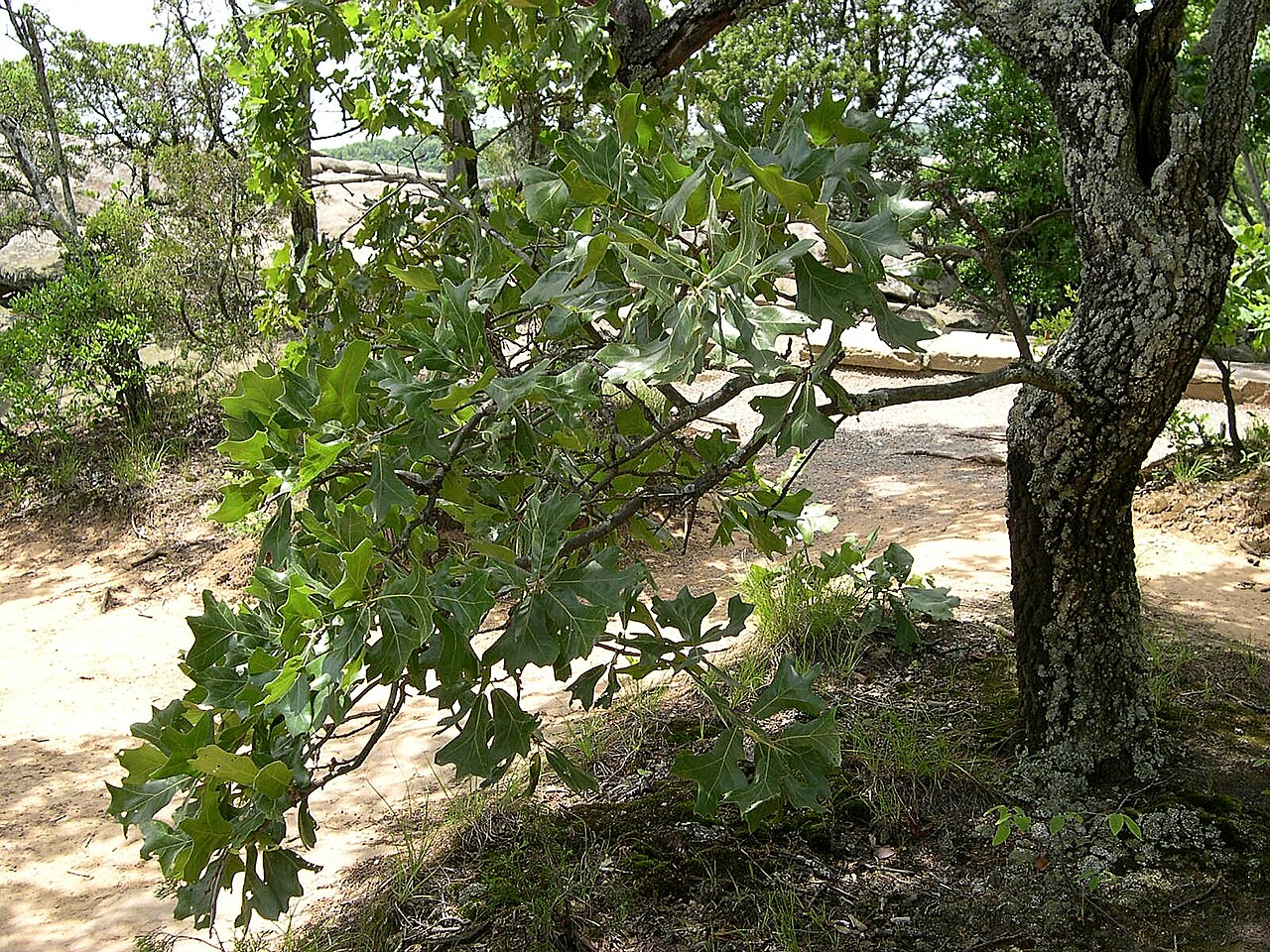
Quercus marilandica, the Blackjack Oak, is a small, tough, slow-growing tree of the poorest, driest, rockiest ground in the eastern and central United States. Where better soil supports taller oaks and hickories, Blackjack Oak claims the leftover sites — thin clay hardpans, sandy ridges, and exposed rock outcrops — and thrives where almost nothing else of its stature can. Its name comes from the nearly black, deeply furrowed bark that darkens its gnarled, often crooked trunk, giving mature trees a weathered, almost ancient look even at a modest size.
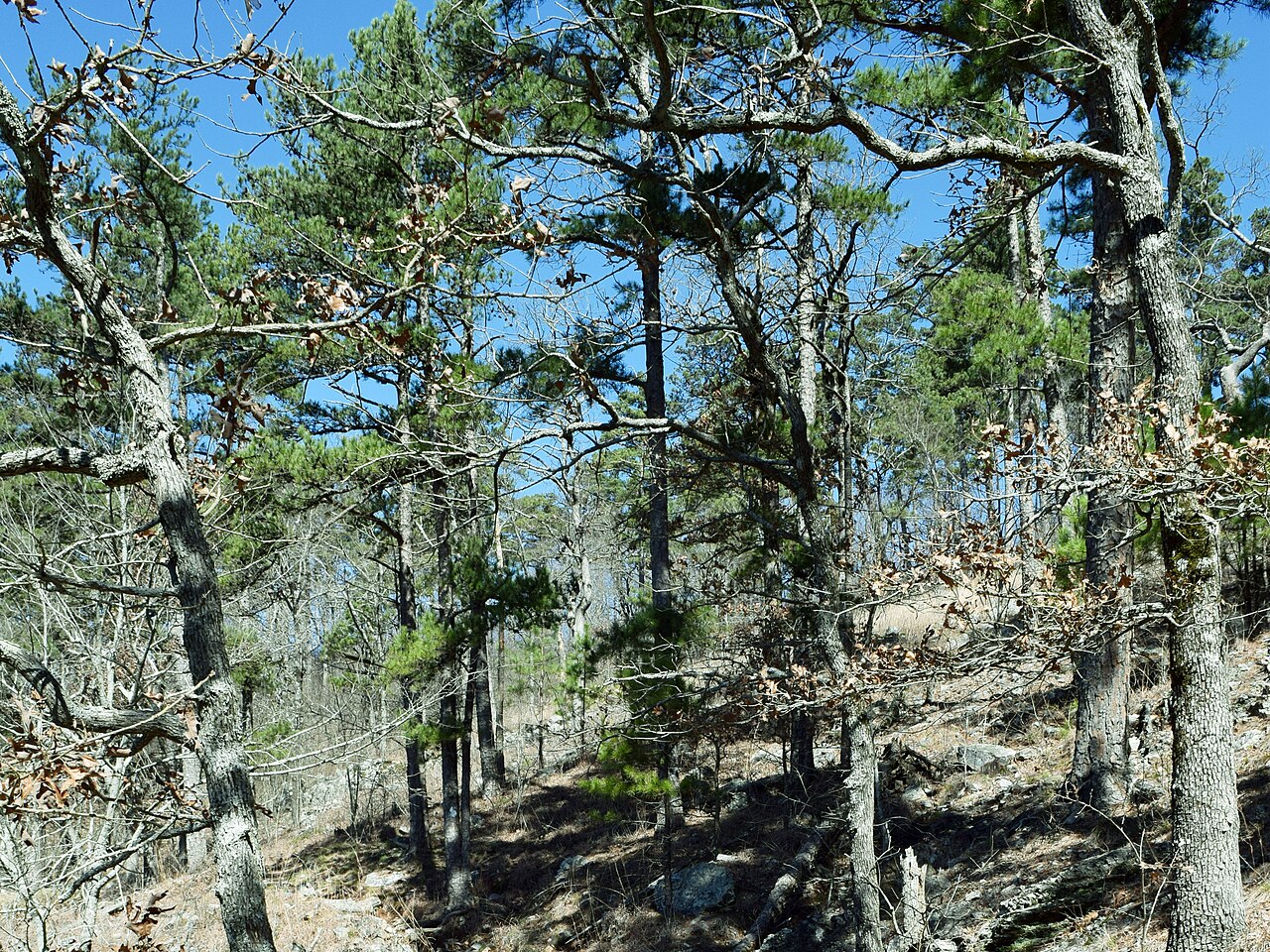
This member of the Fagaceae (beech family), in the red oak group, rarely exceeds 50 feet and more often stays under 30, with a broad, irregular crown of stiff, wide-spreading branches. The thick, leathery, wedge-shaped leaves — usually widest and three-lobed near the tip — are glossy dark green above and rusty-fuzzy beneath, turning dull yellow-brown to burnt orange in fall and often hanging on the tree well into winter. Because it tolerates heat, drought, compacted clay, and poor fertility better than almost any other oak, Blackjack Oak is a defining species of the post oak–blackjack oak woodlands, barrens, and glades that stretch from the Atlantic coastal plain across the South and into the southern Great Plains.
Blackjack Oak is not a tree for a manicured lawn or a rich garden bed — it grows too slowly and looks too rugged for that role. But for restoration of dry woodlands, glades, and barrens, or for a low-maintenance specimen on the worst site in the yard, it has no substitute. Its acorns feed turkey, deer, and small mammals, its rough bark and hollow limbs shelter cavity-nesting wildlife, and its presence signals a healthy, fire-adapted woodland community that is increasingly rare across its range.
Identification
Blackjack Oak typically grows 20 to 50 feet tall with a short trunk 1 to 2 feet in diameter and a dense, irregular, often flat-topped or rounded crown of stout, twisted branches. Growth is slow — often less than a foot a year on the dry sites where it grows — and the tree is frequently found in nearly pure stands mixed with post oak, forming the distinctive “post oak–blackjack” woodland type of poor upland soils.
Bark & Stems
The bark is one of the tree’s best field marks: nearly black, thick, and broken into small, hard, roughly square or rectangular blocks separated by deep furrows, somewhat like alligator hide. Young twigs are stout, orange-brown, and covered in rusty hairs, becoming gray and smooth with age. Terminal buds are large, angled, and covered in pale fuzzy hairs, distinguishing Blackjack Oak from smoother-barked, smaller-budded oaks.
Leaves
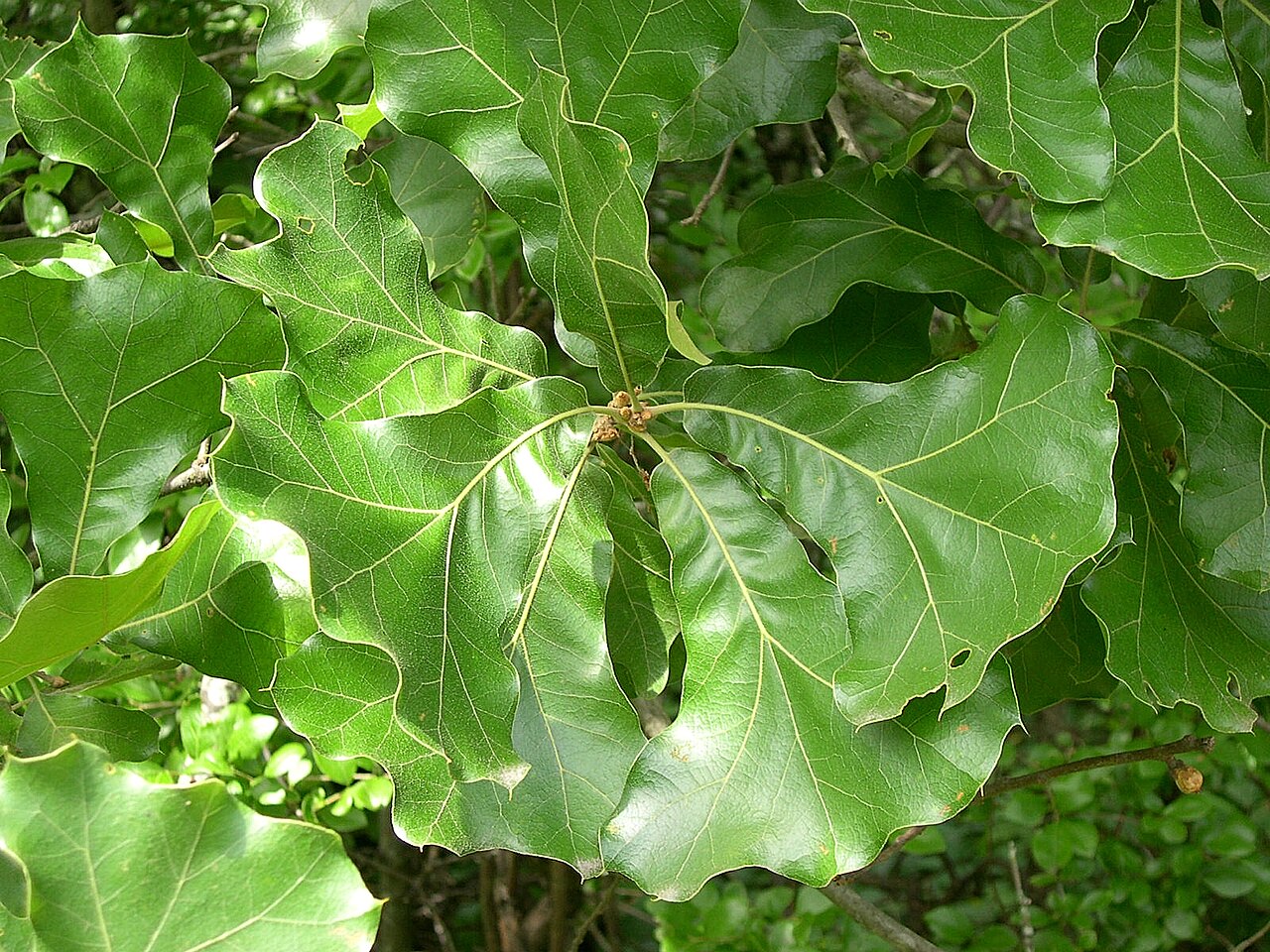
The leaves are simple, alternate, thick, and leathery, 4 to 8 inches long and nearly as wide, broadly wedge-shaped (obovate) with the narrow end at the base. Most leaves flare into three shallow, bristle-tipped lobes near the broad tip, giving them a distinctive fan or “duck’s foot” outline, though some leaves are nearly unlobed. The upper surface is glossy dark green and often slightly bumpy; the underside is paler and covered in fine, rust-colored hairs, especially along the veins. Fall color is a dull yellow-brown to burnt orange, and because the leaves are tough, many stay attached on the twigs through winter (marcescence), rattling in the wind on bare trees.
Flowers & Fruit
Like other oaks, Blackjack Oak is wind-pollinated and monoecious, with male and female flowers on the same tree. Male flowers hang in slender, yellow-green catkins 2 to 4 inches long as the leaves emerge in spring; female flowers are tiny, reddish, and inconspicuous at the tips of new growth. Being in the red oak group, acorns take two years to mature. They are oval, ½ to ¾ inch long, yellow-brown, and enclosed for roughly half their length in a bowl-shaped cap covered with loose, somewhat shaggy orange-brown scales. Acorns ripen in the fall of their second year and are notably bitter, like most red oak acorns, requiring leaching before any human use.
Quick Facts
| Scientific Name | Quercus marilandica |
| Family | Fagaceae (Beech) |
| Plant Type | Deciduous Tree |
| Mature Height | 20–50 ft |
| Mature Spread | 20–35 ft |
| Growth Rate | Slow |
| Sun Exposure | Full Sun |
| Water Needs | Low; highly drought tolerant once established |
| Soil Type | Poor, dry clay, sand, or rocky soils; tolerates compaction |
| Soil pH | 4.5–7.0 (acidic to neutral) |
| Bloom Time | April – May |
| Flower Color | Yellow-green (inconspicuous) |
| Fall Color | Dull yellow-brown to burnt orange |
| Fruit | Bitter acorns, ½–¾ in, mature in 2 years |
| Deer Resistant | Moderate (young growth browsed, mature trees largely left alone) |
| USDA Hardiness Zones | 6–9 |
Native Range
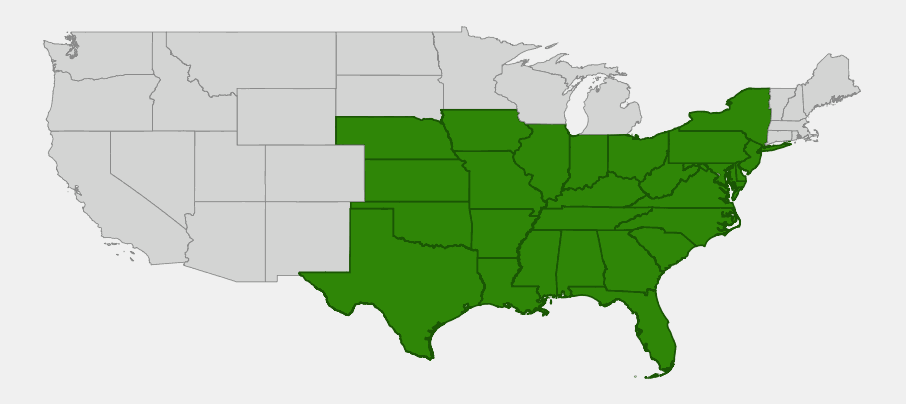
Blackjack Oak is native to a broad swath of the eastern and south-central United States, from Long Island and southeastern New York south through the mid-Atlantic and Southeast to central Florida, and west through the Gulf states into Texas, Oklahoma, Kansas, and Nebraska. It also reaches north and west through the lower Midwest, including Ohio, Indiana, Illinois, Iowa, and Missouri. Across this range it is consistently a tree of poor, droughty ground rather than rich bottomland, making its distribution patchy and tied closely to soil quality rather than latitude.
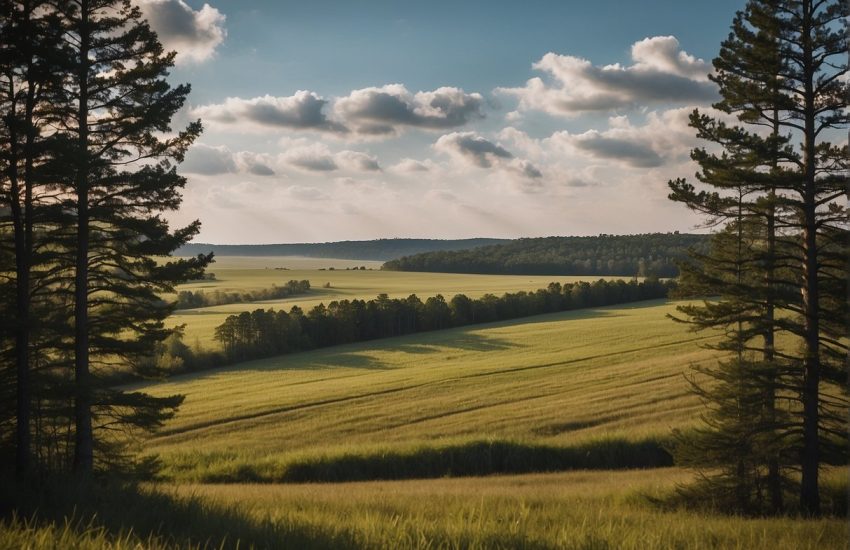
The species reaches its greatest abundance on the dry sandy and clay uplands of the southern coastal plain and the Cross Timbers region of Oklahoma and Texas, where it forms extensive post oak–blackjack oak woodlands and savannas on sites too poor and too fire-prone for more demanding trees. Further north and east, it is scattered on rocky ridgetops, shale barrens, sand hills, and old clay-pan fields, often as a pioneer on abandoned agricultural land. It is notably absent from the richer soils of major river valleys and from the higher, cooler elevations of the Appalachians.
Because Blackjack Oak depends on recurring fire or disturbance to hold back competition from faster-growing, shade-tolerant trees, long-term fire suppression has allowed many historic blackjack woodlands and barrens to gradually fill in with other species. Where prescribed fire or periodic clearing is maintained, Blackjack Oak persists as a defining, fire-adapted member of these increasingly uncommon open woodland communities.
📋 Regional plant lists featuring Blackjack Oak: Delaware, New Jersey & New York · New York, Pennsylvania & New Jersey · Maryland, Virginia & West Virginia · North Carolina & South Carolina · Alabama, Georgia & Mississippi · Arkansas & Louisiana · Kentucky & Tennessee · Indiana & Ohio · Iowa, Illinois & Missouri · Nebraska & Kansas
Growing & Care Guide
Blackjack Oak is grown far less often than it deserves, mostly because it is slow and does not transplant as easily as faster-growing oaks. But for the right site — the hot, dry, infertile corner of a property where little else will thrive — it is nearly unbeatable, and it asks for almost nothing once established.
Light
Blackjack Oak needs full sun. In the wild it almost never grows in shade, and seedlings struggle and eventually die out under a closing canopy. Open, sunny sites with little competition from taller trees give the best growth and the sturdiest branching structure.
Soil & Water
This is the tree for soil nothing else wants: dry, compacted clay, infertile sand, shallow rocky ground, or old eroded fields. It tolerates acidic to neutral pH and needs no soil amendment or fertilizer — in fact, rich, moist, fertile soil can encourage root and crown diseases it would never encounter on its native dry sites. Once past its first couple of years, Blackjack Oak is exceptionally drought tolerant and rarely needs supplemental water.
Planting Tips
Plant small container-grown trees, since Blackjack Oak has a deep taproot and resents transplanting, especially as larger balled-and-burlapped stock. Fall or early spring planting works best. Choose the final site carefully — the tree is not a good candidate for moving later — and give it full sun with room for a broad, spreading crown. Expect slow early growth; patience is part of growing this species.
Pruning & Maintenance
Prune only to remove dead, damaged, or crossing branches, ideally in late winter. Blackjack Oak’s naturally irregular, picturesque branching is part of its character and does not need to be corrected. The tree is otherwise low-maintenance, with good resistance to the droughts and poor soils that stress other species, though like most oaks it can host oak wilt and should not be pruned during the active oak wilt season in affected regions.
Landscape Uses
- Dry woodland and barrens restoration, especially alongside post oak and shortleaf pine
- Difficult-site specimen for dry, rocky, or clay-poor ground where other trees fail
- Wildlife plantings, for acorn production and cavity-nesting habitat
- Naturalized hillside or ridge plantings that mimic its native rocky habitat
- Low-input shade tree for sites where irrigation and fertilization are not practical
Wildlife & Ecological Value
Blackjack Oak may grow on poor ground, but it is far from poor habitat — it anchors some of the toughest, most fire-dependent woodland communities in the East and supports a long list of wildlife.
For Birds
Wild Turkey, Blue Jays, and woodpeckers eat the acorns, while the rough, often hollow or cavity-riddled trunks of older trees provide nesting sites for woodpeckers, titmice, and other cavity nesters. The dense, twisted branching offers good cover and perching habitat in otherwise open, sparsely wooded barrens.
For Mammals
White-tailed Deer, Gray Squirrel, Fox Squirrel, and numerous small rodents rely on Blackjack Oak acorns as a fall and winter food source, particularly in years when other oaks have a poor acorn crop. Deer also browse young shoots and seedlings, which can slow regeneration in heavily browsed areas.
For Pollinators
Though wind-pollinated, Blackjack Oak’s catkins provide an early-season pollen source for various bees. As a larval host for numerous oak-feeding moths and butterflies, including several hairstreak species, it supports the insect food web that in turn feeds breeding songbirds.
Ecosystem Role
Blackjack Oak is a keystone species of dry, fire-maintained oak woodlands and barrens, communities that are now uncommon due to decades of fire suppression and land conversion. Its ability to resprout vigorously after fire or top-kill lets it persist through disturbance that eliminates less adapted trees, helping maintain the open, grassy understory that supports high plant and insect diversity in these woodlands.
Cultural & Historical Uses
Blackjack Oak’s wood is extremely hard, dense, and difficult to work, which limited its use in fine carpentry but made it valued for firewood — it burns hot and long, and was historically prized by blacksmiths and for heating in rural communities across its range. The wood was also occasionally used for fence posts and rough construction where its durability outweighed its difficulty.
Indigenous peoples across the tree’s range used the bitter acorns as a food source after leaching out the tannins, following practices shared across many oak species, and used the bark medicinally in some communities. The tree’s presence was also long recognized by farmers and foresters as a reliable indicator of poor soil — “blackjack land” became shorthand in parts of the South and Midwest for ground too thin and infertile for productive farming.
Today, Blackjack Oak is valued less for any product than for what it represents: a resilient, climate- and drought-adapted native tree increasingly recognized by restoration ecologists and native-plant gardeners as essential to rebuilding the dry oak woodlands and barrens that have declined across much of the eastern and central United States.
Frequently Asked Questions
Why is Blackjack Oak often stunted or twisted?
Because it grows almost exclusively on the poorest, driest, rockiest soils, where resources are too scarce to support tall, straight growth. This isn’t disease or stress in the usual sense — it’s simply the tree’s normal form on marginal ground; on somewhat better sites it can grow taller and straighter, though it still stays modest in size compared with other oaks.
Can Blackjack Oak be grown in good garden soil?
It can, but it isn’t the best use of the tree, and rich, consistently moist soil can actually predispose it to root rots and other problems it rarely faces on its native dry sites. Blackjack Oak is best reserved for the poorest, driest spot on a property, where it will outperform almost any other tree.
Are Blackjack Oak acorns edible?
They are edible after processing, like most red oak group acorns, but they are notably bitter and require extended leaching to remove tannins before eating. Wildlife eat them readily; for human use, white oak group acorns are generally preferred for being less bitter and needing less preparation.
Does Blackjack Oak transplant well?
Not easily. It develops a deep taproot early and resents root disturbance, so it is best planted as a young container-grown tree in its permanent location rather than transplanted later as a larger specimen.
How can you tell Blackjack Oak from Post Oak?
Blackjack Oak has broad, wedge-shaped leaves that flare out near the tip into three shallow lobes, with a glossy, leathery texture and rusty hairs beneath, plus nearly black, blocky bark. Post Oak has leaves with a more cross- or Maltese-cross-shaped outline and five lobes, and grayer, more conventionally ridged bark. The two species often grow side by side on the same poor soils.

Looking for a nursery that carries Blackjack Oak?
Browse our native plant nursery directory: New York, New Jersey, North Carolina, Oklahoma, Ohio & Nebraska · Pennsylvania, Virginia, South Carolina, Texas & Tennessee · Delaware, Georgia & Florida · Maryland, Mississippi, Louisiana, Kentucky & Missouri · West Virginia · Alabama & Arkansas · Indiana, Illinois, Iowa & Kansas