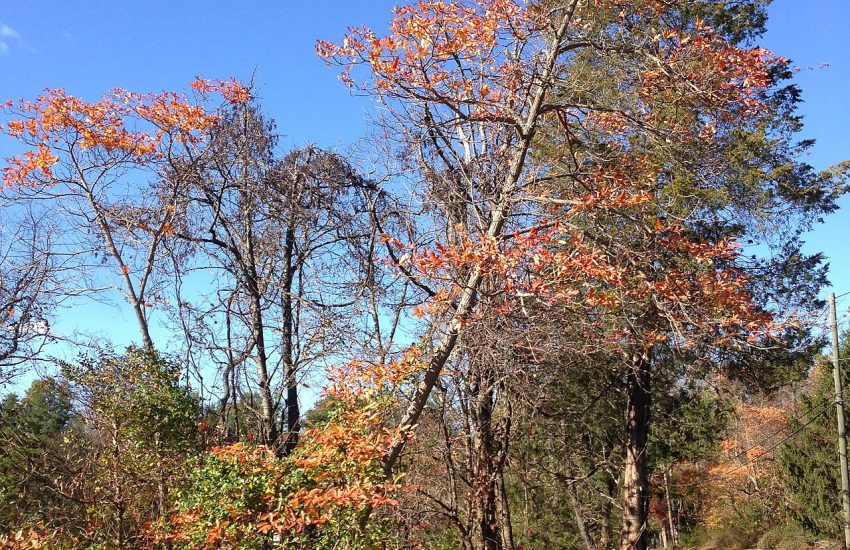
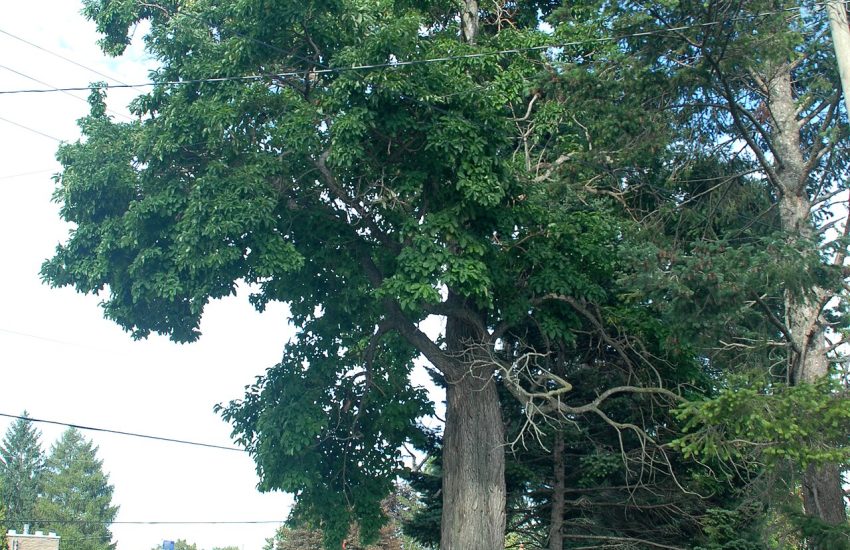
Bigfruit Hawthorn (Crataegus macrosperma)
Crataegus macrosperma, known as Bigfruit Hawthorn or Eastern Hawthorn, is a native shrub or small tree of the rose family (Rosaceae) found across much of the eastern United States and adjacent Canada. It is among the earliest hawthorns to bloom each spring — often flowering before other Crataegus in its range — and is a dependable, low-maintenance small tree for old fields, hedgerows, and wildlife plantings.
Despite the “bigfruit” name, its pomes are not unusually large by hawthorn standards; the name instead reflects the comparatively large seeds (pyrenes) inside each fruit. Like virtually all hawthorns, it is part of a complex, variable species group, and botanists recognize a number of local forms that intergrade with close relatives — a reminder that Crataegus taxonomy is still actively studied and debated.
Identification
Bigfruit hawthorn is a multi-stemmed shrub or small tree 10 to 23 feet (3–7 m) tall. New twig growth is golden-green to strongly reddish-tinged and smooth (glabrous), aging to shiny dark brown and then gray. Thorns on one-year wood are shiny, deep brown to blackish, often black-tipped, and range from stout to slender, typically 1 to 2½ inches (2.5–6 cm) long.
Leaves
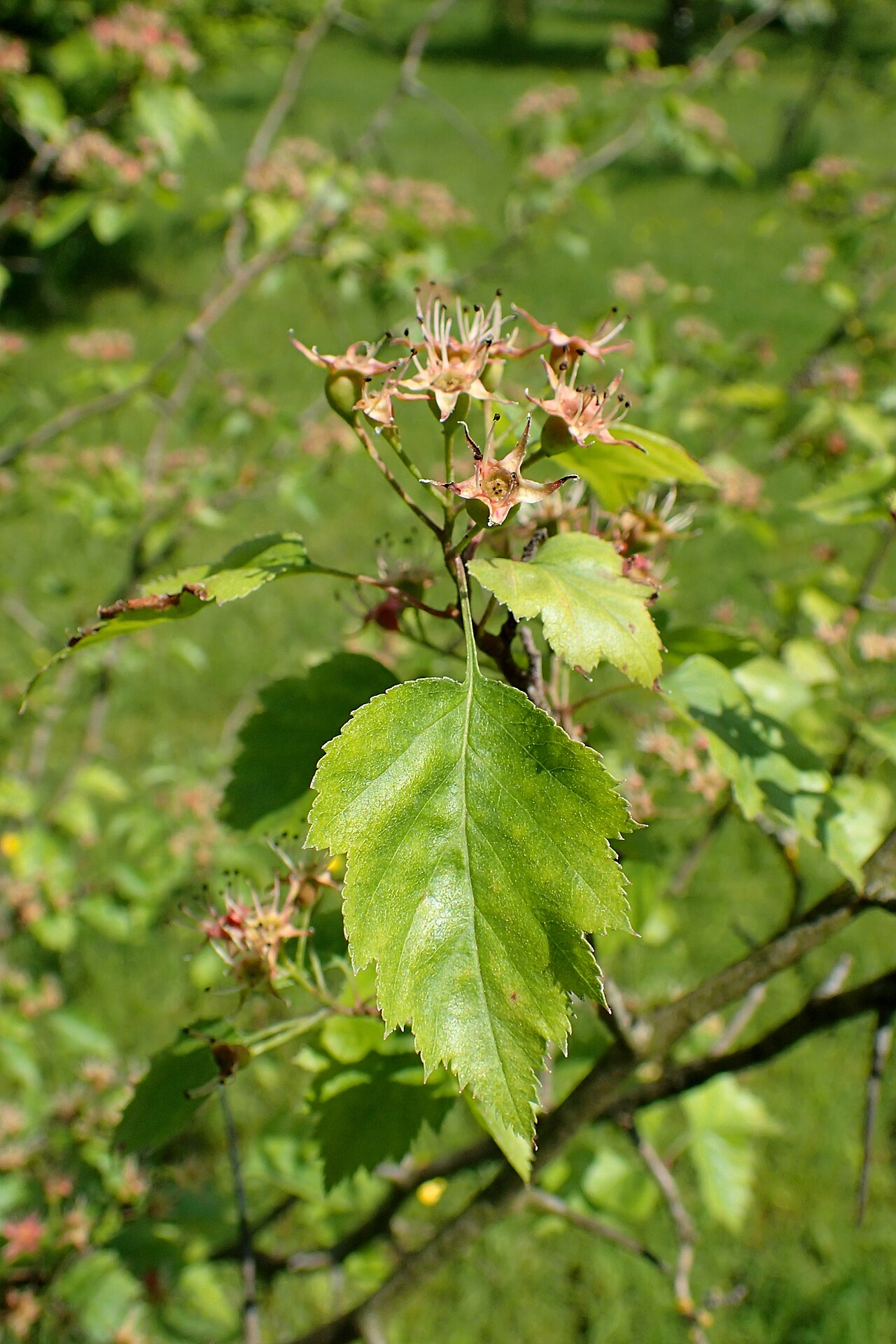
Leaves are ovate, 1¼ to 2½ (occasionally to 3½) inches (3–9 cm) long, with a subcordate, truncate, or rounded-to-cuneate base and 3 to 6 sharply acute to acuminate lobes per side separated by moderately deep sinuses. Margins are sharply serrate with numerous small teeth, the larger ones conspicuously glandular, especially near the leaf base. Young leaves are densely and finely hairy on the upper surface, becoming smoother (glabrescent) with age.
Flowers
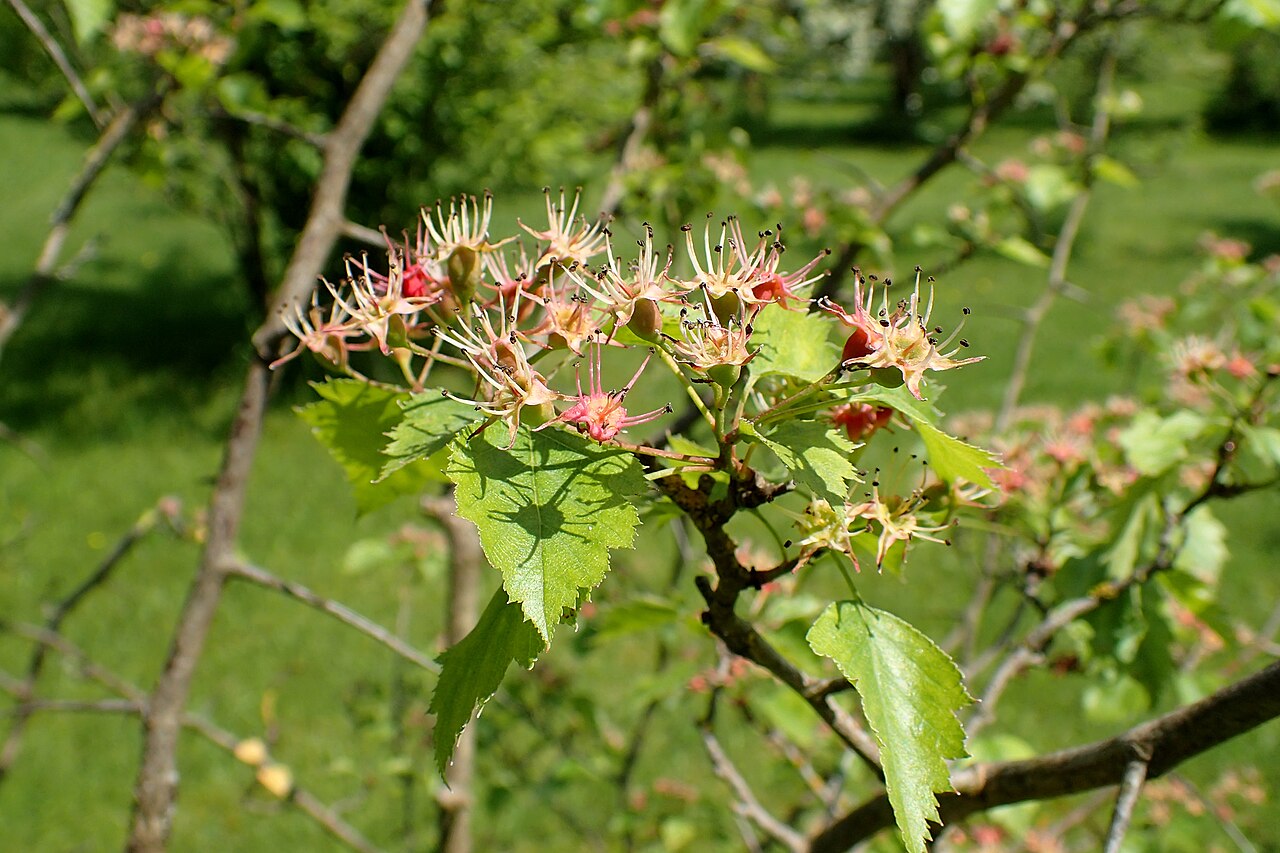
Clusters of 5 to 12 white flowers, each 1½ to 2 inches (13–22 mm) across, open from April into June — among the earliest hawthorn blooms in its range, preceded in the south only by a few close relatives. Anthers are pink to reddish-purple, and the hypanthium (floral cup) is smooth rather than hairy.
Fruit
Pomes are bright to deep red, roughly round to egg-shaped, ⅓ to ⅝ inch (8–15 mm) across, ripening from September into November. Despite the common name, individual fruits are modest in size; what distinguishes the species are its comparatively large internal seeds.
Quick Facts
| Scientific Name | Crataegus macrosperma Ashe |
| Family | Rosaceae (Rose) |
| Plant Type | Deciduous shrub / small tree |
| Mature Height | 10–23 ft (3–7 m) |
| Growth Rate | Slow to moderate |
| Sun Exposure | Full sun to part shade |
| Water Needs | Low to moderate once established |
| Soil Type | Adaptable, including clay; well-drained preferred |
| Bloom Time | April–June (early-blooming) |
| Flower Color | White |
| Fruit | Bright to deep red pomes, Sep–Nov |
| Thorns | Yes, 1–2.5 in, dark brown to blackish |
| USDA Hardiness Zones | 3–7 |
Native Range
Bigfruit hawthorn ranges from north-central Minnesota through the central Great Lakes and St. Lawrence Valley to southern Newfoundland, and south through New England, the Mid-Atlantic, and the Ohio Valley into Arkansas, with scattered populations continuing along the Appalachians to northeastern Alabama. It is typically found in old fields, fencerows, brush, open woods, and on montane balds and rocky slopes from sea level to about 5,250 feet (1,600 m).
The species name honors its comparatively large seeds, and the Flora of North America notes that C. macrosperma is a variable complex, with forms sometimes separated as C. roanensis (smaller-leaved, shrubbier, common from the Great Lakes to Pennsylvania) intergrading freely with the typical form. The USDA PLANTS Database lists it as symbol CRMA3, native to the Lower 48 and adjacent Canada.
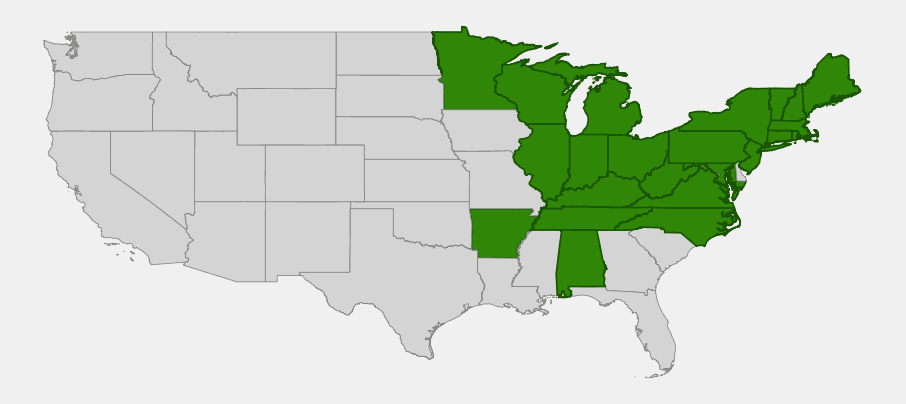
📋 Regional plant lists featuring Bigfruit Hawthorn: New Hampshire, Maine & Vermont · Connecticut, Massachusetts & Rhode Island · New York, Pennsylvania & Northern New Jersey · Maryland, Virginia & West Virginia · North Carolina & South Carolina · Georgia, Alabama & Mississippi · Arkansas, Louisiana & East Texas/Oklahoma · Kentucky & Tennessee · Ohio & Indiana · Illinois, Iowa & Missouri · Michigan, Wisconsin & Eastern Minnesota
Growing & Care Guide
Bigfruit hawthorn is a hardy, undemanding small tree suited to full sun and average to difficult soils.
Light & Water
Plant in full sun to light part shade for the most fruit and best overall form. It tolerates clay soils, wind, and periods of drought reasonably well once established, though it does not tolerate salt-affected soils or coastal salt spray.
Soil & Planting
Adapts to a wide range of well-drained soils including clay-loam. Plant container or balled-and-burlapped stock in fall or spring. Seed-grown trees are slow to reach flowering size — often 5 to 8 years — while grafted nursery stock, where available, can flower within 2 to 3 years.
Pruning & Maintenance
Prune only to remove dead, damaged, or crossing branches in late winter. The species is generally trouble-free, with occasional cedar-hawthorn rust on foliage near eastern redcedar — typically cosmetic. Site away from paths and seating areas due to the sharp, dark thorns.
Landscape Uses
- Early-season wildlife planting — among the first hawthorns to flower each spring
- Hedgerow or thicket planting for nesting birds
- Reclamation and difficult-site plantings on clay or compacted ground
- Naturalized old-field or woodland-edge restoration
Wildlife & Ecological Value
As one of the earliest hawthorns to bloom, bigfruit hawthorn provides an important early nectar source for native bees and other pollinators emerging in spring before many other woody plants have flowered. Its red fruit, ripening from September into November, feeds American robins, cedar waxwings, northern flickers, and other birds, as well as small mammals that forage windfall beneath the canopy.
Dense branching and stout thorns provide secure nesting habitat for shrubland birds such as gray catbirds, brown thrashers, and northern mockingbirds. The foliage also hosts larvae of several native moths and butterflies associated with the hawthorn/apple (Rosaceae) group.
Frequently Asked Questions
Why is it called “bigfruit” hawthorn if the fruit isn’t especially large?
The name refers to the comparatively large seeds (pyrenes) inside each pome, not the overall size of the fruit, which is modest — about ⅓ to ⅝ inch across, similar to many other eastern hawthorns.
Is the fruit edible?
The pomes are not toxic and can be eaten raw or cooked, though the flesh is mealy and best regarded as food for wildlife rather than people. Historical and traditional preparations of hawthorn leaves, flowers, and fruit for cardiovascular support are documented in herbal literature, but this page does not endorse or recommend medicinal use — consult a medical professional before using any plant medicinally.
How quickly does it flower from seed?
Seed-grown trees commonly take 5 to 8 years to reach flowering size. If faster results matter, look for grafted nursery stock, which can flower within a few years of planting.
Is it related to Crataegus roanensis?
Yes — C. roanensis, a smaller-leaved, shrubbier form common from the Great Lakes to Pennsylvania, is now generally treated as part of the variable C. macrosperma complex rather than a separate species, though intermediates between the two forms are common throughout the range.

Looking for a nursery that carries Bigfruit Hawthorn?
Browse our native plant nursery directory: AL–AR · CO–HI · ID–KS · KY–MT · NE–OK · PA–VA · WV–WY
More hawthorns to explore: Downy Hawthorn · Dotted Hawthorn. Related reading: Hawthorn Trees: Plant, Grow & Care, Planting Native Trees for Wildlife, and Pruning Basics for Small Trees.