American Beautyberry vs. Purple Beautyberry: Choosing a Locally Native Option
Last updated: November 6, 2026
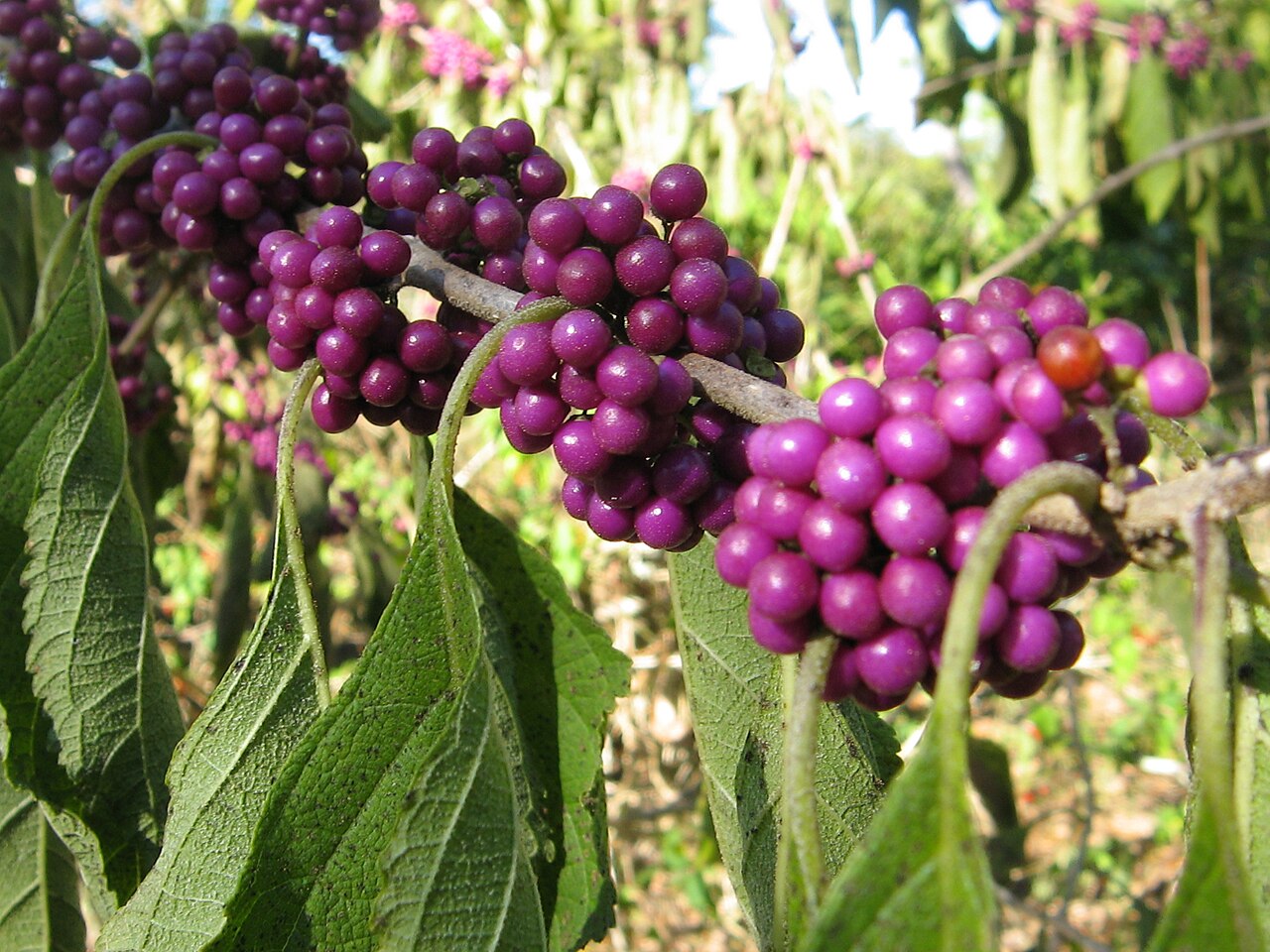
Walk into a garden center in fall and you may find two shrubs with purple berries, both labeled “beautyberry.” One is American beautyberry, native to the South. The other is often purple beautyberry, an Asian species that’s smaller and hardier.
They look alike from a distance, but they’re different choices for a native garden. Purple beautyberry has been found escaping from gardens in several Eastern states.
This guide shows how to tell them apart, which one fits your region, and what to plant instead if neither is native where you live.
Plan at a Glance
| Site | Any shrub border, hedge, or woodland edge where you want fall fruit |
| Size | American: 3 to 8 feet. Purple: 2 to 4 feet. |
| Sun | Both prefer full sun to part shade for good fruiting |
| Soil | Well drained; American beautyberry also likes steady moisture |
| Maintenance | Low. Both flower on new wood and can be pruned in late winter. |
| Best choice by region | American beautyberry in the Southeast and South-Central states. Elsewhere, a locally native fruiting shrub. |
Start With Where You Live
The choice is mostly about geography. A 2019 botanical report led by a New York Botanical Garden researcher describes American beautyberry as the only Callicarpa native to North America. It grows from central Texas to Florida and north to southern Missouri, Tennessee, and Virginia.
The Lady Bird Johnson Wildflower Center gives a similar range: Virginia to Arkansas, south to Florida and eastern Texas. Its distribution also lists Maryland, Oklahoma, and Missouri. NC State Extension lists hardiness zones 6 through 9.
Purple beautyberry (Callicarpa dichotoma) comes from China, Japan, Korea, and Vietnam. NC State lists it as hardy to zone 5, one zone colder than the native species. That makes it easy to find in nurseries in the Northeast and Midwest, where American beautyberry isn’t native.
So the question to ask first is simple. Are you inside American beautyberry’s native range? If yes, plant it. If not, skip both and choose a shrub native to your area.
Why Purple Beautyberry Is a Concern
Purple beautyberry isn’t just non-native. It has started to escape cultivation. A 2019 report in Phytoneuron by Daniel Atha and colleagues lists it as naturalized in South Carolina, North Carolina, Kentucky, Tennessee, Virginia, and Delaware. The same report documented spontaneous plants in New York City’s Central Park.
The authors cite botanist Alan Weakley’s observation that the species is beginning to spread more rapidly in the Southeast. Birds eat the fruit and carry the seeds, which is how a garden shrub ends up in a woodland.
There’s a second concern. The report notes that Asian beautyberries are relatives of the native species, and it raises cross-breeding with American beautyberry as a conservation issue. Inside the native range, planting the Asian species puts it right next to wild populations.
How to Tell Them Apart
Plant tags aren’t always reliable, so check the plant itself. The Phytoneuron report includes a botanical key, and EDDMapS, the invasive species mapping project, gives a simpler field comparison. Three features do most of the work.
1. Where the fruit sits
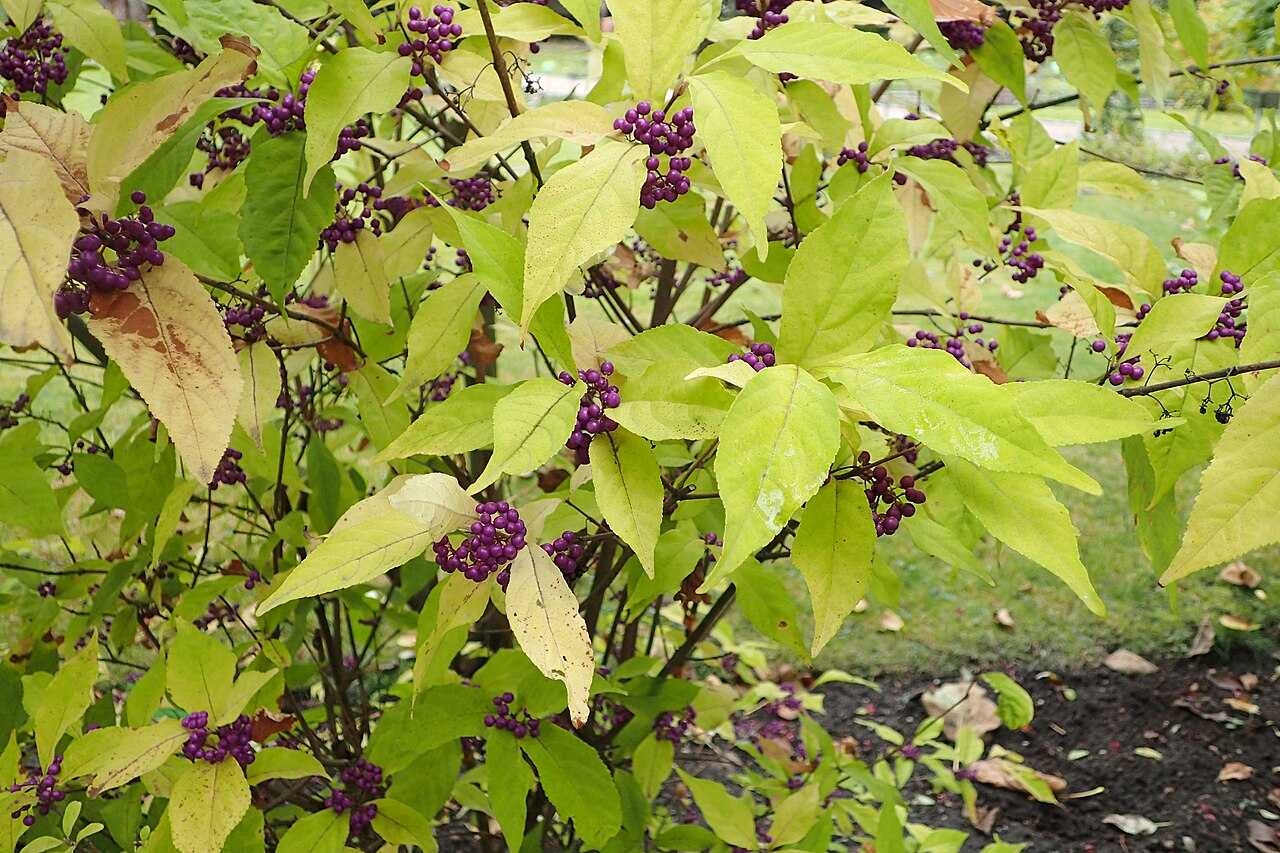
On American beautyberry, the flower and fruit clusters are stalkless. They press tightly against the stem at each leaf pair. The key describes the cluster stalk as shorter than the leaf stalk.
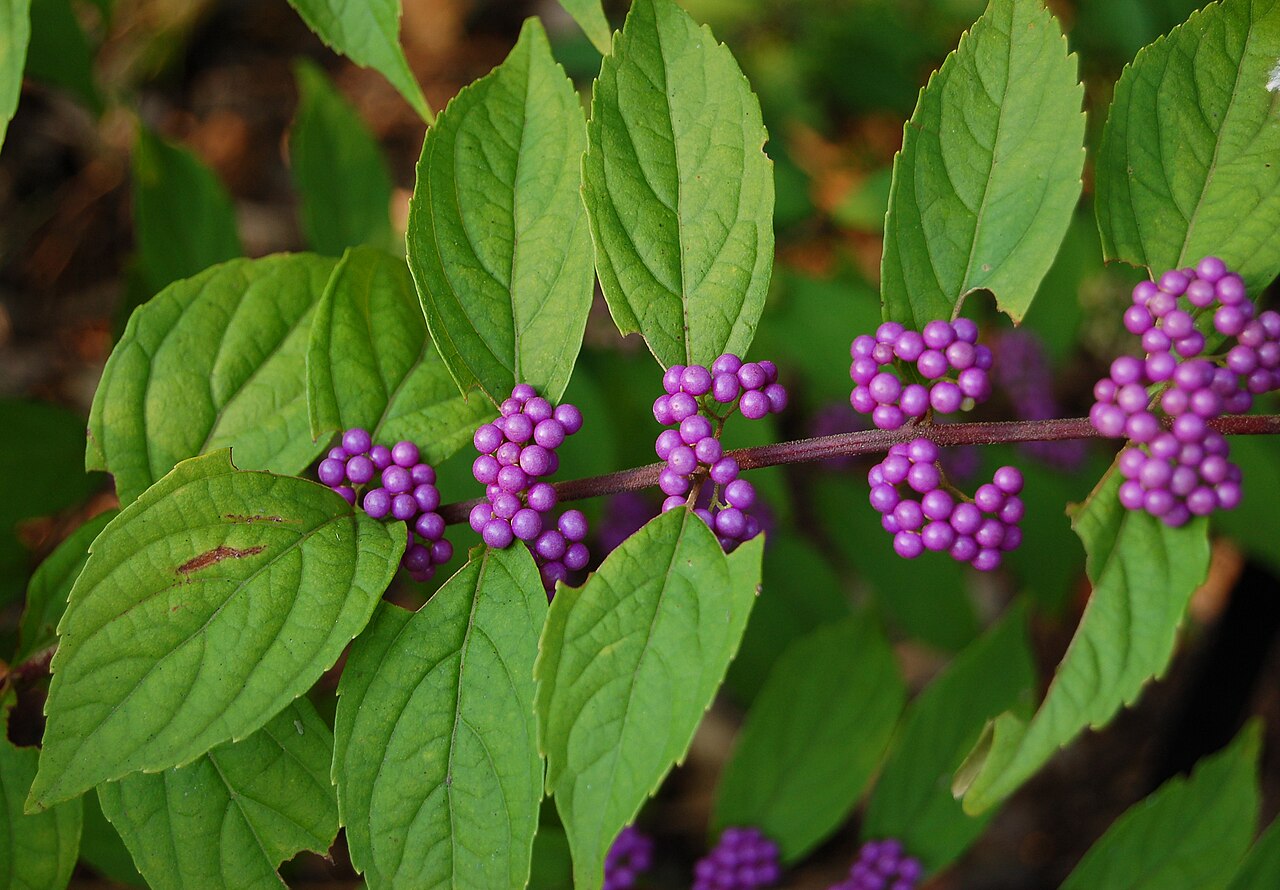
On purple beautyberry, each cluster sits on its own stalk, longer than the leaf stalk. EDDMapS notes that the fruit clusters sit farther from the stem. The berries are also smaller.
2. Leaf size, shape, and fuzz
American beautyberry has large, broad, oval leaves. Wikipedia, citing World Flora Online, gives blades of about 8 to 23 centimeters (3 to 9 inches). The Phytoneuron key describes the undersides as densely hairy.
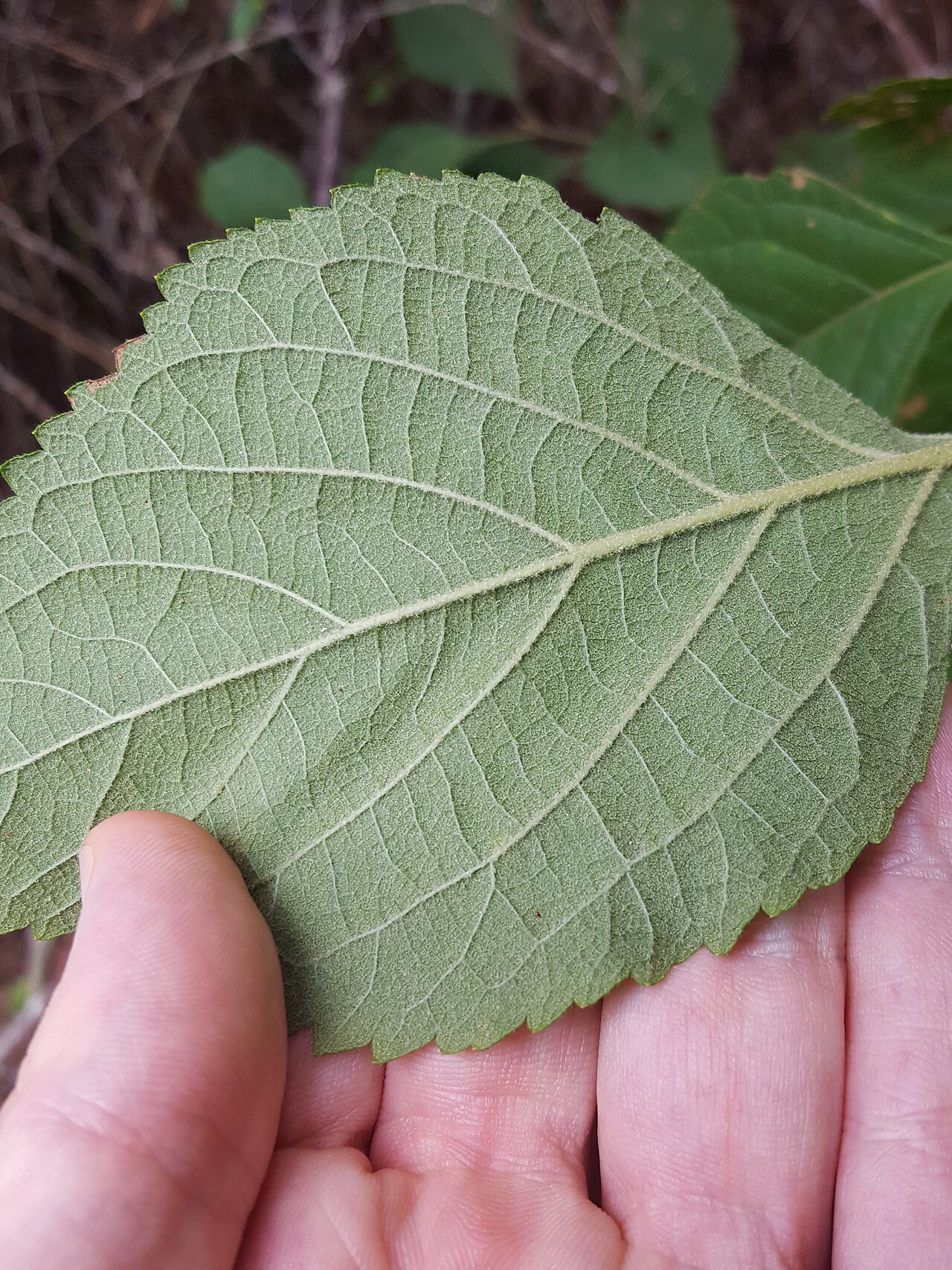
Purple beautyberry’s leaves are narrower and smaller, about 2 to 6 centimeters (roughly 1 to 2½ inches) long in the key, and nearly hairless below. NC State adds that the leaves sit closer together on the stem.
3. Overall size
NC State lists American beautyberry at 3 to 8 feet tall and purple beautyberry at 2 to 4 feet. EDDMapS also notes that the native species tends to form a larger shrub.
Side-by-Side Comparison
| Feature | American beautyberry | Purple beautyberry |
|---|---|---|
| Scientific name | Callicarpa americana | Callicarpa dichotoma |
| Native to | Southeastern and South-Central US | China, Japan, Korea, Vietnam |
| Height | 3–8 ft | 2–4 ft |
| Hardiness (NC State) | Zones 6–9 | Zones 5–8 |
| Fruit clusters | Stalkless, tight against the stem | On stalks, held away from the stem |
| Leaves | Large, broad, hairy below | Small, narrow, nearly hairless below |
| Status | Native; supports local wildlife within its range | Escaping gardens in several Eastern states |
If You Already Have Purple Beautyberry
You don’t have to rip it out tomorrow, but don’t let it seed around. Here’s a reasonable plan:
- Confirm the ID using the fruit stalks and leaf undersides above. Check for a cultivar name such as ‘Early Amethyst’ on old tags.
- Look for seedlings in nearby beds, along fences, and in any woods next to your yard. Pull them while small.
- Plan a replacement. Pick a native shrub from the palette below and decide where it will go.
- Remove the shrub in late winter or early spring, before it flowers and sets fruit. Dig out the main root crown.
- Plant the native replacement in the same spot or nearby, then mulch and water it through its first summer.
- Keep checking for seedlings for a few years, since seeds already dropped may still sprout.
Choosing a Locally Native Option
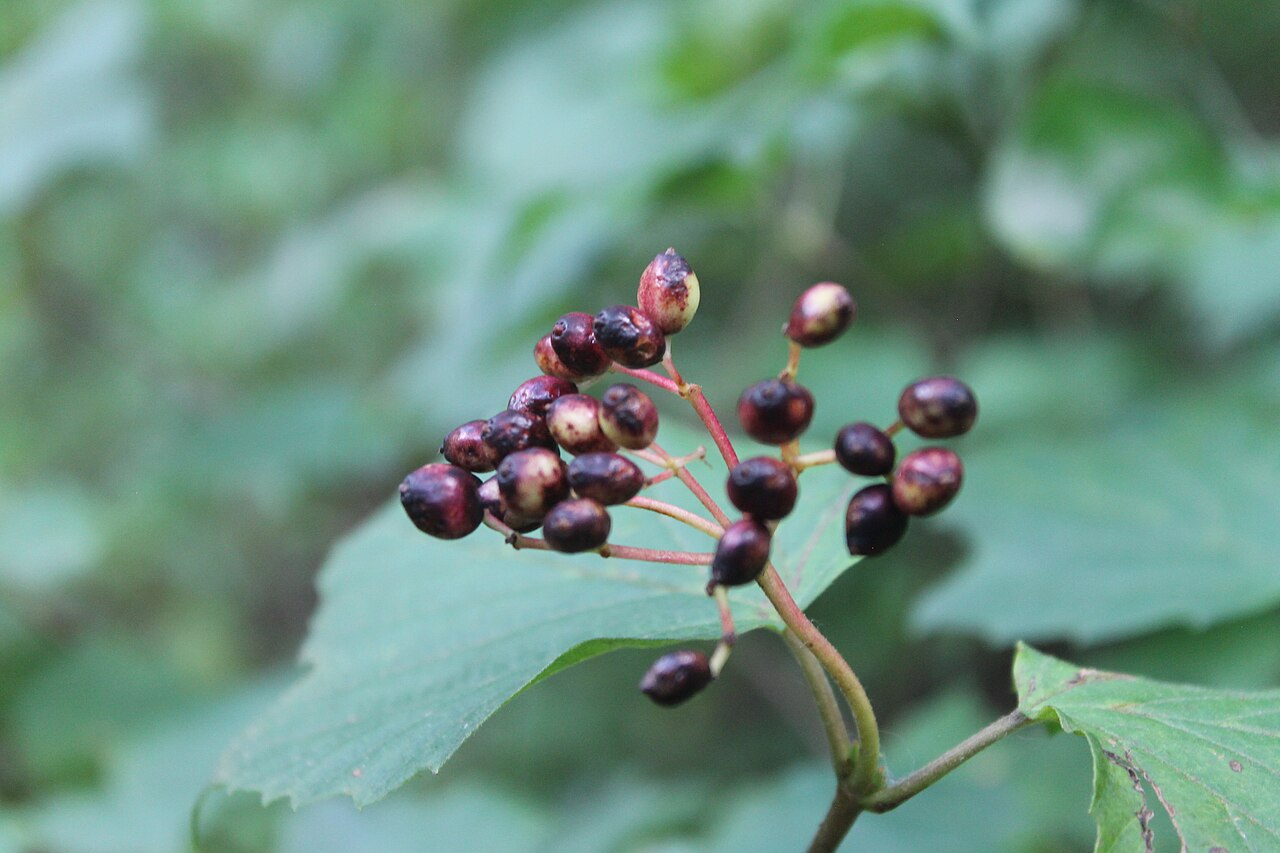
Inside its range, American beautyberry is the obvious pick. Outside it, look for a native shrub that gives you similar fall fruit and wildlife value. NC State itself names maple-leaf viburnum as a native alternative to purple beautyberry.
Plant Palette
| Plant | Role | Height | Sun / moisture | Native range |
|---|---|---|---|---|
| American beautyberry | Purple fall fruit, Southern gardens | 3–8 ft | Sun to part shade; moist, drained | VA to FL, west to AR, OK, MO, e. TX |
| Maple-leaf viburnum | Dark fruit, red-purple fall color, shade | 4–6 ft | Dappled to part shade; moist, drained | Eastern North America |
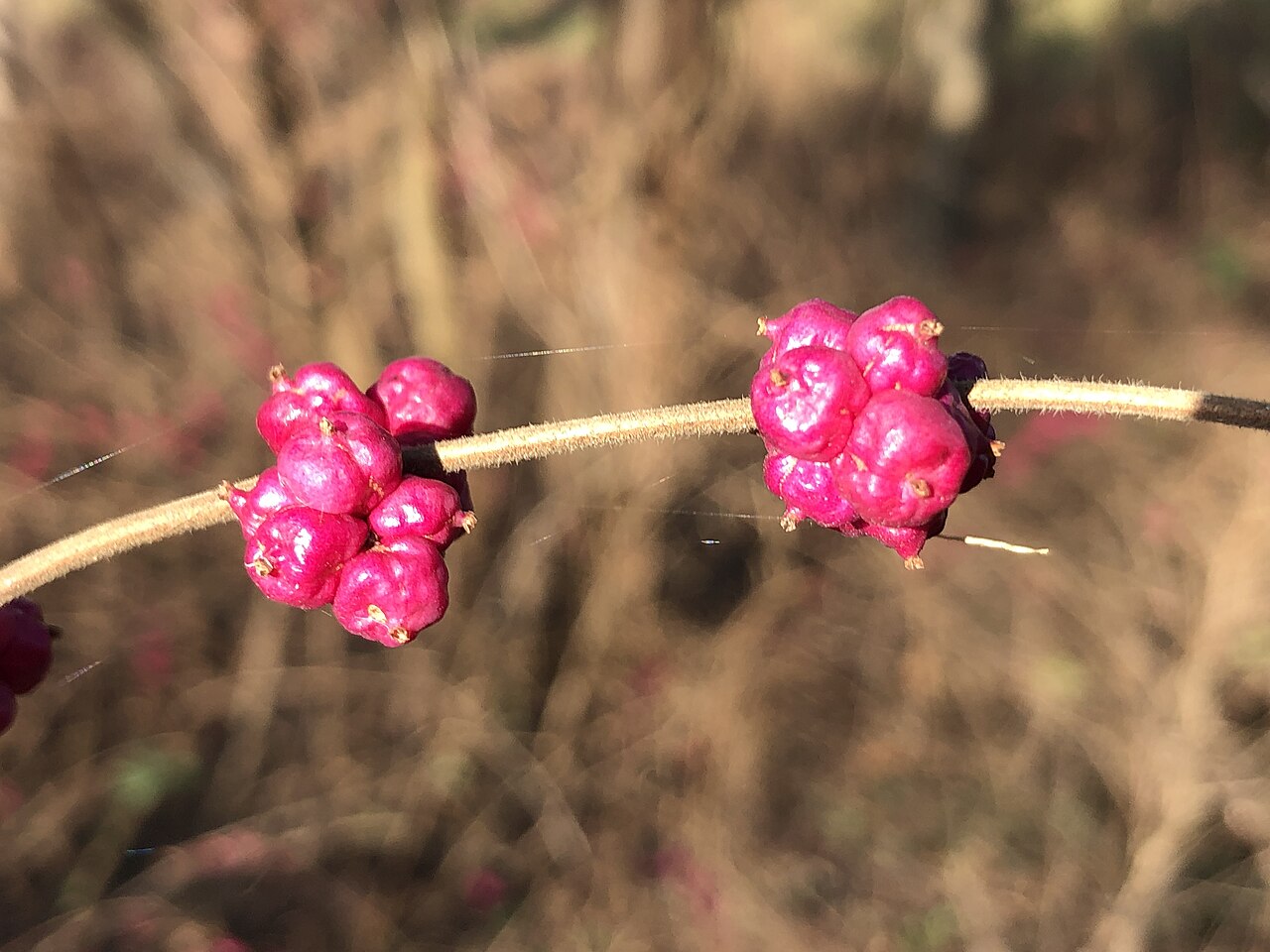
| Coralberry | Pink-purple winter fruit, low cover | 2–4 ft | Sun to part shade; dry to moist | NY to e. TX, west to SD and CO |
| Winterberry holly | Red winter fruit, wet sites | 3–15 ft | Sun to shade; moist to wet | Eastern North America |
| Black chokeberry | Black fruit, red fall color, cold hardy | 3–10 ft | Sun to part shade; dry to wet | Eastern Canada and the eastern US |
Heights and light from NC State Extension; ranges from NC State and the Lady Bird Johnson Wildflower Center. Confirm each plant is native to your county.
Two notes on fruit. NC State says maple-leaf viburnum needs more than one genetic strain nearby for good fruit set, so plant two or more from different sources. It says the same about coralberry. Winterberry holly needs a male plant nearby, which our guide to winterberry with no berries explains.
Planting Your Native Choice
- Buy from a native plant nursery and check the botanical name on the tag. For beautyberry, look for Callicarpa americana.
- Plant in fall or early spring in a hole twice as wide as the root ball, with the top of the root ball level with the soil.
- Mulch 2 to 3 inches deep, keeping mulch off the stems.
- Water deeply through the first summer whenever the top few inches of soil dry out.
For layout ideas, see our American beautyberry garden plans and our list of part-shade companions for beautyberry.
The First Three Years
- Year 1: water in dry spells, weed by hand, and keep pulling any purple beautyberry seedlings. Expect little fruit.
- Year 2, late winter: prune beautyberry before new growth starts, since it flowers on new shoots. Prune viburnum and chokeberry only to remove dead or crossing wood.
- Year 2, summer: water during long droughts, especially while plants flower and set fruit.
- Year 3: fruiting should be regular. Leave the fruit for birds and hold cleanup until late winter.
Mistakes to Avoid
- Trusting the common name. “Beautyberry” on a tag can mean several species. Read the Latin name.
- Planting American beautyberry far outside its range because it’s native somewhere. “Native” should mean native to your region.
- Assuming a white-fruited beautyberry is native. Wikipedia notes a white-fruited form of American beautyberry exists, but NC State also lists white-fruited purple beautyberry cultivars. Check the leaves and fruit stalks.
- Leaving seedlings. If you remove a purple beautyberry, watch for new ones for several years.
📋 Find it in your region: American beautyberry appears in our native plant lists for Georgia, Alabama & Mississippi, Arkansas, Louisiana, Eastern Oklahoma & Eastern Texas, Kentucky & Tennessee, and Illinois, Iowa & Missouri (southern Missouri only).
Frequently Asked Questions
Is purple beautyberry invasive?
It’s escaping gardens in several Eastern states. A 2019 Phytoneuron report lists it as naturalized from South Carolina to Delaware and found wild plants in New York City. Check your state’s invasive plant list for its current status.
Can I grow American beautyberry in the North?
NC State lists it as hardy to zone 6, but it isn’t native in the Northeast or upper Midwest. There, a local shrub such as maple-leaf viburnum, winterberry, or black chokeberry is the better native choice.
Do birds eat both kinds of beautyberry?
Yes. That’s part of the problem with the Asian species, since birds spread its seeds into natural areas. The native species feeds wildlife without that risk inside its range.
What about Japanese beautyberry?
Callicarpa japonica is another Asian species. The same Phytoneuron report found it escaping in New York and New Jersey. Treat it like purple beautyberry.
How can I tell them apart in winter?
Look at the remaining fruit. American beautyberry’s clusters sit tight against the stem, while purple beautyberry’s hang on short stalks. If no fruit is left, check fallen leaves for size and fuzz.
Sources
- Atha, D., M. Gunderson, E. Whitaker, R. Alvarez, and M. Young. 2019. First report of Callicarpa dichotoma and Callicarpa japonica spontaneous and potentially invasive in New York and New Jersey. Phytoneuron 2019-17: naturalized states, identification key, native range of C. americana, hybridization concern.
- EDDMapS, Purple beautyberry (Callicarpa dichotoma): field comparison of leaves, fruit clusters and shrub size.
- North Carolina Extension Gardener Plant Toolbox, Callicarpa dichotoma and Callicarpa americana: origin, US distribution, size, hardiness, leaf spacing, cultivars and native alternative.
- NC Extension Gardener Plant Toolbox: Viburnum acerifolium, Symphoricarpos orbiculatus, Ilex verticillata and Aronia melanocarpa: sizes, light and fruit set.
- Lady Bird Johnson Wildflower Center, Callicarpa americana: native distribution and habitat.
- Wikipedia, Callicarpa americana and Callicarpa dichotoma: leaf dimensions, white-fruited form and origin.