Bald Cypress in a Home Landscape: Space, Wet Soil, and Root-Knee Questions
Last updated: November 6, 2026
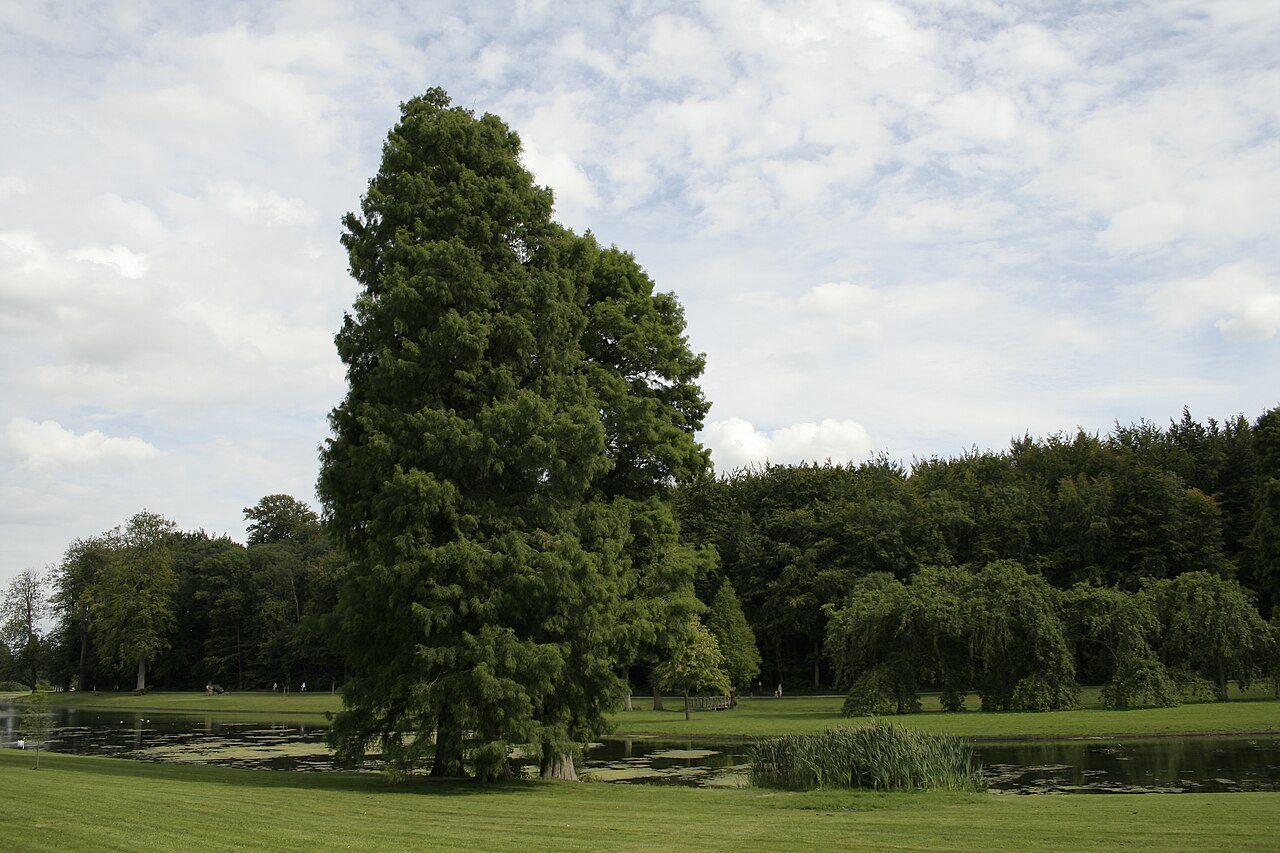
Bald cypress has a reputation as a swamp tree, and plenty of homeowners assume it only belongs in standing water. In practice it grows well in ordinary yards, beside ponds, and even along streets.
The bigger questions are space, soil, and those famous knees. A young bald cypress looks tidy and narrow, but it grows into a large tree that will outlast most houses, and it can raise woody knobs from its roots in wet ground.
This plan walks through how to judge whether your yard has room, where the tree fits best on wet and dry sites, what to plant beneath it, and how to care for it through the first three years.
Plan at a Glance
| Site | Low spot, pond or stream edge, rain-garden margin, or a large open lawn |
| Size | 50 to 70 feet tall and 20 to 30 feet wide at maturity (NC State Extension) |
| Sun | Full sun to part shade; full sun gives the best form |
| Soil | Acidic, moist to wet soils preferred; tolerates clay, occasional flooding, and drier sites once established |
| Maintenance | Low once established; plan for needle and branchlet drop each fall |
| Best regions | Southeast, Gulf Coast, Mississippi Valley, and the Mid-Atlantic coastal plain; widely planted north of its native range |
Start With the Space Test
Before you think about wet soil or knees, measure. NC State Extension lists bald cypress at 50 to 70 feet tall and 20 to 30 feet wide, and the Lady Bird Johnson Wildflower Center gives 50 to 75 feet. Old trees also develop a broad, flared base that NC State describes as 3 to 6 feet across.
Stand where you want the trunk and mark a circle 30 feet across with stakes or a hose. That circle is the minimum canopy footprint. Walls, roof edges, decks, and wires should sit outside it. Our guide to mapping a tulip tree’s mature canopy walks through the same method step by step.
The Arbor Day Foundation calls available space the most overlooked factor in tree selection and asks planters to consider height, crown spread, and root space. The International Society of Arboriculture (ISA) adds that roots commonly spread well beyond the crown, sometimes farther than the tree is tall.
If the circle will not fit, bald cypress is the wrong tree for that spot. A smaller cultivar or a different native may suit you better; options are covered below. For a shady, damp spot, American hornbeam is a much smaller native tree that tolerates periodic flooding.
Look Up and Look Down: Utilities and Structures
The ISA advises planters to “look up and look down” before choosing a tree site. Overhead lines are easy to miss when you are holding a 6-foot sapling, but a 60-foot tree under a wire will eventually be pruned by the utility company to keep clearance. That pruning often leaves a lopsided tree and can shorten its life.
Underground lines matter just as much. Water, sewer, gas, and electric lines can be damaged by digging, and roots can interfere with them over time. In the United States, contact 811 a few business days before you dig, even for a single tree, and wait until every utility has marked its lines.
We do not give a fixed distance from foundations or septic systems here, because safe setbacks depend on your soil, the structure, and local codes. Your county extension office, your utility provider, or an ISA Certified Arborist can help you choose a spot when space is tight.
Wet Soil, Dry Soil, or Somewhere Between
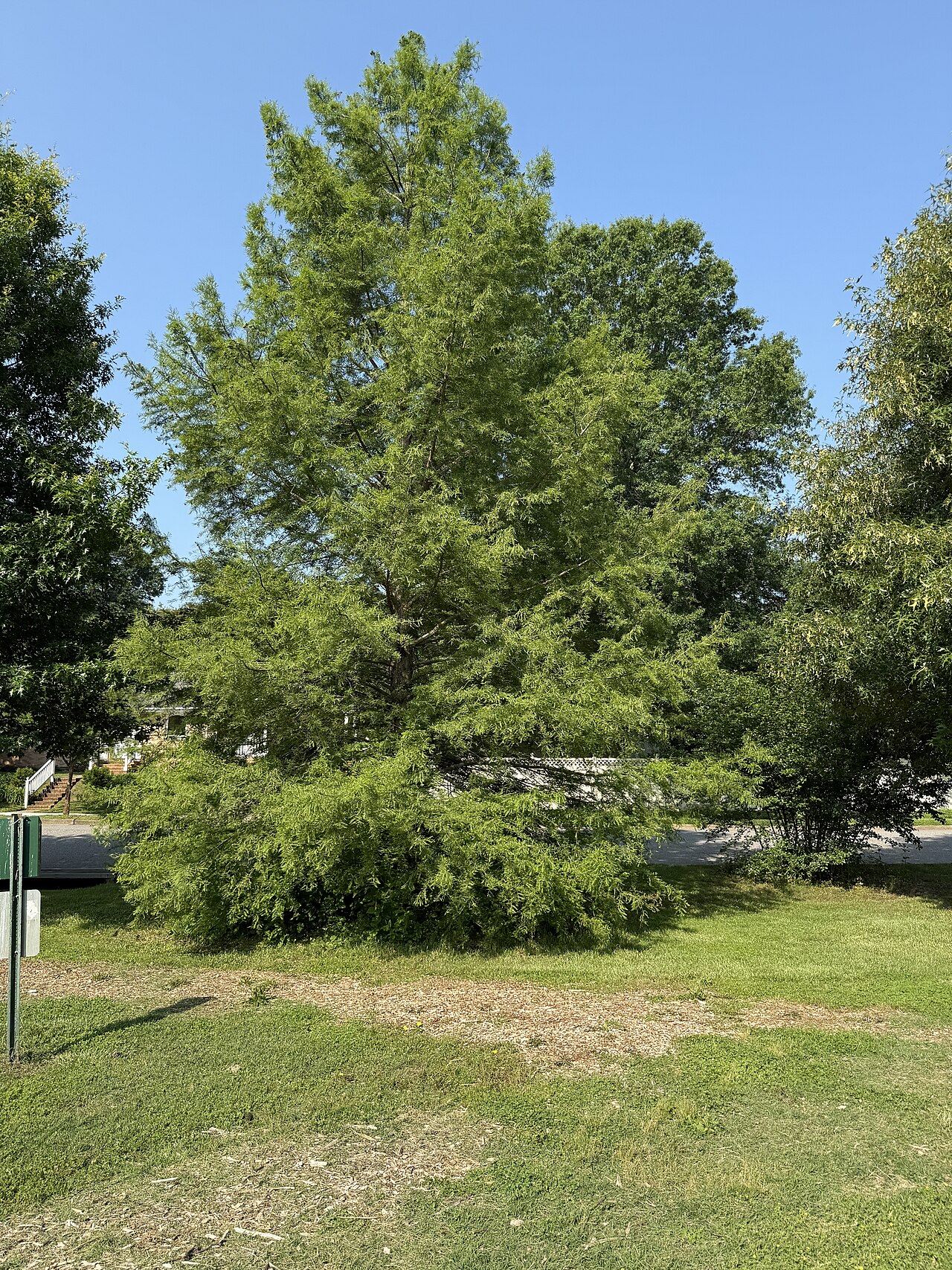
Bald cypress is one of the few large native trees that handles truly wet ground. NC State notes it tolerates standing water and flooding for extended periods, and the Wildflower Center says its roots are not prone to suffocation, which is why it is often planted in parking lots.
It is not limited to wet sites, though. NC State recommends moist but well-drained soil and lists it as tolerant of a wide range of conditions. The Morton Arboretum says it adapts to wet, dry, or swampy sites. The Wildflower Center notes it is widely planted in drier soils and colder climates than its native swamps.
Two soil cautions apply everywhere. Both NC State and the Morton Arboretum warn that bald cypress can turn yellow (chlorosis) in alkaline soil, so test your pH if you garden on limestone-derived soil. Morton also rates its drought tolerance as moderately sensitive, so a dry-site tree needs watering through dry spells, especially while young.
Matching the tree to your low spot
The ideal home-landscape spot is a low area that stays damp after rain, the edge of a pond, or the lower margin of a large rain garden. Bald cypress fits these places better than most shade trees, which may decline in soggy soil.
Avoid planting it in the center of a small rain garden. A tree this size will shade and root through the whole basin over time. Place it at the outer edge where its roots can reach moisture without taking over the planting.
The Root-Knee Question
Cypress knees are woody, cone-shaped projections that rise from the roots. They are also the reason some homeowners hesitate to plant it.
Knees are tied to wet ground. The Wildflower Center says they develop mostly in poorly drained situations, and NC State says they usually occur when the tree grows near or in water. A bald cypress in a well-drained lawn may produce few or none, although there is no guarantee either way.
Their purpose is still debated. NC State describes the common belief that they help bring oxygen to roots in oxygen-poor mud, while the Wikipedia summary of the research notes the evidence for that is limited and that structural support in soft soil is another likely role.
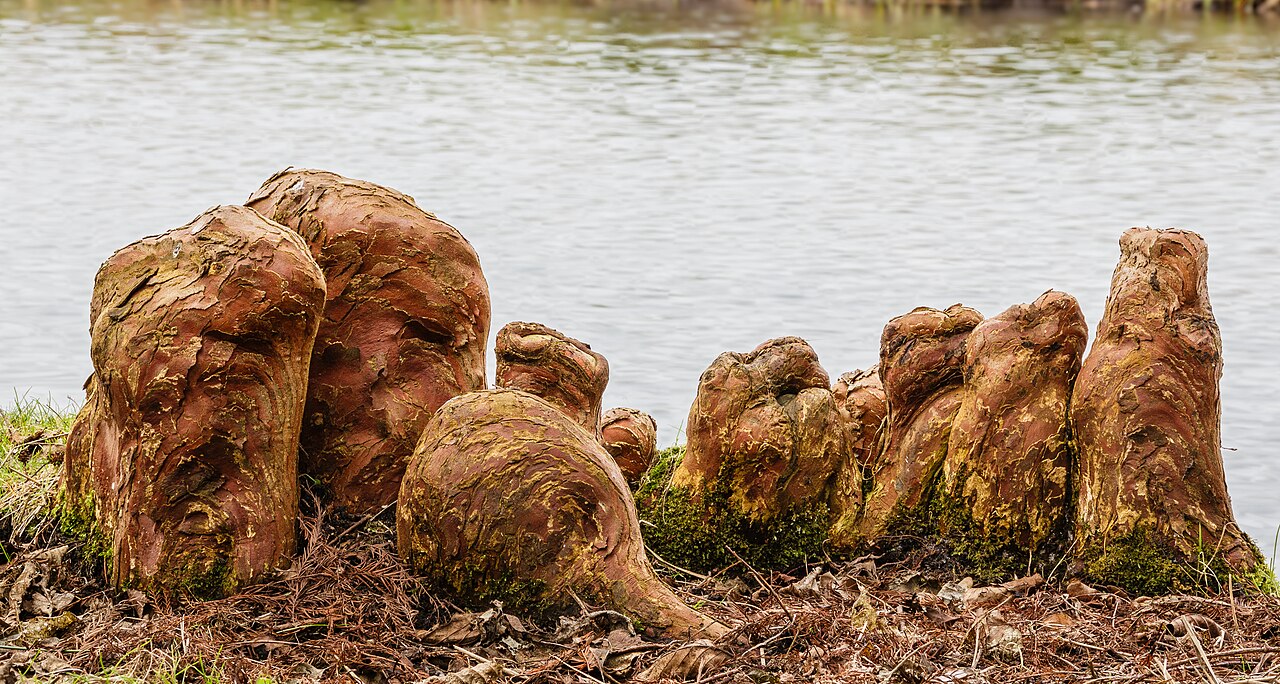
Living with knees in a yard
If you plant in a damp spot, assume knees may appear within the root zone. Design for them instead of fighting them later.
- Keep the tree out of mown lawn where possible. A mulched or planted bed under the canopy means the mower never meets a knee.
- Keep paths, patios, and play areas outside the wettest part of the root zone, where knees are most likely.
- Treat knees as part of the tree. Do not cut them as routine maintenance; if a knee truly has to go, ask an ISA Certified Arborist first, since it is attached to the root system.
Where Bald Cypress Fits in a Home Design
The pond or stream edge. Set the tree back from the bank so the canopy leans over the water rather than the house. Plant moisture-loving shrubs and perennials along the bank in front of it, and expect knees in the wettest zone.
The wet corner of a large lawn. Use bald cypress as a single specimen, with a mulched bed at least as wide as the young canopy. Widen the bed as the tree grows, adding sedges and wet-meadow perennials beneath it.
The drier, open yard. Here it can act as a fine-textured shade tree. NC State calls it a good specimen or shade tree for recreational areas. Give it full sun, acidic soil, and the full space circle, and water during droughts.
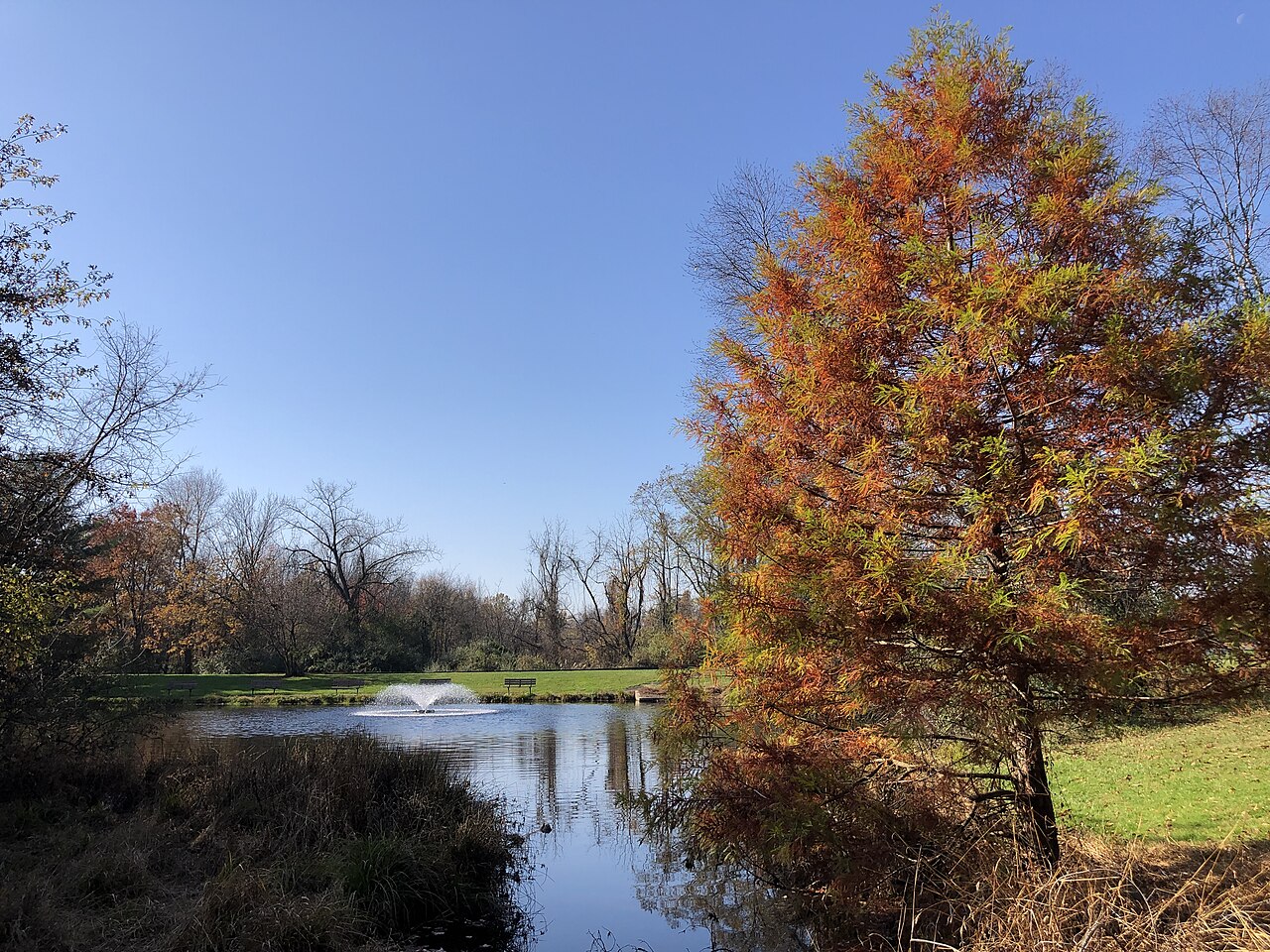
Plant Palette
Heights and ranges are from the Lady Bird Johnson Wildflower Center unless noted. Confirm each plant is native to your county before buying.
| Plant | Role | Height | Sun / moisture | Native range |
|---|---|---|---|---|
| Bald cypress (Taxodium distichum) | Specimen or shade tree | 50–75 ft | Sun to part shade / moist to wet | DE to FL, west to central TX; north along the Mississippi to southern IL and IN |
| Buttonbush (Cephalanthus occidentalis) | Shrub layer at water’s edge | Up to about 12 ft | Part shade to shade / moist to wet | New Brunswick and Quebec to FL and TX |
| Swamp milkweed (Asclepias incarnata) | Summer flowers, monarch host | Up to about 5 ft | Sun to part shade / moist to wet | Much of the eastern and central U.S. and southern Canada |
| Cardinal flower (Lobelia cardinalis) | Late-summer red spikes | Up to about 6 ft | Sun to shade / moist to wet | New Brunswick to MN, south to FL, TX and CA |
| Virginia blue flag (Iris virginica) | Spring flowers along the bank | About 3 ft | Sun / wet | Coastal Plain from southeastern VA to TX |
Regional alternates
Plant choices must match your region. Virginia blue flag is a coastal-plain species; gardeners farther north and inland can use larger blue flag (Iris versicolor) for the same role.
In the Southeast, pond cypress is a close relative with shorter, scale-like leaves. The Wildflower Center lists it from southeastern Virginia or Maryland to Florida and Louisiana, mainly in shallow ponds and poorly drained ground.
In the far North, where bald cypress is planted outside its native range, American larch is the native deciduous conifer of wet ground. The Wildflower Center lists it across boreal North America, south to Minnesota, northern Pennsylvania and New Jersey.
Space and Cultivar Options
If the full-size species will not fit, smaller selections exist. They are cultivars rather than wild-type plants, so weigh that against your goals.
Size Comparison
| Species (wild type) | 50–70 ft tall, 20–30 ft wide (NC State) |
| ‘Shawnee Brave’ | Narrowly pyramidal, about 50 ft tall and 20 ft wide (Morton Arboretum) |
| ‘Lindsey’s Skyward’ | Narrow and columnar, about 25 ft tall and 10 ft wide (NC State) |
| ‘Peve Minaret’ | Dwarf, about 8–10 ft tall and 3–4 ft wide (Morton Arboretum) |
Installation Steps
Fall or early spring planting gives roots time to grow before summer heat. These steps follow ISA’s tree-planting guidance.
- Call 811 and wait for marks. Do this a few business days ahead, and recheck the space circle against any marked lines.
- Find the trunk flare. The point where the trunk widens should be partly visible after planting. Remove excess soil from the top of the root ball if needed.
- Dig wide, not deep. ISA recommends a hole two to three times wider than the root ball but only as deep as the root ball.
- Check the roots. Remove wrapping and wire, and straighten or cut circling roots.
- Backfill and water. Fill firmly, watering as you go to remove air pockets. ISA advises against fertilizing at planting.
- Mulch. Spread 2 to 3 inches of mulch over the root zone, keeping it a couple of inches away from the trunk.
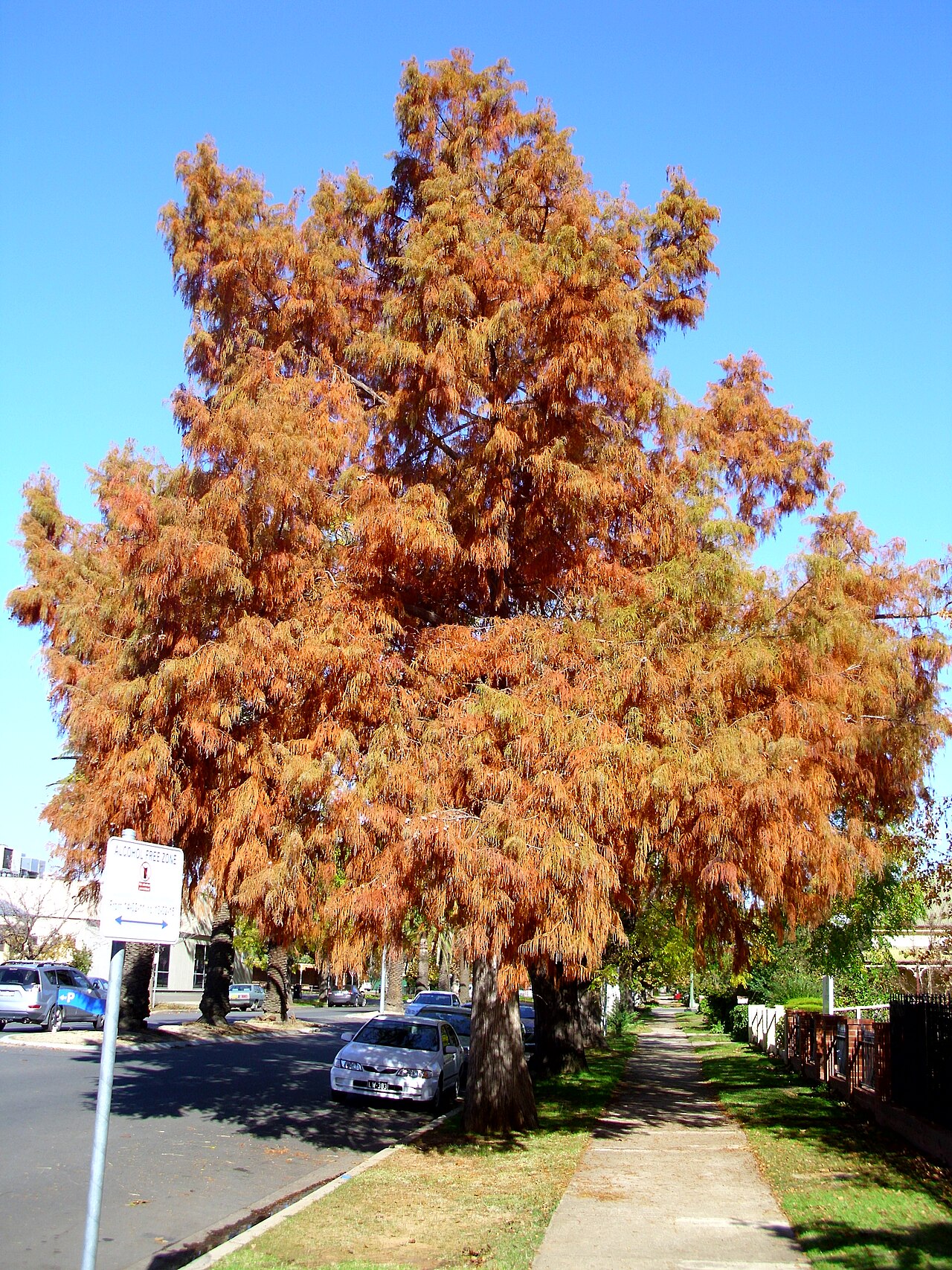
First-Three-Years Maintenance Calendar
- Year 1, spring to fall: water weekly when it does not rain, more in hot or windy weather, tapering off in mid-fall (ISA). Keep the mulch ring weed-free and do only minor pruning of damaged branches.
- Year 1, fall: expect the needles to turn copper and drop with their small branchlets attached, which NC State says is normal. A “bald” tree in winter is not a dead tree.
- Year 2: water during dry spells, especially on drier sites. Widen the mulch bed, and watch new growth for yellowing that could signal alkaline soil.
- Year 3: begin structural pruning if needed, keeping one central leader. Add sedges and wet-meadow perennials in the expanding bed, and keep mowers away from any knees.
- Every fall: clear needles and branchlets from gutters and drains near the tree, and leave the rest in beds as mulch.
Mistakes to Avoid
- Judging size by the nursery pot. The tree you plant is a fraction of the one you will have. Measure the full mature circle first.
- Planting under wires or over utilities. Utility pruning and digging damage are both avoidable with a few minutes of planning.
- Putting it in mown lawn on a wet site. That is the setup most likely to produce knees in the mower’s path.
- Ignoring soil pH. Yellowing needles in alkaline soil are a site problem, not a fertilizer shortage.
- Assuming it never needs water. Bald cypress tolerates flooding, but young trees on dry ground still need help through droughts.
For moist-ground shrub companions, see our guides to where buttonbush fits in a rain garden and choosing a shrub for a wet garden edge.
📋 Find plants for your region: see the full Bald Cypress (Taxodium distichum) profile or our native plant lists for Delaware, Southern New Jersey & Long Island, Georgia, Alabama & Mississippi, Arkansas, Louisiana, Eastern Oklahoma & Eastern Texas, Illinois, Iowa & Missouri, and South and West Texas.
Frequently Asked Questions
Will a bald cypress grow knees in my yard?
It may, but knees develop mostly in wet or poorly drained soil. On a well-drained site, a tree may produce few or none. Plan the root zone as a bed rather than lawn so any knees cause no trouble.
How close to a house can I plant a bald cypress?
Keep the full mature crown, at least 20 to 30 feet across, clear of the house, and allow for roots that spread beyond the crown. Because safe distances depend on soil, foundations, and local rules, ask your extension office or an ISA Certified Arborist when space is tight.
Does bald cypress need standing water?
No. It tolerates standing water and flooding but grows well in moist, well-drained soil and adapts to drier sites once established. Young trees on dry ground need watering in droughts.
Why did my bald cypress lose all its needles?
It is a deciduous conifer. The needles turn copper in fall and drop with their small branchlets, and new needles appear in spring.
Can bald cypress grow north of its native range?
Yes. The Morton Arboretum lists it as hardy in zone 4 and it is widely planted in northern landscapes. Growth is slower where summers are cool, so local natives such as American larch may be a better fit in the far North.
Sources
- NC State Extension Gardener Plant Toolbox, Taxodium distichum: size, base width, soil and flood tolerance, knees, chlorosis, branchlet drop, cultivars.
- Lady Bird Johnson Wildflower Center, Taxodium distichum: height, native distribution, knees in poorly drained sites, root tolerance, pond cypress. Companion data from Wildflower Center pages for buttonbush, swamp milkweed, cardinal flower, Virginia blue flag and American larch.
- The Morton Arboretum, Bald-cypress: site adaptability, drought sensitivity, acid soil, hardiness, cultivar sizes.
- International Society of Arboriculture, Planting a Tree: planting steps, mulching, watering, utility conflicts and root spread.
- Arbor Day Foundation, Planning, selection and location: considering height, crown spread and root space.
- 811 Before You Dig, Contact 811 before every dig.
- Wikipedia, Cypress knee and Taxodium distichum: debated knee function and growth in cool-summer climates.