A Native Garden for Heavy Clay: Separate Wet-Soil Choices From Dry-Clay Choices
Last updated: November 6, 2026
Heavy clay gets one piece of advice over and over: “choose clay-tolerant plants.” The trouble is that clay behaves in two very different ways depending on where it sits in your yard.
Clay in a low spot can stay soggy for days after rain. Clay on a slope, a berm, or a compacted new-build lot can bake as hard as pavement by midsummer. A plant that loves one of those sites will often struggle or die in the other.
This plan splits the decision in two. First you work out whether your clay is the wet kind or the dry kind. Then you plant from the matching list, with a transition band where the two meet.
Plan at a Glance
| Site | Yards with heavy clay soil, from soggy low spots to hard, dry slopes and compacted new-build lots |
| Size | Any; the sample plan is a 10 × 20-foot bed with a wet end and a dry end |
| Sun | Full sun to part shade; most dry-clay choices want full sun |
| Soil | Clay or clay loam; drainage decides the plant list, not texture alone |
| Maintenance | Low once established: weed the first two seasons, then one late-winter cutback |
| Best regions | Eastern and central U.S. for the plants named here; swap in species from your regional list elsewhere |
Why “Clay-Tolerant” Isn’t Enough
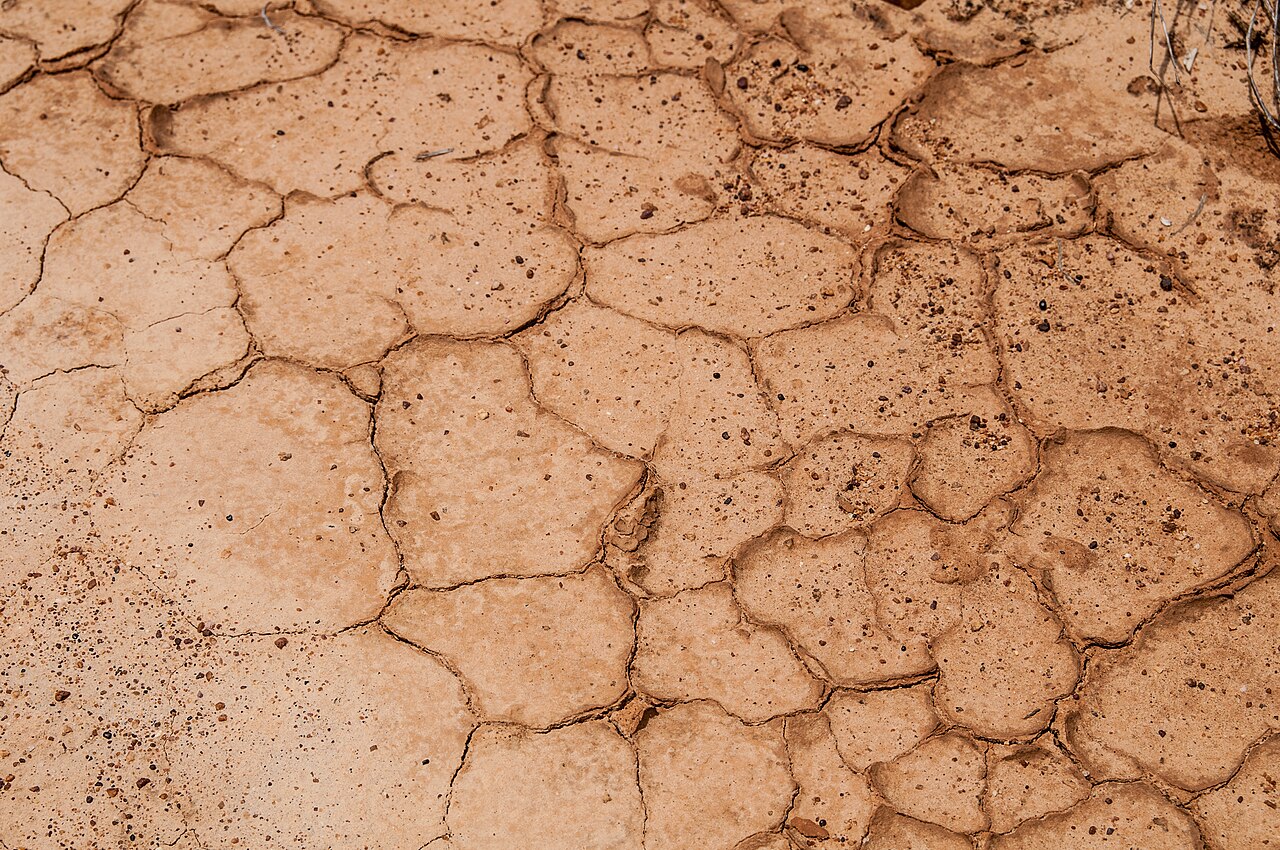
Clay is made of the smallest soil particles, and they are flat and plate-shaped. Utah State University Extension explains that those plates can stack into sheets, compact easily, and form hard layers called pans.
That structure is why clay holds water so well when it is wet and turns rock-hard when it dries. The Piedmont Master Gardeners describe it as sticky and moldable when wet and concrete-like when dry. It also warms more slowly in spring than well-drained soil.
A plant tag that says “tolerates clay” may mean “survives in a moist clay meadow” or “copes with dry, rocky clay prairie.” Know which one you have before you buy.
Site Assessment: Is Your Clay Wet or Dry?
Watch it after a heavy rain
Note where water stands and for how long. Puddles that last a day or more mark wet clay. A spot that sheds water and is dry on top by the next afternoon is probably dry clay, even if it feels like modeling clay.
Run a simple drainage test
N.C. Cooperative Extension in Durham County suggests a “perc test” when the soil is neither very wet nor very dry. Dig a hole about 12 inches deep, fill it with water, let it drain, then fill it again and check it over the next 24 hours.
Their guide reads the result like this: empty in 3 to 4 hours is good drainage, 5 to 12 hours is moderate, and 12 to 24 hours is poor. Water still standing after a day marks the wet end of your bed.
Look for compaction and buried subsoil
Utah State notes that construction often strips the topsoil and leaves clay subsoil at the surface. If your house is new and the ground under the sod is dense and pale, expect a dry, compacted clay that sheds water rather than soaking it up.
Map the bed into zones
If the wet spot is fed by a roof gutter, our plan for native plants at a downspout covers moving and spreading that water first. If your soil turns out to be gritty and fast-draining rather than clay, see our sunny native border for sandy soil instead.
Many beds hold both conditions. A gentle slope can be dry at the top and wet at the bottom. Sketch the bed and mark a wet zone, a dry zone, and the transition band between them. The plant lists below follow that map.
Design the Bed Around Water, Not Around Color
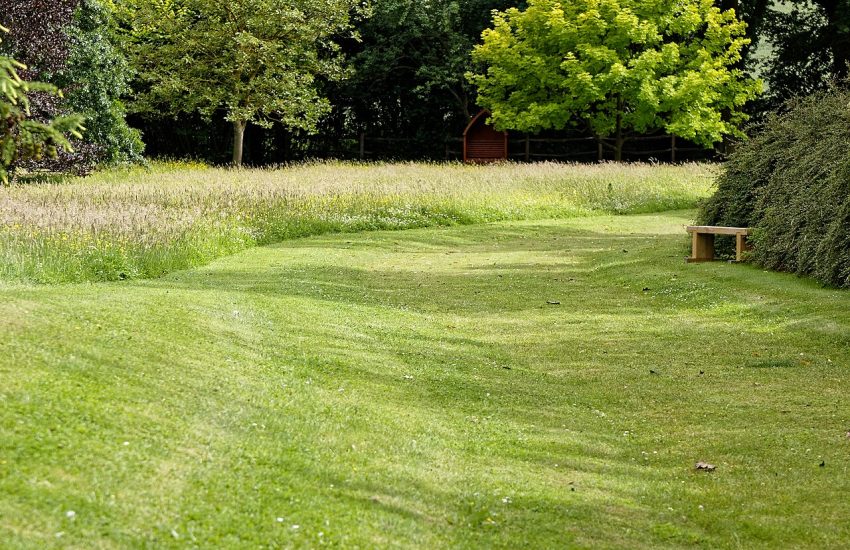
Put the plants that need constant moisture in the lowest, slowest-draining part of the bed. Put the dry-clay plants on the high side, where water runs off. Use plants that handle both conditions in the middle.
The logic resembles a rain garden, except that you are matching plants to clay that is already wet or dry rather than digging a basin to catch runoff.
Layers
Use one or two shrubs as anchors at the back or corners. Fill the middle with clumping grasses and sedges, which knit the soil and hide bare ground. Then add flowering perennials in drifts of three to seven, repeating the same few plants rather than buying one of everything.
Paths and edges
Clay compacts when you walk on it wet. Lay a stepping-stone or mulched path so you can weed without standing in the bed. Utah State specifically warns against foot traffic on wet clay.
The Wet-Clay Zone
These plants accept soil that stays saturated after rain. All are listed for moist to wet soil by the Lady Bird Johnson Wildflower Center.
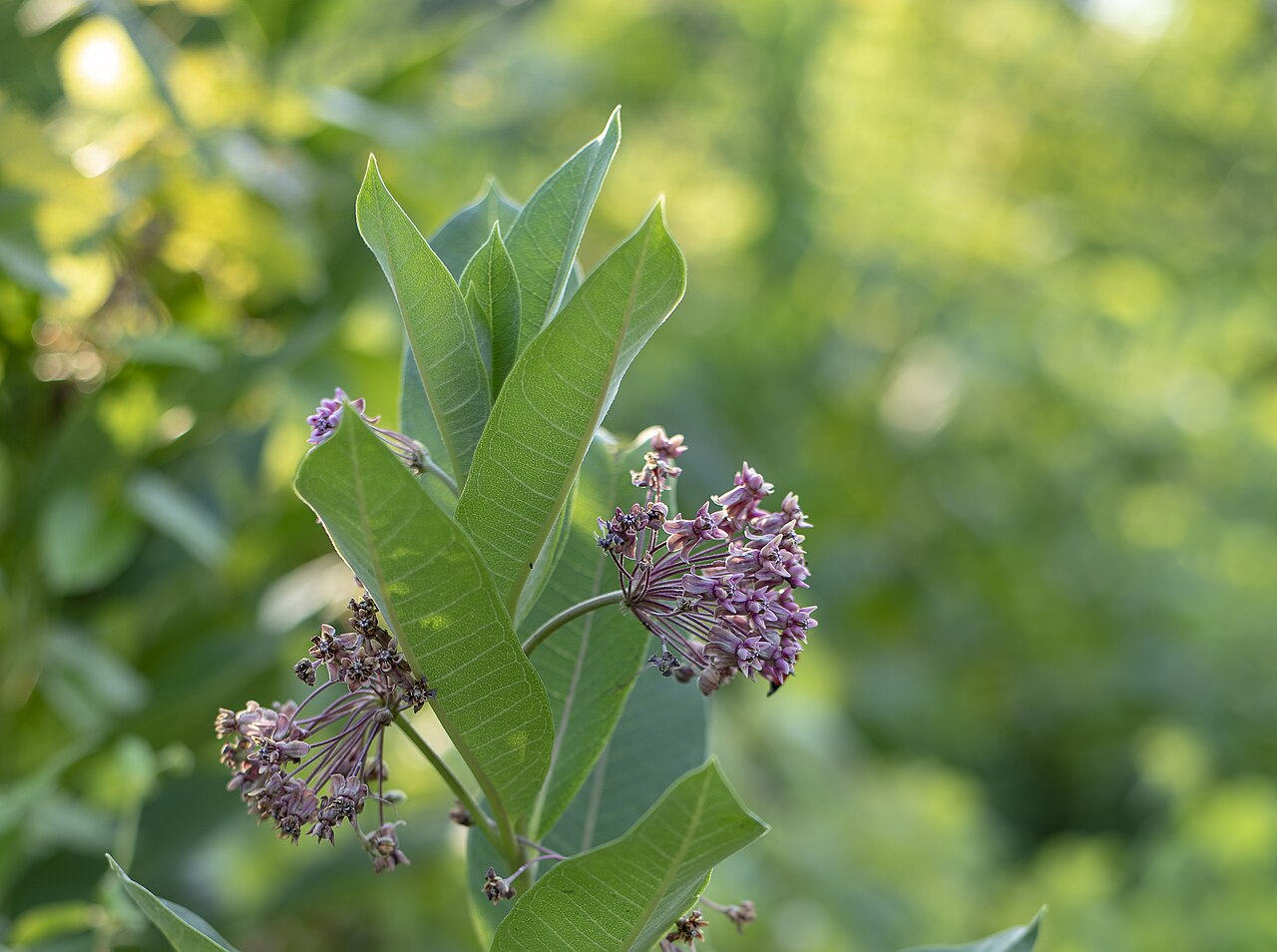
Swamp milkweed is the standout perennial here. The Wildflower Center calls it one of the few ornamentals that thrives in mucky clay, and it grows up to about 5 feet with pink to purple flowers from summer into fall.
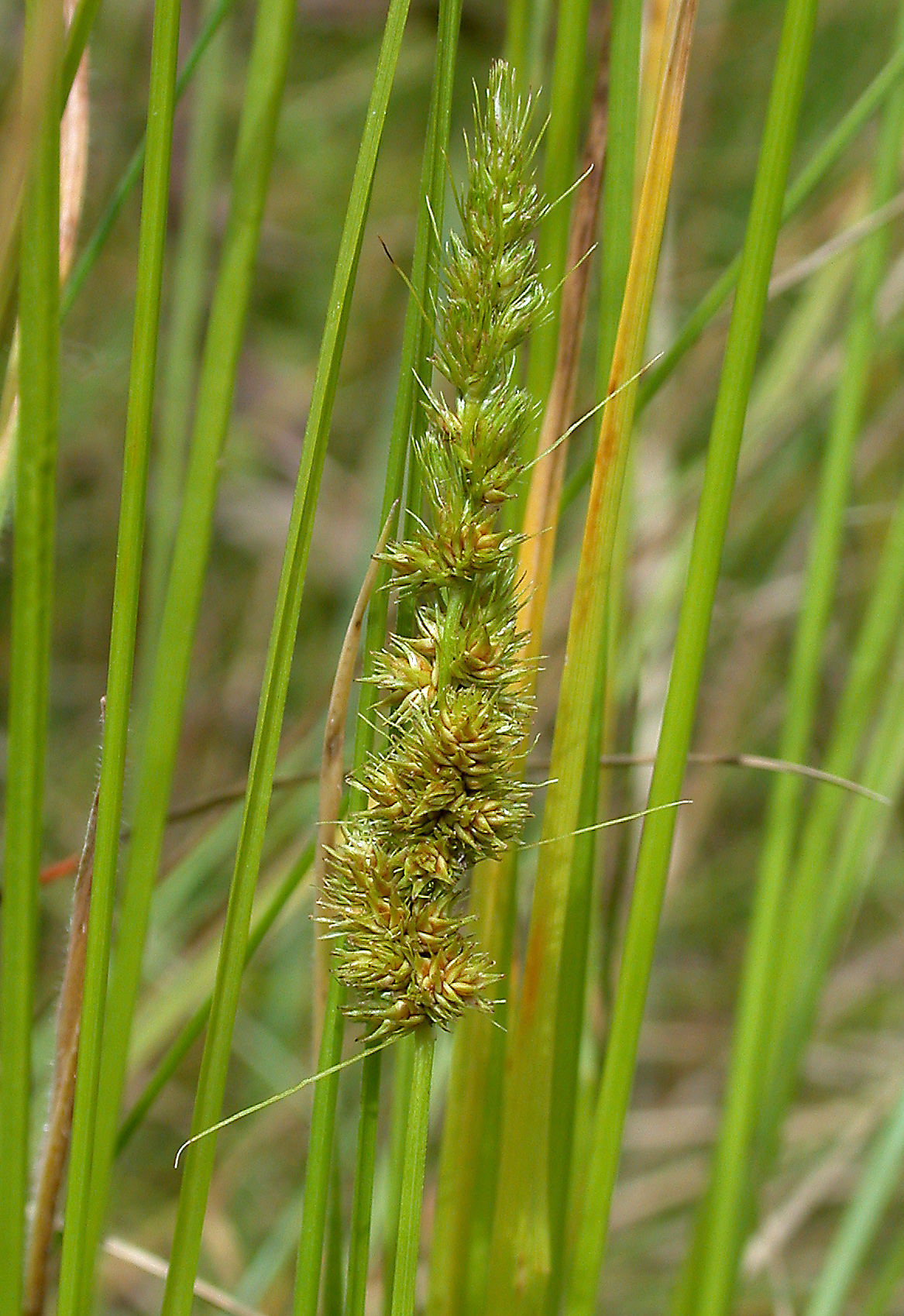
Fox sedge is a tough clumping sedge that the Wildflower Center lists for clay and loam in wet meadows and marshes. Wikipedia notes it tolerates fluctuating water levels and grows in clumps up to about a meter tall.
Northern blue flag gives you spring flowers and sword-shaped leaves at 2 to 3 feet. It is a northern species, native from Labrador to Manitoba and south to Virginia, Ohio, Michigan and Minnesota. Farther south, use Virginia blue flag (Iris virginica), which the Wildflower Center places on the Coastal Plain from southeastern Virginia to Texas.
For a shrub, buttonbush grows 6 to 12 feet and accepts poor drainage and even standing water. If you want to know where it fits and where it gets too big, see where buttonbush fits in a rain garden.
Black chokeberry is a smaller shrub option at 3 to 6 feet. The Wildflower Center calls it very flood tolerant, though it prefers acidic soil and suckers freely. Our guide to planting black chokeberry in clay walks through a drainage test for a single shrub.
The Dry-Clay Zone
These plants want clay that drains, or at least dries out between rains.
Little bluestem is the backbone grass. The Wildflower Center lists it for well-drained soils that include clay loam and clay, forming dense mounds 18 to 24 inches tall. It reseeds readily, so give it room or edit seedlings.
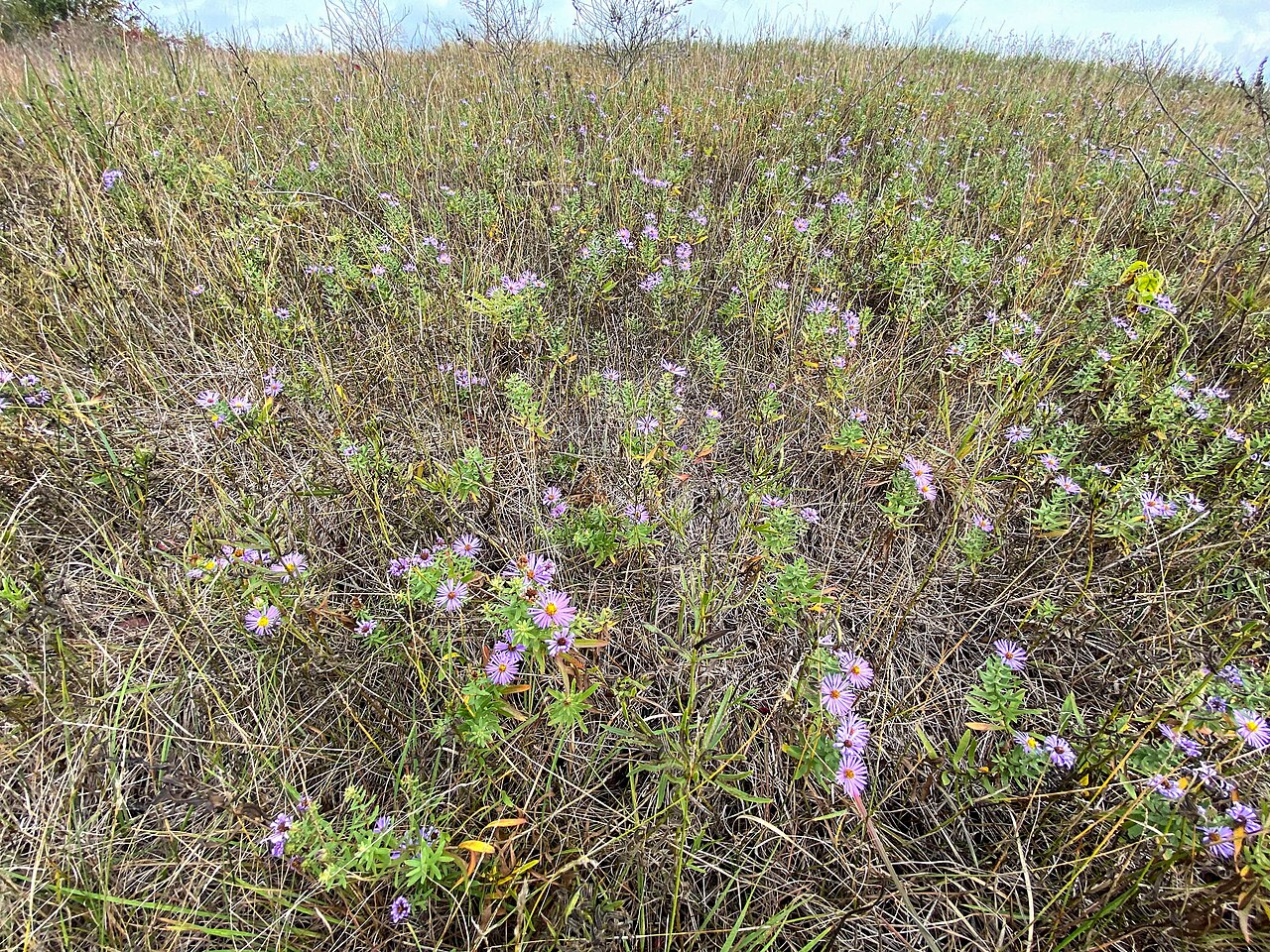
Aromatic aster grows in well-drained sand, loam, clay and limestone, according to the Wildflower Center. Its stems usually stay under 20 inches, and it blooms purple from September into November.
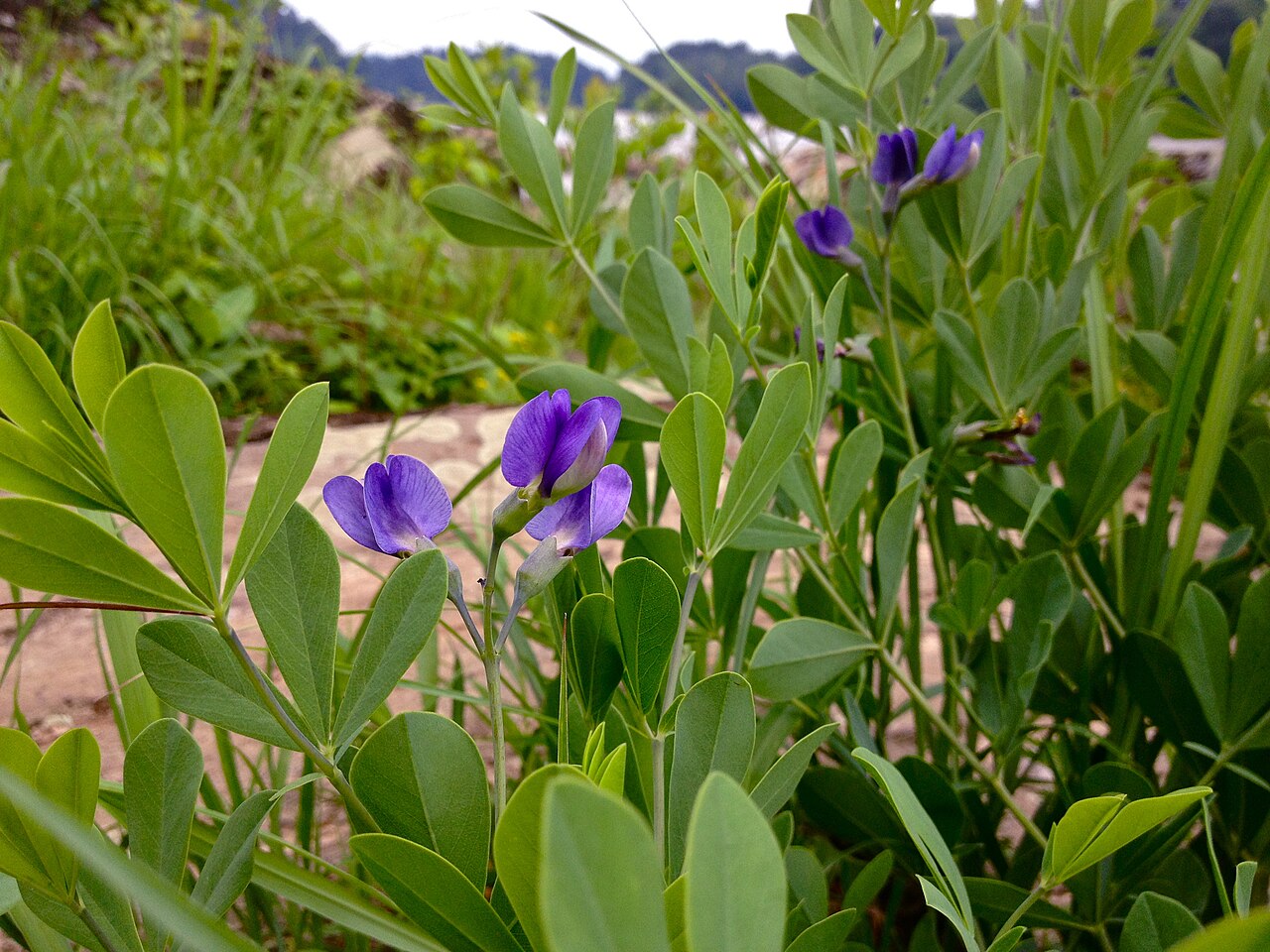
Blue wild indigo rises 2 to 4 feet from a woody base, with blue-purple flower spikes in late spring. The Wildflower Center lists it for moist, well-drained clays.
Gray-headed coneflower (Ratibida pinnata) adds height at 3 to 5 feet. The Wildflower Center says it tolerates soils from sandy to clay and that the tall stems may need neighbors to lean on.
For a shrub, fragrant sumac (Rhus aromatica) handles dry, rocky clay and limestone soils. The Wildflower Center lists it at 6 to 12 feet and notes that it colonizes to form thickets, so give it space.
The Transition Band
The middle of a sloped clay bed is moist in spring and dry by August. Plants listed for both dry and moist soil belong here.
Switchgrass is the classic bridge. The Wildflower Center lists it for dry to moist soils, including clay loam and clay, at 3 to 10 feet. It is rhizomatous and spreads as a loose sod, so pick a compact selection for small beds.
Plant Palette
Heights and ranges are from the Lady Bird Johnson Wildflower Center unless noted. Confirm each plant is native to your state before buying.
| Plant | Zone / role | Height | Sun / moisture | Native range |
|---|---|---|---|---|
| Swamp milkweed (Asclepias incarnata) | Wet: flowering perennial | Up to ~5 ft | Sun–part shade; moist–wet | Manitoba & Nova Scotia south to GA, west to TX & ND |
| Fox sedge (Carex vulpinoidea) | Wet: groundcover sedge | Up to ~3 ft (Wikipedia) | Sun; moist–wet | Most of the lower 48 and Canada |
| Northern blue flag (Iris versicolor) | Wet: spring flower | 2–3 ft | Sun–part shade; moist–wet | Labrador to Manitoba, south to VA, OH, MI, MN |
| Buttonbush (Cephalanthus occidentalis) | Wet: large shrub | 6–12 ft | Part shade–shade; moist–wet | Eastern N. America west to e. NE, e. KS & TX |
| Black chokeberry (Aronia melanocarpa) | Wet–moist: small shrub | 3–6 ft | Part shade; moist, acidic | Newfoundland to MN, south to GA mts., TN & AR |
| Switchgrass (Panicum virgatum) | Transition: grass | 3–10 ft | Sun–part shade; dry–moist | Most of the U.S. except the far West |
| Little bluestem (Schizachyrium scoparium) | Dry: bunchgrass | 18–24 in. mounds | Sun–part shade; dry | Much of N. America east of the Rockies |
| Aromatic aster (Symphyotrichum oblongifolium) | Dry: fall flower | Under 20 in., up to ~3 ft | Sun–part shade; dry–moist | PA to NC, west to WY & TX |
| Blue wild indigo (Baptisia australis) | Dry–mesic: spring flower | 2–4 ft | Sun; moist, well-drained | PA to s. IN, south to GA & TN; var. minor IA to TX |
| Gray-headed coneflower (Ratibida pinnata) | Dry: summer flower | 3–5 ft | Sun–part shade; dry–moist | W. PA & s. Ontario to MN & NE, south to GA, LA, OK |
| Fragrant sumac (Rhus aromatica) | Dry: shrub | 6–12 ft | Sun–shade; dry–moist | Quebec to GA & KS, and west to CA |
Sample Quantities for a 10 × 20-Foot Bed
A starting point for a bed with a wet end and a dry end. Adjust the split to match your drainage map.
| Zone | Area | Plants |
|---|---|---|
| Wet end | About 6 × 10 ft | 1 buttonbush or 2 black chokeberry; 5 fox sedge; 3 swamp milkweed; 3 blue flag |
| Transition band | About 4 × 10 ft | 3 switchgrass; 3 gray-headed coneflower |
| Dry end | About 10 × 10 ft | 7 little bluestem; 5 aromatic aster; 2 blue wild indigo |
Installation Steps
- Wait for workable soil. Utah State and N.C. Extension both warn against working clay while it is wet, because it compacts and forms clods. Squeeze a handful: if it smears into a ribbon, wait.
- Kill turf without tilling deep. Smother sod under cardboard and mulch for a season, or strip it. Deep tilling of wet clay does more harm than good.
- Loosen, don’t excavate. Loosen the top several inches where you plant. Do not dig deep holes in the wet zone; a deep hole in clay fills with water and drowns roots.
- Skip the sand. Utah State says sand is a poor amendment for clay, because the wrong mix can set like low-grade concrete. If you amend, use compost and mix it in thoroughly across the bed, not just in the hole.
- Plant the wet zone slightly high. Set crowns level with or a touch above the surrounding grade so they are not sitting in a basin.
- Mulch lightly. Two to three inches of shredded leaves or wood mulch keeps the surface from crusting. Keep it off the crowns.
- Water by need. Utah State explains that clay should dry out somewhat between waterings so air can reach the roots. Water deeply and less often, and skip the wet zone after rain.
First-Three-Years Maintenance Calendar
Year one
- Spring: plant once the soil crumbles. Water new plants weekly in dry spells, less in the wet zone.
- Summer: pull weeds while they are small. Clay holds weed roots tightly, so weed after rain when the soil is soft but not soggy.
- Fall: note which plants sulk. A dry-clay plant yellowing in the low end is telling you it is in the wrong zone.
Year two
- Late winter: cut last year’s stems down to a few inches before new growth starts. Leave some hollow stems standing for nesting insects if you can.
- Spring: move struggling plants to the zone that suits them. Fill gaps with more of whatever is thriving.
- Summer: water only in long droughts. Established dry-clay plants should manage on rainfall.
Year three
- Spring: thin spreading plants. Switchgrass, aromatic aster and fragrant sumac all spread over time.
- Summer: edit little bluestem and coneflower seedlings where they crowd other plants.
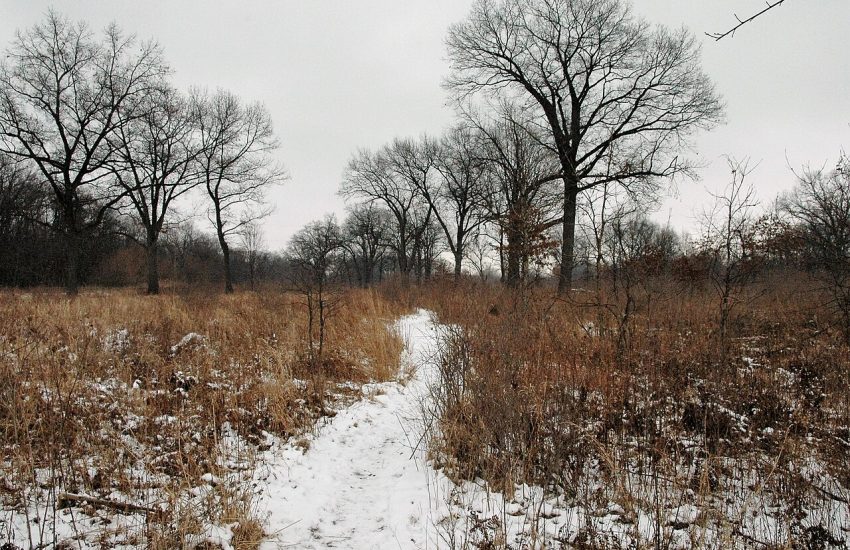
- Fall: leave seed heads standing for birds and winter structure.
Mistakes to Avoid
- Planting one list everywhere. A palette of “clay plants” without checking drainage puts wet-soil plants on dry slopes and dry-soil plants in puddles.
- Adding sand. It does not loosen clay; Utah State warns it can make it denser.
- Working the soil wet. Tilling, digging or walking on wet clay compacts it and undoes your work.
- Choosing species from outside your region. Several plants here have limited ranges.
📋 Find plants for your region: start with the profiles linked above, then check our native plant lists for Arkansas, Louisiana, Eastern Oklahoma & Eastern Texas and Maryland, Virginia & West Virginia, or the list for your own state, for wet- and dry-soil species that fit your area.
Frequently Asked Questions
Can I grow the same plants in wet clay and dry clay?
Only a few. Switchgrass, which the Wildflower Center lists for dry to moist soils including clay, is one. Most species do well in one condition or the other, which is why this plan splits the bed into zones.
Should I add sand to heavy clay?
No. Utah State University Extension says sand is a poor amendment for clay because the wrong proportions can create a material like low-grade concrete. Compost or other organic matter, mixed in thoroughly, is the usual recommendation.
How do I know if my clay drains well enough for dry-clay plants?
Do a perc test. Dig a 12-inch hole, fill it, let it drain, refill it and time it. N.C. Extension rates 3 to 4 hours as good drainage and 12 to 24 hours as poor.
What is the best native shrub for wet clay?
Buttonbush handles standing water and grows 6 to 12 feet. For a smaller shrub, black chokeberry tops out at 3 to 6 feet and is very flood tolerant, though it prefers acidic soil.
Are these plants right for the West Coast or the desert Southwest?
Mostly no. The palette is built from eastern and central species. Use it as a pattern, wet zone, transition band and dry zone, and fill each zone from your own state’s native plant list.
Sources
- Utah State University Extension, Gardening in Clay Soils: clay particle structure, pans, construction subsoil, working wet clay, sand as an amendment, letting clay dry between waterings.
- N.C. Cooperative Extension, Durham County, Making the Most of Your Garden’s Soil: perc test method and drainage ratings, not working wet clay.
- Piedmont Master Gardeners (Virginia Cooperative Extension), Gardening in Clay: how clay behaves wet and dry, slow spring warming.
- Lady Bird Johnson Wildflower Center plant database: swamp milkweed, fox sedge, northern blue flag, Virginia blue flag, buttonbush, black chokeberry, switchgrass, little bluestem, aromatic aster, blue wild indigo, gray-headed coneflower, fragrant sumac: soil, moisture, light, height and native range.
- Wikipedia, Carex vulpinoidea: clump height and tolerance of fluctuating water levels.