Native Plants for a Downspout Area: A Plan for Wet Bursts and Dry Intervals
Last updated: November 6, 2026
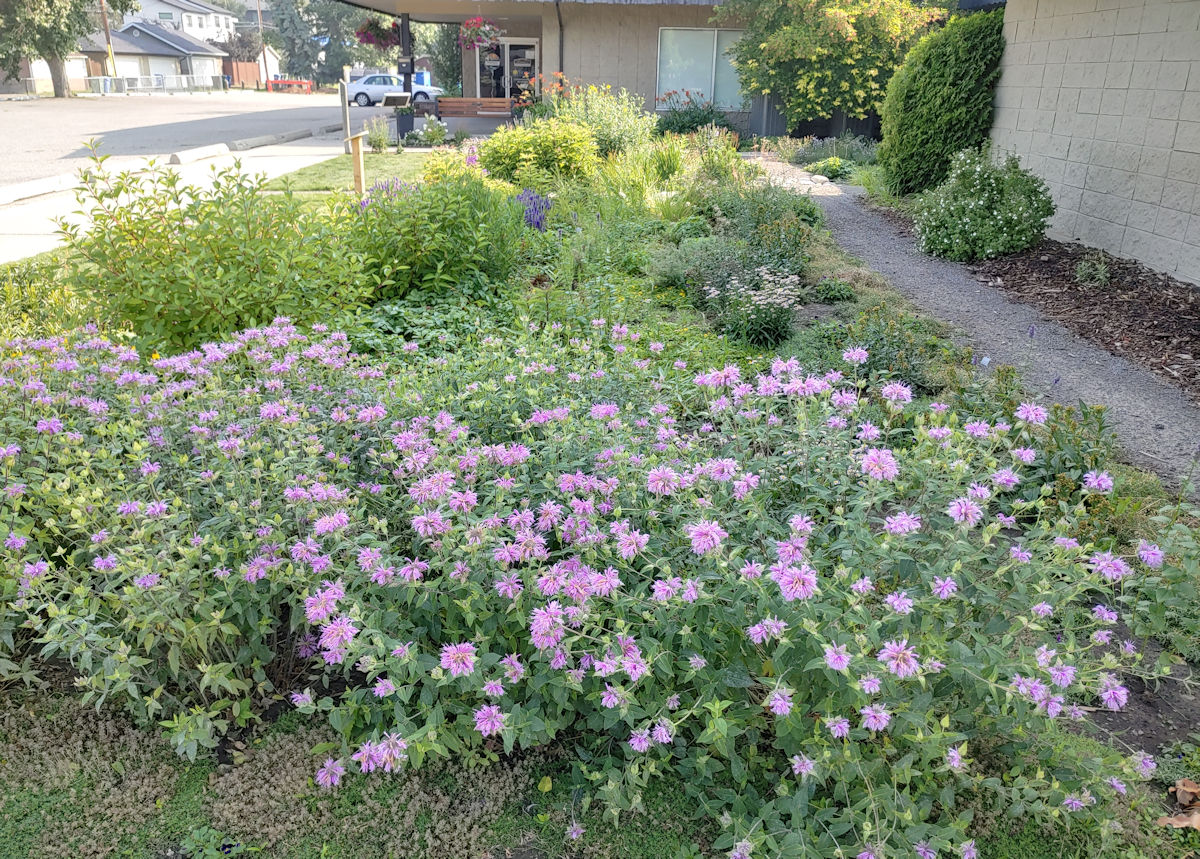
The ground at the end of a downspout lives a strange double life. During a storm it takes a fire-hose blast of roof water in minutes. A week later the same spot can be as dry as any other bed in the yard.
That is why so many downspout plantings fail. Bog plants dry out between storms, and drought-lovers rot during the soaking. The plants that last are the ones built for both.
This plan shows how to move the water to a safe spot, shape a small basin, and fill it with native plants that handle wet bursts and dry intervals. It also flags common “rain garden” picks that are a poor fit next to a downspout.
Plan at a Glance
| Site | The area fed by one roof downspout, with the water carried at least 10 feet from the house |
| Size | Roughly the roof area draining to that downspout divided by 20; often 50 to 150 square feet |
| Sun | Full sun to part shade |
| Soil | Any soil that drains within a few days; very heavy clay needs a different plan |
| Maintenance | Low after year two: clear debris from the inlet, weed, one late-winter cutback |
| Best regions | Eastern and central U.S. for the plants named here; use your regional list elsewhere |
Why Downspout Spots Are Harder Than Ordinary Wet Ground
A pond edge or swale is wet most of the time. A downspout area swings back and forth. It floods quickly, drains, and then gets nothing until the next storm.
Virginia Cooperative Extension’s rain garden fact sheet asks for exactly this kind of plant: ones that tolerate both shorter wet periods and longer dry periods. That is a narrower list than “plants for wet soil.”
Fast water also scours. The first few feet below the outlet take the hardest hit, so that spot needs protection before it needs plants.
Site Assessment
Move the water away from the house first
Virginia Extension says rain gardens should sit at least 10 feet from building foundations, and it pictures a flexible downspout extension carrying roof water that far into the landscape. Do not build a soaking basin against your foundation.
The same fact sheet rules out steep slopes, spots over underground utilities or a septic field, sites with high clay content, and places with a high water table. The bottom of the basin should sit at least 2 feet above the seasonal high water table.
Watch a real storm
Go out during a heavy rain and see where the water goes when it leaves the pipe. Note where it pools and how long it stands afterward. The natural low point a little downhill is often the best place for the basin.
Test drainage
Virginia Extension recommends a percolation test before you dig. If you have heavy, slow-draining clay, read our native garden plan for heavy clay first; it may suit the site better than a basin.
Size it to the roof
Virginia Extension’s method is simple: measure the roof area that drains to this downspout, then divide by 20 for the minimum garden size. Their example takes a quarter of a 4,800-square-foot roof, 1,200 square feet, which with a driveway added came to a garden of about 94 square feet.
Design: Three Zones Around One Outlet
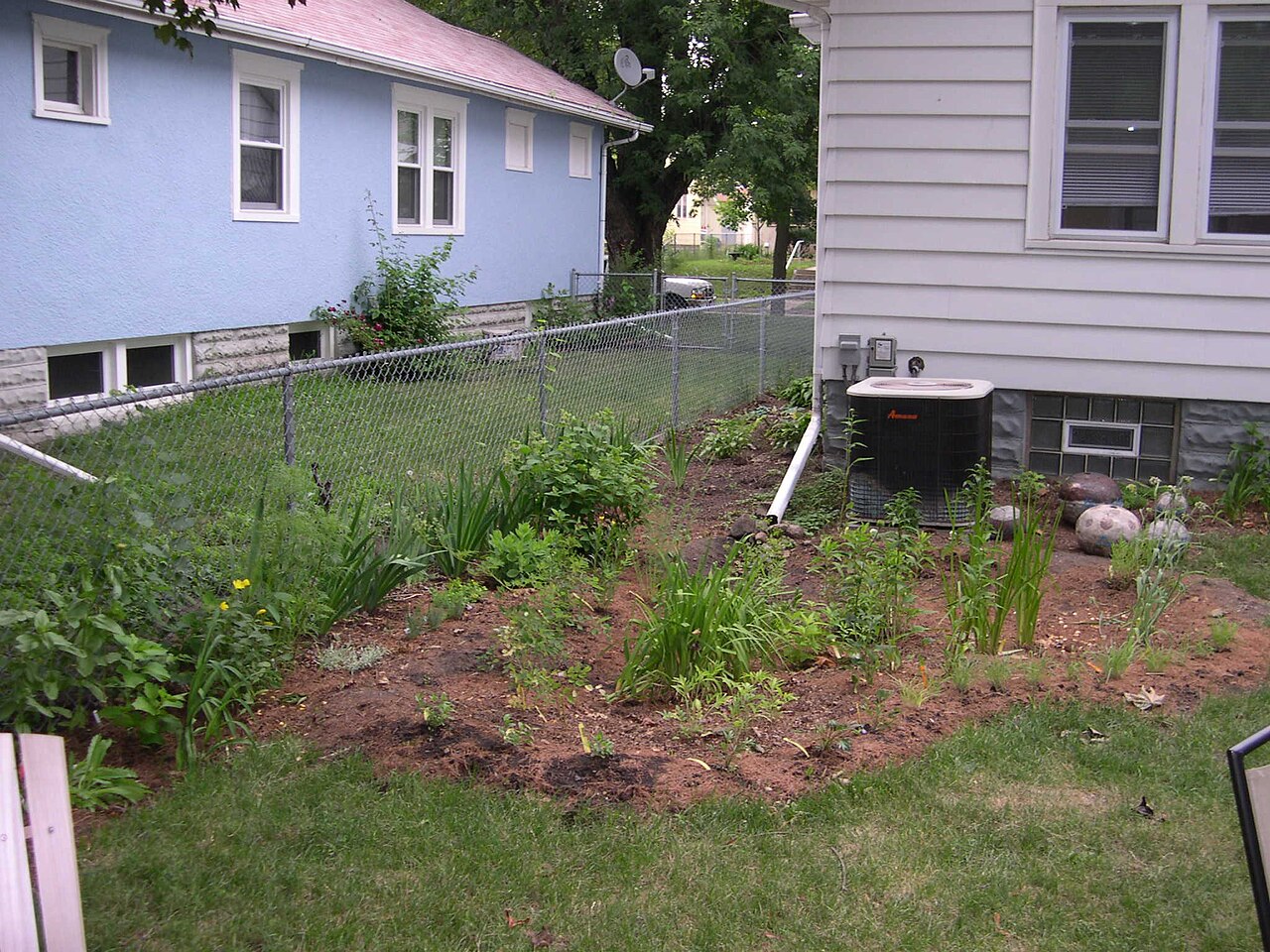
Think of the basin as three rings around the point where water enters.
The inlet
This is where the pipe or a shallow swale delivers water. Lay flat stones or a splash pad here so the burst spreads out instead of carving a gully. Keep plants a foot or two back from the stone.
The basin bottom
Virginia Extension says the finished depth should be 6 to 8 inches below the surrounding soil. The bottom stays wet longest, so it gets the plants that best tolerate standing water for a day or two.
The rim and side slopes
The upper edges drain within hours and dry out first. Put the most drought-tolerant plants here. They also hold the soil on the slope.
Overflow
Virginia Extension warns that very heavy rain will overflow any rain garden. Decide where the extra water goes, such as a lawn, another bed, or a second small basin, and make that edge slightly lower so it spills where you choose.
Layout
Plant shrubs and perennials in groups of three to five, as the Virginia fact sheet suggests, with taller plants toward the center or back. Leave a path or stepping stones to the inlet so you can clear it after storms.
Plants for Wet Bursts and Dry Intervals
The core plants below are listed by the Lady Bird Johnson Wildflower Center for more than one moisture condition, or, for fox sedge, fluctuating water. Two moist-soil perennials fill the middle band, where the soil stays damp longest after the bottom drains.
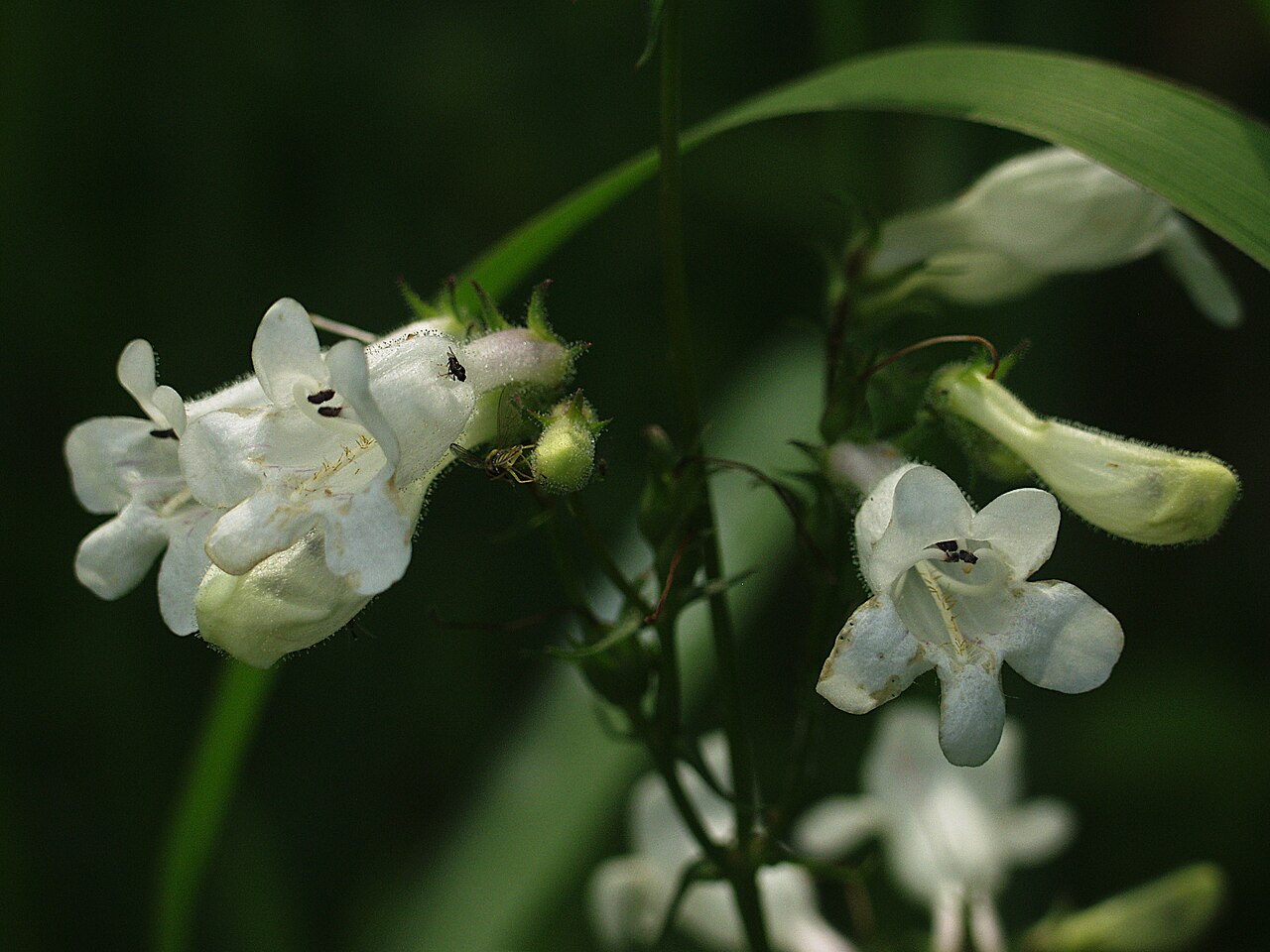
Foxglove beardtongue may be the best all-round downspout perennial. The Wildflower Center lists it for dry, moist and wet soils and calls it a great bloomer for clay loam in poorly drained areas. Its white tubular flowers on 2- to 5-foot stems draw hummingbirds and bumblebees.
Fox sedge is the groundcover for the basin bottom. Wikipedia notes it tolerates fluctuating water levels and periods of drying, and the Wildflower Center lists it for moist to wet clay and loam.
Switchgrass belongs on the rim. The Wildflower Center lists it for dry to moist soils, from sand to clay, so it handles both the soaking and the drought that follows. It spreads by rhizomes, so choose a compact selection for a small basin.
Black-eyed Susan adds quick color on the slopes while slower plants fill in. The Wildflower Center lists it for moist to dry, well-drained soil and notes it can act as an annual, biennial or short-lived perennial, reseeding to persist.
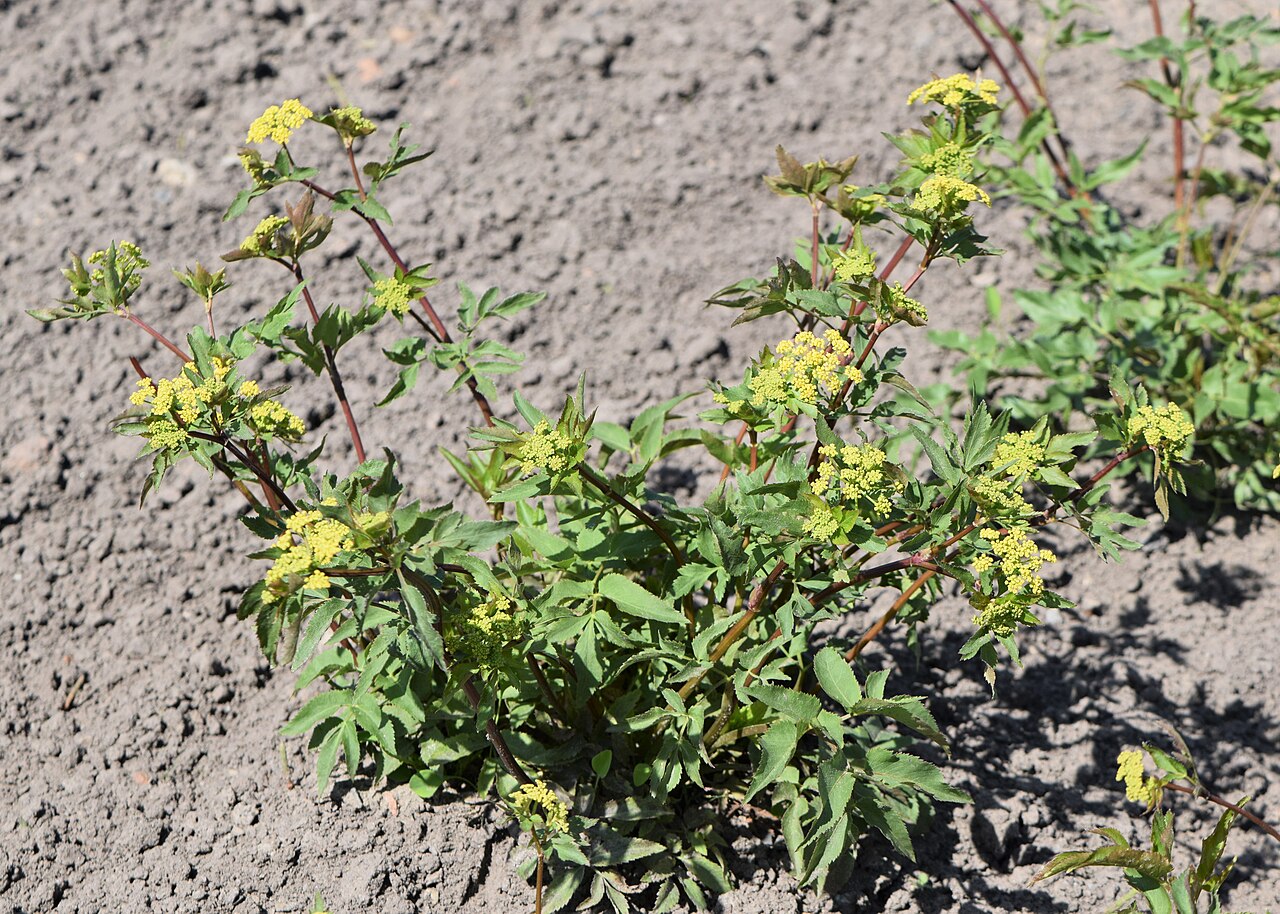
Golden alexanders gives early yellow flowers in the moist middle band. The Wildflower Center lists it for moist, sandy or sandy-clay soils and as a host plant for black swallowtail caterpillars. It is a short-lived perennial that reseeds.
New England aster provides fall color on the lower slope. The Wildflower Center lists it for moist soil and notes it can reach 6 feet or more and can be aggressive, so give it space at the back.
A shrub, only if there is room
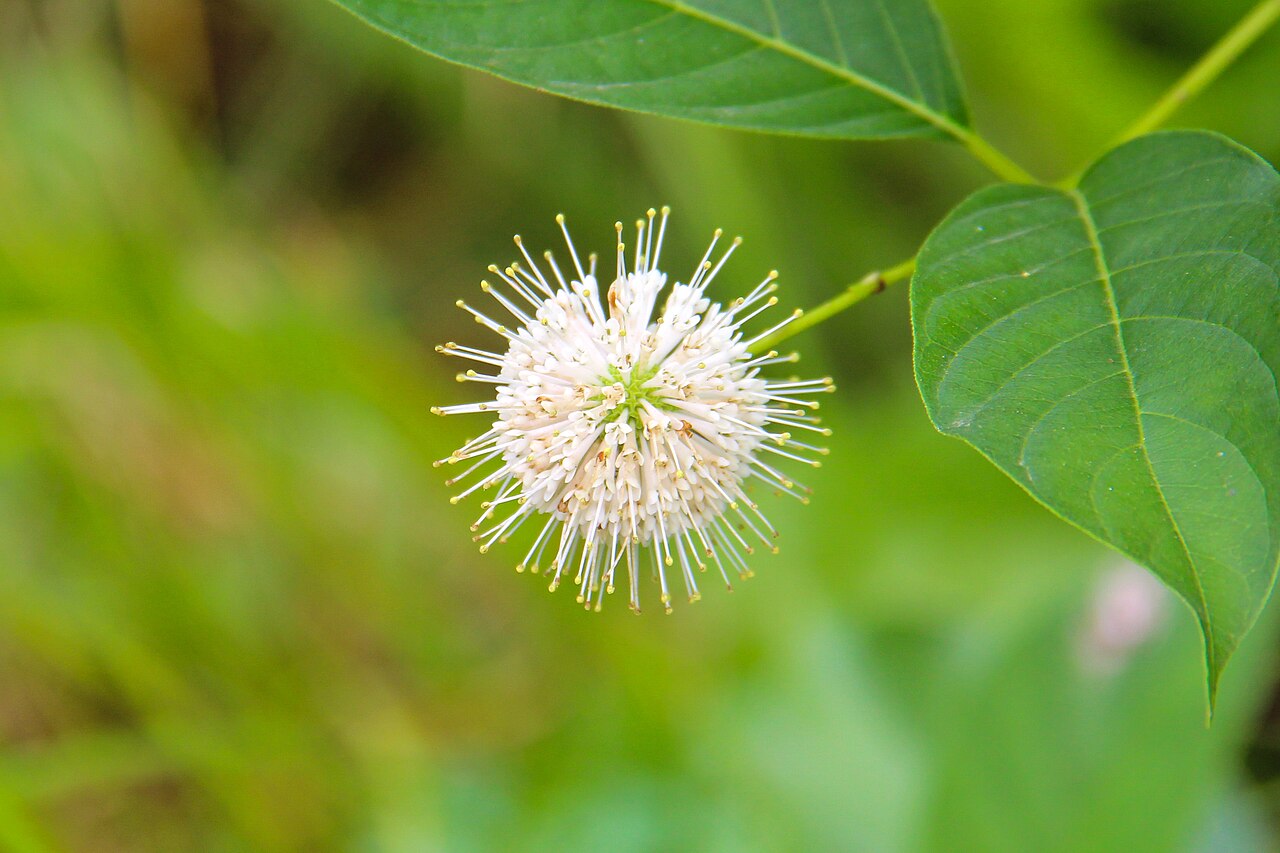
Buttonbush tolerates poor drainage and standing water, according to the Wildflower Center, but it grows 6 to 12 feet tall. That is too big for most single-downspout basins. Use it only in a large basin well away from the house; our guide on where buttonbush fits in a rain garden covers the details.
Plants to skip next to a downspout
Some popular rain garden plants want constant moisture. The Wildflower Center describes great blue lobelia as “not at all drought tolerant,” and turtlehead as a plant of rich, wet to moist soils. Both can fail during the dry intervals unless you water them, so save them for a spot that stays damp.
Plant Palette
Heights, moisture and ranges are from the Lady Bird Johnson Wildflower Center unless noted. Confirm each plant is native to your state.
| Plant | Zone / role | Height | Sun / moisture | Native range |
|---|---|---|---|---|
| Foxglove beardtongue (Penstemon digitalis) | Bottom to slope: flowering perennial | 2–5 ft | Sun–part shade; dry, moist or wet | ME to MI & SD, south to VA, AL & e. TX |
| Fox sedge (Carex vulpinoidea) | Bottom: groundcover sedge | Up to ~3 ft (Wikipedia) | Sun; moist–wet, fluctuating | Most of the lower 48 and Canada |
| Golden alexanders (Zizia aurea) | Middle: spring flower | Short-lived, reseeds | Sun–part shade; moist | Quebec to Saskatchewan, south to FL & TX |
| New England aster (Symphyotrichum novae-angliae) | Lower slope: fall flower | 6 ft or more | Part shade; moist | Quebec & ME to SC, west to the e. Great Plains |
| Switchgrass (Panicum virgatum) | Rim: grass | 3–10 ft | Sun–part shade; dry–moist | Most of the U.S. except the far West |
| Black-eyed Susan (Rudbeckia hirta) | Rim: quick color | Short-lived, reseeds | Sun; dry–moist | W. MA to Manitoba & WY, south to FL & NM |
| Buttonbush (Cephalanthus occidentalis) | Large basins only: shrub | 6–12 ft | Part shade–shade; moist–wet | Eastern N. America west to e. NE, e. KS & TX |
Sample Planting for a 10 × 10-Foot Downspout Basin
A starting point for about 100 square feet. Quantities assume plugs or quart pots in groups of three to five.
| Zone | Plants |
|---|---|
| Inlet | Flat stones or splash pad; no plants in the first foot or two |
| Basin bottom | 7 fox sedge; 3 foxglove beardtongue |
| Middle band | 5 golden alexanders; 3 foxglove beardtongue |
| Rim and slopes | 3 switchgrass (compact selection); 5 black-eyed Susan; 3 New England aster at the back |
Installation Steps
- Extend the downspout. Run a solid extension pipe or a shallow, lined swale from the downspout to the basin, at least 10 feet from the foundation per Virginia Extension.
- Mark the basin and overflow. Outline the shape with a hose, keep the long side across the slope, and mark where overflow will leave.
- Dig the depression. Aim for a finished depth of 6 to 8 inches. Virginia Extension notes you may need to dig about 12 inches if you add compost or plant large root balls, since compost, root balls and mulch all raise the level.
- Level the bottom. A flat bottom spreads water evenly instead of letting it pool at one end.
- Armor the inlet. Set flat stones where the water arrives.
- Plant by zone. Wet-tolerant plants at the bottom, drought-tolerant plants on the rim.
- Mulch. Virginia Extension notes mulch adds organic matter, improves infiltration, prevents weeds and keeps the soil from drying out. Use shredded hardwood, which floats less than bark nuggets.
- Water through the first season. New plants need regular water in dry spells even in a rain garden.
If you would rather save some of the roof water, a rain barrel can sit on the same downspout. Send its overflow to the basin.
First-Three-Years Maintenance Calendar
Year one
- After every big storm: check the inlet for scour and the basin for standing water. Virginia Extension says water should be gone within about four days, because mosquitoes need about seven days to breed.
- Dry spells: water new plants deeply once a week.
- Summer: weed often. Bare, disturbed soil invites weeds until the plants close the gaps.
Year two
- Late winter: cut back last year’s stems before new growth starts.
- Spring: replace plants that drowned or dried out with more of whatever is thriving in that zone.
- After storms: clear leaves and debris from the inlet so water can enter.
Year three
- Spring: thin crowded plants, as Virginia Extension recommends after several years. Switchgrass and New England aster are the likeliest to need it.
- Any time: if water stands longer than four days, loosen the bottom with a digging fork, as the fact sheet suggests.
- Fall: leave seed heads standing for birds and winter interest.
Mistakes to Avoid
- Building the basin against the house. Carry the water at least 10 feet out.
- Skipping the overflow. Every rain garden overflows in a big storm. Decide where that water goes.
- Choosing only wet-soil plants. A downspout basin is dry most of the time. Plants like great blue lobelia struggle without regular moisture.
- Leaving the inlet bare. Unprotected soil below a downspout washes out in the first heavy rain.
- Using bark nuggets. Light mulch floats and ends up at the overflow.
📋 Find plants for your region: see our native plant lists for Michigan, Wisconsin & Eastern Minnesota and Illinois, Iowa & Missouri, or the list for your own state, for wet-and-dry tolerant species that fit your area.
Frequently Asked Questions
How far from the house should a downspout garden be?
Virginia Cooperative Extension says at least 10 feet from building foundations. Use a downspout extension or a shallow swale to carry the water there.
How big should a downspout rain garden be?
Measure the roof area that drains to that downspout and divide by 20 for the minimum size. A downspout draining 1,000 square feet of roof needs about 50 square feet of garden.
How deep should the basin be?
A finished depth of 6 to 8 inches below the surrounding soil, according to Virginia Extension. You may need to dig deeper at first to make room for compost and mulch.
What native plants handle both flooding and drought?
Foxglove beardtongue, which the Wildflower Center lists for dry, moist and wet soil, is a top choice. Fox sedge handles fluctuating water levels and periods of drying, and switchgrass handles dry to moist soil from sand to clay.
Will a downspout garden breed mosquitoes?
Not if it drains properly. Virginia Extension says water should not stand more than about four days, since mosquitoes need about seven days to breed. If it lingers, loosen the bottom with a digging fork.
Sources
- Virginia Cooperative Extension, Stormwater Management for Homeowners Fact Sheet 5: Rain Gardens (SPES-13): 10-foot setback, site exclusions, water-table clearance, sizing by roof area ÷ 20, depth, overflow, grouping, mulch, drain time and mosquitoes, maintenance.
- Lady Bird Johnson Wildflower Center plant database: foxglove beardtongue, fox sedge, golden alexanders, New England aster, switchgrass, black-eyed Susan, buttonbush, great blue lobelia, turtlehead: moisture, light, height and native range.
- Wikipedia, Carex vulpinoidea: tolerance of fluctuating water levels and periods of drying.