
Panicled Tick-trefoil (Desmodium paniculatum)
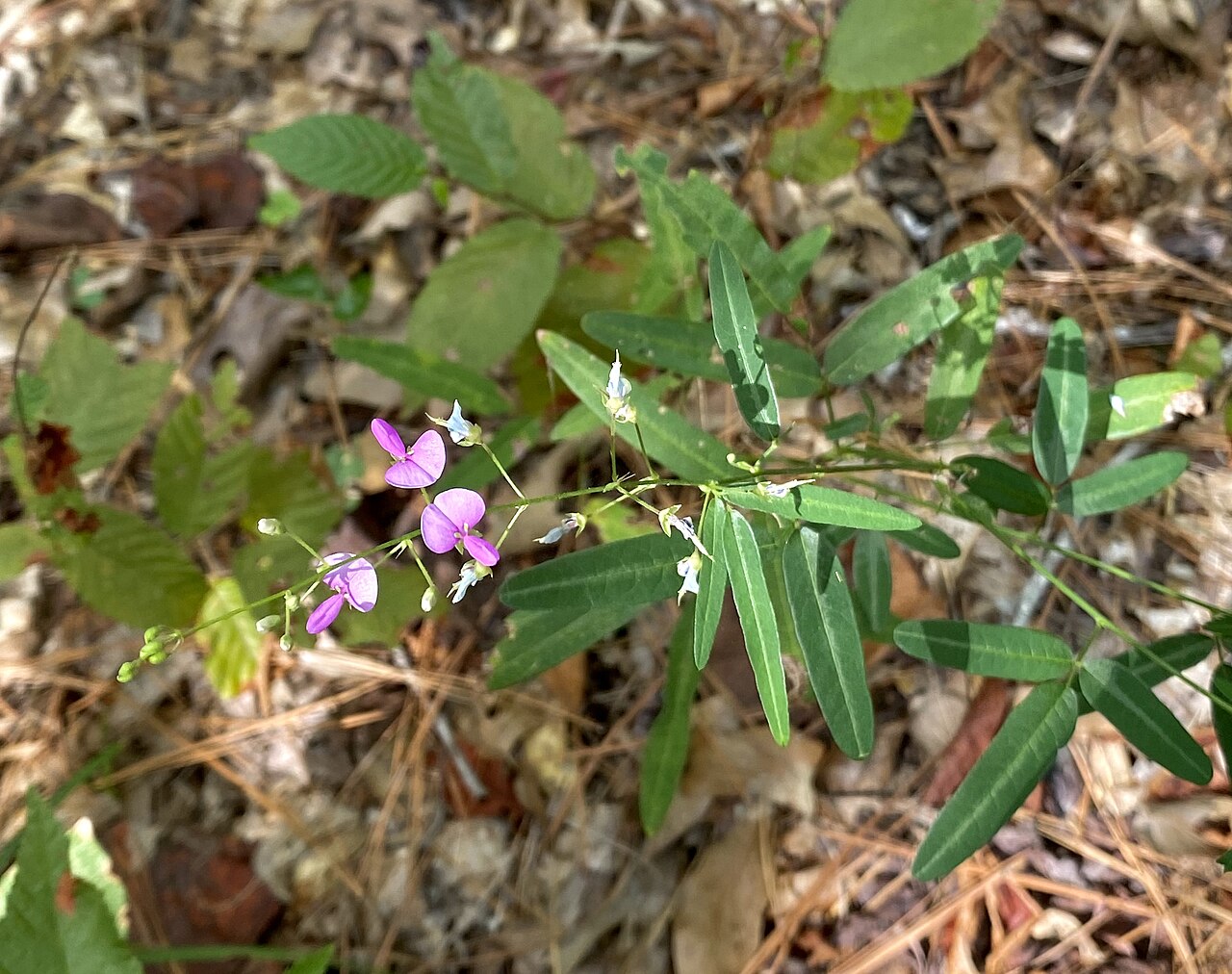
Desmodium paniculatum, known as Panicled Tick-trefoil (USDA: panicledleaf ticktrefoil), is a slender, airy perennial legume of eastern North America. From midsummer into early fall it sends up loose, branching sprays of small pink to lavender pea flowers above narrow, three-part leaves. It belongs to the pea family (Fabaceae) and grows in woodland edges, clearings, open oak and pine woods, thickets, old fields and roadsides from New England and southern Ontario south to Florida and west to Nebraska, Oklahoma and Texas.
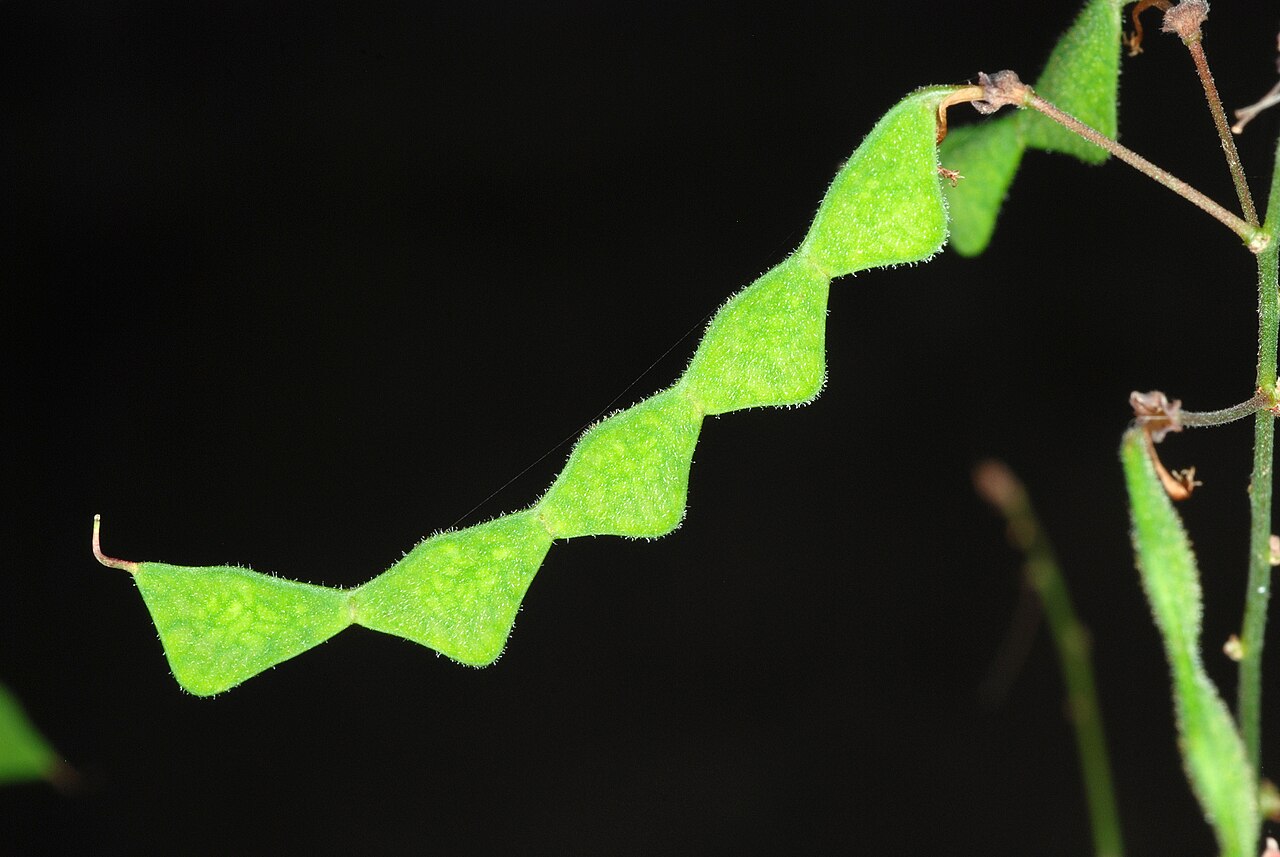
Most people meet this plant in fall, when its flat, segmented seed pods break apart and cling by the dozen to socks, trouser legs and dog fur. Those “beggar’s lice” or “stick-tights” are how the plant travels. Each pod segment is covered in tiny hooked hairs that work like natural Velcro. The common name refers to the same trait: “tick” for the clinging pods and “trefoil” for the three leaflets. The genus name Desmodium comes from the Greek for a chain or band, a nod to the jointed pods.
Panicled tick-trefoil is far more than a nuisance on a walk. Like most legumes it works with root bacteria to fix nitrogen. Its leaves feed the caterpillars of several native skippers and blues, its flowers are worked by bumblebees and other native bees, and its seeds are eaten by quail and turkeys. This guide covers how to identify it among its many look-alike relatives, where it grows, how to use it in a meadow or woodland-edge planting, and its place in eastern ecosystems.
Identification
Tick-trefoils are a notoriously tricky group, with more than 20 species in eastern North America and several close relatives that differ only in leaflet shape and hairiness. Panicled tick-trefoil is one of the commonest, and its long, narrow leaflets, slender stalks and open, branching flower clusters are the best clues.
Stems & Roots
Plants are usually 2 to 3 feet tall and occasionally reach 4 feet or more. One to several slender, upright to arching stems grow from a tough, somewhat woody root crown. The stems are green, often smooth or only sparsely hairy, and tend to lean or sprawl once the plant is heavy with seed. It is a long-lived perennial that dies back to the ground each winter.
Leaves
The leaves are alternate and divided into three leaflets, like a clover leaf. The leaflets are long and narrow, lance-shaped to narrowly oblong, typically 2 to 3½ inches long and well under an inch wide, often several times longer than they are wide. The terminal leaflet sits on a short stalk beyond the side pair, and each compound leaf has its own leafstalk up to about 2 inches long. Plants with broader leaflets occur and can be hard to separate from smooth tick-trefoil (D. glabellum) and perplexed tick-trefoil (D. perplexum), which some botanists treat as part of the same species complex.
Flowers
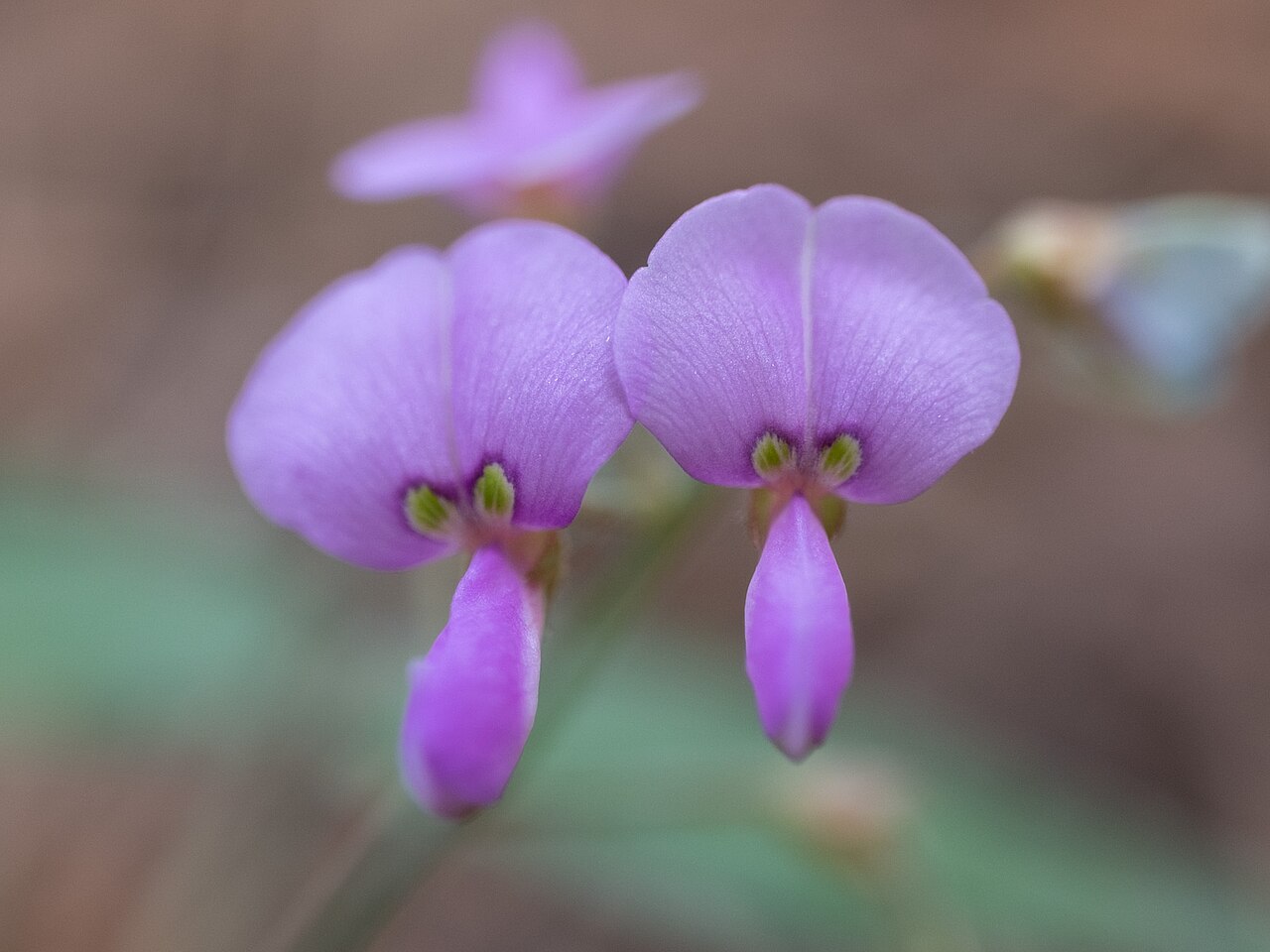
The upper stems end in open, widely branching clusters (panicles) or long racemes of small pea flowers, each about ¼ inch long, on thread-like stalks. They are pink, lavender or purplish, and often fade to blue-green or turquoise as they age. Each flower has the classic legume shape: a broad upright banner petal with two small green or yellow spots at its base, two side wings and a keel that hides the stamens and pistil. Flowering runs from about July to September across most of the range, starting earlier in the South, and lasts roughly a month to six weeks on a given plant.
Fruit & Seeds
The fruit is a flat loment, a pod divided into 2 to 6 one-seeded segments. The upper edge is nearly straight to slightly wavy and the lower edge is deeply notched, so each segment looks rounded-triangular. The pods ripen from August into October, turn brown, and snap apart at the joints. Each segment is covered with minute hooked hairs that grab fur and fabric. Canada tick-trefoil (D. canadense) has similar pods but much larger, showier flowers in dense spikes and leaves with very short leafstalks.
Quick Facts
| Scientific Name | Desmodium paniculatum (syn. Hedysarum paniculatum, Meibomia paniculata) |
| Family | Fabaceae (pea or legume family) |
| Plant Type | Herbaceous perennial wildflower; nitrogen-fixing legume |
| Mature Height | 2–3 ft (occasionally to 4 ft or more) |
| Mature Spread | 1–2 ft; stems often lean or arch when in seed |
| Growth Rate | Moderate |
| Sun Exposure | Full sun to part shade |
| Water Needs | Low to medium; tolerates dry soil once established |
| Soil Type | Loam, clay loam, sandy or rocky soils; average to poor fertility |
| Soil pH | Acidic to neutral (about 5.0–7.0) |
| Bloom Time | July–September (earlier in the Deep South) |
| Flower Color | Pink, lavender or purple, fading blue-green |
| Fall Color | Leaves turn dull yellow before frost |
| Fruit | Flat, segmented loment with hooked hairs (stick-tight) |
| Deer Resistant | No; deer and rabbits browse the foliage |
| USDA Hardiness Zones | 4–9 |
Native Range
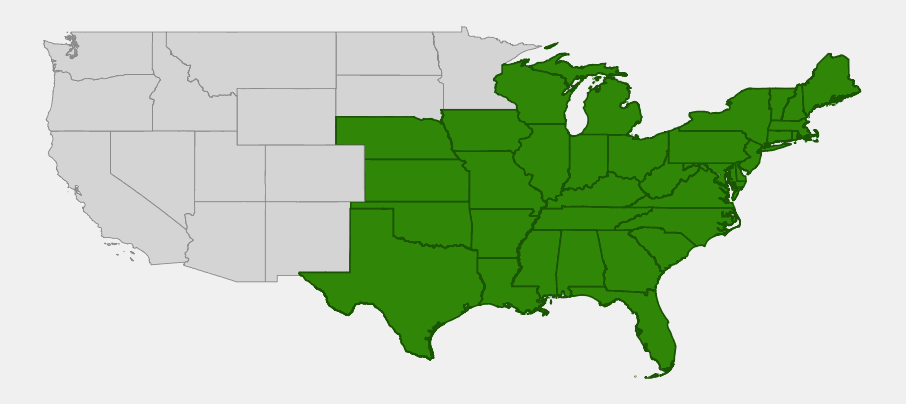
Panicled tick-trefoil is a common plant of the eastern and central United States. The Lady Bird Johnson Wildflower Center, drawing on USDA data, lists it from 33 states and the District of Columbia, from Maine and Vermont west through New York, Pennsylvania, Ohio and Michigan to Iowa, Nebraska and Kansas, and south to Florida, Louisiana, Oklahoma and Texas. It also reaches Wisconsin, where the USDA Natural Resources Conservation Service collected the seed for its Grant Germplasm release from native stands in Grant County. In Canada it grows in southern Ontario.
It is most abundant in the Appalachians, the Piedmont, the Ohio and Mississippi valleys and the upland South, where open oak and pine woods, glades and old fields provide the light, well-drained ground it prefers. Toward its northern and western limits in New England, the upper Midwest and the Great Plains it becomes more scattered. It reaches into peninsular Florida and the eastern third of Texas but drops out on the dry plains farther west.
Panicled tick-trefoil is a pioneer of partly open ground. It turns up quickly after logging, fire, clearing or mowing and persists along woodland borders, powerline corridors, fencerows and roadsides. Outside North America it has become naturalized in parts of East Asia, including Japan and Korea, where it is treated as an introduced weed.
📋 Regional plant lists featuring Panicled Tick-trefoil: North & South Florida · Alabama, Georgia & Mississippi · North & South Carolina · Maryland, Virginia & West Virginia · Kentucky & Tennessee · Arkansas, Louisiana, Eastern Oklahoma & Eastern Texas · Illinois, Iowa & Missouri · Ohio & Indiana · Nebraska, Kansas & Eastern Colorado · Michigan, Wisconsin & Eastern Minnesota · New York, Pennsylvania & Northern New Jersey · Delaware, Southern New Jersey & Long Island · Connecticut, Massachusetts & Rhode Island · New Hampshire, Maine & Vermont
Growing & Care Guide
Panicled tick-trefoil is an easy, undemanding native for meadows, woodland edges and naturalistic plantings. It is not a plant for a formal border, though. It is open and a little floppy, and its clingy pods make it a poor choice beside paths, play areas or anywhere dogs run. Give it a spot toward the back of a meadow or along a woodland edge, where its airy flower sprays can mingle with grasses and other wildflowers.
Light
It grows in full sun to part shade and is at home in the dappled light of open woods and woodland edges. In full sun it is sturdier and flowers more heavily. In deeper shade it becomes lanky and sparse.
Soil & Water
Plant it in average to lean, well-drained soil: loam, clay loam, sandy or rocky ground all suit it. It prefers dry to medium moisture and, once its deep roots are established, tolerates drought well. Avoid rich, heavily fertilized beds, which produce lush, floppy growth. Like other legumes it makes its own nitrogen with the help of root-nodule bacteria, so it never needs nitrogen fertilizer.
Planting Tips
Sow seed in fall or very early spring, barely covered (about ⅛ to ¼ inch deep) on firm, weed-free soil. Scarifying the hard seeds lightly with sandpaper, or sowing in fall so winter does the work, improves germination. When starting a new planting, inoculating the seed with the appropriate Rhizobium bacteria can help, although the bacteria are often already present in soils where wild tick-trefoils grow. Container plants can go in during spring; space them 1 to 2 feet apart and mix them with bunchgrasses that will help hold the stems upright.
Pruning & Maintenance
Little care is needed. If plants lean too much, cut them back by a third in early June to encourage bushier growth. To limit the clinging pods in a garden setting, cut the flower stalks after bloom, before the seeds ripen in late summer. Otherwise leave the stems standing over winter for the birds and cut them to the ground in early spring. Japanese beetles sometimes chew the leaves and flowers, but the damage is rarely serious.
Propagation
Grow it from seed, which is produced every year in abundance. Collect the brown, dry pods in fall, rub the segments to loosen them, and sow outdoors in fall or store them cool and dry for spring sowing. Seedlings grow a deep root quickly and resent being moved once established, so transplant them young. Plants often self-sow modestly in open ground.
Landscape Uses
- Meadows and prairie plantings: a native legume that adds nitrogen and late-summer color to grass-based mixes
- Woodland edges and savannas: tolerates the partial shade of open oak and pine woods
- Butterfly gardens: a host plant for the silver-spotted skipper, hoary edge, cloudywings and eastern tailed-blue
- Wildlife food plots and restoration: seeds feed bobwhite quail and wild turkeys, and NRCS has released it for conservation plantings
- Erosion-prone and disturbed ground: a pioneer that colonizes cleared, burned or logged sites
Wildlife & Ecological Value
Native legumes are a key part of eastern meadows and woodland edges, and panicled tick-trefoil is one of the most widespread. It supports insects, birds and mammals at once and quietly enriches the soil around it.
For Pollinators
The flowers are pollinated mainly by bees. Long-tongued bees such as bumblebees (including the common eastern bumblebee and the American bumblebee), leafcutter bees and long-horned bees collect pollen, and small sweat bees also visit. As in many tick-trefoils, the keel petals snap open when a bee lands, dusting it with pollen. Several butterflies use the plant as a caterpillar host: the silver-spotted skipper, hoary edge, southern cloudywing and northern cloudywing feed on the leaves, the eastern tailed-blue eats the foliage, and the gray hairstreak feeds on flowers and developing pods.
For Birds
The seeds are eaten by upland game birds, including northern bobwhite and wild turkey. Insects feeding on the foliage, from caterpillars to beetles and stink bugs, add to the food supply for songbirds raising young in late summer.
For Mammals
White-tailed deer readily browse the foliage, and cottontail rabbits also eat it. White-footed mice and deer mice eat the seeds. The clinging pods are carried long distances in the fur of deer, raccoons, foxes and other animals, which is how the plant colonizes new ground.
Ecosystem Role
Panicled tick-trefoil forms root nodules with nitrogen-fixing bacteria, so it adds nitrogen to the lean, well-drained soils where it grows. It is a disturbance-adapted pioneer that thrives after fire, selective logging and other openings in the canopy and declines as woods close in. Its protein-rich foliage has also been studied as a native forage legume for warm-season pastures.
Cultural & Historical Uses
Carl Linnaeus described the plant in 1753 as Hedysarum paniculatum, and the Swiss botanist Augustin Pyramus de Candolle moved it to Desmodium in 1825. Older floras sometimes list it as Meibomia paniculata, and the narrow-leaved forms have been called narrow-leaf tick-trefoil. Botanists still debate how to divide the “Desmodium paniculatum complex,” which also includes smooth tick-trefoil (D. glabellum) and perplexed tick-trefoil (D. perplexum).
Ethnobotanical records for this species are sparse. The Houma people of Louisiana are reported to have used an infusion of the roots to treat weakness and cramps. That history is not a guide for home use, and the plant is not a recognized herbal remedy today.
In recent decades panicled tick-trefoil has gained attention as a conservation plant. The USDA NRCS Rose Lake Plant Materials Center in Michigan released Grant Germplasm, a seed source collected from native stands in Grant County, Wisconsin, to supply native legumes for conservation and wildlife plantings in the Great Lakes region. For most people, though, the plant’s cultural identity is still the stick-tights it leaves on socks after an autumn walk.
Frequently Asked Questions
Why is it called tick-trefoil?
“Trefoil” refers to the leaves, which are divided into three leaflets like a clover. “Tick” refers to the seed pods, whose segments are covered in tiny hooked hairs and cling to clothing and fur like ticks. The pods are also called stick-tights or beggar’s lice.
How do I get tick-trefoil seeds off my clothes?
The hooked hairs hold on tightly. Pick them off by hand, scrape fabric with a dull knife edge or the teeth of a comb, or use a lint roller or strip of tape. Fleece and wool are the worst offenders; smooth, tightly woven fabrics pick up far fewer.
Is panicled tick-trefoil a good garden plant?
It is a good choice for meadows, prairie plantings and woodland edges, where it supports bees and butterflies and fixes nitrogen. It is less suited to small, formal gardens because it is open and floppy, and its pods stick to anything that brushes past in fall.
How is it different from Canada tick-trefoil?
Canada tick-trefoil (Desmodium canadense) has larger, brighter flowers in dense spikes, broader leaflets on very short leafstalks, and prefers moister prairie and meadow soils. Panicled tick-trefoil has narrower leaflets on longer leafstalks and small flowers in loose, open, branching clusters, and it tolerates drier, shadier sites.
Is it the same as “Florida tick-trefoil”?
No. Panicled tick-trefoil is occasionally mislabeled that way online, but it is a widespread plant of the eastern United States, not a Florida specialty. Florida tick-trefoil is a name used for Desmodium floridanum, a different species. Check the scientific name when buying seed or plants.

Looking for a nursery that carries Panicled Tick-trefoil?
Browse our native plant nursery directory: Alabama & Arkansas · Connecticut, Delaware, Florida & Georgia · Illinois, Indiana, Iowa & Kansas · Kentucky, Louisiana, Maine, Maryland, Massachusetts, Michigan, Mississippi & Missouri · Nebraska, New Hampshire, New Jersey, New York, North Carolina, Ohio & Oklahoma · Pennsylvania, Rhode Island, South Carolina, Tennessee, Texas, Vermont & Virginia · West Virginia & Wisconsin