
Softhair Coneflower (Rudbeckia mollis)
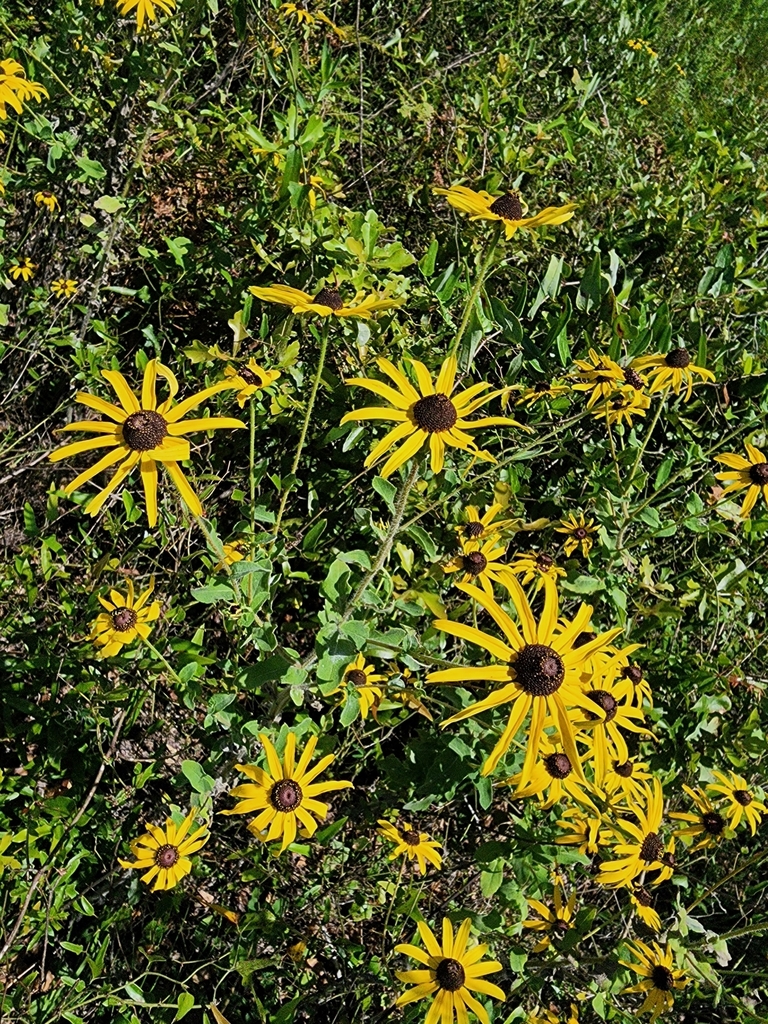
Rudbeckia mollis, the Softhair Coneflower, is a black-eyed Susan of the Deep South that you can recognize with your fingers as easily as with your eyes. Its stems, leaves and flower bracts are covered in dense, soft, grayish hairs, which give the whole plant a velvety feel and a slightly silvery cast. From late spring into fall it carries a branching crown of golden-yellow daisies, each with a domed, dark purple-brown center. It is a member of the aster family (Asteraceae).
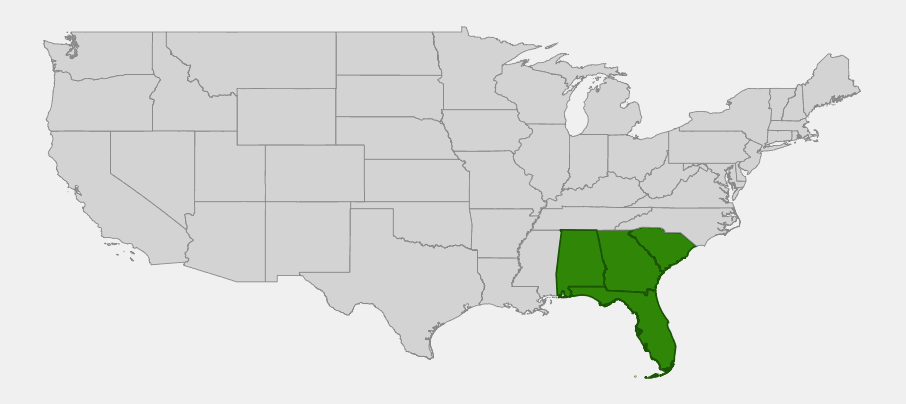
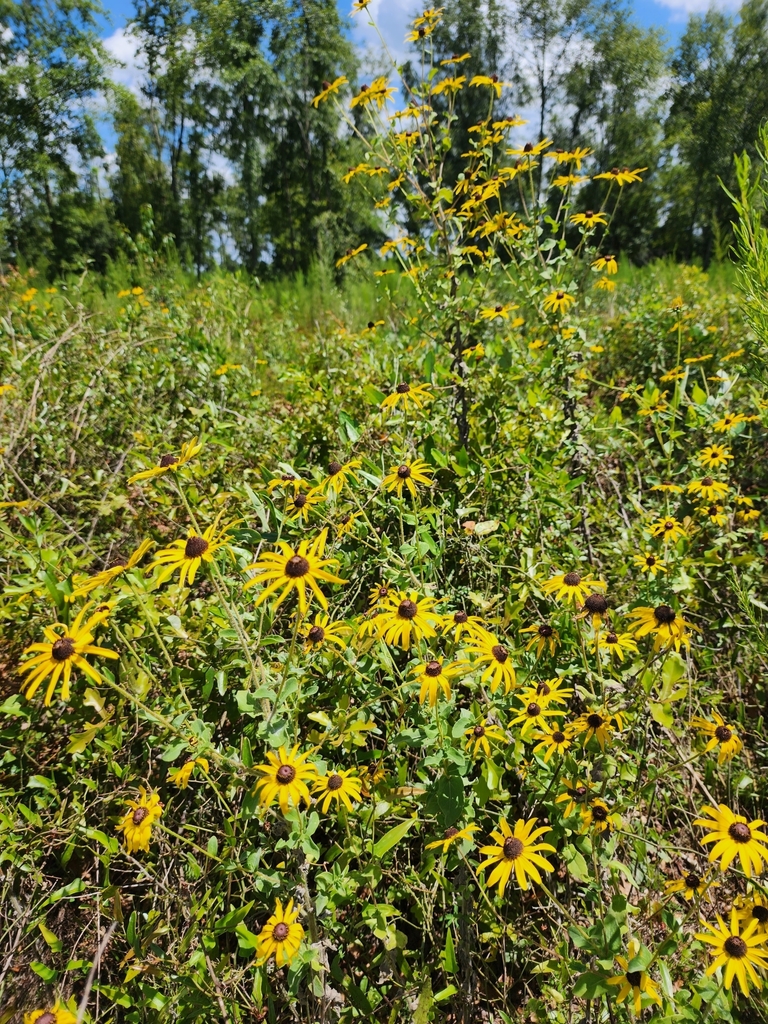
Softhair coneflower is native only to the coastal plain of Alabama, Georgia, South Carolina and Florida. It grows in dry, sunny, sandy places: sandhills, open pine and oak woods, old fields, fire lanes and the shoulders of rural roads. In north and central Florida it is one of the most common yellow wildflowers along summer roadsides, often blooming by the hundreds where mowing is light and the soil is deep sand.
The species name mollis is Latin for “soft.” Gardeners who know the familiar Black-eyed Susan (Rudbeckia hirta) will find softhair coneflower similar in flower but different in feel, habit and drought tolerance. This guide covers identification, range, growing it from seed in a sunny Southern garden, and its value to bees, butterflies and seed-eating birds.
Identification
Softhair coneflower belongs to a group of yellow-rayed, dark-centered Rudbeckia species that can be confusing at a glance. Feel a leaf and look at how the plant branches; those two clues usually settle the identification.
Stems & Habit
Plants are biennial or short-lived perennials. They spend their first year as a low rosette of leaves and send up flowering stems the next season. Mature plants are usually 2 to 3 feet tall, occasionally taller, with one or several stems that branch freely in the upper half. A well-grown plant becomes a loose, rounded bush of flower heads. The stems are densely covered in soft, spreading gray hairs.
Leaves
The leaves are oblong to elliptic or oblanceolate, mostly 1 to 4 inches long, with smooth or shallowly toothed edges. The upper stem leaves are stalkless and often partly clasp the stem. Both leaf surfaces are thickly velvety-hairy, so they look gray-green rather than bright green. The basal rosette leaves are larger and often wither by the time the plant is in full bloom.
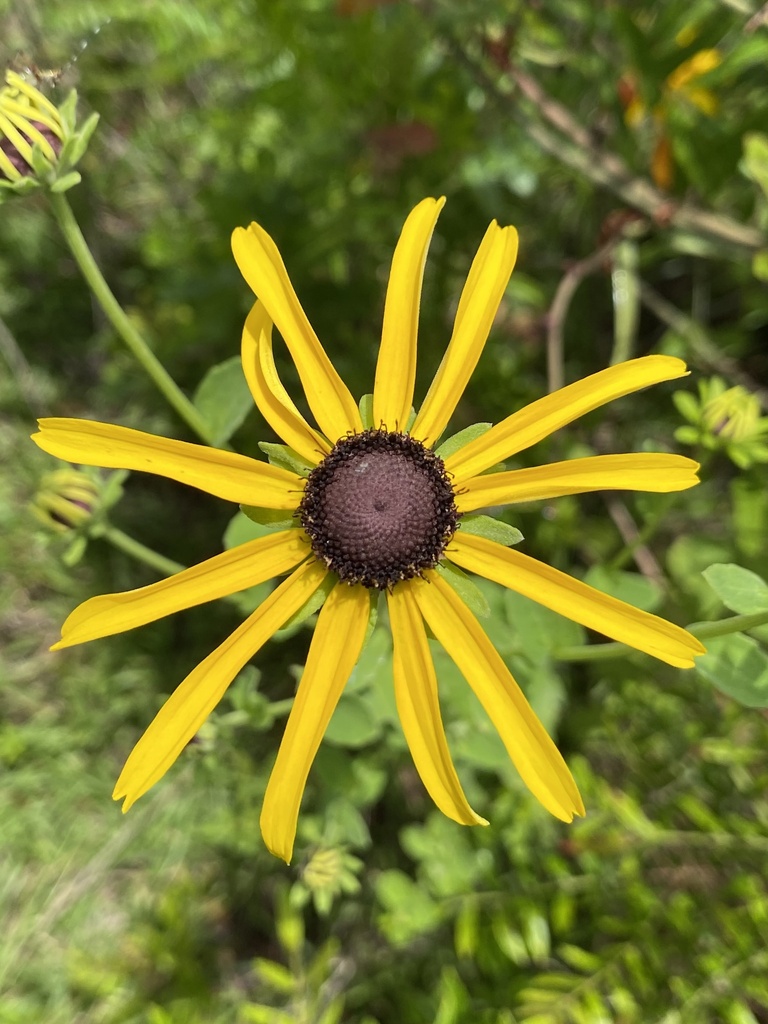
This soft hair is the best field mark. Black-eyed Susan (R. hirta) is covered in stiff, bristly hairs that feel like sandpaper, and its leaves are greener and longer-stalked near the base.
Flowers
The flower heads are borne singly at the tips of long branches, often dozens per plant. Each head is about 2 to 3 inches across, with roughly 10 to 20 golden-yellow ray florets around a rounded, dark purple-brown disc. The rays sometimes have a slightly darker orange band at the base. The green bracts beneath the head are long, narrow and, like the rest of the plant, densely hairy. Flowering peaks in early and mid-summer, but scattered blooms continue into fall in Florida.
Fruit & Seeds
After flowering, the disc elongates slightly and darkens as the small, four-angled seeds (technically cypselae) ripen inside it. The seeds have no fluffy pappus, so they simply drop near the parent plant or are carried off by birds. Dry seed heads stand on the plant well into fall.
Quick Facts
| Scientific Name | Rudbeckia mollis Elliott |
| Family | Asteraceae (aster family) |
| Plant Type | Herbaceous biennial or short-lived perennial wildflower |
| Mature Height | 2–3 ft (occasionally to about 4 ft) |
| Mature Spread | 1–2 ft |
| Growth Rate | Fast |
| Sun Exposure | Full sun |
| Water Needs | Low; well-drained, dry to moderately moist sand |
| Soil Type | Sand or sandy loam; tolerates poor, infertile soil |
| Soil pH | Acidic to near neutral (about 5.0–7.0) |
| Bloom Time | Late spring through summer, with scattered blooms into fall |
| Flower Color | Golden-yellow rays with a dark purple-brown center |
| Fall Color | None of note; seed heads remain dark brown |
| Fruit | Small, dark, four-angled seeds (cypselae) without a pappus |
| Deer Resistant | Moderately; the hairy foliage is rarely browsed heavily |
| USDA Hardiness Zones | 8–10 |
Native Range
Softhair coneflower has a small range for a Rudbeckia. USDA PLANTS and the Lady Bird Johnson Wildflower Center record it from only four states: Alabama, Florida, Georgia and South Carolina. Within that area it is a plant of the coastal plain, the low, sandy country below the Fall Line, and it is most common in southern Georgia and northern Florida.
In Florida it grows through the Panhandle and the northern and central peninsula, becoming scarce farther south. Typical habitats are sandhills and other dry, open pinelands with Longleaf Pine, Turkey Oak and Wiregrass, plus the disturbed ground that people create: old fields, pastures, clearings, fire breaks and roadsides. The Florida Native Plant Society describes its habitat as “mostly ruderal,” and it can be abundant on sunny road shoulders.
Like many sandhill wildflowers, softhair coneflower is adapted to frequent, low-intensity fire and to open, sunny ground. It declines where pinelands become shaded by dense hardwoods, and it moves readily into nearby clearings and road edges where seed can reach bare sand.
📋 Regional plant lists featuring Softhair Coneflower: North & South Florida · Alabama, Georgia & Mississippi · North & South Carolina
Growing & Care Guide
Softhair coneflower is one of the easiest native wildflowers for sunny, sandy Southern gardens. It thrives in exactly the hot, dry, infertile conditions that defeat many garden perennials, and it is grown mostly from seed. Seed is sold by several Florida and Georgia native wildflower seed producers, and plants are sometimes available from native nurseries.
Light
Plant it in full sun. In part shade the stems stretch, lean and flower poorly. It is at its best in an open, sunny bed, a meadow or a sunny strip along a fence or driveway.
Soil & Water
Give it well-drained sand or sandy loam. It does not need fertile soil, and rich, heavily watered beds make it floppy and short-lived. Water new transplants until established; after that, natural rainfall is enough in most of its range. It does not tolerate soggy soil or standing water. It is not salt tolerant, so keep it away from salt spray on the coast.
Planting Tips
Sow seed in fall or winter on bare, lightly raked soil and press it in without burying it deeply. Seedlings form rosettes the first year and flower the next, so a fall sowing usually blooms by the following summer. Container plants can be set out in fall or early spring, 12 to 18 inches apart. Mixing it with native grasses and other sun-loving wildflowers gives a natural meadow look.
Pruning & Maintenance
Little care is needed. Leave some seed heads standing in fall so the plant can reseed and birds can feed, since individual plants usually live only two or three years. Cutting stems back by about a third in early summer can make the plant bushier, but it is not necessary. In meadows, mow or burn once a year in late winter to keep woody plants and heavy grass from crowding it out.
Propagation
Grow it from seed. Seed collected when heads are dry and dark can be sown in fall, or stored dry and sown in winter. Some growers cold-stratify stored seed in moist sand in the refrigerator for about a month before spring sowing to improve germination. Established plantings maintain themselves by self-seeding on open ground.
Landscape Uses
- Wildflower meadows: a long-blooming yellow anchor for sunny, sandy meadow plantings
- Roadside and right-of-way plantings: recommended by FNPS for roadside wildflower plantings
- Pollinator gardens: for bees, butterflies and checkerspot caterpillars
- Dry, sunny beds: for hot, infertile spots where watering is not practical
- Sandhill and pineland restoration: in the coastal plain of Florida, Georgia, Alabama and South Carolina
Wildlife & Ecological Value
A patch of softhair coneflower in summer is usually busy with insects. Its long bloom season makes it a dependable food source when many spring wildflowers have finished.
For Pollinators
The flower heads attract bumble bees, small sweat bees (Halictidae), other native bees, butterflies and beetles. Like other Rudbeckia, the rays have ultraviolet patterns invisible to us that guide bees toward the center. The plant is also a larval host for the silvery checkerspot (Chlosyne nycteis) and the gorgone checkerspot (Chlosyne gorgone), whose caterpillars feed on the leaves. FNPS notes that in Florida the silvery checkerspot is found only in the extreme north of the state.
For Birds
Goldfinches, sparrows and other small seed-eating birds pick seeds from the dry heads in late summer and fall. Leaving stems standing over winter also provides cover and insect food.
For Mammals
The hairy foliage is not a favorite of deer or rabbits, though they may nibble young growth. Small rodents eat fallen seed.
Ecosystem Role
Softhair coneflower is part of the diverse wildflower layer of fire-maintained sandhills and pine savannas, and it is among the first wildflowers to bloom on cleared or burned sand. Its ability to colonize disturbed ground quickly helps cover bare soil and feed pollinators while slower perennials become established.
Cultural & Historical Uses
The species was described by Stephen Elliott, a South Carolina banker, legislator and botanist, in his Sketch of the Botany of South-Carolina and Georgia (published in parts, 1816–1824). Elliott named many plants of the southeastern coastal plain, and his choice of mollis points straight at the feature that sets this coneflower apart from its rough-haired relatives.
The genus Rudbeckia honors the Swedish professors Olof Rudbeck the Elder and his son Olof Rudbeck the Younger. Linnaeus studied under the younger Rudbeck and named the genus for both. All of the roughly two dozen Rudbeckia species are native to North America.
Softhair coneflower has never become a mainstream garden plant, but it is increasingly offered by native seed companies in the Southeast as a tougher, more drought-tolerant alternative to common black-eyed Susan for meadows and roadside plantings.
Frequently Asked Questions
How is softhair coneflower different from black-eyed Susan?
Both have yellow rays and dark centers. Softhair coneflower has dense, soft, velvety gray hairs on its stems and leaves, stalkless upper leaves and a bushier, freely branched habit with many heads. Black-eyed Susan (Rudbeckia hirta) has stiff, bristly hairs and greener foliage, and it grows across most of North America rather than only in the Southeast.
Is softhair coneflower a perennial?
It is usually a biennial or short-lived perennial. Plants form a rosette the first year, flower the second, and may live another year or two. In a sunny, sandy garden it maintains itself by reseeding.
When does softhair coneflower bloom?
Mainly from late spring through summer. In Florida, scattered flowers often continue into fall.
Does softhair coneflower need a lot of water?
No. Once established it is quite drought tolerant and does best in well-drained, sandy soil with no irrigation beyond natural rainfall. Wet, rich soil shortens its life.
Which butterflies use softhair coneflower?
Many butterflies visit the flowers for nectar. It is also a caterpillar host for the silvery checkerspot and gorgone checkerspot.

Looking for a nursery that carries Softhair Coneflower?
Browse our native plant nursery directory: Alabama · Florida & Georgia · South Carolina