
Florida Greeneyes (Berlandiera subacaulis)
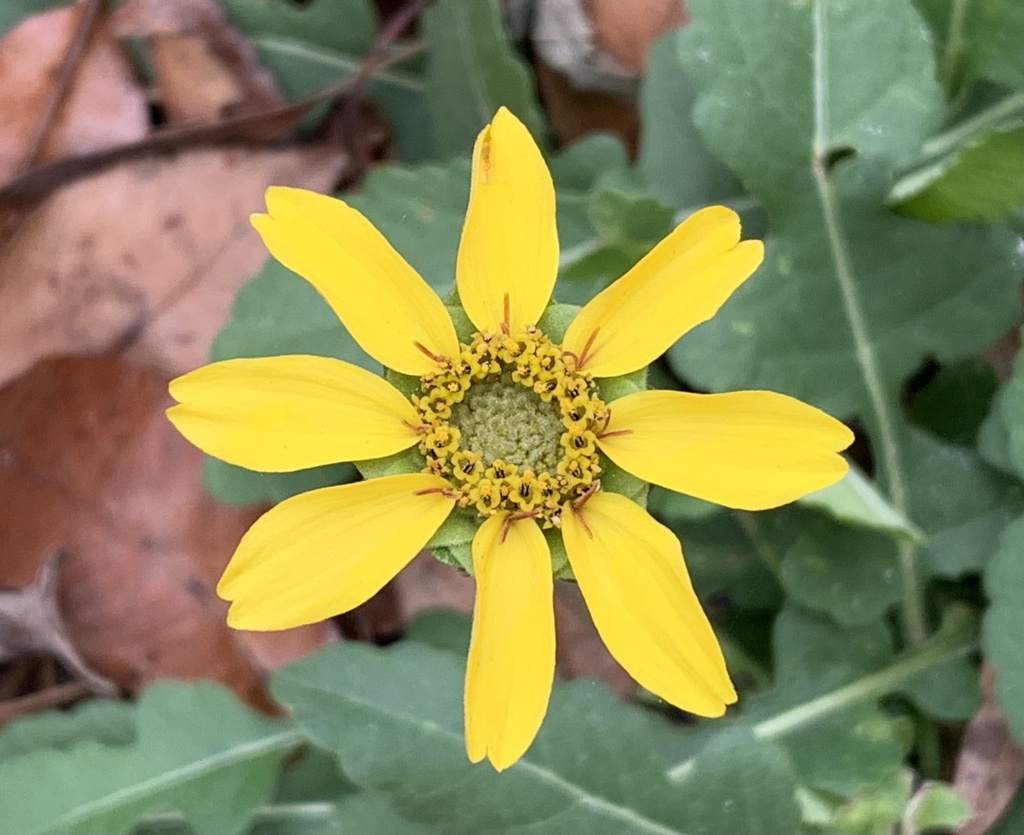
Berlandiera subacaulis, known as Florida Greeneyes or simply greeneyes, is a cheerful, low-growing yellow daisy of Florida’s dry pinelands and sandy fields. From a flat rosette of rough, scalloped leaves it sends up a long series of flower heads on nearly bare stalks, each with about eight broad, bright yellow rays around a green center. It blooms over a remarkably long season, with flowers in almost every month in central and south Florida.
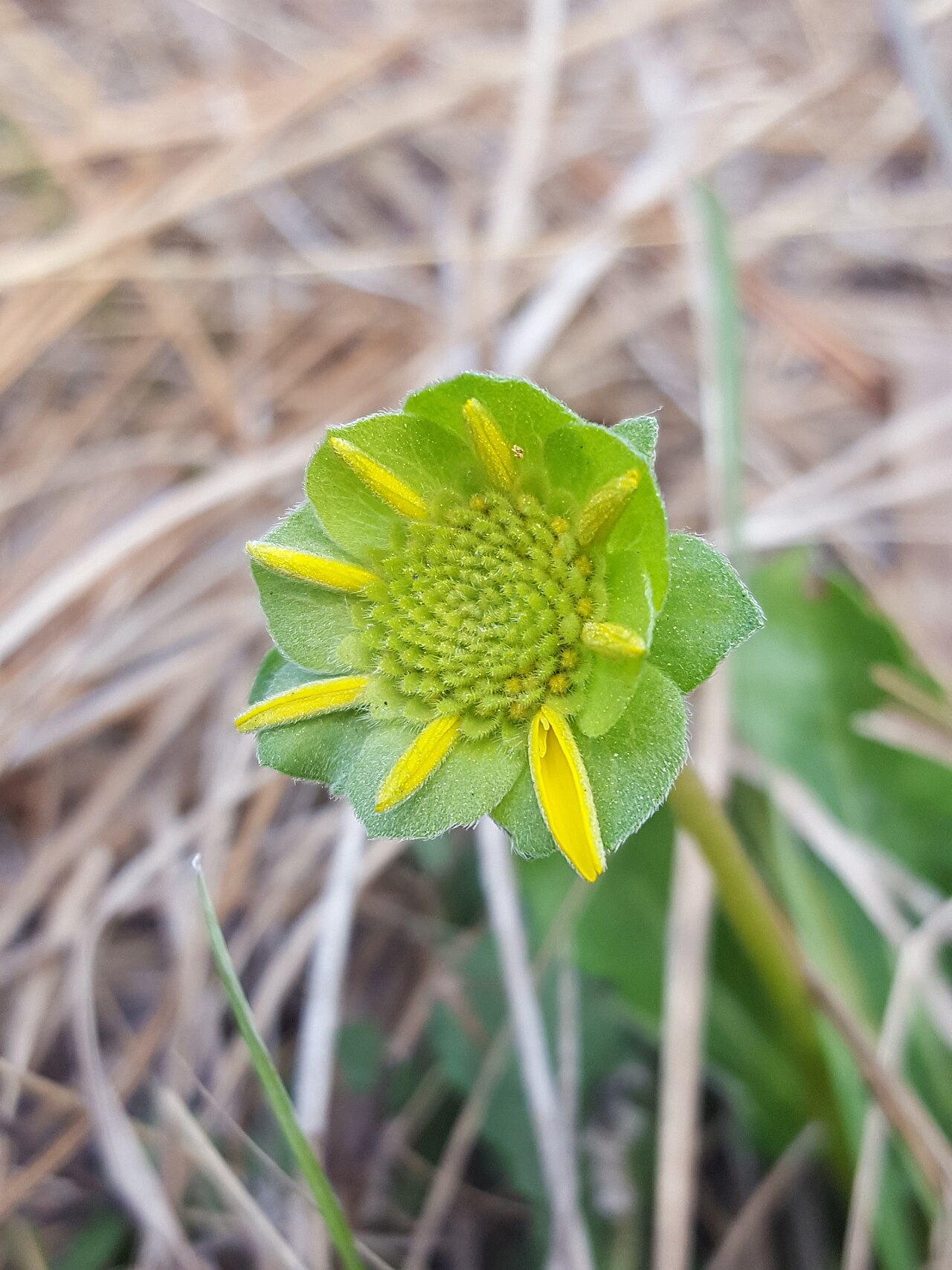
The name comes from that green center. The heads are surrounded by broad, leafy green bracts, and once the small central flowers fade, the bracts and the green receptacle remain as a distinctive green “eye.” The species name subacaulis means “nearly stemless,” a reference to the way the leaves are all crowded at the base of the plant. It is a member of the aster family (Asteraceae) and a close relative of the chocolate-scented chocolate daisy of the Southwest.
Florida greeneyes is endemic to Florida per the Atlas of Florida Plants; it grows wild in no other state. It is common within its range and also one of the easiest Florida wildflowers to grow, but gardeners should still buy nursery-propagated plants or seed and never dig plants from the wild. This guide covers how to identify it, where it grows, and how to use it in sunny, dry Florida gardens.
Identification
Florida greeneyes is easy to recognize when in flower: few other yellow daisies in Florida have flower heads held on long stalks from a basal rosette, with such broad green bracts around the head.
Leaves & Roots
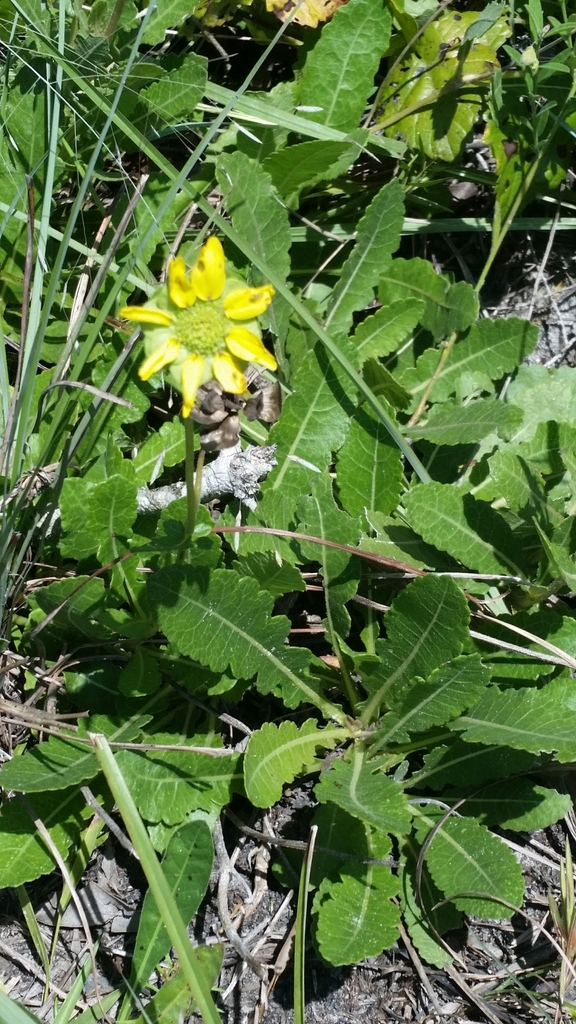
The leaves form a basal rosette, often 6 to 12 inches across. Each leaf is 2 to 8 inches long, rough and somewhat hairy, and deeply scalloped or pinnately lobed, often with a larger rounded lobe at the tip (a lyre shape). Leaf shape varies a great deal from plant to plant, from shallowly toothed to deeply cut. The plant grows from a thick, deep taproot, which helps it survive drought and fire.
Flowers
The flower heads are about 1½ to 2 inches across, held singly on stalks 6 to 20 inches tall that carry only a few small leaves. Each head usually has eight broad, bright yellow ray flowers, notched at the tip, around a disk of small florets. The outer ring of disk florets opens yellow with dark anthers and reddish style branches, while the center stays green. Several rows of broad, rounded, green bracts cup the head from below.
In south and central Florida it can flower throughout the year. In north Florida the main bloom is from spring through fall, with fewer flowers in winter.
Fruit & Seeds
In greeneyes, the ray flowers produce the seeds, not the central disk flowers. Each ray floret develops a flattened, dark achene. When ripe, each achene drops off together with its attached bract and a couple of neighboring disk florets, forming a small unit that can be carried by wind or animals. This unusual seed package is typical of the genus Berlandiera.
Similar Species
Berlandiera pumila (soft greeneyes) grows in north Florida and nearby states. It is a taller, leafy-stemmed plant with softer, velvety leaves along the stems rather than only in a basal rosette. Chocolate Daisy (Berlandiera lyrata) is a plant of the Southwest. Several yellow composites of Florida pinelands, such as tickseeds and Golden Aster, have narrower rays and lack the broad green bracts.
Quick Facts
| Scientific Name | Berlandiera subacaulis |
| Family | Asteraceae (aster family) |
| Plant Type | Herbaceous perennial wildflower with a basal rosette and taproot |
| Mature Height | Rosette 3–6 in; flower stalks 6–20 in |
| Mature Spread | 6–12 in |
| Growth Rate | Moderate |
| Sun Exposure | Full sun |
| Water Needs | Low; very drought tolerant once established |
| Soil Type | Dry to moist, well-drained sand |
| Soil pH | About 5.0–7.5 |
| Bloom Time | Year-round in central and south Florida; mainly spring–fall in the north |
| Flower Color | Bright yellow rays with a green center |
| Fall Color | None; the rosette is usually evergreen |
| Fruit | Flattened achenes that drop with their attached bract |
| Deer Resistant | Moderately; rough leaves are not a preferred browse |
| USDA Hardiness Zones | 8b–10b |
Native Range
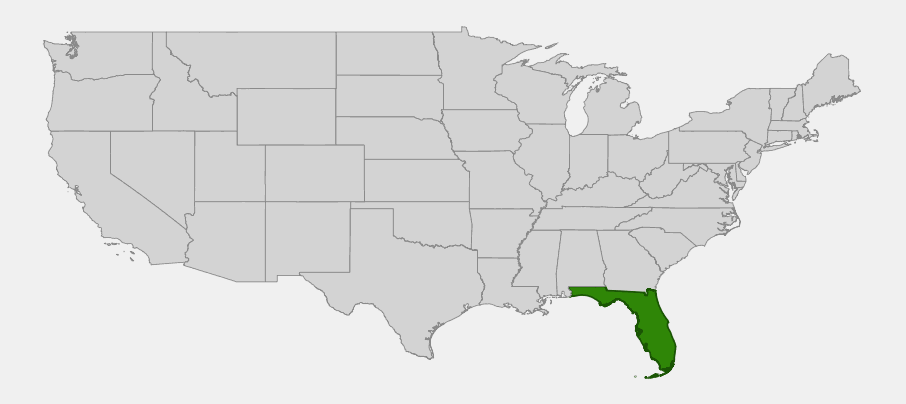
Florida greeneyes is found only in Florida. USDA PLANTS records it only from Florida, the Lady Bird Johnson Wildflower Center lists it as endemic to the state, and it is endemic to Florida per the Atlas of Florida Plants. It grows through most of the peninsula, from north Florida south into south Florida, and is scarce in the western Panhandle.
Its natural habitats are dry, open, sandy places: sandhills, scrubby flatwoods, dry pine flatwoods, dry prairies and coastal uplands. It also adapts well to disturbed ground, and is often seen along sandy road shoulders, in old fields, in vacant lots and even in unfertilized lawns. This tolerance of disturbance means it is still common, even though much of its original habitat has been developed.
Like most pineland wildflowers, it is adapted to frequent fire. Its deep taproot survives burns, and plants often flower heavily soon after a fire. Because it grows wild nowhere else in the world, collecting from wild populations should be avoided; nursery-grown plants and commercially produced seed are readily available in Florida.
📋 Regional plant lists featuring Florida Greeneyes: North & South Florida
Growing & Care Guide
Florida greeneyes is one of the most dependable native wildflowers for Florida gardens. It tolerates heat, drought and poor sand, blooms for months, and is widely available from native nurseries and as seed. Plant nursery-propagated stock rather than digging wild plants, which seldom survive because of their long taproots.
Light
Give it full sun. In partial shade it survives but flowers much less and the stalks flop.
Soil & Water
It grows best in well-drained sandy soil, from dry to moderately moist. Water new plants every few days for the first few weeks, then taper off; established plants rarely need irrigation. Avoid heavy fertilizing and constantly wet soil, which shorten its life.
Planting Tips
Plant small containers any time of year in central and south Florida, or in spring and fall in north Florida. Space plants about 12 inches apart. Because the rosette is low, place it at the front of a bed, along a path or between taller grasses and wildflowers. It also works in a mowed native “lawn” if the mower is set high.
Pruning & Maintenance
Little care is needed. Remove spent flower stalks if you want a tidier look, or leave them so the plant can reseed. Keep taller plants from shading the rosette. Plants are fairly long-lived, and new seedlings fill gaps as older plants decline.
Propagation
It is easy from seed. Let seed heads dry on the plant, collect them, and sow the seed shallowly in a sandy mix or directly in the garden. The Lady Bird Johnson Wildflower Center notes that it freely self-sows. Seedlings form a taproot quickly, so move them to their final spot while small.
Landscape Uses
- Pollinator gardens: a long-blooming nectar source for bees and butterflies
- Front of borders: a low rosette with long-stalked yellow flowers
- Native lawns and meadows: tolerates occasional high mowing and dry sandy soil
- Sandhill and flatwoods restoration: a common forb of fire-maintained Florida pinelands
- Low-maintenance landscapes: needs no irrigation once established
Wildlife & Ecological Value
Florida greeneyes is a small plant, but its long flowering season makes it a reliable food source for pollinators in nearly every month in much of Florida.
For Pollinators
The flowers attract a wide range of native bees, including small sweat bees and leafcutter bees, as well as butterflies, skippers and flower flies. The Lady Bird Johnson Wildflower Center notes that it attracts butterflies. Because it often blooms in winter in central and south Florida, it fills gaps when few other wildflowers are open.
For Birds
Seed-eating birds such as sparrows and ground doves may take the achenes, and the open, sandy habitats it grows in are used by ground-feeding birds.
For Mammals
Gopher tortoises graze on low-growing wildflowers in sandhills, and Florida greeneyes is among the many forbs available to them. Deer browse it only lightly.
Ecosystem Role
As a fire-adapted, deep-rooted perennial, it helps form the diverse wildflower layer of sandhills and dry flatwoods. Its tolerance of disturbance also makes it one of the first native wildflowers to return to sandy road edges and old fields.
Cultural & Historical Uses
The genus Berlandiera honors Jean-Louis Berlandier, a French-Swiss naturalist who collected plants in Mexico and Texas in the 1820s and 1830s. Thomas Nuttall first described Florida greeneyes in the genus Silphium and later moved it to Berlandiera himself, which is why his name appears twice in its full botanical name, Berlandiera subacaulis (Nutt.) Nutt.
The common name “greeneyes” is shared by all members of the genus and refers to the green center that remains after the disk flowers fade. Its relative, the chocolate daisy of the Southwest, is famous for its chocolate scent; Florida greeneyes has little fragrance.
Today Florida greeneyes is a staple of Florida native wildflower plantings. It is grown commercially for seed and is used in roadside wildflower programs and pollinator gardens across the state. For many Florida gardeners it is one of the first native wildflowers they grow successfully.
Frequently Asked Questions
Is Florida greeneyes only found in Florida?
Yes. It is endemic to Florida per the Atlas of Florida Plants. It is common within the state, but buy nursery-propagated plants or seed and never dig plants from the wild.
Why is it called greeneyes?
After the central flowers fade, the green center of the head and the broad green bracts that cup it remain visible, like a green eye surrounded by yellow rays.
Does Florida greeneyes bloom all year?
In central and south Florida it can bloom in almost every month. In north Florida it flowers mainly from spring through fall and slows down in winter.
Is Florida greeneyes easy to grow?
Yes. Give it full sun and well-drained sandy soil, water it while it establishes, and then leave it alone. It needs no fertilizer and freely self-sows.
Will it grow in my lawn?
It often appears on its own in unfertilized, sandy Florida lawns and tolerates mowing at a high setting, though it flowers best when not mowed frequently.

Looking for a nursery that carries Florida Greeneyes?
Browse our native plant nursery directory: Florida