
Leavenworth’s Tickseed (Coreopsis leavenworthii)
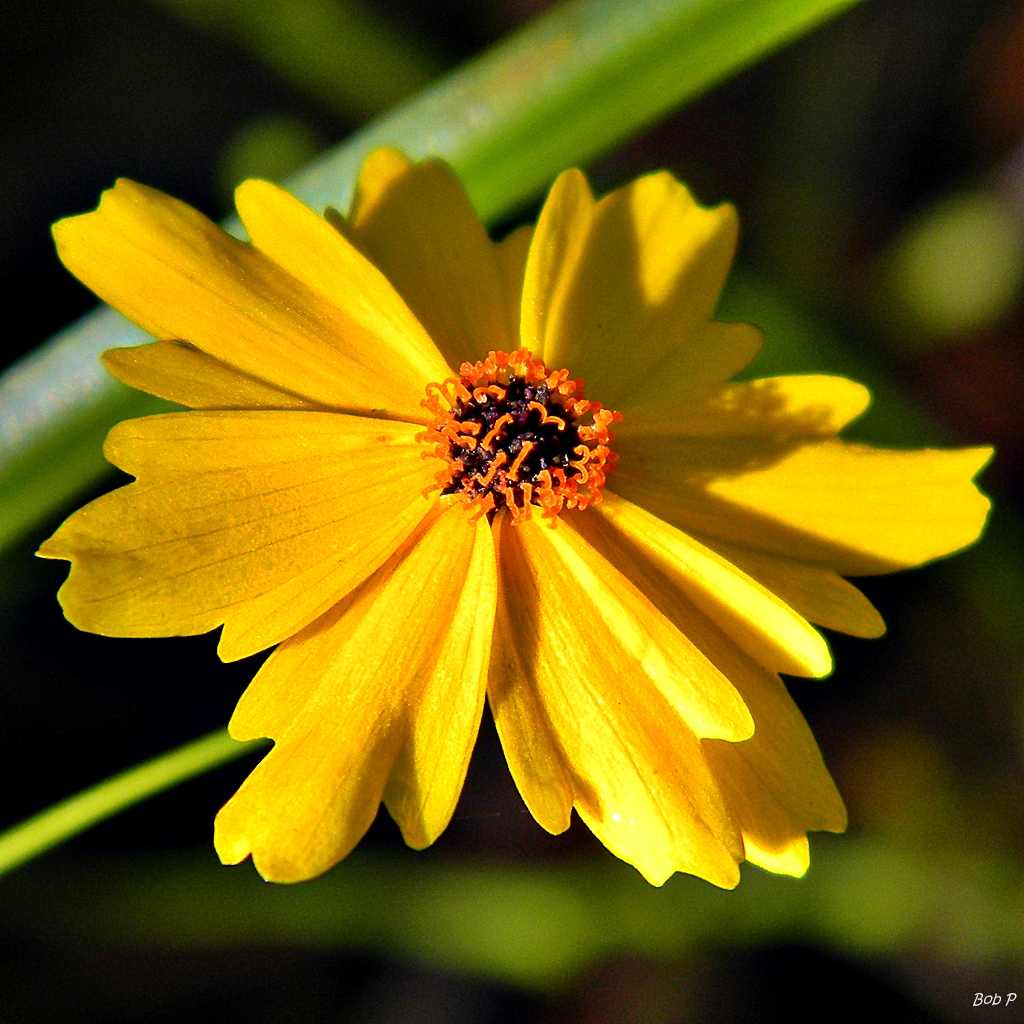
Coreopsis leavenworthii, called Leavenworth’s Tickseed or simply Leavenworth’s coreopsis, is the yellow daisy that lines wet roadside ditches across most of Florida. It is a slender, wiry member of the aster family (Asteraceae) that grows one to three feet tall and carries small, bright yellow flower heads with a distinctive dark purple-brown center. Where it is happy it does not grow as single plants but as drifts of hundreds, and a damp swale in full bloom reads as a solid yellow band from a moving car.
The plant is short-lived by design. Most individuals behave as annuals or very short-lived perennials, germinating with the rains, flowering within a few months, setting a heavy crop of seed, and dying. That strategy makes it one of the easiest native wildflowers to establish from seed, and it is the reason Florida highway crews and wildflower programs have used it more than almost any other native species for roadside plantings.
Florida named Coreopsis its state wildflower in 1991, and while that honor covers the whole genus, C. leavenworthii is the species most Floridians actually see. It occurs in nearly every county in the state and reaches just into the Gulf counties of southern Alabama. This guide covers how to tell it from Florida’s other tickseeds, where it grows, how to establish it from seed in a home garden or meadow, and what it supports in the way of insect life.
Identification
Florida has around a dozen native Coreopsis species, and several of them are yellow daisies of wet, sunny ground. Leavenworth’s tickseed is separated by the combination of small heads, a dark disk, and thin, mostly narrow leaves on a wiry, much-branched stem.
Stems & Habit
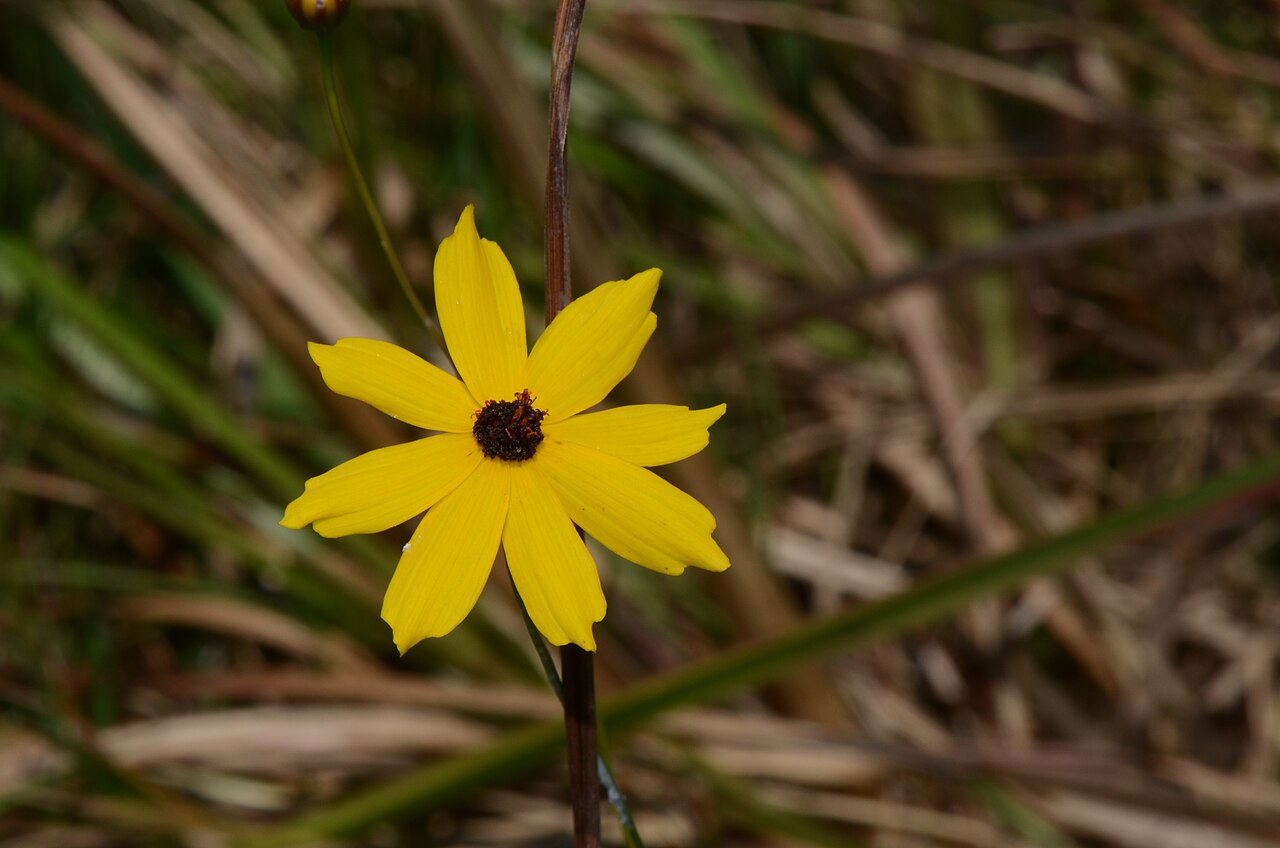
The plant makes a thin, erect, strongly branched stem one to three feet tall, occasionally a little more in rich, wet soil. Stems are smooth, green to reddish, and so slender that a flowering plant looks almost leafless from a distance. Branching happens mostly in the upper half, so each plant ends up holding a scattered spray of flower heads on long bare stalks. Plants often lean on each other in a stand, which is why it looks better planted in a mass than as an isolated specimen.
Leaves
Leaves are opposite and generally narrow. The lowest ones are the widest, spoon-shaped to oval, and sometimes divided into three lobes or a few narrow segments. Leaves get narrower and simpler as they go up the stem, until the uppermost are little more than linear green threads one to three inches long. All of them are smooth, without hairs, and soft green. Seedlings begin as a small rosette of spoon-shaped leaves close to the ground, which is useful when weeding a sown patch.
Flowers
Each head is about half an inch to an inch across and is carried singly at the tip of a long, thin stalk. There are usually eight yellow ray florets, each one broad and shallowly notched or three-toothed at the tip, surrounding a button of disk florets that are dark purple-brown to nearly black. That dark center is the single most reliable field mark; several related tickseeds have a yellow or brownish-yellow disk instead. Two rows of green bracts sit under the head, the outer ones narrow and spreading.
Flowering peaks from spring through fall. In central and south Florida plants in moist sites can be found in bloom in every month of the year, and populations renew themselves continuously, with seedlings coming up under the parents.
Fruit & Seeds
Pollinated florets ripen into small, flat, dark achenes with narrow papery wings along the edges, about an eighth of an inch long. The old common name “tickseed” comes from the resemblance of these seeds to ticks. They are released as the head dries and are mostly moved by water and by sticking to wet feet, fur and tires, which explains why the plant travels so readily along ditches and roadsides. A single healthy plant can produce several hundred seeds.
Quick Facts
| Scientific Name | Coreopsis leavenworthii Torr. & A. Gray (USDA symbol COLE3) |
| Family | Asteraceae (aster family) |
| Plant Type | Herbaceous annual or short-lived perennial wildflower |
| Mature Height | 1–3 ft (occasionally taller in rich wet soil) |
| Mature Spread | 6–18 in per plant; self-sows into drifts |
| Growth Rate | Fast; flowers within a few months of germination |
| Sun Exposure | Full sun; tolerates very light shade |
| Water Needs | Moderate to high; best in soil that stays moist, tolerates seasonal flooding |
| Soil Type | Moist to wet sand, sandy loam, muck; poor soils are fine |
| Soil pH | About 5.0–7.5 |
| Bloom Time | Mainly May–July, but spring through fall and year-round in south Florida |
| Flower Color | Yellow rays with a dark purple-brown to blackish disk |
| Fall Color | None; stems dry to tan |
| Fruit | Small flat winged achene (“tickseed”) |
| Deer Resistant | Moderately; deer rarely browse it heavily |
| USDA Hardiness Zones | 8–11 |
Native Range
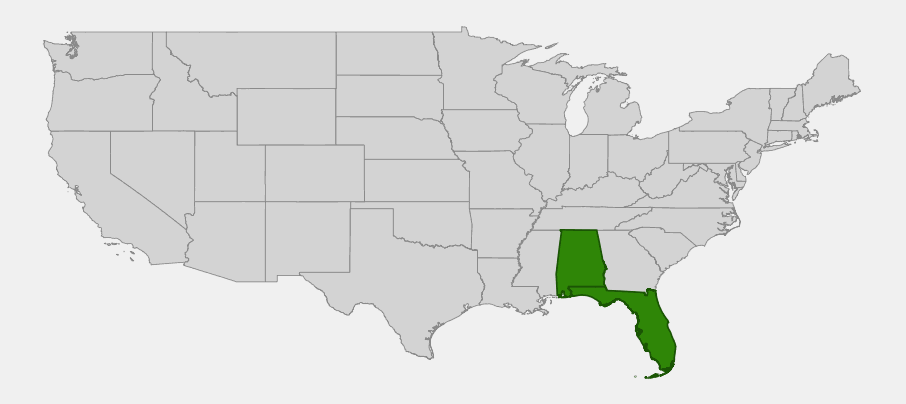
Leavenworth’s tickseed has one of the tightest ranges of any widely planted American wildflower. USDA PLANTS and the Lady Bird Johnson Wildflower Center record it from only two states, Florida and Alabama. The Atlas of Florida Plants shows it as native in essentially every Florida county, from the western Panhandle to the Keys, and Alabama records are limited to a handful of counties near the Gulf. It is effectively a Florida plant, and it is often described as near-endemic to the state.
Within Florida it belongs to open, sunny, seasonally wet ground: wet and mesic pine flatwoods, wet prairies, marsh and pond edges, depression marshes, bare moist sand in disturbed openings, and above all roadside swales and drainage ditches. It is a specialist in places that flood in the summer rainy season and dry out in spring. It will not persist in dense shade, in permanently flooded water, or in closed turf.
Its roadside abundance is partly natural and partly the result of planting. The Florida Department of Transportation and the Florida Wildflower Foundation have seeded it widely along highways, and Florida-grown seed is commercially available. Because populations differ genetically from one part of the state to another, seed of local or at least Florida origin is the right choice; seed produced out of state has in the past performed poorly in Florida conditions.
📋 Regional plant lists featuring Leavenworth’s Tickseed: North & South Florida · Alabama, Georgia & Mississippi
Growing & Care Guide
Leavenworth’s tickseed is one of the simplest native wildflowers to grow in Florida, provided you treat it as what it is: a fast, seed-dependent plant of open wet ground rather than a long-lived border perennial. Sow it, let it flower, and let it drop seed. Gardeners who deadhead it tidily and mulch heavily usually lose it after the first year.
Light
Full sun. Six or more hours of direct sun gives compact plants and heavy flowering. In partial shade stems stretch, flop and produce far fewer heads, and in real shade the plant disappears within a season.
Soil & Water
Moist to seasonally wet soil is ideal, and ordinary Florida sand works as long as it does not stay bone dry. Plants tolerate standing water for days to weeks during the rainy season and also survive a dry spring, though they finish flowering earlier in drought. No fertilizer is needed, and rich soil mostly produces soft, floppy stems and encourages weeds. Irrigation during establishment helps; afterward, rainfall is usually enough in its native range.
Planting Tips
Start from seed, broadcast on bare, raked, weed-free soil in fall or early winter so that seedlings come up with cool-season moisture and flower in spring. Do not bury the seed deeply; press it into the surface and water it in, since it needs light and good soil contact to germinate. Sow thickly enough for a stand rather than a few scattered plants, roughly a quarter to half an ounce per 1,000 square feet in a meadow setting. Nursery transplants also establish well in spring. Choose Florida-origin seed when you can.
Pruning & Maintenance
Very little. Shearing a stand lightly after the first flush can trigger a second round of bloom, but leave the last flowering of the season alone so seed ripens and falls. Avoid mulch over the seedbed; new seedlings cannot come up through it. The main maintenance task is keeping aggressive grasses and exotic weeds out of the planting, and mowing a meadow once in late winter after the seed has dropped.
Propagation
Almost always from seed, which needs no cold treatment or scarification and germinates readily on moist soil. Collect heads when the seed is dark and dry and the head crumbles at a touch, then store it dry and cool and sow within a year. Established patches reseed so freely that collecting is usually unnecessary. Cuttings are possible but pointless given how easily the plant comes from seed.
Landscape Uses
- Wildflower meadows: the backbone species for a sunny, seasonally wet Florida meadow
- Roadside and right-of-way plantings: Florida’s most-used native species for highway wildflower programs
- Rain gardens and swales: thrives exactly where water sits for a few days after storms
- Pond and ditch margins: self-sows along the wet fringe without becoming weedy
- Pollinator gardens: a long-season nectar and pollen source for small native bees and butterflies
- Restoration of flatwoods and wet prairie: a fast-establishing native that holds bare soil while slower species come in
Wildlife & Ecological Value
A plant that flowers almost year-round in a warm climate and produces pollen and nectar in small, open, easily reached heads is worth more to insects than its size suggests. Leavenworth’s tickseed is a steady, undramatic food source rather than a magnet species.
For Pollinators
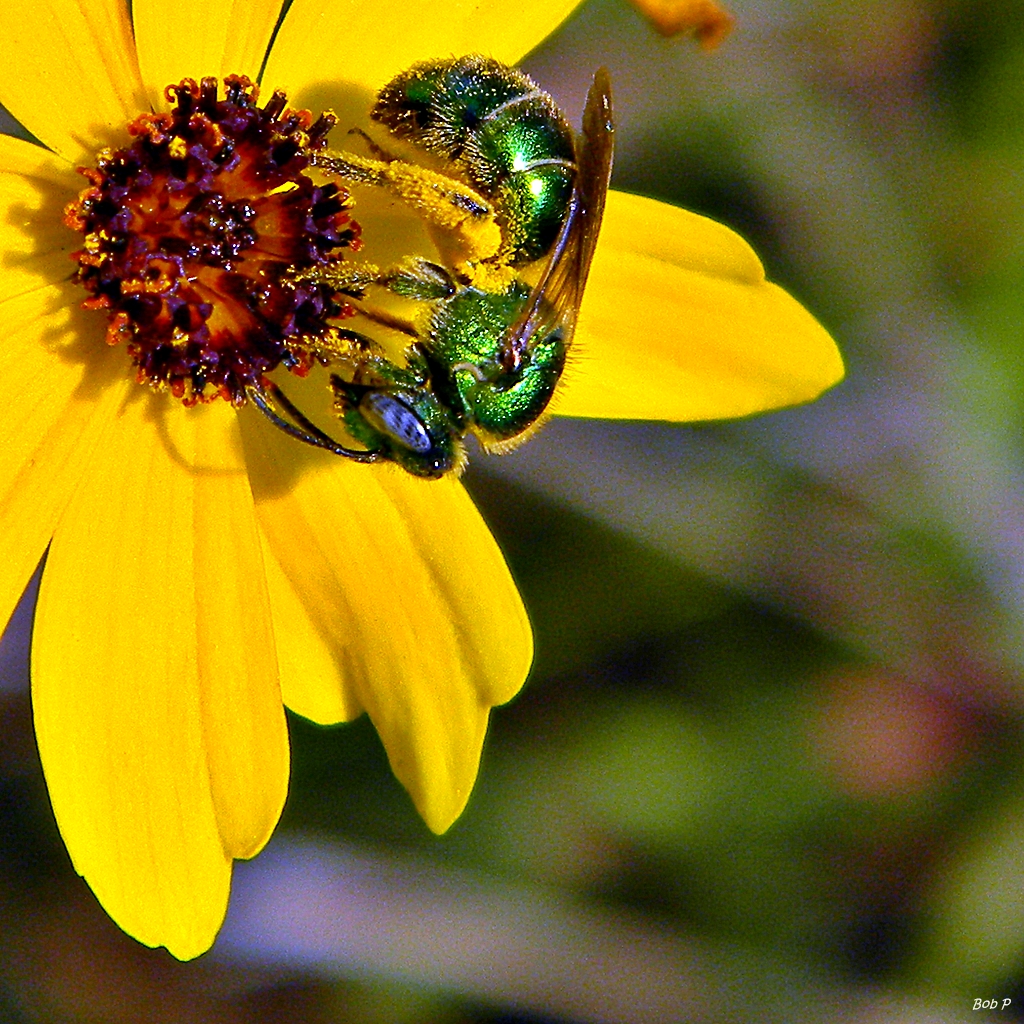
The open, shallow heads suit short-tongued insects, and the most frequent visitors are small native bees: sweat bees in the genera Augochloropsis, Augochlorella and Lasioglossum, small leafcutter bees, and plasterer bees. Honey bees work it as well. Butterflies, particularly skippers, sulphurs and small hairstreaks, take nectar from it, and hover flies, soldier beetles and small wasps are constant on the disks. Because the plant flowers over such a long season in Florida, it helps fill the gaps between the big spring and fall flushes of other wildflowers.
For Birds
Seed-eating birds including goldfinches, sparrows and indigo buntings take the small achenes from drying heads in late summer and fall. Leaving the final flush of seed heads standing is more valuable to birds than cutting them down for tidiness, and it also restocks the seed bank.
For Mammals
Of modest value. Deer and rabbits sometimes browse young stems, but the plant is not a preferred food, and it recovers quickly by branching and reseeding.
Ecosystem Role
Leavenworth’s tickseed is a gap colonizer. It depends on open, bare, seasonally wet soil of the kind created in flatwoods by fire, by shallow flooding, by grazing, and now by mowing and ditch maintenance. In a healthy fire-maintained flatwoods it flowers heavily in the year or two after a burn and then declines as grasses and shrubs close in, persisting in the seed bank until the next opening. Its heavy seed production and waterborne dispersal let it track those temporary openings across a landscape.
Cultural & Historical Uses
The species was named by John Torrey and Asa Gray for Melines Conkling Leavenworth, an army surgeon and botanist who collected plants in Florida and the Gulf South in the 1830s while stationed there during the Seminole Wars. Leavenworth sent specimens to Torrey and Gray in New York, and several southeastern plants carry his name. The genus name Coreopsis comes from Greek koris, a bedbug, and opsis, resemblance, referring to the flat, dark seeds, and that same idea gives the English name tickseed.
In 1991 the Florida legislature designated Coreopsis the official state wildflower, naming the genus rather than a single species so that all of Florida’s native tickseeds would be covered. Sales of Florida’s State Wildflower license plate fund the Florida Wildflower Foundation, which supports native seed production, research and roadside planting. C. leavenworthii is the species most often pictured in connection with the designation.
That connection has made it the subject of unusual attention from plant breeders and agronomists. University of Florida researchers studied its seed production, germination and regional genetics specifically to support commercial Florida-grown seed, after early roadside plantings using out-of-state seed performed badly. Today the plant is a standard item in Florida native seed catalogs, and it is one of the few native wildflowers a Florida gardener can establish from a packet of seed with near-certain success.
Frequently Asked Questions
Is Leavenworth’s tickseed an annual or a perennial?
In practice, treat it as an annual. Individual plants occasionally live more than one year in mild, moist conditions, but most germinate, flower, seed and die within a single season. A planting persists as a self-sowing population rather than as the same plants year after year, so always let the last flush of seed ripen and fall.
Is this the Florida state wildflower?
Florida designated the genus Coreopsis as its state wildflower in 1991, not one species. Coreopsis leavenworthii is the most widespread of Florida’s roughly a dozen native tickseeds and the one most commonly shown and planted, so it is often called the state wildflower in everyday use.
How do I tell it from Florida tickseed (Coreopsis floridana)?
Size and season are the easiest cues. C. floridana has noticeably larger heads, often an inch and a half or more across, and blooms mainly in fall; C. leavenworthii has smaller heads, under about an inch, on thinner stems and flowers through much of the year. Both have dark disks, so judge by flower size and stem thickness rather than by disk color alone.
Will it take over my garden?
It self-sows freely on bare, moist, sunny soil, which is the point of planting it, but it is not aggressive in the way exotic weeds are. It cannot compete in shade, in dense turf, or in mulched beds, and unwanted seedlings pull out easily. Confine it to a meadow, swale or rain garden if you want a tidy border elsewhere.
Does the seed need to be from Florida?
It is strongly preferable. Populations from different parts of Florida and the Gulf Coast differ genetically in flowering time and vigor, and plantings made with out-of-state seed have performed poorly. Buying Florida-grown seed, ideally from a source reasonably near you, gives much better results and avoids diluting local populations.
