
Woolly Dutchman’s Pipe (Aristolochia tomentosa)
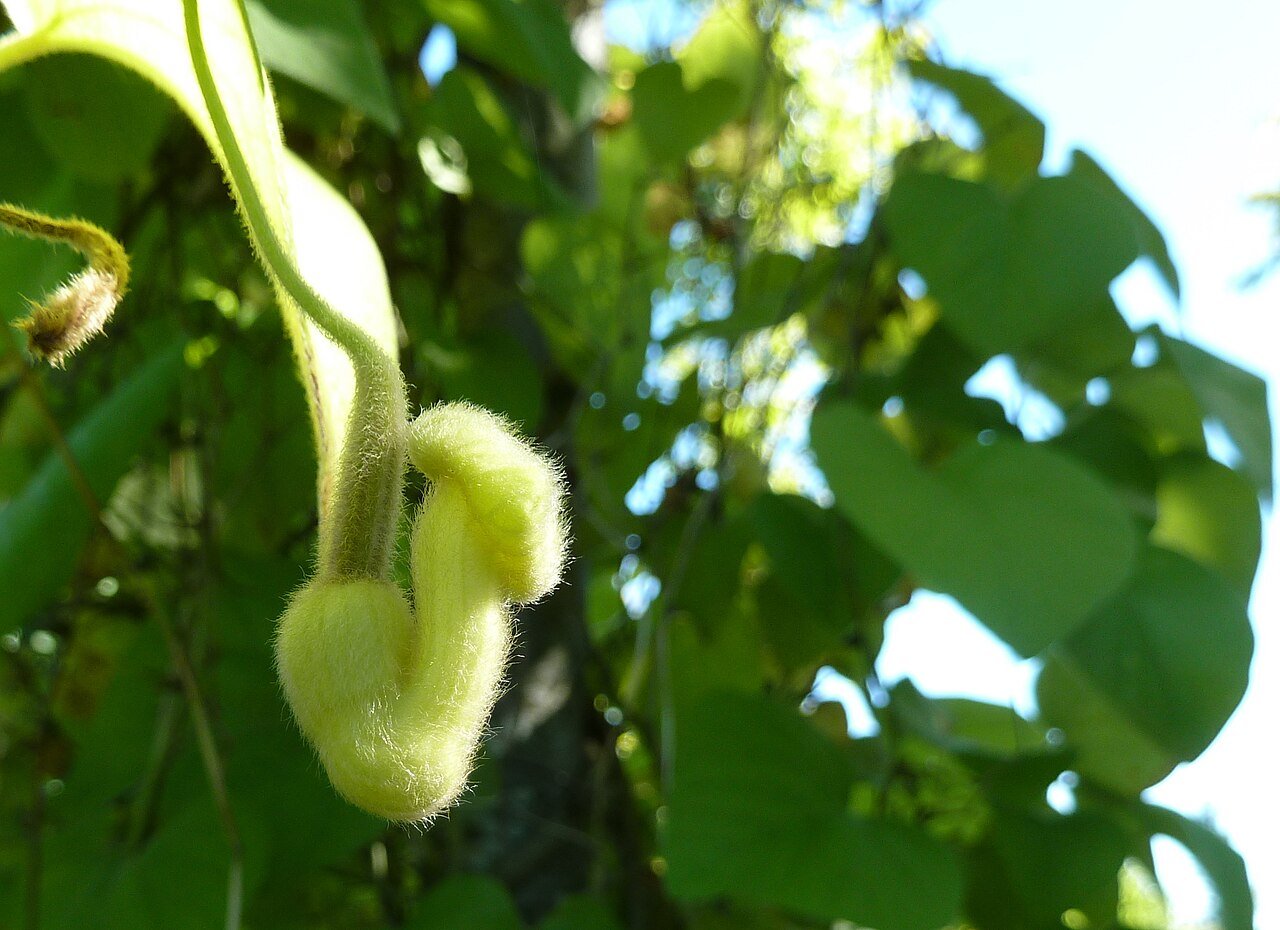
Aristolochia tomentosa, known as Woolly Dutchman’s Pipe or woolly pipevine, is a vigorous woody vine of river floodplains in the southeastern and south-central United States. It climbs by twining into trees and shrubs, often reaching 20 to 30 feet or more, and covers its supports with large, heart-shaped leaves that are soft and downy underneath. In spring and early summer it produces curious, fuzzy flowers bent in a U shape like an old-fashioned smoking pipe, which give the genus its common name. It belongs to the birthwort family (Aristolochiaceae).
Gardeners grow it mainly for butterflies. Woolly Dutchman’s pipe is a larval host plant for the pipevine swallowtail (Battus philenor), whose caterpillars feed only on pipevines and related plants, and in Florida also for the polydamas swallowtail (Battus polydamas). It is a fast, dense screen for a trellis, arbor or fence, and one of the best native choices for anyone hoping to raise pipevine swallowtails.
In Florida, woolly Dutchman’s pipe reaches the southern edge of its range and is rare, limited to floodplain forests in the northern part of the state. It is listed as Endangered by the State of Florida (Florida Department of Agriculture and Consumer Services). Buy nursery-propagated plants from reputable native nurseries, and never dig plants or collect seed from wild populations.
Identification
Woolly Dutchman’s pipe is easy to recognize when in flower. Out of flower, the large heart-shaped leaves on a twining woody vine, together with the dense soft hairs on stems and leaf undersides, separate it from most other vines in its habitat.
Stems & Habit
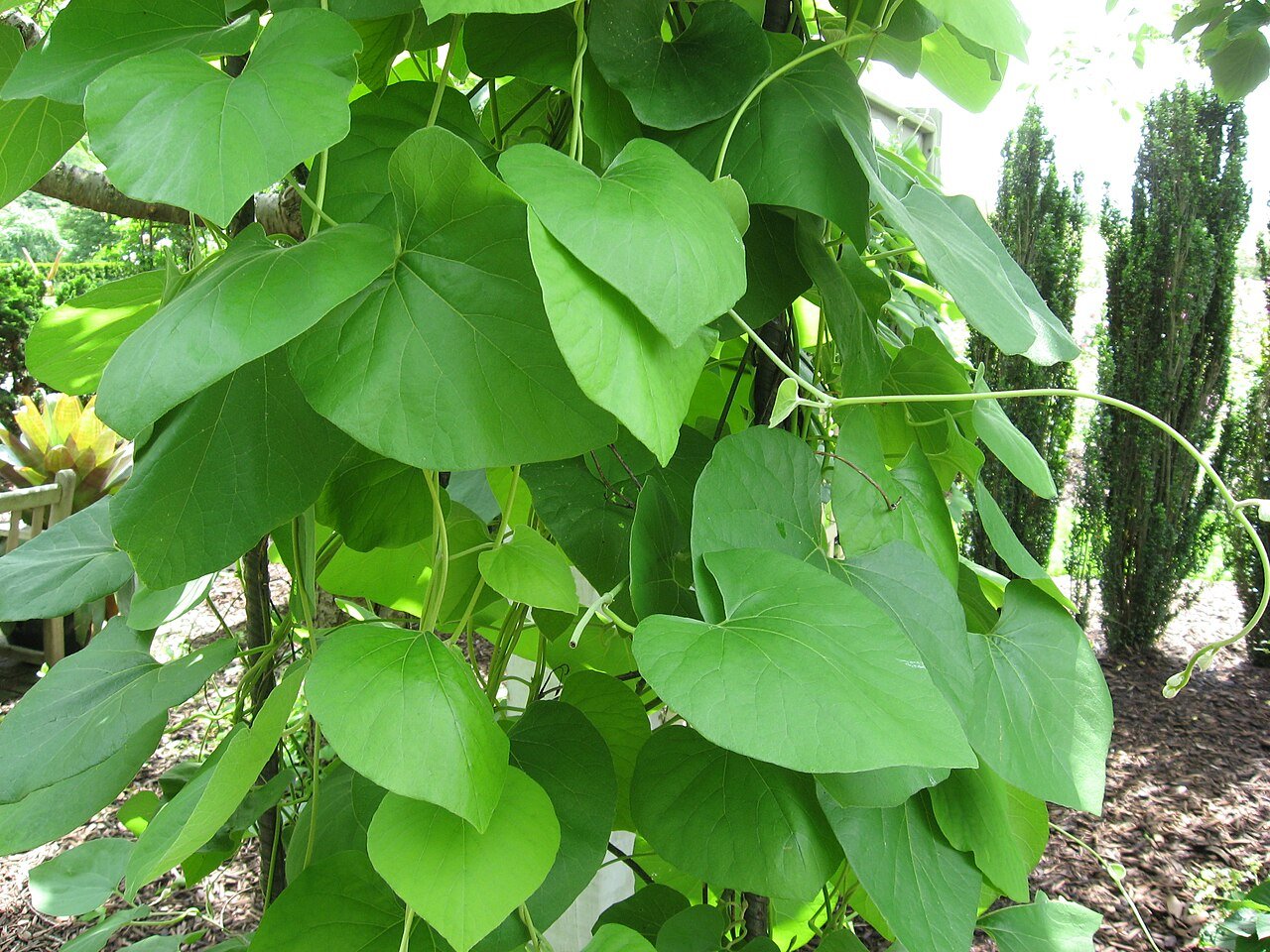
This is a deciduous, woody, twining vine with no tendrils or aerial roots. Young stems are green and densely covered in short hairs, and older stems become gray-brown, corky and furrowed. In the wild it scrambles over shrubs and climbs into the crowns of floodplain trees, and in gardens it quickly covers a trellis, arbor or chain-link fence. Plants also spread by underground runners and can sucker some distance from the parent vine.
Leaves
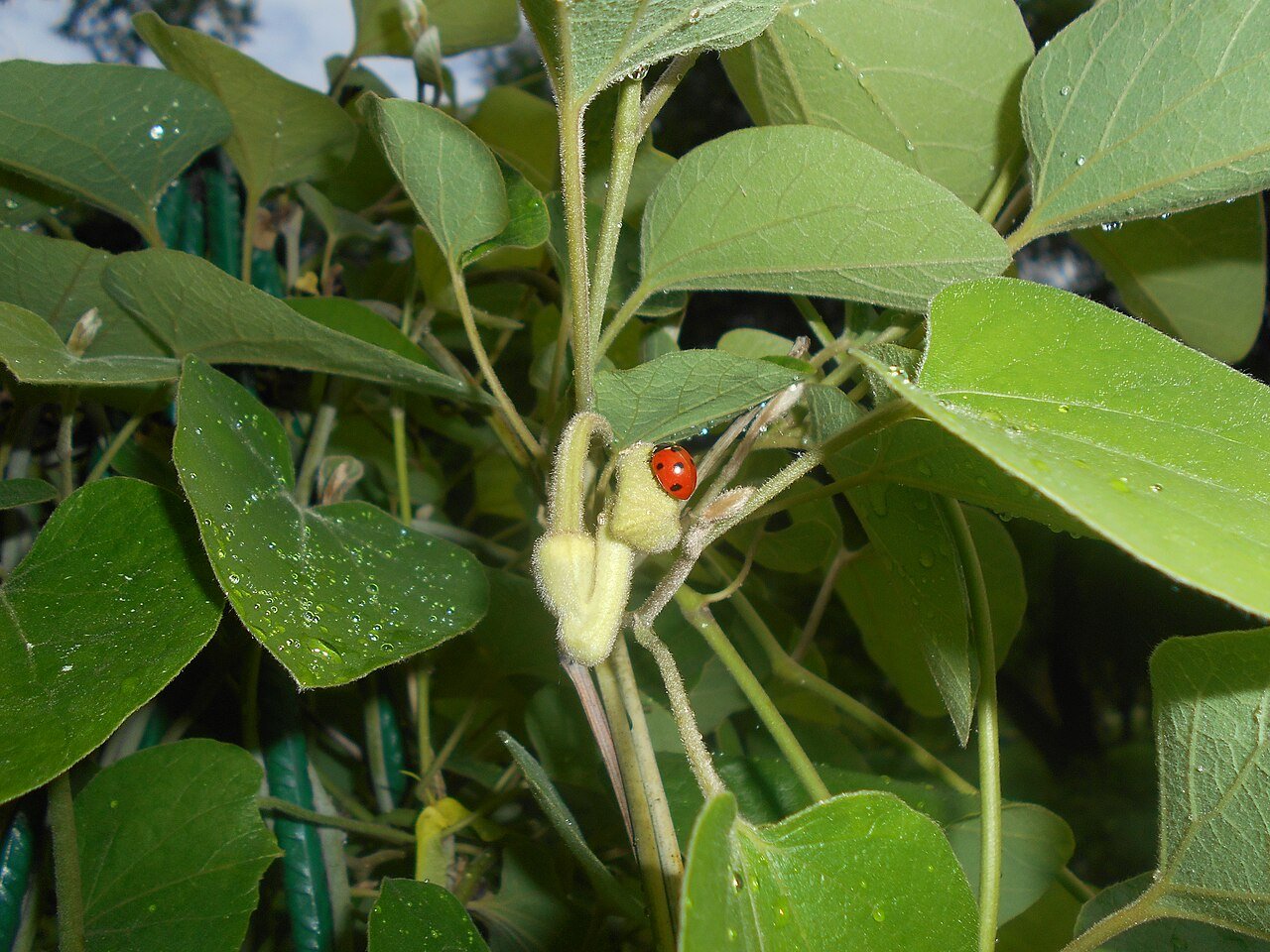
The leaves are alternate, broadly heart-shaped to rounded, about 4 to 8 inches long, with smooth margins and a deep notch at the base where the leaf stalk attaches. The upper surface is dull green and slightly hairy, while the lower surface is pale and densely woolly or velvety to the touch. Leaves overlap like shingles and form a dense curtain that casts deep shade.
Flowers
Flowers appear singly in the leaf axils in spring and early summer, often partly hidden by the foliage. Each is a curved, U-shaped tube about 1½ inches long, yellowish-green and covered in fine hairs on the outside. The tube opens into a small, flattened, three-lobed mouth that is yellow with a dark purplish-brown or maroon center. The flowers have no true petals; the showy tube is formed from fused sepals. Like other pipevines, they are trap flowers that temporarily hold small flies and gnats inside the tube while pollination takes place.
Fruit & Seeds
The fruit is a cylindrical, ribbed capsule about 2 to 3 inches long that hangs from the vine. It ripens from green to brown in late summer and fall and splits along its six ribs to release many flat, triangular seeds stacked inside like coins.
Similar Species
Pipevine or Dutchman’s pipe (Aristolochia macrophylla) of the Appalachians is very similar, but its leaves are nearly hairless underneath and its flowers are smoother, with a broader, darker mouth. Woolly Dutchman’s pipe is the only one of the two native to Florida and the Gulf Coastal Plain.
Quick Facts
| Scientific Name | Aristolochia tomentosa (syn. Isotrema tomentosum) |
| Family | Aristolochiaceae (birthwort family) |
| Plant Type | Deciduous woody twining vine |
| Mature Height | 20–30 ft or more when climbing |
| Mature Spread | Wide; spreads by runners and can cover a large trellis or fence |
| Growth Rate | Fast once established |
| Sun Exposure | Partial shade to full sun |
| Water Needs | Moderate to high; prefers consistently moist soil |
| Soil Type | Moist sandy, loamy or alluvial soils |
| Soil pH | Slightly acidic to neutral |
| Bloom Time | April–June |
| Flower Color | Yellowish green with a purplish-brown to maroon mouth |
| Fall Color | Pale yellow before leaf drop |
| Fruit | Ribbed cylindrical capsule, 2–3 in long |
| Deer Resistant | Generally; the foliage is toxic and seldom browsed |
| USDA Hardiness Zones | 5–9 |
Native Range
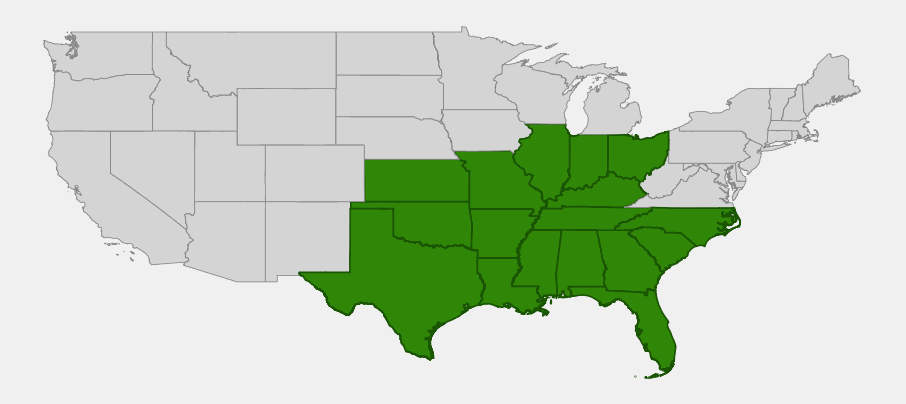
Woolly Dutchman’s pipe is native to the southeastern and south-central United States. It grows from North Carolina, South Carolina, Georgia and northern Florida west through Alabama, Mississippi and Louisiana to eastern Texas, and north through the Mississippi and Ohio River valleys to Oklahoma, Kansas, Missouri, Illinois, Indiana, Ohio, Kentucky and Tennessee. Records from New England, New York and Wisconsin represent plants that escaped from cultivation rather than native populations.
Across this range it is a vine of rich, moist bottomlands. It grows along stream banks and river levees, in floodplain and bottomland hardwood forests, and on forest edges where it can climb toward the light. Its distribution follows the major river systems, and it is most common in the lower Mississippi and Ohio valleys.
In Florida it is found only in a small number of floodplain forests in the northern part of the state, near the southern limit of its range. The Atlas of Florida Plants lists it as native, and the State of Florida lists it as Endangered. Florida gardeners should use nursery-propagated plants and leave wild vines and their seed undisturbed.
📋 Regional plant lists featuring Woolly Dutchman’s Pipe: North & South Florida · Alabama, Georgia & Mississippi · North & South Carolina · Kentucky & Tennessee · Arkansas, Louisiana, Eastern Oklahoma & Eastern Texas · Illinois, Iowa & Missouri · Ohio & Indiana · Nebraska, Kansas & Eastern Colorado
Growing & Care Guide
Woolly Dutchman’s pipe is easy to grow in moist, fertile soil and is far more vigorous than most gardeners expect. Give it a sturdy support and room to spread. In Florida, where it is state-listed as Endangered, buy only nursery-propagated plants from reputable native nurseries; never collect cuttings, seed or plants from the wild.
Light
It grows best in partial shade to full sun. In deep shade it survives but flowers less and grows sparser. In hot southern gardens, afternoon shade helps keep the large leaves from wilting.
Soil & Water
Plant it in moist, humus-rich sandy or loamy soil. It is a floodplain vine and tolerates occasional short flooding, but it does not tolerate salt or brackish water, or salt spray. Water regularly during the first season and during droughts; established plants on moist sites need little extra care.
Planting Tips
Provide a strong trellis, arbor, pergola or fence before planting; mature vines are heavy. Space plants at least 10 feet apart, and keep them away from small trees and shrubs they could smother. In Florida, plant it in the northern part of the state (zones 8A to 9B), where it is native. Buy only nursery-propagated plants, because wild Florida populations are protected.
Pruning & Maintenance
Prune in late winter to control size and remove dead stems, and cut back or dig out runners that wander into lawns and beds. Expect pipevine swallowtail caterpillars to strip some leaves in summer; that is the point of growing it, and healthy vines recover quickly. Avoid pesticides on and near the vine.
Propagation
Woolly Dutchman’s pipe is propagated from seed, stem cuttings and rooted suckers. Seed is best sown fresh in fall or after several weeks of cold, moist stratification. Semi-hardwood cuttings taken in summer root in a humid propagation bed, and rooted runners can be dug and moved while dormant.
Landscape Uses
- Butterfly gardens: a larval host for pipevine swallowtails and, in Florida, polydamas swallowtails
- Screening and shade: quickly covers arbors, pergolas, porches and fences with large overlapping leaves
- Floodplain and streambank restoration: for moist bottomland plantings within its native range
- Woodland edges: lets it climb into open-grown trees and shrubs at the edge of a wooded lot
- Educational gardens: a striking way to show pollination by trap flowers and caterpillar chemical defenses
Wildlife & Ecological Value
Woolly Dutchman’s pipe has an unusually close relationship with a few insects, both the small flies that pollinate it and the swallowtail butterflies that depend on it as caterpillar food.
For Pollinators
The flowers are pollinated by small flies and gnats. Attracted by the color and faint scent, the insects crawl into the curved tube, where downward-pointing hairs keep them inside for a time. Once the flower’s pollen is released, the hairs wither and the insects leave dusted with pollen. The vine offers little nectar for butterflies and bees; its value to butterflies lies in its leaves.
For Butterflies
Pipevine swallowtail caterpillars feed on pipevine leaves and absorb aristolochic acids from them. Those compounds make the caterpillars and the adult butterflies distasteful to birds, and several other butterflies, including the spicebush swallowtail and the black form of the female eastern tiger swallowtail, benefit by mimicking the pipevine swallowtail’s dark blue colors. In Florida, polydamas swallowtails also use this vine as a host. Avoid tropical pipevines sold for butterfly gardens, such as giant pipevine (Aristolochia gigantea) and calico flower (A. littoralis), which are reported to be harmful to pipevine swallowtail caterpillars.
For Birds
Birds use the dense, leafy tangles for cover and nesting sites. The seeds and foliage are not a significant food source.
For Mammals
The plant is toxic and is rarely browsed by deer or rabbits. Its thick growth gives small mammals shelter along streams.
Ecosystem Role
As a high-climbing vine of bottomland forests, woolly Dutchman’s pipe adds structure to the forest edge and canopy and helps stabilize streambanks with its runners. Its role as a specialist host plant makes it essential to pipevine swallowtail populations wherever it grows.
Cultural & Historical Uses
The genus name Aristolochia comes from Greek words meaning “best birth”. Ancient herbalists believed that the shape of some Aristolochia flowers, which resemble a birth canal, indicated a use in childbirth, and the plants are still called birthworts. The species name tomentosa means “densely woolly”, for the hairs on its leaves and flowers. John Sims described the species in 1811.
Aristolochia plants were used in traditional medicine on several continents, but modern research has shown that the aristolochic acids they contain cause severe kidney damage and cancer. All parts of woolly Dutchman’s pipe should be considered toxic, and it should never be used as an herbal remedy.
In the nineteenth and early twentieth centuries, pipevines were popular porch and arbor vines because of their dense shade and curious flowers. Today woolly Dutchman’s pipe is grown mostly by butterfly gardeners, and native nurseries in the Southeast and Midwest offer it specifically for pipevine swallowtails.
Frequently Asked Questions
Is woolly Dutchman’s pipe endangered in Florida?
Yes. The State of Florida lists it as Endangered. It is native only in a small number of floodplain forests in northern Florida. Buy nursery-propagated plants and never dig vines or gather seed from the wild.
Will pipevine swallowtail caterpillars kill my vine?
Rarely. Caterpillars can strip leaves from small or newly planted vines, so give young plants a season or two to establish. Established vines recover quickly and are usually large enough to feed many caterpillars.
Is woolly Dutchman’s pipe poisonous?
Yes. All parts contain aristolochic acids, which can cause kidney damage and cancer. Keep it out of reach of children and pets that chew plants, and never use it medicinally.
How do I tell woolly Dutchman’s pipe from Aristolochia macrophylla?
Woolly Dutchman’s pipe has leaves that are densely hairy and soft beneath, and hairy flowers with a small yellow mouth. Aristolochia macrophylla has nearly smooth leaves and less hairy flowers with a broad, dark mouth, and it grows mainly in the Appalachians.
Does woolly Dutchman’s pipe spread?
Yes. It spreads by underground runners and can sucker several feet from the parent plant. Give it room, or pull suckers that come up where you don’t want them.

Looking for a nursery that carries Woolly Dutchman’s Pipe?
Browse our native plant nursery directory: Alabama & Arkansas · Florida & Georgia · Illinois, Indiana & Kansas · Kentucky, Louisiana, Mississippi & Missouri · North Carolina, Ohio & Oklahoma · South Carolina, Tennessee & Texas