
Herb-of-Grace (Bacopa monnieri)
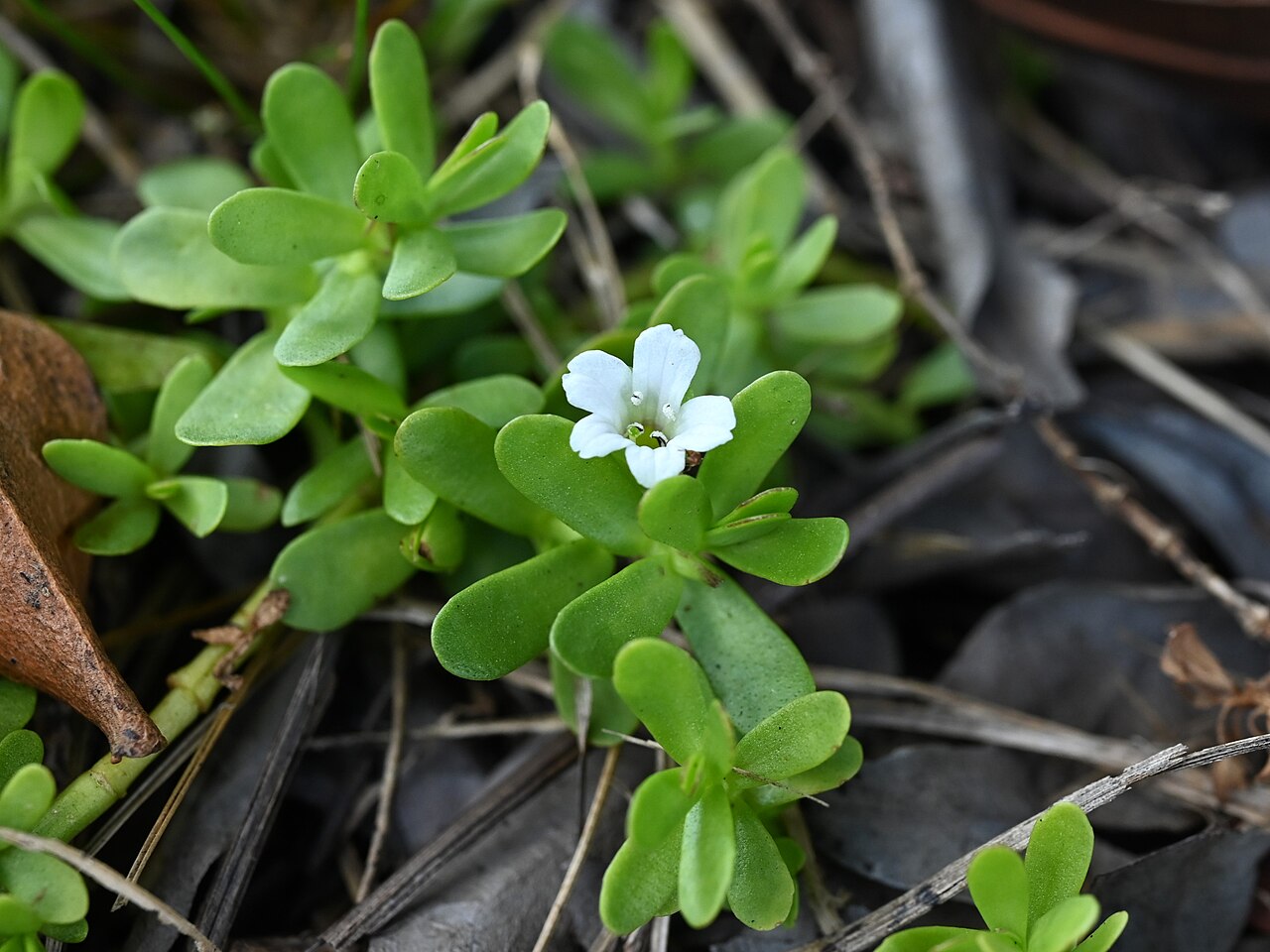
Bacopa monnieri, known as Herb-of-Grace, water hyssop or coastal water-hyssop, is a low, creeping wetland plant with thick, rounded leaves and small white to pale lavender flowers. Its smooth, succulent stems root as they spread across wet sand and mud, forming bright green mats along pond shores, ditches, marsh edges and tidal flats. In Florida it flowers in every month of the year.
Herb-of-grace belongs to the plantain family (Plantaginaceae); older references place it in the figwort family (Scrophulariaceae). It is one of the most widespread wetland plants in the world, native to tropical and warm-temperate regions on every continent except Antarctica. In South Asia it is the well-known Ayurvedic herb “brahmi.” In the United States it grows across the southern states, and USDA PLANTS also lists it as native in Hawaii, Puerto Rico and the U.S. Virgin Islands.
For gardeners it is a useful, easy groundcover for wet, sunny places, including rain gardens, pond margins and brackish shorelines, and it is a larval host for the white peacock butterfly. This guide covers how to identify it, where it grows, and how to use it in wet native landscapes.
Identification
Herb-of-grace is easy to recognize by its combination of creeping, fleshy stems, small paired leaves without stalks, and solitary pale flowers in the leaf axils. Its close relative, lemon bacopa, often grows nearby.
Stems & Growth Habit
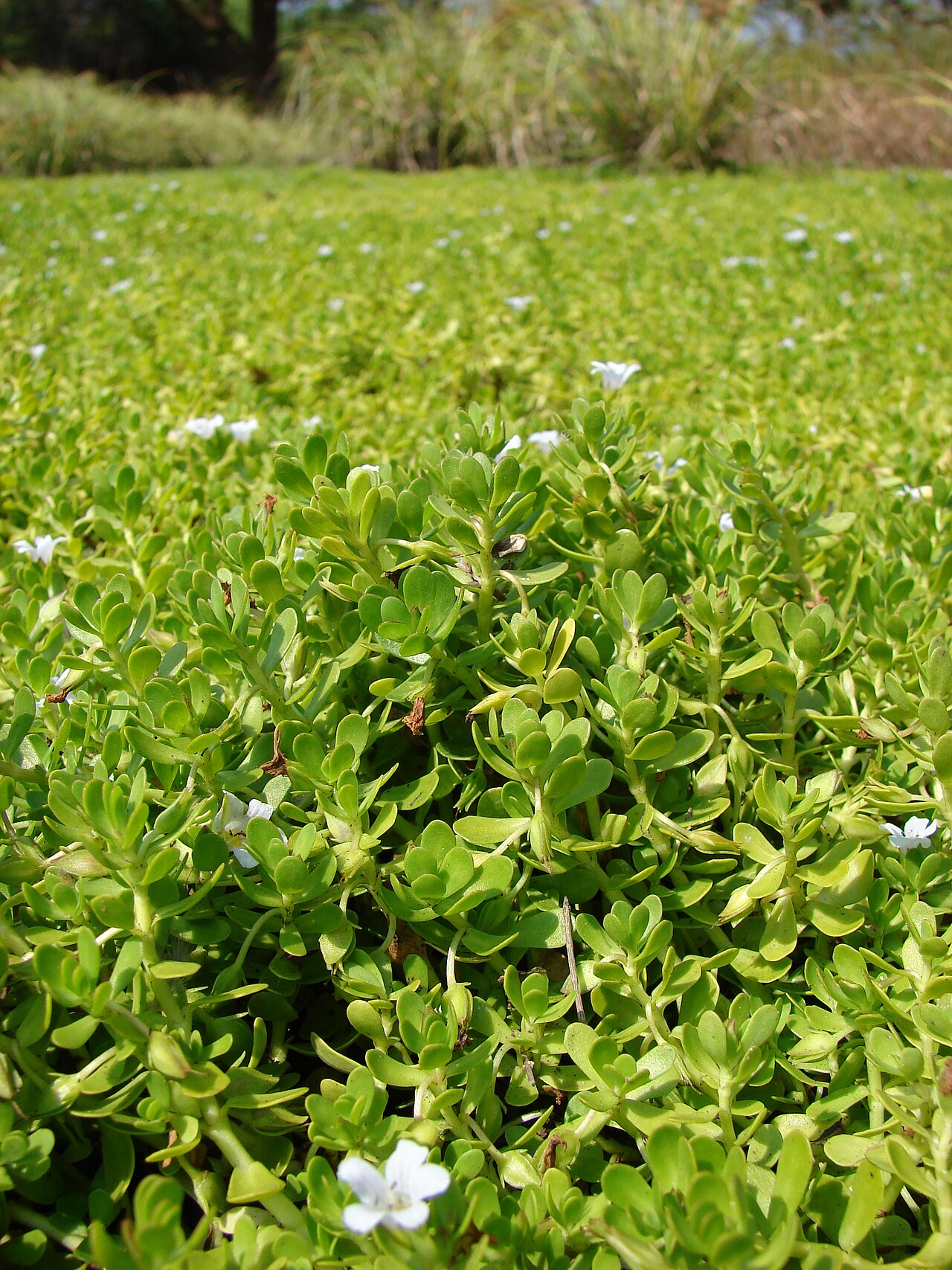
The stems are smooth, round, fleshy and green, creeping along the ground and rooting at the nodes, with the tips turning upward. A single plant can spread several feet and knit together with others into a dense mat a few inches tall. In shallow water the stems can float or grow partly submerged.
Leaves
The leaves are opposite, stalkless, thick and somewhat succulent, spoon-shaped to oblong (broadest near the rounded tip), about ¼ to ¾ inch long, with smooth or faintly toothed edges. They are smooth and bright to yellowish green, and they have no strong smell when crushed.
Flowers
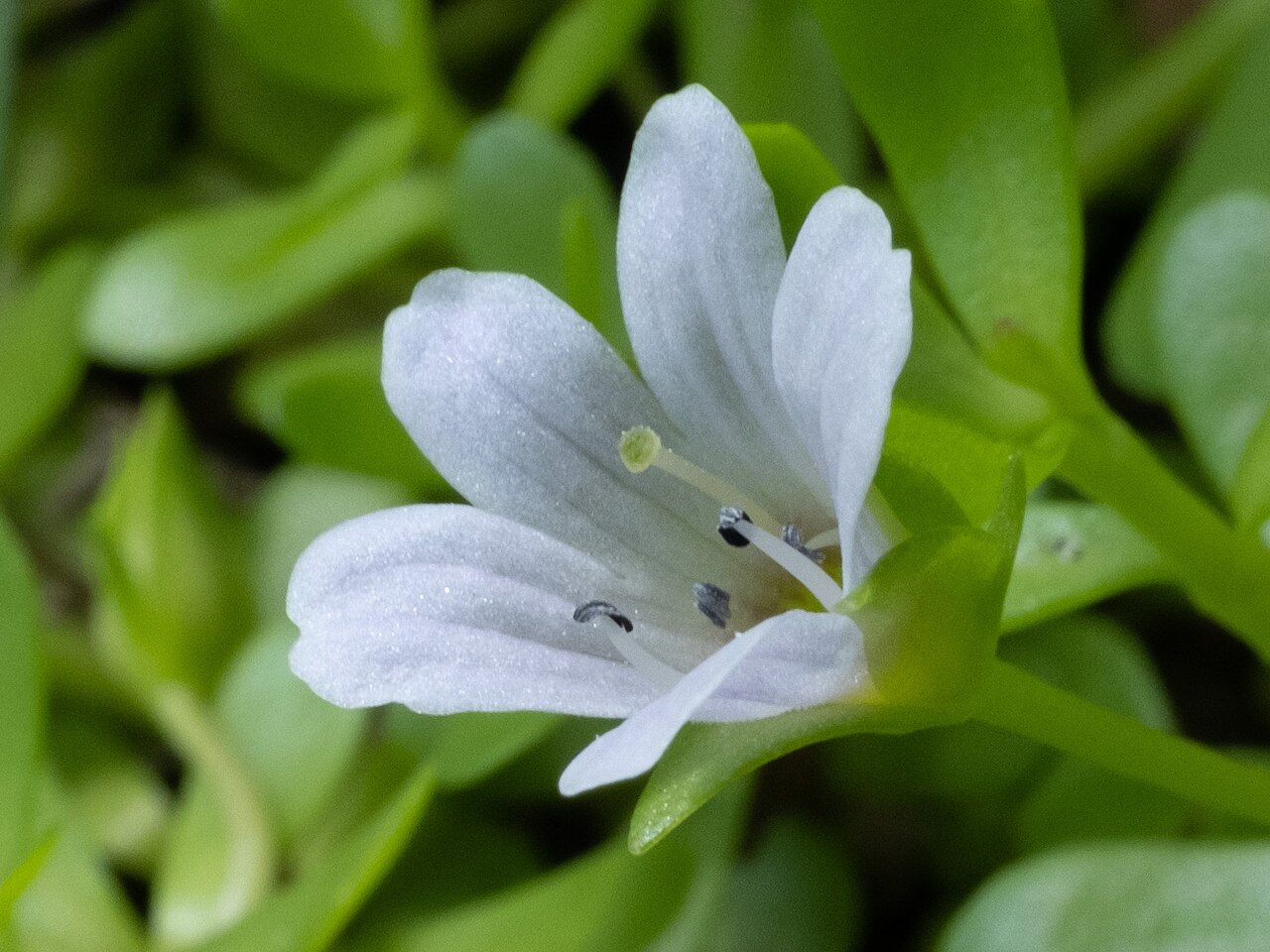
Flowers are borne one at a time in the leaf axils on slender stalks about ½ to 1 inch long. Each flower is about ⅓ to ½ inch across, with five nearly equal, rounded lobes that are white, pale lavender or pinkish, sometimes with faint purple veins. Inside are four stamens with dark anthers. Two small bracts sit just below the calyx. In Florida and the Gulf Coast it flowers year-round; farther north it blooms mainly from late spring into fall.
Fruit & Seeds
The fruit is a small, pointed, egg-shaped capsule enclosed by the persistent sepals. It splits to release many tiny seeds. Much of the plant’s spread, though, comes from creeping stems and stem fragments carried by water.
Similar Species
Bacopa caroliniana (lemon bacopa or blue waterhyssop) is hairy, has larger, broader, clasping leaves that smell of lemon when crushed, and has blue flowers. Bacopa innominata and other small water hyssops have much tinier flowers. Non-flowering mats can resemble seaside purslane, but that plant has fleshier, longer leaves and pink, star-shaped flowers.
Quick Facts
| Scientific Name | Bacopa monnieri (syn. Lysimachia monnieri, Bramia monnieri) |
| Family | Plantaginaceae (plantain family); formerly Scrophulariaceae |
| Plant Type | Creeping, mat-forming herbaceous perennial |
| Mature Height | 2–6 in |
| Mature Spread | 1–3 ft per plant; spreads into large mats |
| Growth Rate | Fast |
| Sun Exposure | Full sun to partial shade |
| Water Needs | High; moist to wet soil or shallow water |
| Soil Type | Wet sand, mud or muck; fresh or brackish |
| Soil pH | About 5.5–8.0 |
| Bloom Time | Year-round in Florida and the Gulf Coast; late spring–fall farther north |
| Flower Color | White to pale lavender or pinkish |
| Fall Color | None; evergreen where winters are mild |
| Fruit | Small egg-shaped capsule with many tiny seeds |
| Deer Resistant | Not well documented |
| USDA Hardiness Zones | 8–11 |
Native Range
Herb-of-grace is native to warm regions around the world, from the Americas through Africa, South and Southeast Asia to Australia and the Pacific. In the United States, USDA PLANTS and the Lady Bird Johnson Wildflower Center record it from Maryland and Virginia south along the Atlantic and Gulf Coastal Plain to Florida and Texas, inland to Oklahoma, and in the Southwest in Arizona and California. USDA also lists it as native in Hawaii, Puerto Rico and the U.S. Virgin Islands; Hawaii and Puerto Rico are not drawn on the map.
It is most common near the coast. In Florida it grows throughout the state, from the Panhandle to the Keys, in freshwater and brackish marshes, wet prairies, the edges of ponds, lakes and canals, ditches, wet pastures, and the upper edges of salt marshes and mangroves. It tolerates moderate salinity, periodic flooding and trampling, so it is often seen on disturbed wet ground as well as in natural wetlands.
In the West it is much more local, found at springs, seeps, marsh edges and river margins in the low deserts of southern Arizona and southern California. Because it spreads easily by stem fragments, it is also widely grown in aquariums and water gardens.
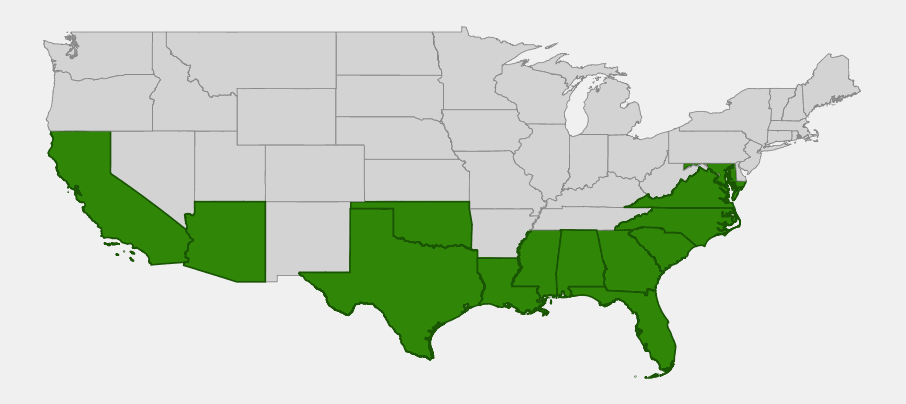
📋 Regional plant lists featuring Herb-of-Grace: North & South Florida · Alabama, Georgia & Mississippi · North & South Carolina · Maryland, Virginia & West Virginia · Arkansas, Louisiana, Eastern Oklahoma & Eastern Texas · South & West Texas · Arizona & New Mexico · California & Nevada · Hawaii
Growing & Care Guide
Herb-of-grace is one of the easiest native plants to grow in wet, sunny spots. It is sold by native nurseries in Florida and the Gulf states and by aquarium and water-garden suppliers. If you buy it from an aquarium source, make sure it is true Bacopa monnieri and not a hybrid or a different species.
Light
It grows best in full sun to partial shade. In deep shade it becomes thin and stops flowering.
Soil & Water
Keep the soil constantly moist to wet. It grows in sand, muck or ordinary garden soil, fresh or slightly salty, and in shallow water up to a few inches deep. It does not tolerate long dry periods, so it is not a good choice for upland beds unless irrigated. No fertilizer is needed.
Planting Tips
Plant small plugs or rooted cuttings 6 to 12 inches apart along pond edges, in rain gardens, bioswales, wet ditches or the low parts of a yard that stay soggy. It also works in containers set in a saucer of water and as a spill-over plant at the edge of a water garden. In brackish settings it can be planted at the upper edge of a salt marsh or living shoreline.
Pruning & Maintenance
It spreads quickly in wet soil and can cover open ground within a season. Trim the edges if it moves into areas where you do not want it. Frost burns back the top growth in north Florida and similar climates, but plants usually regrow from the stems in spring.
Propagation
It is easy from stem cuttings: any piece with a few nodes will root in wet soil or water within a week or two. Established mats can also be divided. It can be grown from seed, but this is rarely necessary.
Landscape Uses
- Rain gardens and bioswales: a low groundcover for constantly wet, sunny areas
- Pond and water-garden edges: soft green mats that trail into shallow water
- Butterfly gardens: a larval host plant for the white peacock butterfly
- Living shorelines: for the upper edges of brackish marshes and canals
- Aquariums: widely grown as a submerged or emergent aquarium plant
Wildlife & Ecological Value
Herb-of-grace is a small plant, but its year-round flowers and dense mats make it useful to insects and wetland animals.
For Pollinators
The flowers attract small native bees, flies and small butterflies such as skippers. Because it blooms year-round in Florida, it provides a steady source of nectar when few other wetland plants are in flower.
For Birds
Its seeds are too small to matter much to birds, but the mats shelter insects and invertebrates that wading birds and shorebirds feed on.
For Mammals
Marsh rabbits and other small mammals may graze on wetland plants including herb-of-grace, but it is not known as an important food.
Ecosystem Role
Herb-of-grace is a larval host for the white peacock butterfly (Anartia jatrophae), a common butterfly in Florida and south Texas. Its creeping mats help hold wet soils and shorelines in place, and they shelter tadpoles, small fish and aquatic insects in shallow water.
Cultural & Historical Uses
Linnaeus first described this plant in the genus Lysimachia. It later passed through several genera, including Herpestis and Bramia, before Francis Pennell placed it in Bacopa. The species name honors the French physician and botanist Louis-Guillaume Le Monnier.
In India and neighboring countries, the plant is known as brahmi and has been used for many centuries in Ayurvedic medicine, especially in connection with memory and the mind. Brahmi preparations are sold as supplements today, and the plant has been the subject of modern research. Those uses are outside the scope of this guide; consult a medical professional before taking any herbal supplement. The common name “herb-of-grace” has also been used for rue (Ruta graveolens), a different plant.
In American wetlands, herb-of-grace is valued mainly as a sturdy native groundcover and as a host plant for the white peacock butterfly. It is one of the plants most often recommended for wet spots in Florida yards, where few lawn grasses thrive.
Frequently Asked Questions
Is herb-of-grace native to Florida?
Yes. It is native throughout Florida and across the southern United States. USDA PLANTS also lists it as native in Hawaii, Puerto Rico and the U.S. Virgin Islands.
Is herb-of-grace the same as brahmi?
Yes, Bacopa monnieri is the plant called brahmi in Ayurvedic medicine. Garden plants and wild plants are the same species. Do not use it medicinally without professional advice.
Will herb-of-grace grow in a dry yard?
Not well. It needs soil that stays moist to wet. In a dry bed it will decline unless watered often. Use it in rain gardens, pond edges or low, soggy spots instead.
Which butterfly uses herb-of-grace?
It is a larval host plant for the white peacock butterfly, which lays its eggs on the leaves. The caterpillars cause little lasting harm to established mats.
Is herb-of-grace invasive?
It is native, but it spreads quickly in wet soil and can cover open ground. Edge it or trim it where you want to keep it contained.

Looking for a nursery that carries Herb-of-Grace?
Browse our native plant nursery directory: Alabama & Arizona · California · Florida & Georgia · Louisiana, Maryland & Mississippi · North Carolina & Oklahoma · South Carolina, Texas & Virginia