
Mexican Alvaradoa (Alvaradoa amorphoides)
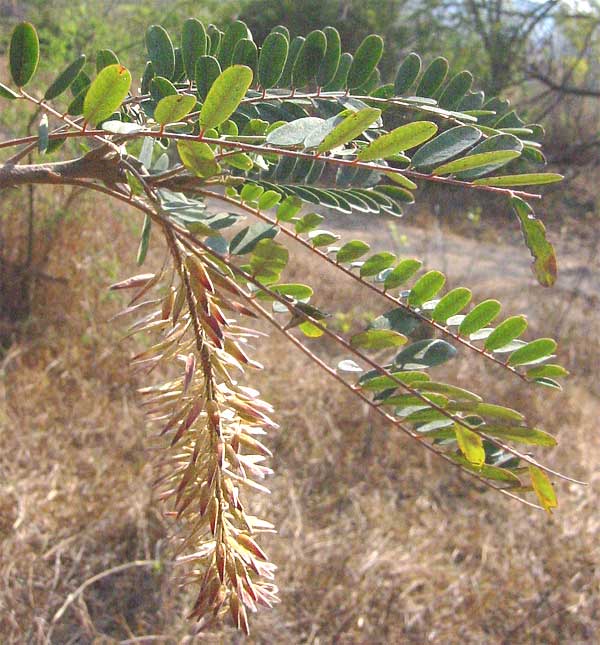
Alvaradoa amorphoides, the Mexican Alvaradoa, is a small tropical tree with fine, feathery foliage and long hanging spikes of flowers and fruit. It is common in parts of Mexico and Central America, but in the United States it grows wild only in a small area of southern Miami-Dade County, Florida, on the limestone of the Miami Rock Ridge. There it is listed by the State of Florida as endangered (FDACS Regulated Plant Index; also noted in the Atlas of Florida Plants).
The tree belongs to the small family Picramniaceae, and older references place it in the quassia family (Simaroubaceae). Its pinnate leaves, with up to several dozen small oblong leaflets, resemble those of false indigo (Amorpha), which is why the species is named amorphoides. Through much of the year it carries slender drooping spikes of greenish-white flowers or clusters of hairy, winged fruits tinged with pink and red, which give the tree a soft, tasseled look.
Because the Florida population is tiny, gardeners who want to grow Mexican alvaradoa should buy only nursery-propagated plants and never collect seeds, cuttings or plants from the wild. This guide covers how to identify it, where it grows, how to use it in south Florida landscapes and why it matters to a rare native butterfly.
Identification
Mexican alvaradoa is a light, open little tree rather than a dense shade tree. Its foliage looks almost like a legume or a soapberry relative at first glance, but the hanging spikes of tiny flowers and the hairy winged fruits are distinctive.
Form & Bark
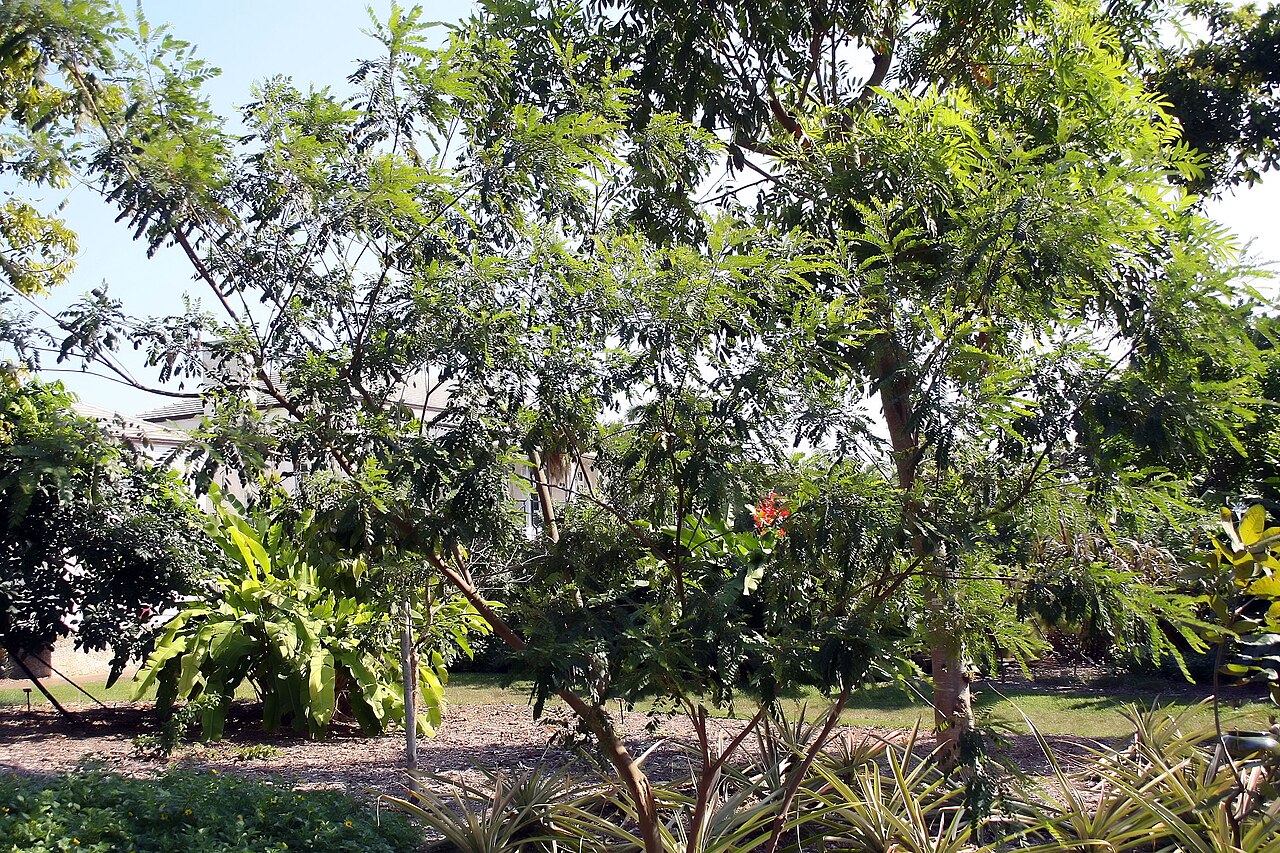
In Florida it is usually a large shrub or small tree 10 to 20 feet tall, occasionally taller, with one or a few slender trunks and an open, spreading crown. Mature trunks are seldom more than 4 to 8 inches across. The bark is smooth and gray to gray-brown. Young twigs are finely hairy.
Leaves
The leaves are alternate and once-pinnate, 4 to 10 inches long, with many small oblong leaflets about ½ to 1 inch long arranged along a slender central stalk. The leaflets are thin, bright green above and paler, often finely hairy, beneath, with a rounded or slightly notched tip. The overall effect is fine and feathery, and the crown casts only light shade.
Flowers
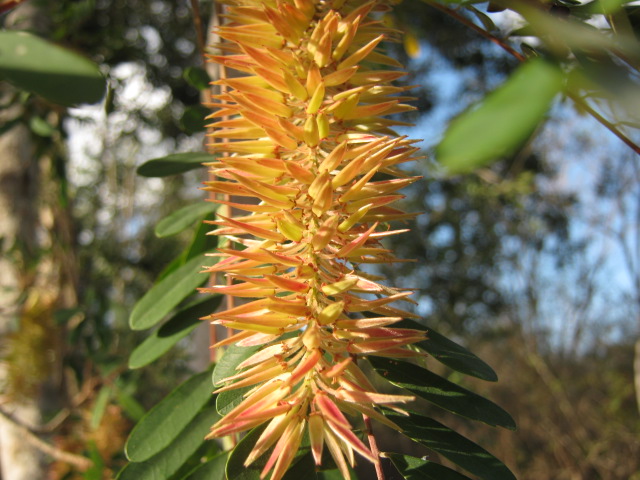
Mexican alvaradoa is dioecious, with male and female flowers on separate trees. The flowers are tiny and greenish to yellowish-white, packed into narrow spikes about 3 to 4 inches long that hang from the branch tips. In south Florida they appear mainly from fall through spring. The flowers are thought to be largely wind-pollinated.
Fruit
Female trees produce dense hanging clusters of small winged fruits (samaras). Each fruit is flattened, covered in soft hairs and light tan tinged with red or purple. A tree in full fruit looks as though it is hung with pinkish tassels. As the fruits dry they drift away on the wind.
Quick Facts
| Scientific Name | Alvaradoa amorphoides (USDA symbol ALAM3) |
| Family | Picramniaceae (formerly placed in Simaroubaceae) |
| Plant Type | Small evergreen tree or large shrub |
| Mature Height | 10–20 ft in Florida; occasionally to about 30 ft |
| Mature Spread | 8–15 ft; usually taller than broad |
| Growth Rate | Moderate |
| Sun Exposure | Full sun to light shade |
| Water Needs | Low once established; drought tolerant |
| Soil Type | Well-drained limestone (oolite) or sandy soils, with or without a humus layer |
| Soil pH | About 7.0–8.5 (alkaline limestone soils) |
| Bloom Time | Mainly fall through spring in south Florida |
| Flower Color | Greenish to yellowish-white |
| Fall Color | None; mostly evergreen |
| Fruit | Hairy winged samaras in hanging clusters, tan tinged red or purple |
| Deer Resistant | Not well documented; deer are scarce in its urban Florida range |
| USDA Hardiness Zones | 10b–11 |
Native Range
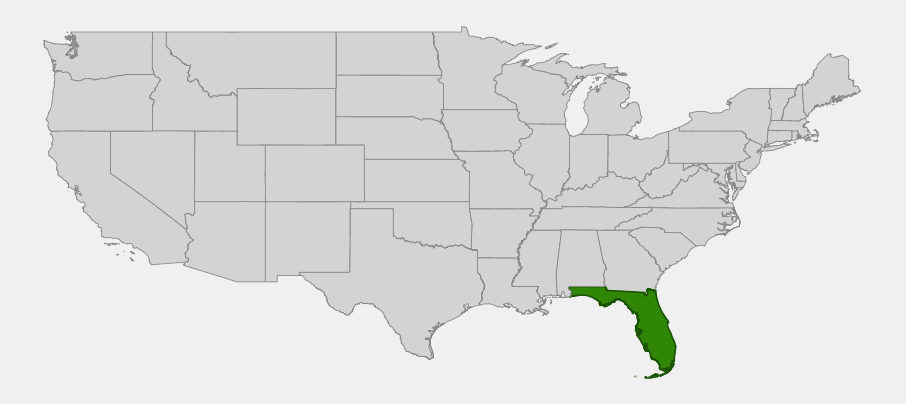
In the United States, Mexican alvaradoa is native only to Florida. USDA PLANTS lists it from Florida alone, and the Atlas of Florida Plants and the Institute for Regional Conservation record wild plants only in Miami-Dade County. There it is limited to the southern Miami Rock Ridge, from Long Pine Key in Everglades National Park northeast to the area west of Goulds.
In Florida it grows almost entirely in the edge zone between rockland hammocks and pine rocklands, where the open pine forest meets the denser tropical hardwood hammock. Both habitats sit on exposed oolitic limestone with very little soil. Most of the pine rockland on the Miami Rock Ridge has been cleared for development, and the remaining stands depend on prescribed fire and protection in parks and preserves.
Outside the United States, the species is widespread and common in Mexico and Central America, and it also grows in the Bahamas and the Greater Antilles. Globally it is not considered threatened. Its Florida status, endangered under the FDACS Regulated Plant Index, reflects how small and restricted the Florida population is, not its status worldwide.
📋 Regional plant lists featuring Mexican Alvaradoa: North & South Florida
Growing & Care Guide
Mexican alvaradoa is rarely grown, but it is a graceful small tree for frost-free south Florida, especially on the limestone soils of Miami-Dade County. Its state endangered status in Florida means it should be bought only as a nursery-propagated plant from a reputable native nursery. Never collect seeds, cuttings or plants from the wild; wild Florida populations are protected, and collecting harms the few that remain.
Light
Plant it in full sun to light shade. In the wild it grows at sunny hammock edges, so a site at the edge of a native hammock planting or among other small trees suits it well. Deep shade makes a thin, leaning tree that flowers poorly.
Soil & Water
It prefers moist but well-drained soil over limestone, with or without a layer of leaf litter, and does reasonably well in poor, rocky soils. It does not tolerate flooding, salt water or strong salt wind, so keep it away from the immediate coast. Water regularly for the first growing season. After that it needs no supplemental irrigation in south Florida.
Planting Tips
Plant at the start of the rainy season. On rocky Miami-Dade sites, break up the limestone in a wide planting hole and backfill with the native soil and rock rather than rich potting mix. Because trees are male or female, plant several if you want fruit; only female trees bear the showy winged fruit clusters.
Pruning & Maintenance
Very little pruning is needed. Remove crossing or damaged branches and, if desired, lower limbs to show off the slender trunks. Avoid heavy fertilizer, which produces weak growth. Protect young trees from frost in the coolest parts of its zone; established trees recover from brief cold snaps.
Propagation
It can be grown from fresh seed, though not every seed is viable, and germination is often uneven. Nurseries that propagate it use seed from cultivated trees or legally permitted sources. If you grow alvaradoa, sharing seed from your own garden trees with native plant groups helps keep the species in cultivation without touching wild plants.
Landscape Uses
- Accent tree: a light, feathery small tree for courtyards, patios and narrow spaces in south Florida
- Hammock edge plantings: suits the sunny edge of a native hardwood hammock or pine rockland garden
- Butterfly gardens: larval host for the dina yellow butterfly
- Restoration: used on edges of rockland hammock restorations in southern Miami-Dade County
- Rare plant conservation: growing nursery-propagated plants helps keep a Florida endangered species in cultivation
Wildlife & Ecological Value
Mexican alvaradoa is a small part of Florida’s pine rockland and hammock flora, but it plays an outsized role for at least one rare butterfly.
For Pollinators
The Institute for Regional Conservation lists Mexican alvaradoa as a larval host plant for the dina yellow (Eurema dina, also called Pyrisitia dina), a small tropical sulphur butterfly whose U.S. range is mainly south Florida. The tiny flowers are thought to be mainly wind-pollinated, though small insects visit them.
For Birds
The open crown provides perching and foraging space for warblers, gnatcatchers and other insect-eating birds, especially during migration, when they glean caterpillars and small insects from the foliage.
For Mammals
There is little documented use by mammals. Its main wildlife value is to insects and the birds that feed on them.
Ecosystem Role
In Florida it helps define the transition zone between fire-maintained pine rockland and fire-sensitive tropical hammock. Light, periodic fire and open edges favor it, while long fire exclusion lets hammock trees shade it out. Its windblown fruits help it colonize new openings along hammock margins.
Cultural & Historical Uses
Danish botanist Frederik Michael Liebmann described Alvaradoa amorphoides in the nineteenth century from plants collected in Mexico, where it is a familiar tree of dry forests and scrub. The species name compares its leaves with those of Amorpha, a genus of legumes with similar finely divided foliage.
Over most of its range in Mexico and Central America it is an ordinary tree of dry forest, scrub and roadsides, and few people there think of it as rare. Its local names and uses differ from region to region and are not well documented in English-language sources. In Florida, where it is rare, its significance is mainly botanical: it is one of a group of tropical species that reach the United States only on the Miami Rock Ridge.
Today Mexican alvaradoa is grown in a few botanical gardens and arboreta in Miami, including Fairchild Tropical Botanic Garden and the John C. Gifford Arboretum at the University of Miami, and by a small number of native nurseries. Planting it from legally propagated stock is a simple way for south Florida gardeners to support a Florida endangered tree and the butterfly that depends on it.
Frequently Asked Questions
Is Mexican alvaradoa endangered?
In Florida, yes. It is listed as endangered by the State of Florida (FDACS Regulated Plant Index) because it grows wild only in a small part of Miami-Dade County. Worldwide it is common in Mexico and Central America and is not considered threatened.
Can I collect seeds or plants from the wild?
No. Buy nursery-propagated plants from a reputable native nursery and never collect seeds, cuttings or plants from wild Florida populations. Collecting harms an endangered population, and taking listed plants from land you do not own is illegal without permission.
Where can Mexican alvaradoa be grown?
It is suited to frost-free south Florida, roughly zones 10b and 11. It does best on well-drained limestone or sandy soil in full sun to light shade, away from salt spray.
Why does my alvaradoa have no fruit?
The species is dioecious, so only female trees produce fruit, and they need a male tree nearby to set viable seed. A single male tree will still flower but never fruit.
What wildlife uses Mexican alvaradoa?
Its leaves are a larval food plant for the dina yellow butterfly, a small sulphur found mainly in south Florida. Insect-eating birds forage in the open crown.

Looking for a nursery that carries Mexican Alvaradoa?
Browse our native plant nursery directory: Florida