
Georgia Calamint (Calamintha georgiana)
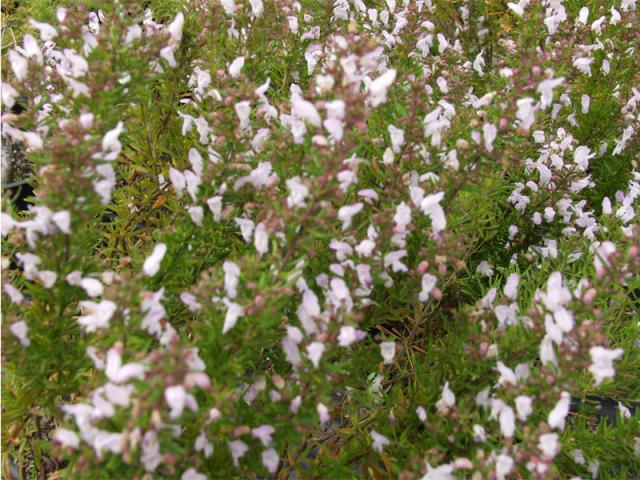
Calamintha georgiana, known as Georgia Calamint or Georgia savory, is a small, aromatic, semi-evergreen shrub of dry, sandy woods and clearings in the southeastern Coastal Plain and lower Piedmont. In late summer and fall it covers itself with small, two-lipped, pale lavender-pink to nearly white flowers speckled with purple, and its tiny, minty-scented leaves release their fragrance when brushed. It belongs to the mint family (Lamiaceae).
USDA PLANTS accepts the name Clinopodium georgianum for this species, and some recent floras use Clinopodium carolinianum. Nurseries, the Atlas of Florida Plants and most gardeners still call it Calamintha georgiana, which is the name used on this page. All three names refer to the same plant.
Georgia calamint is listed as Endangered by the state of Florida (FDACS Regulated Plant Index), where it grows only in a few counties of the Panhandle. Elsewhere in its range it is more frequent. It is one of the best small native shrubs for dry, sunny gardens in the Southeast: compact, aromatic, drought-tolerant and covered with bees and butterflies in fall. Buy nursery-propagated plants, which are widely available, and never dig or collect plants from the wild.
Identification
Georgia calamint is easy to recognize in flower: a low, twiggy shrub smothered in small, pale, spotted, two-lipped flowers, with tiny paired leaves that smell of mint.
Stems & Habit
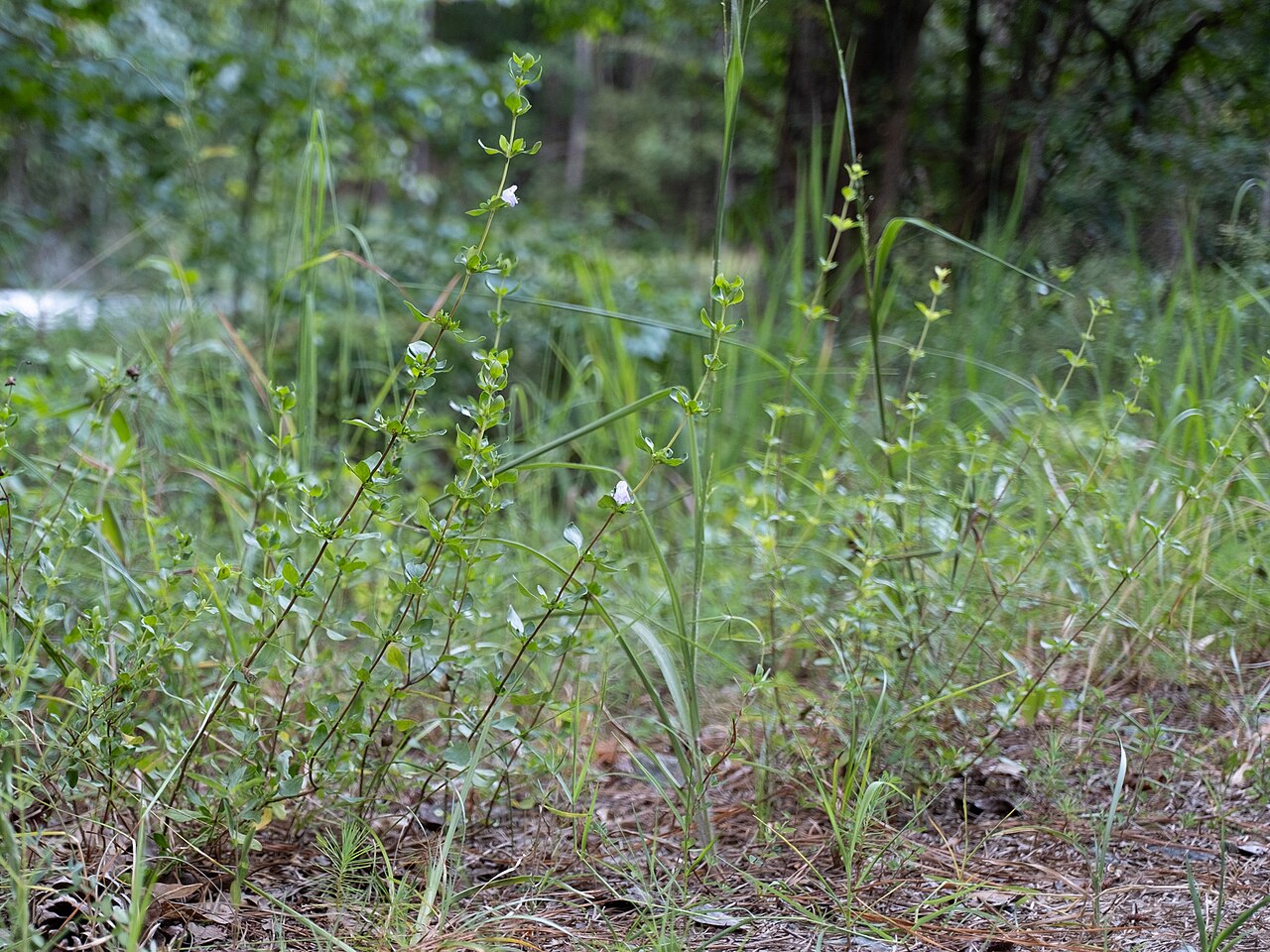
It is a small, much-branched shrub, usually 1 to 2 feet tall and wide, sometimes to 3 feet in cultivation. The stems are thin and wiry, woody at the base, and square in cross-section near the tips like other mints. In the wild, plants are often open and sparse. In gardens with full sun, they form dense, rounded mounds.
Leaves
The leaves are opposite, small (about ¼ to ¾ inch long), narrowly oval to oblong, with smooth or slightly toothed edges. They are gray-green to dark green and finely dotted with oil glands, which release a sweet, minty fragrance when crushed. Plants are semi-evergreen: some leaves remain through mild winters, and others drop in cold weather.
Flowers
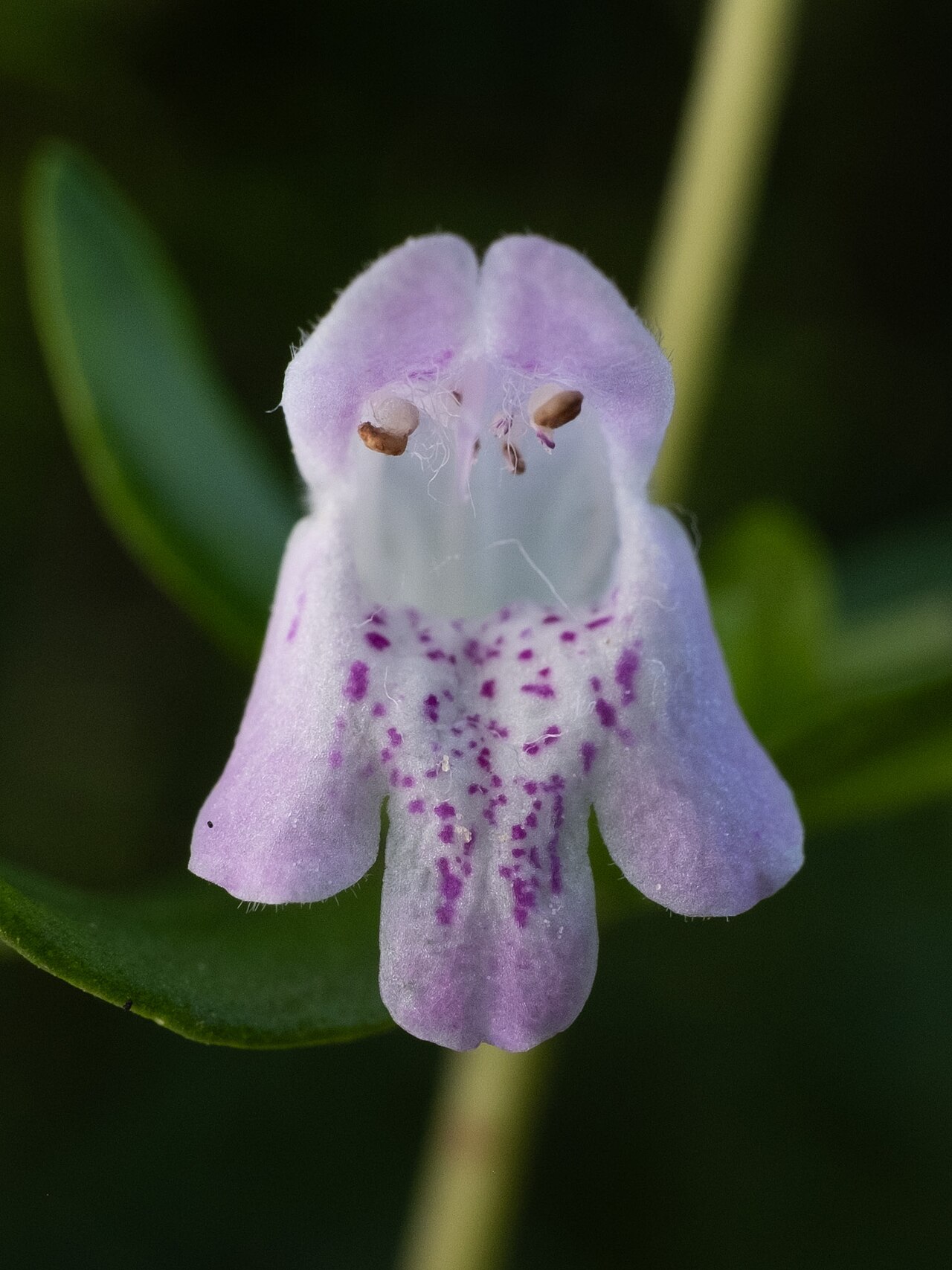
Flowering is mainly from late summer into fall, roughly July through October, with scattered flowers as early as June. The flowers grow in small clusters in the leaf axils along the upper branches. Each is about ½ to ¾ inch long, tubular, with two lips: an upper lip that is notched and a lower lip with three lobes. They are pale lavender-pink to nearly white, and the lower lip is marked with purple spots.
Fruit
Each flower produces up to four tiny, smooth, brown nutlets inside the persistent calyx. They ripen in fall and fall near the parent plant. The plant is more often propagated from cuttings than from seed.
Quick Facts
| Scientific Name | Calamintha georgiana (syn. Clinopodium georgianum, Clinopodium carolinianum) |
| Family | Lamiaceae (mint family) |
| Plant Type | Small semi-evergreen aromatic shrub |
| Mature Height | 1–2 ft (to about 3 ft in gardens) |
| Mature Spread | 1–2 ft |
| Growth Rate | Moderate |
| Sun Exposure | Full sun to part shade |
| Water Needs | Low; drought tolerant once established |
| Soil Type | Well-drained sand or sandy loam |
| Soil pH | About 5.0–6.5 (acidic) |
| Bloom Time | Late summer to fall (mainly July–October) |
| Flower Color | Pale lavender-pink to white, spotted purple |
| Fall Color | None; semi-evergreen |
| Fruit | Tiny brown nutlets |
| Deer Resistant | Yes; aromatic foliage is seldom browsed |
| USDA Hardiness Zones | 7–9 |
Native Range
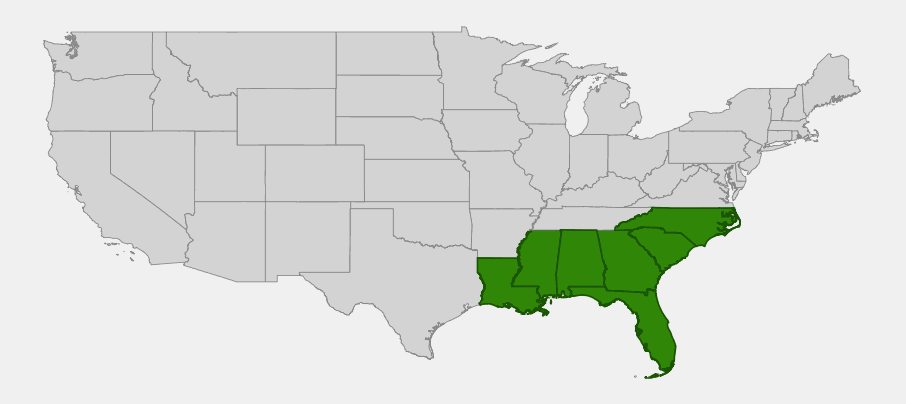
Georgia calamint is native to the southeastern United States. USDA PLANTS records it from North Carolina, South Carolina, Georgia, Florida, Alabama, Mississippi and Louisiana. It is most frequent on the Coastal Plain and lower Piedmont of Georgia, South Carolina and Alabama, and becomes rarer toward the edges of its range.
In Florida it is known only from a few counties in the Panhandle, and it is listed as Endangered by the state of Florida (FDACS Regulated Plant Index). Florida populations are small and scattered, so plants in the state should never be disturbed or collected.
It grows in dry, sandy or rocky soils in open places: sandhills, dry pine and oak woodlands, wooded slopes and bluffs, and sunny edges such as roadsides and clearings. Like many plants of these habitats, it does best where periodic fire or other disturbance keeps the canopy open. Habitat loss and dense growth of shrubs and trees after fire suppression are the main threats to wild populations.
📋 Regional plant lists featuring Georgia Calamint: North & South Florida · Alabama, Georgia & Mississippi · North & South Carolina · Arkansas, Louisiana, Eastern Oklahoma & Eastern Texas
Growing & Care Guide
Georgia calamint is an easy, rewarding shrub for dry, sunny gardens. Because it is state-listed as Endangered in Florida, buy only nursery-propagated plants. It is widely sold by native plant nurseries, so there is no reason to collect it, and wild plants should never be dug or collected.
Light
Give it full sun to part shade. It blooms most heavily and stays compact in full sun. In more shade, plants become open and leggy.
Soil & Water
Above all, it needs good drainage. Sandy or gravelly soils are ideal, and it tolerates poor, dry soil. Heavy clay or wet soil causes root rot. Water regularly while it becomes established, then only in extended droughts. Do not fertilize, which makes plants floppy and short-lived.
Planting Tips
Plant in spring or fall, spacing plants 1½ to 2 feet apart. In heavy soil, plant on a mound or slope, or amend with coarse sand or gravel. Avoid thick mulch around the stem, which can trap moisture.
Pruning & Maintenance
Lightly shear or trim the plant after flowering or in late winter to keep it compact and encourage new growth. Do not cut into old, bare wood, which may not resprout. Plants can be short-lived in rich or wet soils, so take a few cuttings occasionally to keep it going in your garden.
Propagation
Softwood cuttings root easily in late spring or early summer, and this is how most nurseries propagate it. Seed can also be sown in fall, though germination may be uneven. Propagate only from legally purchased, nursery-grown plants.
Landscape Uses
- Pollinator gardens: late-season nectar for bees, butterflies and other insects
- Rock and dry gardens: thrives in sandy or gravelly, well-drained soil
- Low borders and edging: compact, aromatic shrub for the front of beds
- Sandhill and pine woodland restoration: within its native range, using propagated stock
- Fragrance gardens: minty leaves release their scent when brushed
Wildlife & Ecological Value
Georgia calamint is one of the most valuable late-season nectar plants of dry southeastern woodlands.
For Pollinators
The flowers attract a wide range of bees, including bumblebees, carpenter bees and many smaller native bees, as well as butterflies, skippers and bee flies. The purple spots on the lower lip act as nectar guides. Blooming from late summer into fall, it provides nectar for pollinators preparing for winter and for migrating butterflies.
For Birds
Birds do not eat much of the plant, but they forage for the insects it attracts. Dense plants provide some cover for small ground-dwelling birds.
For Mammals
The aromatic foliage is rarely browsed by deer or rabbits, making it a good choice for gardens with heavy browsing pressure.
Ecosystem Role
Georgia calamint is part of the diverse shrub and herb layer of fire-maintained sandhills and dry pine-oak woodlands. Its late flowers fill a gap in nectar supply. Like other plants of these habitats, it depends on open, sunny conditions maintained by fire or other disturbance.
Cultural & Historical Uses
The species was first described by the botanist Roland Harper in the early 20th century, from Georgia, which is recorded in the name Clinopodium georgianum Harper. It has been placed in Calamintha, Satureja and Clinopodium by different botanists, reflecting long debate about how these closely related mint genera should be divided.
The leaves have a pleasant, minty fragrance, much like the European calamints grown as culinary and tea herbs. There is little written record of its use by Native Americans.
Today Georgia calamint is widely grown by native plant gardeners and is grown on display at public gardens such as Mt. Cuba Center in Delaware. Its compact size, fragrance and late flowers make it a popular choice for native pollinator gardens in the Southeast and beyond.
Frequently Asked Questions
Is Georgia calamint endangered?
It is listed as Endangered by the state of Florida (FDACS Regulated Plant Index), where it grows only in a few Panhandle counties. It is more frequent in Georgia, South Carolina and Alabama. Buy nursery-propagated plants, and never dig or collect plants from the wild.
Is Calamintha georgiana the same as Clinopodium georgianum?
Yes. USDA PLANTS uses Clinopodium georgianum, some recent floras use Clinopodium carolinianum, and nurseries and the Atlas of Florida Plants generally use Calamintha georgiana. They are all the same plant.
Does Georgia calamint attract pollinators?
Yes. It is covered with bees, butterflies and other insects when it blooms in late summer and fall, and it is one of the best small native shrubs for a pollinator garden.
Why did my Georgia calamint die?
The most common cause is poor drainage. It needs sandy or gravelly, well-drained soil and does not tolerate wet or heavy clay. Overwatering and fertilizer also shorten its life.
How big does Georgia calamint get?
Most plants reach 1 to 2 feet tall and wide, sometimes up to 3 feet in a garden. A light trim after flowering or in late winter keeps them compact.

Looking for a nursery that carries Georgia Calamint?
Browse our native plant nursery directory: Alabama · Florida & Georgia · Louisiana & Mississippi · North Carolina · South Carolina