
Moundlily Yucca (Yucca gloriosa)
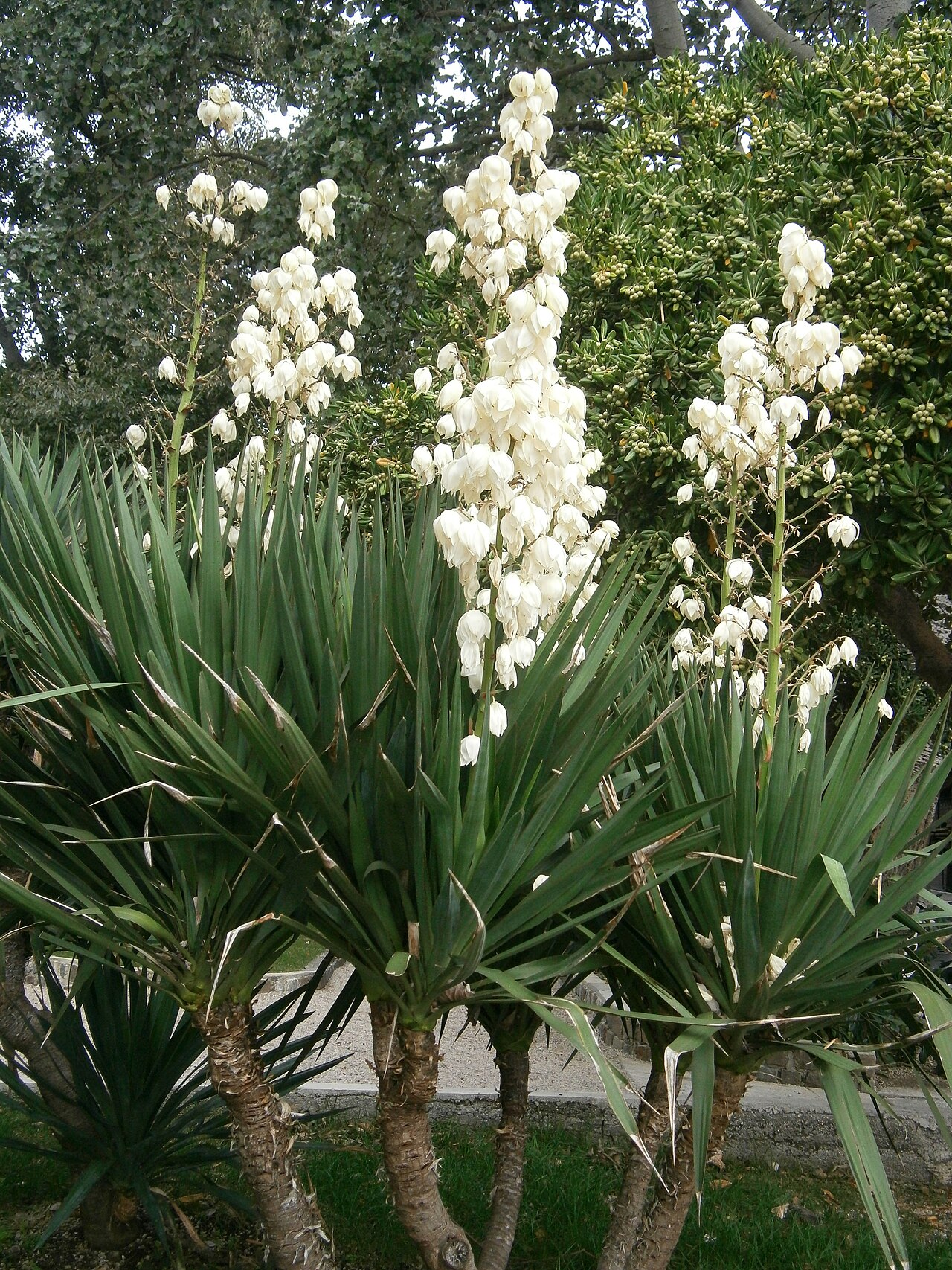
Yucca gloriosa, known as Moundlily Yucca, Spanish dagger or Lord’s candle, is a robust evergreen yucca of the southeastern Atlantic coast. It forms one or several short, stout trunks, usually 3 to 8 feet tall, each topped by a dense rosette of stiff, sword-shaped, blue-green leaves. From late summer into fall (and sometimes in spring) it sends up spikes of nodding, creamy white, bell-shaped flowers, often tinged reddish purple on the outside. Botanists have placed it in the agave family (Agavaceae, now usually included in Asparagaceae).
In the wild, moundlily yucca is a rare plant of coastal dunes, the edges of maritime forest and the borders of brackish marshes, from North Carolina to the northeastern tip of Florida. It is listed as Endangered by the state of Florida (FDACS Regulated Plant Index), where it is confined to a few coastal sites. Paradoxically, it is also one of the most widely planted yuccas in the world. It has been grown in European gardens since the 1500s and is cultivated today from Britain to Australia.
If you garden in Florida or anywhere in its native range, buy nursery-propagated plants and never dig or collect yuccas from the wild. This guide covers how to tell moundlily yucca from its look-alikes, including Adam’s Needle, Spanish bayonet and the Texas Spanish Dagger (Yucca treculeana), where it grows, how to grow it, and its remarkable partnership with the yucca moth.
Identification
Several large yuccas grow along the southeastern coast, and they are often confused in gardens and in the trade. The shape and texture of the leaves are the most reliable clues.
Trunks & Habit
Moundlily yucca has one or a few short, thick trunks, usually 3 to 8 feet tall, that branch slowly and may lean or sprawl with age. New shoots sprout from the base, so old plants form a mound or clump several feet across, which is the origin of the name “moundlily.” Old, dead leaves hang down against the trunk in a skirt unless they are removed.
Leaves
The leaves are 1 to 2½ feet long and 1½ to 3 inches wide, flat to slightly folded, smooth and blue-green to gray-green. Each ends in a sharp point, but the leaves are more flexible than those of Spanish bayonet (Yucca aloifolia), and older leaves often bend or droop near the middle. The margins are smooth or very finely toothed and turn brown or yellowish with age. They do not have the curly white threads of Adam’s needle. A form with leaves that curve backward, often sold as Yucca recurvifolia or Y. gloriosa var. recurvifolia, is common in gardens on the Gulf Coast.
Flowers
The flower stalk rises from the center of a rosette and carries an upright, branched panicle 2 to 5 feet long, densely packed with hundreds of nodding flowers. Each flower is a bell 2 to 4 inches long made of six waxy, creamy white tepals, often blushed with reddish purple on the outside. The Lady Bird Johnson Wildflower Center lists September to November as the main bloom season, and plants in cultivation often bloom in early summer as well.
Fruit & Seeds
Pollinated flowers produce leathery, cylindrical, six-sided capsules about 2 to 3 inches long that hang down and do not split open readily. They contain flat black seeds. In many places, especially outside its native range, the plant sets little or no fruit because its specialized moth pollinator is absent.
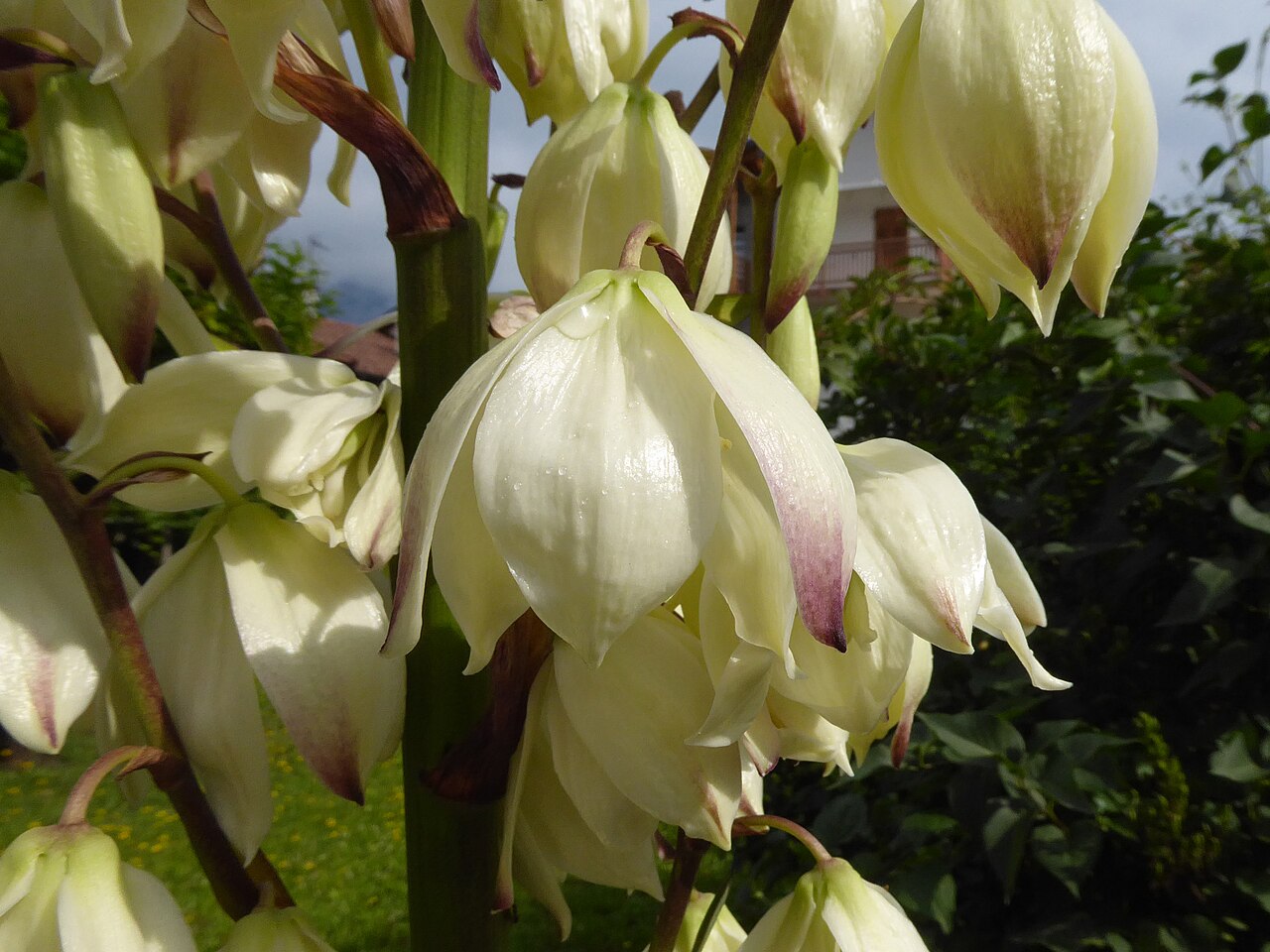
Quick Facts
| Scientific Name | Yucca gloriosa (incl. var. recurvifolia) |
| Family | Agavaceae (agave family; now often placed in Asparagaceae) |
| Plant Type | Evergreen shrub with short trunks and leaf rosettes |
| Mature Height | 3–8 ft (flower stalks add 2–5 ft) |
| Mature Spread | 3–6 ft; clumps can grow wider |
| Growth Rate | Slow to moderate |
| Sun Exposure | Full sun; tolerates light shade |
| Water Needs | Low; very drought tolerant once established |
| Soil Type | Well-drained sand or sandy loam; tolerates salt spray |
| Soil pH | About 5.5–8.0 |
| Bloom Time | Mainly September–November; sometimes spring or early summer |
| Flower Color | Creamy white, often tinged reddish purple |
| Fall Color | None; evergreen |
| Fruit | Leathery, hanging, six-sided capsule with flat black seeds |
| Deer Resistant | Yes; the stiff, pointed leaves are seldom browsed |
| USDA Hardiness Zones | 7–11 |
Native Range
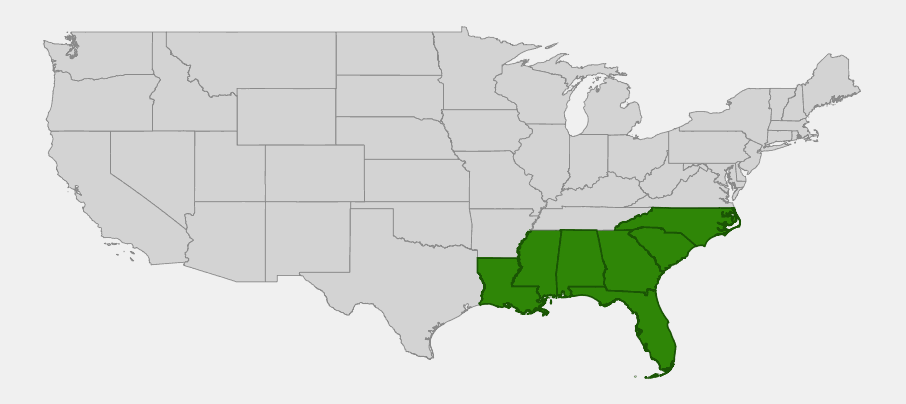
Moundlily yucca is native to the southeastern coastal plain of the United States. The Lady Bird Johnson Wildflower Center describes its native range as northeastern North Carolina to southeastern Georgia and extreme northeastern Florida, near sea level, and notes that it is rare and local. USDA PLANTS lists it as native in Alabama, Florida, Georgia, Louisiana, Mississippi, North Carolina and South Carolina, and as introduced in Puerto Rico.
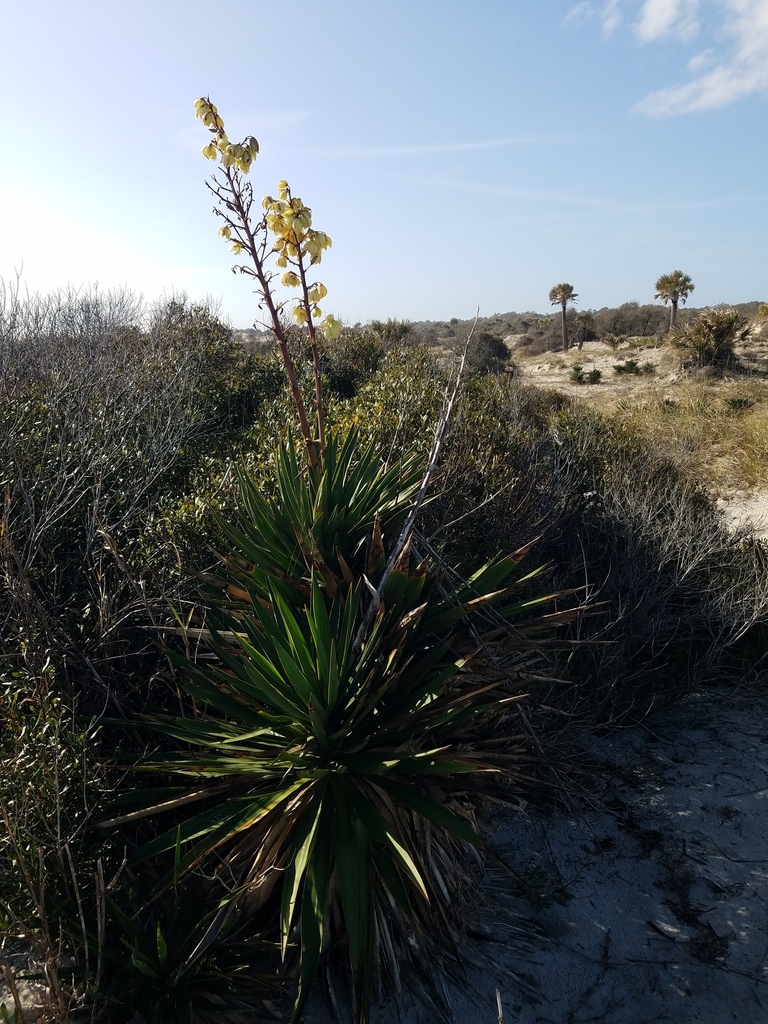
Its stronghold is the barrier islands and coastal dunes of the Carolinas and Georgia, such as Hilton Head, Kiawah, Jekyll and Cumberland islands, where it grows on stabilized back dunes, shell mounds and the sunny edges of maritime forest and brackish marshes. In Florida it reaches only the northeast coast, and it is listed as Endangered by the state of Florida (FDACS Regulated Plant Index). Gulf Coast records from Alabama, Mississippi and Louisiana are mostly of the recurved-leaf form (var. recurvifolia), which some botanists treat as a separate species. Because the plant has been grown in gardens for centuries, some populations near towns may be of planted or escaped origin.
Coastal development, dune erosion and the loss of open, sunny dune habitat have reduced the wild populations. Planting nursery-grown moundlily yucca in coastal landscapes within its range is a good way to enjoy it. Wild plants should be left where they grow, and in Florida, taking or disturbing a state-listed plant without the landowner’s permission is against the law.
📋 Regional plant lists featuring Moundlily Yucca: North & South Florida · Alabama, Georgia & Mississippi · North & South Carolina · Arkansas, Louisiana, Eastern Oklahoma & Eastern Texas
Growing & Care Guide
Moundlily yucca is one of the easiest and most durable yuccas for southeastern gardens, and it is widely available from nurseries. Because it is listed as Endangered in Florida, buy only nursery-propagated plants and never dig or collect plants from the wild. It thrives on neglect in hot, sunny, sandy and salty sites where many other plants struggle.
Light
Plant it in full sun for the most compact form and best flowering. It tolerates partial shade, but in shade plants grow lanky and lean and flower less.
Soil & Water
Good drainage is essential: sand, sandy loam or gravelly soil is ideal, and plants rot in heavy, wet clay or poorly drained spots. It is highly tolerant of salt spray and wind, and it can be planted on the front lines of oceanfront landscapes. Water regularly the first season, then rarely if at all. No fertilizer is needed.
Planting Tips
Plant in spring or early fall. Set the plant at the same depth it grew in the pot, and mound sand around it in heavy soils to improve drainage. Because the leaf tips are sharp (though softer than those of Spanish bayonet), keep it at least 3 to 4 feet back from walkways, doors and places where children play.
Pruning & Maintenance
Remove old, brown leaves from the base of the rosette if you want a tidier look, and cut the flower stalk at its base after flowering or after the seed pods ripen. Wear gloves and eye protection. Old, leaning trunks can be cut back. They usually resprout from the base, and the cut pieces can be rooted.
Propagation
Moundlily yucca is easily propagated from offsets, which can be separated from the base of older plants, and from trunk or stem cuttings, which root readily in sandy soil after the cut end has dried for a few days. It can also be grown from seed, which germinates readily but grows slowly.
Landscape Uses
- Coastal landscapes: an exceptionally salt- and wind-tolerant accent plant for oceanfront properties within its native range
- Dune and xeriscape gardens: pairs well with sea oats, muhly grass and other drought-tolerant coastal natives
- Architectural accent: a bold, sculptural form for containers, courtyards and modern plantings
- Barrier plantings: the stiff, pointed leaves discourage foot traffic along property lines
- Pollinator and wildlife gardens: supports the yucca moth and provides shelter for small animals
Wildlife & Ecological Value
Moundlily yucca is a good example of one of the most famous partnerships in the plant world: the yucca and the yucca moth.
For Pollinators
Yuccas are pollinated by yucca moths (Tegeticula species). The eastern yucca moth, Tegeticula yuccasella, visits moundlily yucca at night. A female moth gathers pollen into a ball with special mouthparts, flies to another flower, lays eggs in the ovary and then deliberately packs pollen onto the stigma. Some of the developing seeds feed her caterpillars, and the rest mature. Neither partner can complete its life cycle without the other. Bees and other insects visit the flowers, too, but they are not effective pollinators.
For Birds
Songbirds such as mockingbirds and wrens nest and perch in or near the dense rosettes, which protect them from predators.
For Mammals
The leaves are too tough and sharp for most browsers. Small mammals and reptiles shelter among the leaf bases and fallen leaves. Deer may eat the flower stalks.
Ecosystem Role
On stabilized dunes, moundlily yucca helps hold sand with its deep, fibrous root system and its dense clumps, and it provides shelter for dune animals. Its decline is due mainly to the loss and disturbance of coastal dune habitat.
Cultural & Historical Uses
Moundlily yucca was one of the first North American plants grown in European gardens. Plants from the Carolina coast were growing in English gardens by the end of the 1500s. Carl Linnaeus described it in 1753, and its name gloriosa refers to its glorious display in flower. Since then it has been cultivated across the temperate and subtropical world, and several variegated garden forms are popular.
Native Americans of the Southeast used yucca leaves for fiber to make cord, baskets and mats, and the roots of several species were used as soap. The flowers of many yuccas are edible when cooked, though the plant should not be eaten without expert knowledge.
The common names “Spanish dagger” and “Lord’s candle” are shared with other yuccas, so they can cause confusion. On PlantNative, the Spanish dagger of Texas and Mexico, Yucca treculeana, has its own page. Using the scientific name helps you buy the plant you intend.
Frequently Asked Questions
Is moundlily yucca endangered?
It is listed as Endangered by the state of Florida (FDACS Regulated Plant Index), where it grows naturally only on the northeast coast. It is rare and local throughout its natural range, though widely planted in gardens. Buy nursery-propagated plants and never dig or collect them from the wild.
How is moundlily yucca different from Spanish bayonet?
Spanish bayonet (Yucca aloifolia) has rigid, dagger-sharp, dark green leaves with finely toothed edges and grows taller and more trunked. Moundlily yucca has softer, smooth-edged, blue-green leaves that often droop, making it safer near paths.
Does moundlily yucca die after flowering?
No. Unlike agaves, the rosette continues to grow after flowering and blooms again in later years. Clumps produce new rosettes from the base over time.
Why doesn’t my yucca produce seed pods?
Moundlily yucca needs the yucca moth for pollination. If no yucca moths live nearby, the flowers usually fall without setting fruit. This is common in gardens and almost always the case outside North America.
Is moundlily yucca safe for coastal gardens?
Yes. It is one of the most salt-spray- and wind-tolerant plants for coastal gardens in the Southeast. Give it sun and sharp drainage, and place it where its pointed leaves won’t injure passersby.

Looking for a nursery that carries Moundlily Yucca?
Browse our native plant nursery directory: Alabama · Florida & Georgia · Louisiana & Mississippi · North Carolina · South Carolina