
Necklace Pod (Sophora tomentosa)
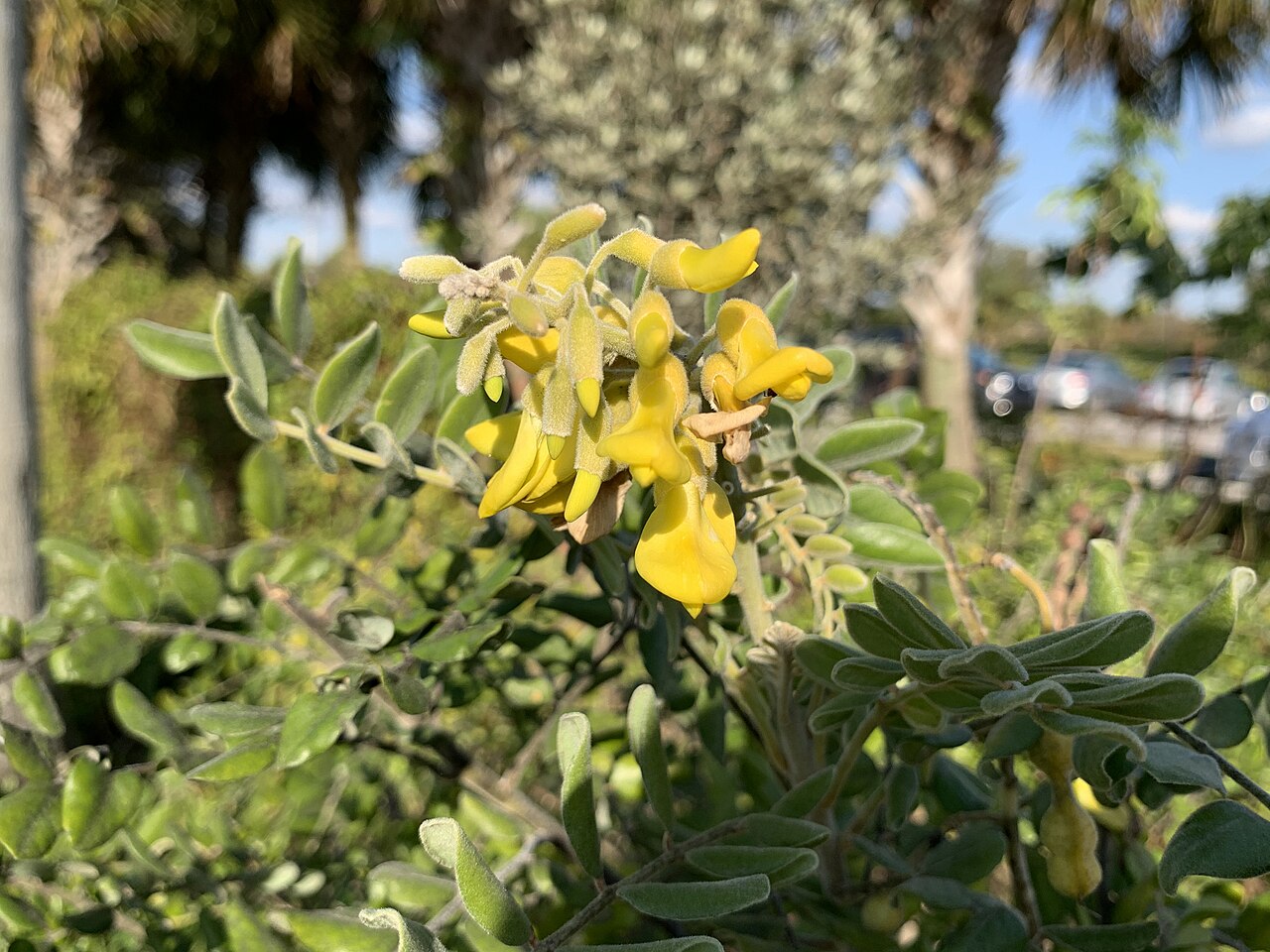
Sophora tomentosa, known as Necklace Pod and listed by USDA PLANTS as yellow necklacepod, is a coastal shrub of the pea family (Fabaceae) with soft, silvery-green foliage and spikes of bright yellow, pea-like flowers. It is named for its seed pods, which are pinched tightly between each seed so that they hang from the branches like strings of beads. The species name tomentosa means “densely hairy,” a reference to the fine, felt-like hairs that cover the leaves, stems and pods.
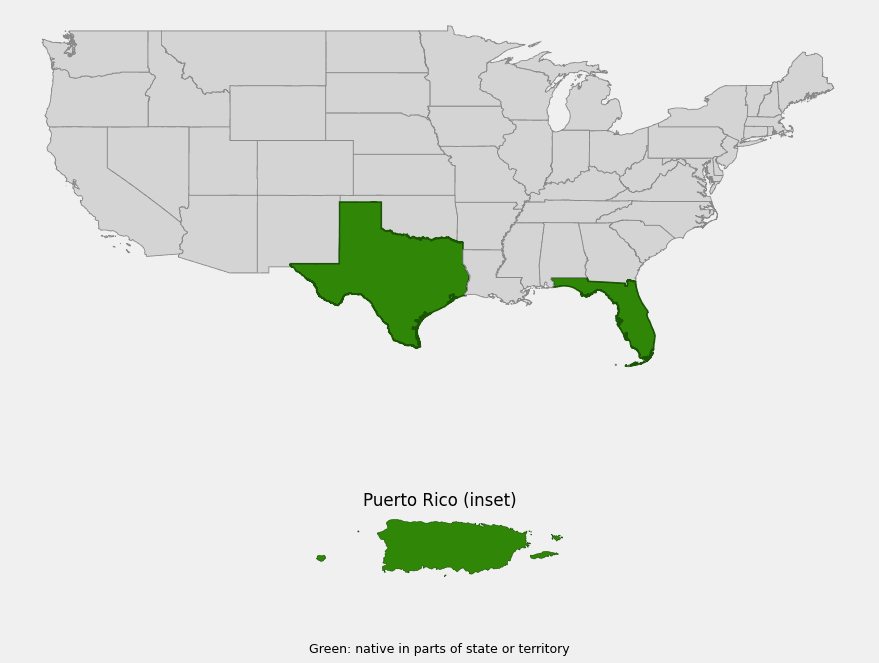
Necklace pod is native to Puerto Rico and the U.S. Virgin Islands, to the coasts of central and south Florida, and to the south Texas coast, and the species as a whole grows along tropical and subtropical shores around the world. It is a tough, salt-tolerant plant of beach dunes, coastal strand, shell mounds and the edges of coastal hammocks, and it blooms on and off for much of the year. Bees, butterflies and hummingbirds visit the flowers.
Because it handles sun, salt spray, sandy soil and drought, necklace pod is one of the most useful native shrubs for seaside gardens in Puerto Rico, South Florida and the Texas coast. This guide covers how to identify it, where it grows, how to grow it, and what to know about its poisonous seeds.
Identification
Necklace pod is easy to recognize at any time of year: few coastal shrubs combine fuzzy, silvery compound leaves with yellow pea flowers and bead-like pods, and old pods often hang on the plant while new flowers open.
Growth Form
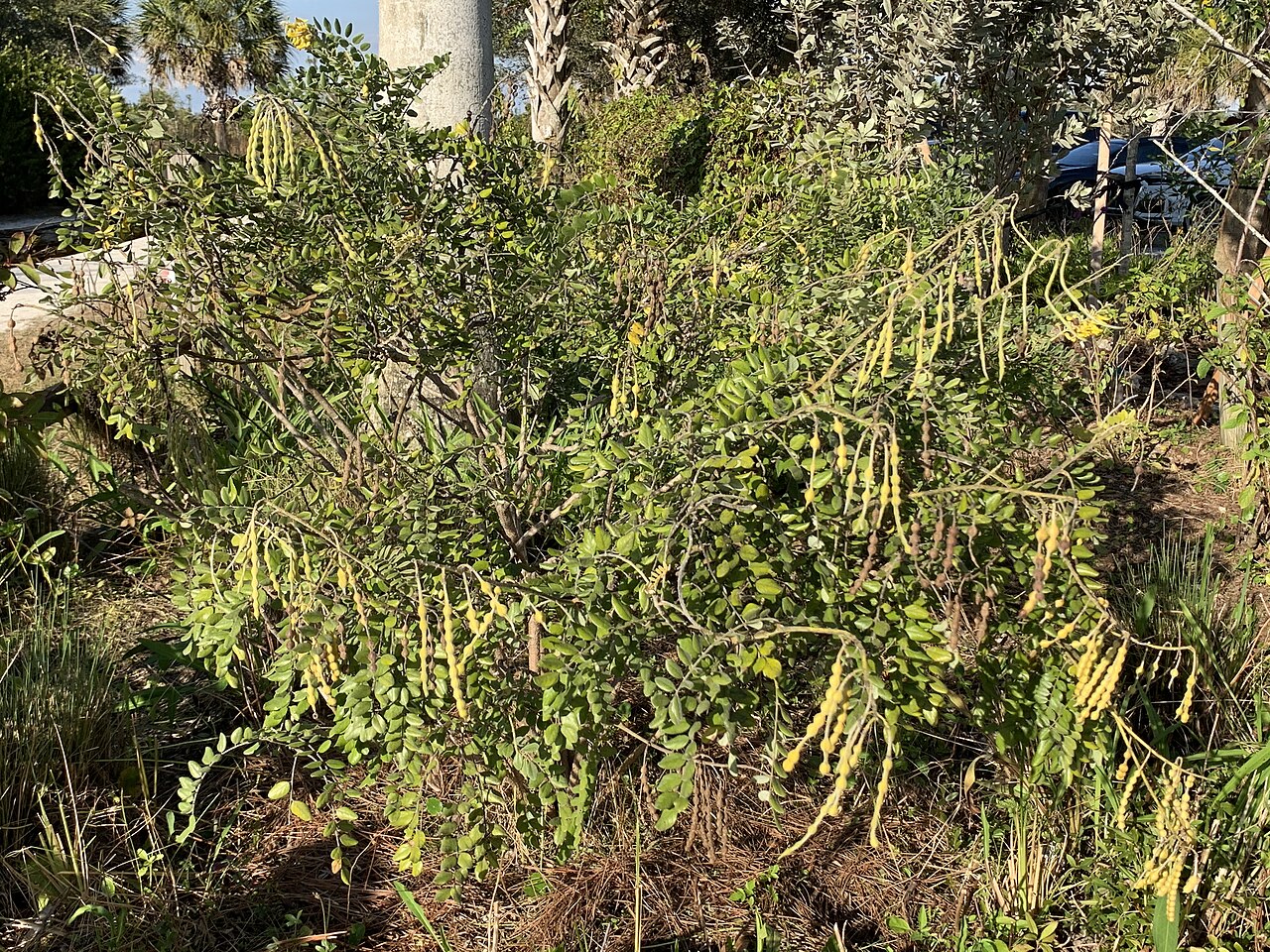
Necklace pod is a loose, multi-stemmed, rounded shrub, usually 3 to 10 feet tall and about as wide, occasionally trained as a small tree. Young stems are greenish and covered with velvety hairs. Near the beach, wind and salt spray keep plants low and dense; in sheltered spots they grow taller and more open.
Leaves
The leaves are pinnately compound, with numerous rounded to oval leaflets arranged along a central stalk. Leaflets are thick and soft, densely covered with fine hairs that give the foliage a gray-green to silvery look, especially on new growth and on the undersides. Plants in Florida and Puerto Rico, treated by USDA as var. truncata, are typically quite silvery.
Flowers
Bright yellow, pea-like flowers are borne on upright spikes (racemes) at the branch tips; the Lady Bird Johnson Wildflower Center describes the spikes as 4 to 16 inches long. The Lady Bird Johnson Wildflower Center lists bloom from March to October, and in frost-free areas such as Puerto Rico and South Florida plants can flower sporadically through much of the year.
Fruit & Seeds
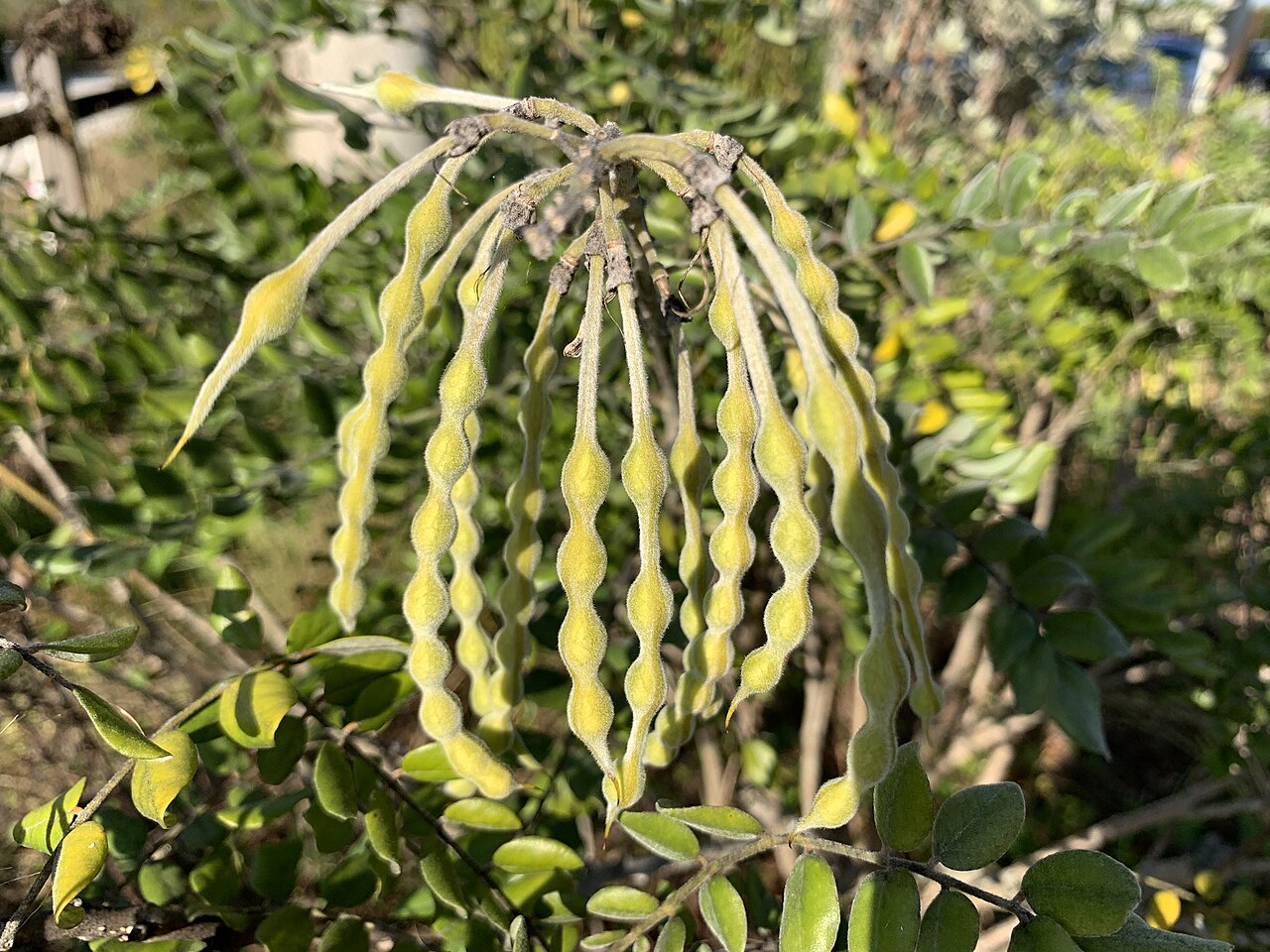
The pods are several inches long, hairy, yellow-green when young and tan to brown when dry, and they are strongly constricted between the seeds, giving the classic “necklace” look. Each pod holds several round, hard, yellowish-brown seeds. Pods often stay on the shrub for months. Like the seeds of several other Sophora species, the seeds contain toxic alkaloids and should never be eaten.
Quick Facts
| Scientific Name | Sophora tomentosa (USDA common name: yellow necklacepod; vars. truncata and occidentalis) |
| Family | Fabaceae (pea or legume family) |
| Plant Type | Evergreen shrub or small tree |
| Mature Height | 3–10 ft |
| Mature Spread | 3–8 ft |
| Growth Rate | Moderate to fast |
| Sun Exposure | Full sun to part shade |
| Water Needs | Low; drought tolerant once established |
| Soil Type | Well-drained sand, shell or sandy loam; salt tolerant |
| Soil pH | About 6.0–8.5 (tolerates alkaline coastal sand) |
| Bloom Time | March–October; sporadically year-round in frost-free areas |
| Flower Color | Bright yellow |
| Fall Color | None; evergreen |
| Fruit | Hairy pods constricted between seeds like a necklace; seeds poisonous |
| Deer Resistant | Generally not browsed |
| USDA Hardiness Zones | 10–12; to about 9 with freeze dieback |
Native Range
USDA PLANTS lists necklace pod as native to the lower 48 states, Puerto Rico, the U.S. Virgin Islands and the Pacific Basin. In the continental U.S. it grows naturally in only two states. In Florida, the Atlas of Florida Plants maps it from coastal counties in the central and southern part of the state, and the variety found there, var. truncata, was first described from Tampa Bay in 1834. In Texas, the Lady Bird Johnson Wildflower Center records it as infrequent along and near the coast of south Texas, north to Aransas County, where USDA treats the plants as var. occidentalis.
In Puerto Rico and the Virgin Islands, USDA lists necklace pod (as var. truncata) as native. As elsewhere in the Caribbean, it is a plant of the coast: sandy beaches and dunes, coastal thickets and scrub, rocky shores and the edges of dry coastal forest, where it tolerates salt spray, wind and intense sun.
The species as a whole is pantropical, found on seashores in the Americas, Africa, Asia, Australia and the Pacific islands, which makes it one of the most widespread coastal legumes in the world. Its buoyant pods and hard seeds help it spread along coastlines. It is sometimes planted in Hawaii, but it is not among the plants native to Hawaii.
📋 Regional plant lists featuring Necklace Pod: Puerto Rico · North & South Florida · South & West Texas
Growing & Care Guide
Necklace pod is an easy, low-maintenance shrub for sunny, sandy, coastal gardens. In Puerto Rico, the Virgin Islands, South Florida, the Florida Keys and Hawaii it grows outdoors year-round. In central Florida and along the south Texas coast it can be grown outdoors but may be frozen back in cold winters; the Lady Bird Johnson Wildflower Center notes that in Texas it usually freezes to the ground each winter and regrows from the base. Farther north it is a container plant to bring indoors before frost.
Light
Plant in full sun for the densest growth and the most flowers. It tolerates part shade, but becomes leggy and blooms less in heavy shade.
Soil & Water
Necklace pod needs excellent drainage and does well in poor sandy or shelly soil, limestone soils and coastal sand. It is highly salt tolerant and can be planted on the front line of dunes. Water regularly until established; after that, it is very drought tolerant and seldom needs irrigation except in long dry spells. Avoid soggy, poorly drained spots. Fertilizer is rarely needed because, like many legumes, it thrives in lean soils.
Planting Tips
Use it as a specimen, in a mixed native hedge, or massed on a dune or berm. Space plants 4 to 6 feet apart. Its silvery foliage combines well with the darker greens of sea grape, cocoplum and other coastal natives. Because the seeds are poisonous, consider where children play before planting it near patios or play areas.
Pruning & Maintenance
Necklace pod can become open and leggy with age. Prune lightly after a flush of flowering to keep it compact, or cut it back harder in late winter to rejuvenate it. Remove old pods if you want a tidier look or want to keep seeds out of reach. Watch for caterpillars and scale insects, which occasionally feed on the foliage; plants usually recover without treatment.
Propagation
Grow it from seed. The Lady Bird Johnson Wildflower Center recommends collecting seeds when the pods begin to dry and the seeds turn reddish, then scarifying them (nicking or filing the hard seed coat) before sowing in warm soil. Soaking dry pods in warm water makes the seeds easier to remove. Cuttings can also be rooted. Wear gloves and wash hands after handling seeds.
Landscape Uses
- Seaside and dune gardens: one of the best native shrubs for salt spray, wind and sand on the front line of the coast
- Pollinator and hummingbird gardens: long-blooming yellow flowers for bees, butterflies and hummingbirds
- Xeriscape and low-water plantings: drought tolerant once established in sandy or limestone soils
- Informal hedges and screens: combine with sea grape, cocoplum and other coastal natives
- Coastal restoration: dune and coastal strand plantings within its native range
Wildlife & Ecological Value
Necklace pod is a small but valuable part of coastal plant communities. Its long bloom season provides nectar when few other beach plants are flowering, and its dense, salt-tolerant growth helps shelter wildlife and hold sand in place.
For Pollinators
The bright yellow flowers are visited by bees, butterflies and moths, and in the tropics and subtropics by hummingbirds. The Lady Bird Johnson Wildflower Center lists it as a nectar source for bees, butterflies and moths.
For Birds
Hummingbirds feed at the flowers, and the dense shrub provides cover for birds along the coast, including migrants resting after a flight over open water. The seeds are poisonous and are not an important food for birds.
For Mammals
The hairy foliage and toxic seeds make necklace pod unattractive to browsing mammals, and it has little direct food value for them.
Ecosystem Role
Like most legumes, necklace pod forms partnerships with nitrogen-fixing bacteria in root nodules, which lets it grow in nutrient-poor beach sand and enriches the soil around it. Its roots help stabilize dunes, and its floating pods and hard seeds allow it to colonize new stretches of shoreline.
Cultural & Historical Uses
Linnaeus named Sophora tomentosa in 1753. The genus Sophora includes dozens of species, among them the Texas mountain laurel (Sophora secundiflora) and Hawaii’s māmane (Sophora chrysophylla). Necklace pod’s Florida variety, var. truncata, was described by John Torrey and Asa Gray in 1840 from a specimen collected at Tampa Bay in 1834.
Around the world, necklace pod has been used in traditional medicine, and in some regions its toxic seeds and roots have reportedly been used as fish poison. Because the seeds contain toxic alkaloids, none of these uses should be tried at home.
In Florida, necklace pod became popular in native landscaping in recent decades, and native plant organizations recommend it for coastal and low-water gardens. It is just as valuable in Puerto Rico and the Virgin Islands, where it suits hotel grounds, seaside homes and public beach plantings that need a tough, flowering native shrub.
Frequently Asked Questions
Is necklace pod poisonous?
Yes. The seeds contain toxic alkaloids and should never be eaten. Keep children and pets from chewing on pods or seeds, and wash your hands after handling them.
Can necklace pod grow right on the beach?
Yes. It is highly tolerant of salt spray, wind and sandy soil, and it is one of the best native shrubs for the front line of dunes and coastal gardens in Puerto Rico, South Florida and the Texas coast.
Where can necklace pod be grown outdoors in the U.S.?
Year-round in Puerto Rico, the U.S. Virgin Islands, Hawaii, South Florida and the Keys (USDA zones 10–12). In central Florida and along the south Texas coast it grows outdoors but may be frozen back in cold winters. Elsewhere, grow it in a container and bring it inside before frost.
What is the difference between the Florida and Texas necklace pods?
USDA treats Florida, Puerto Rico and Virgin Islands plants as var. truncata and south Texas plants as var. occidentalis. Both are coastal shrubs with yellow flowers and bead-like pods.
How fast does necklace pod grow?
It grows moderately fast in full sun and can reach flowering size in a year or two from seed. Light pruning after flowering keeps it compact.

Looking for a nursery that carries Necklace Pod?
Our nursery directory does not yet include Puerto Rico. Browse the native plant nursery directory by state: Alabama–Arkansas · California · Colorado–Hawaii · Idaho–Kansas · Kentucky–Montana · Nebraska–Oklahoma · Oregon · Pennsylvania–Virginia · Washington · West Virginia–Wyoming