
Hammock Fern (Blechnum occidentale)
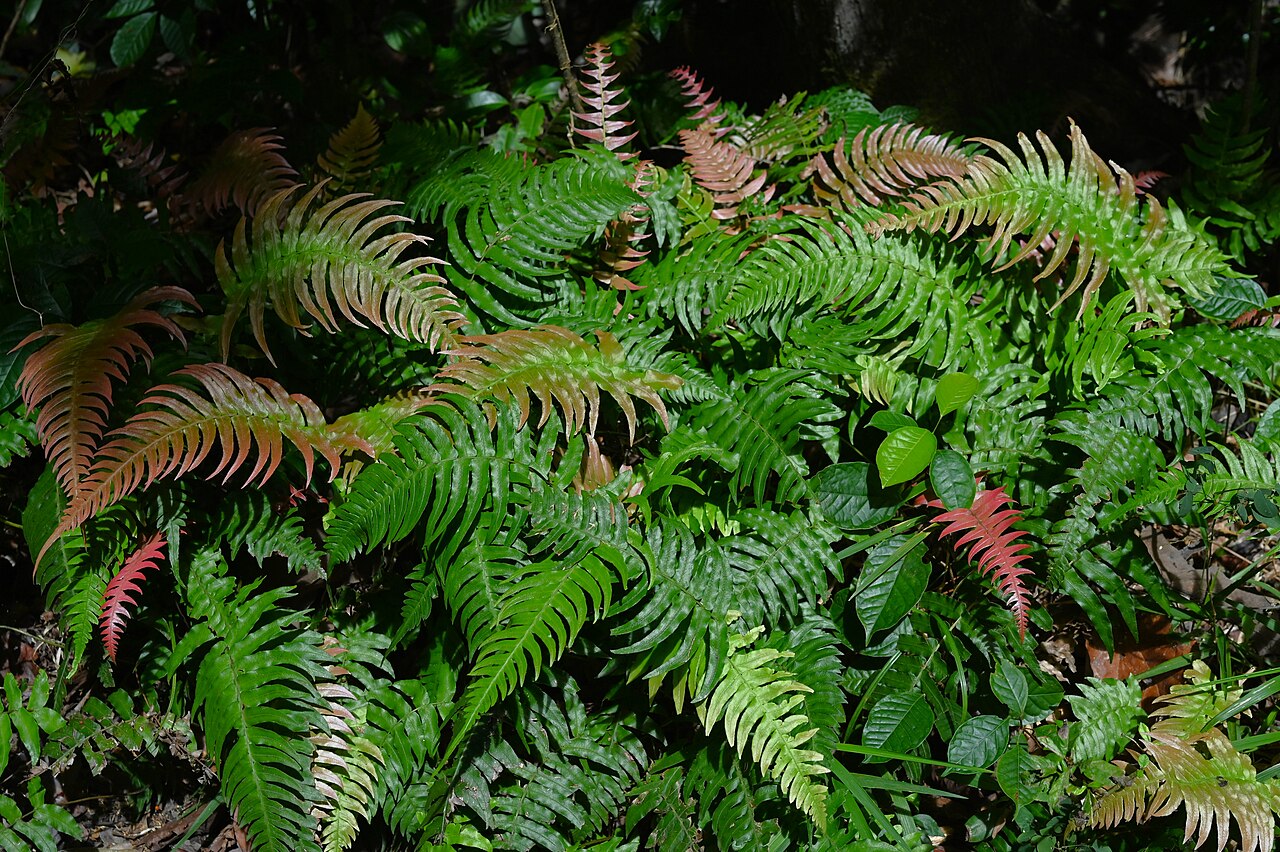
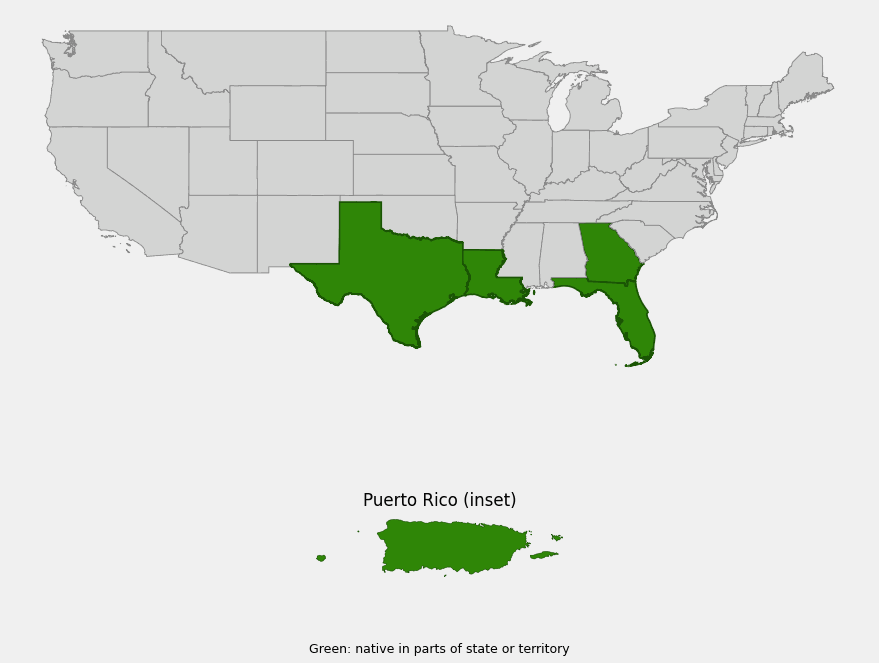
Blechnum occidentale, known as Hammock Fern or sinkhole fern, is a small, colony-forming fern of the American tropics with a habit that gardeners love: its new fronds unroll in shades of pink, copper and red before turning a glossy green. It belongs to the chain fern family (Blechnaceae). USDA PLANTS lists it as native in Puerto Rico, the U.S. Virgin Islands and four mainland states, Florida, Georgia, Louisiana and Texas, and as introduced in Hawaii. In Puerto Rico it grows on the forest floor and on limestone and serpentine slopes in forests such as El Yunque, Maricao, Río Abajo and Susúa.
On the mainland the hammock fern is a rarity. It reaches the northern edge of its range in a handful of shady limestone sinkholes and hammocks in Florida and southern Georgia, and in a small, isolated population in granite crevices at Enchanted Rock in the Texas Hill Country. The Atlas of Florida Plants treats Florida plants as Blechnum occidentale var. minor and lists them as state Endangered. Some recent floras, including the Flora of the Southeastern United States, place mainland plants in the closely related Blechnum appendiculatum; USDA PLANTS keeps them under B. occidentale.
Despite its rarity in the wild, hammock fern is a widely grown and easy garden fern in warm climates. This guide covers how to recognize it, where it grows in Puerto Rico and the mainland, and how to grow nursery-propagated plants in a shady garden.
Identification
Hammock fern is a once-divided fern of medium size, and the reddish color of its young fronds is the quickest field mark. Mature fronds are green and can look much like several other tropical ferns, so check the arrangement of the spore lines on the underside.
Rhizome & Habit
The fern grows from a short, creeping rhizome that sends out slender underground runners (stolons). New plants arise along the runners, so a single plant gradually becomes a loose colony or a dense patch rather than a single crown. The fronds stand upright to arching, usually 1 to 2 feet long; LBJ Wildflower Center gives fronds up to about 2 feet.
Fronds
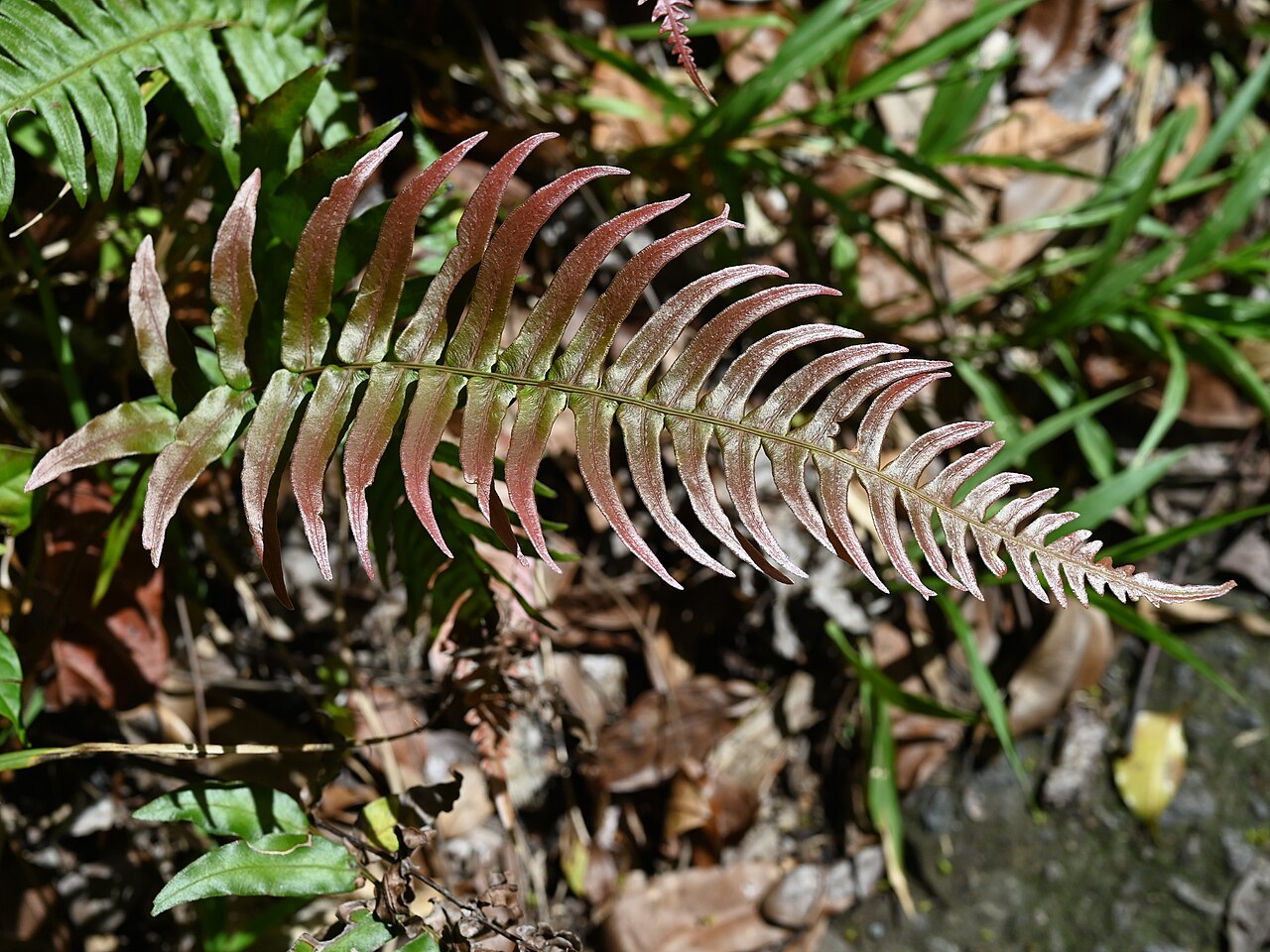
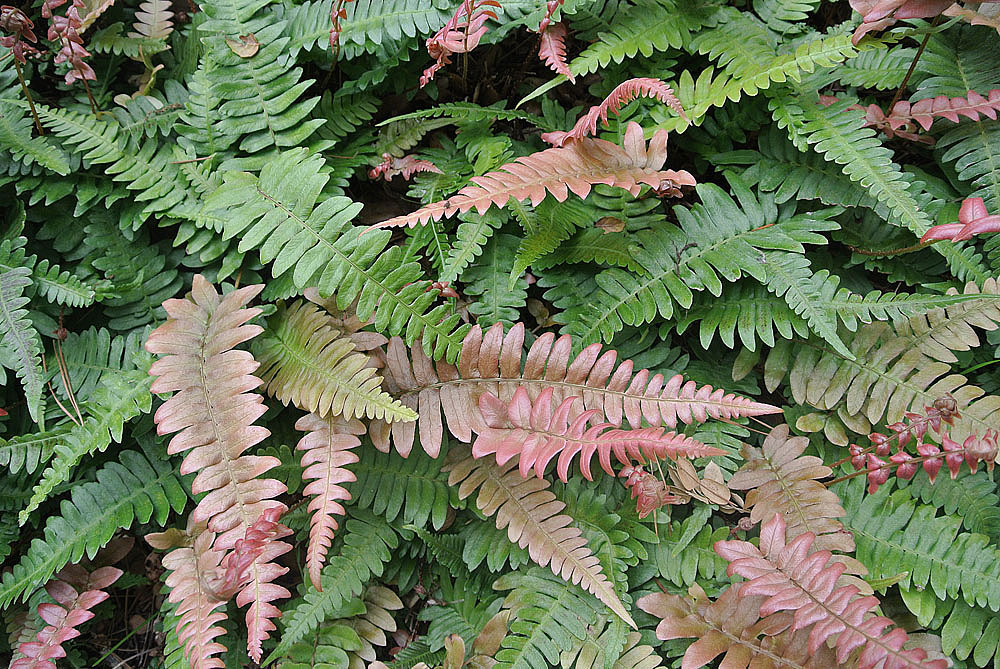
Each frond is pinnate, divided once into a row of narrow, lance-shaped, pointed leaflets (pinnae) attached along the central stalk. The pinnae are smooth-edged or finely toothed, and the lowest pairs are usually a little shorter and may angle slightly downward. New fronds unfold in pink, salmon, copper or wine red, then slowly turn medium to dark green. Plants in good light show the most color; in deep shade the flush is paler.
Sori & Spores
The spore-bearing structures (sori) are a key feature of the chain fern family. On the underside of a fertile pinna, the sori form a continuous line along each side of the midrib, covered at first by a thin flap (indusium) that opens toward the midrib. Hammock fern does not form separate fertile fronds; ordinary green fronds bear the spores.
Similar Species
Swamp fern (Blechnum serrulatum, now often called Telmatoblechnum serrulatum) is a much larger relative of wet, sunny Florida marshes and swamps, with fronds 2 to 5 feet long and finely toothed pinnae. Giant sword fern and Boston fern (Nephrolepis) have many more, smaller pinnae and round, separate sori near the leaflet margins. Ornamental Brazilian tree fern relatives (Blechnum brasiliense and others) form trunks or large crowns, unlike the low, running hammock fern.
Quick Facts
| Scientific Name | Blechnum occidentale L.; USDA common name: hammock fern (Florida plants: var. minor) |
| Family | Blechnaceae (chain fern family) |
| Plant Type | Evergreen terrestrial fern, spreading by runners |
| Mature Height | 1–2 ft (frond length) |
| Mature Spread | 1–3 ft; slowly forms wider colonies |
| Growth Rate | Moderate |
| Sun Exposure | Partial shade to full shade |
| Water Needs | Moderate; keep evenly moist |
| Soil Type | Moist, humus-rich soil; limestone, sandy or rocky ground with leaf litter |
| Soil pH | Slightly acid to alkaline; grows on limestone in the wild |
| Bloom Time | Does not flower; produces spores |
| Flower Color | None (fern) |
| Fall Color | None; evergreen, with pink to red new fronds |
| Fruit | None; reproduces by spores and runners |
| Deer Resistant | Generally; ferns are rarely browsed |
| USDA Hardiness Zones | 8b–11 (native populations persist in sheltered sites at the cold end) |
Native Range
Hammock fern is a widespread tropical American species. Wikipedia gives its native range as Mexico through Central America and the Caribbean to tropical South America, and the Institute for Regional Conservation (IRC) adds the southeastern United States and the Lesser and Greater Antilles. USDA PLANTS lists it as native in the lower 48 states (Florida, Georgia, Louisiana and Texas), Puerto Rico and the U.S. Virgin Islands, and as introduced in Hawaii, where it has naturalized.
In Puerto Rico it is a terrestrial fern of moist forests. IRC records it in El Yunque National Forest in the Luquillo Mountains, Maricao and Susúa state forests in the west, and Río Abajo State Forest in the northern karst region, on limestone and karst as well as on the serpentine soils of Maricao and Susúa. It is most often seen on shaded slopes, banks and trail cuts at low to middle elevations. In Florida it is very rare: herbarium records come mainly from limestone sinkholes and rocky hammocks in Hernando, Pasco and Alachua counties, and IRC reports a single South Florida population, first found in 2000 in Fakahatchee Strand Preserve State Park (Collier County). The Florida Natural Areas Inventory lists the sinkhole fern among the rare ferns of moist limestone outcrops. The Atlas of Florida Plants lists Florida plants as var. minor, state Endangered.
Outside Florida, mainland records are few and scattered. There are herbarium specimens from Echols County in southern Georgia. In Texas the fern is known from Enchanted Rock in Llano County, where botanists collected it in the 1970s and 1980s in moist, shady crevices at the base of granite boulders on the Hill Country’s famous granite dome. The Flora of the Southeastern United States notes a single Louisiana collection from bottomland hardwoods in Iberville Parish; because that record is an isolated collection rather than an established regional population, PlantNative does not include the fern on its Arkansas and Louisiana list.
📋 Regional plant lists featuring Hammock Fern: Puerto Rico · North & South Florida · Alabama, Georgia & Mississippi · South & West Texas
Growing & Care Guide
Hammock fern is one of the easier tropical ferns to grow. It is sold by fern specialists and many tropical nurseries, usually as plants grown from spores or divisions. Because wild mainland populations are tiny and protected in Florida as an Endangered species, buy nursery-propagated plants only and never dig ferns from sinkholes, hammocks or rock outcrops.
Light
Give it partial to full shade, such as the light under tall trees or the north side of a house. A few hours of soft morning sun bring out the reddest new growth, but hot afternoon sun scorches the fronds. In Puerto Rico’s bright lowlands, plant it in the shadiest spot available; in the mountains it tolerates more light.
Soil & Water
Use moist, well-drained soil rich in leaf mold or compost. In the wild it grows on limestone, serpentine and granite, so it is not fussy about pH. Keep the soil evenly moist; established colonies tolerate short dry spells, but long droughts brown the fronds. It is not salt tolerant and should be kept away from salt spray.
Planting Tips
Plant divisions or potted plants at the same depth they grew, spacing them 12 to 18 inches apart for a groundcover. Mulch with leaf litter rather than wood chips. In northern Florida, zone 8 and the coldest parts of zone 9, choose a sheltered site under evergreen trees; frost browns the fronds, but the rhizomes usually resprout in spring. Elsewhere grow it in containers and bring it indoors for winter.
Pruning & Maintenance
Cut out old, tattered or frost-damaged fronds at the base in late winter or whenever they look ragged. The runners spread steadily but not aggressively; lift and pot up extra plants if a colony outgrows its spot. Snails and slugs occasionally chew the tender new fronds.
Propagation
Division is quick and easy: in spring, sever young plants from the runners or cut a clump into pieces, each with several fronds and roots. It can also be raised from spores sown on a sterile, moist medium under humid cover, though this is slower.
Landscape Uses
- Shade groundcover: a low, spreading carpet with seasonal pink and red color
- Woodland and hammock gardens: under oaks, palms and native shade trees
- Rock gardens and limestone edges: echoes its natural sinkhole and outcrop habitat
- Containers: on shaded patios, or as a houseplant where winters are cold
- Puerto Rico native gardens: a native fern for shady yards and forest-edge plantings
Wildlife & Ecological Value
Hammock fern is a modest part of the forest-floor layer wherever it grows, but its colonies add cover and structure to shaded ground.
For Pollinators
Ferns reproduce by spores, not flowers, so hammock fern offers no nectar or pollen to bees or butterflies.
For Birds
Dense patches give cover to ground-foraging birds and shelter the insects, spiders and snails that thrushes, wrens and other birds feed on.
For Mammals
It is of little direct food value to mammals. Like most ferns it is seldom eaten by deer.
Ecosystem Role
The spreading runners help bind soil on shaded slopes, banks and rocky ground, and in tropical forests the fern often grows on moist road cuts, banks and trail edges. Its mainland populations are relicts at the edge of the range, valued by botanists as part of the unusual fern flora of Florida sinkholes and Texas granite outcrops.
Cultural & Historical Uses
Linnaeus named Blechnum occidentale in 1753; the name occidentale means “western”, for a plant of the New World. The genus name Blechnum comes from a Greek word for fern. The species has long been treated as a variable complex: botanists now separate several look-alikes, which is why some floras call the mainland plants Blechnum appendiculatum.
The common names reflect Florida habitats. “Hammock fern” refers to the shaded hardwood hammocks of the Florida peninsula, and “sinkhole fern”, the name the Florida Natural Areas Inventory uses, refers to the moist walls of limestone sinkholes where most Florida populations grow. In Texas, the colony on the granite of Enchanted Rock is one of several tropical and southern ferns that survive in the cool, moist crevices of the Hill Country.
In horticulture hammock fern is grown in botanical-garden conservatories around the world, from Chicago to Lisbon, and is valued for its pink new growth and tolerance of indoor conditions. In frost-free areas it is used outdoors as a shade groundcover.
Frequently Asked Questions
Is hammock fern native to Puerto Rico?
Yes. USDA PLANTS lists Blechnum occidentale as native in Puerto Rico and the U.S. Virgin Islands, and IRC records it in El Yunque, Maricao, Río Abajo and Susúa forests.
Why are the new fronds red?
The young fronds contain red pigments (anthocyanins) that fade as the fronds mature and turn green. The color is strongest in bright, indirect light and is a normal feature of the species.
Is hammock fern endangered in Florida?
Yes. The Atlas of Florida Plants lists Florida populations (var. minor) as state Endangered. Buy nursery-propagated plants and never collect from the wild.
Will hammock fern spread in my garden?
It spreads slowly by underground runners into a colony, which makes it a good groundcover. It is easy to keep in bounds by lifting extra plants.
Can I grow hammock fern indoors?
Yes. It does well as a houseplant or greenhouse plant in bright, indirect light with evenly moist soil and good humidity.

Looking for a nursery that carries Hammock Fern?
Our nursery directory does not yet include Puerto Rico. Browse the native plant nursery directory by state: Alabama–Arkansas · California · Colorado–Hawaii · Idaho–Kansas · Kentucky–Montana · Nebraska–Oklahoma · Oregon · Pennsylvania–Virginia · Washington · West Virginia–Wyoming