
Rue Anemone (Thalictrum thalictroides)
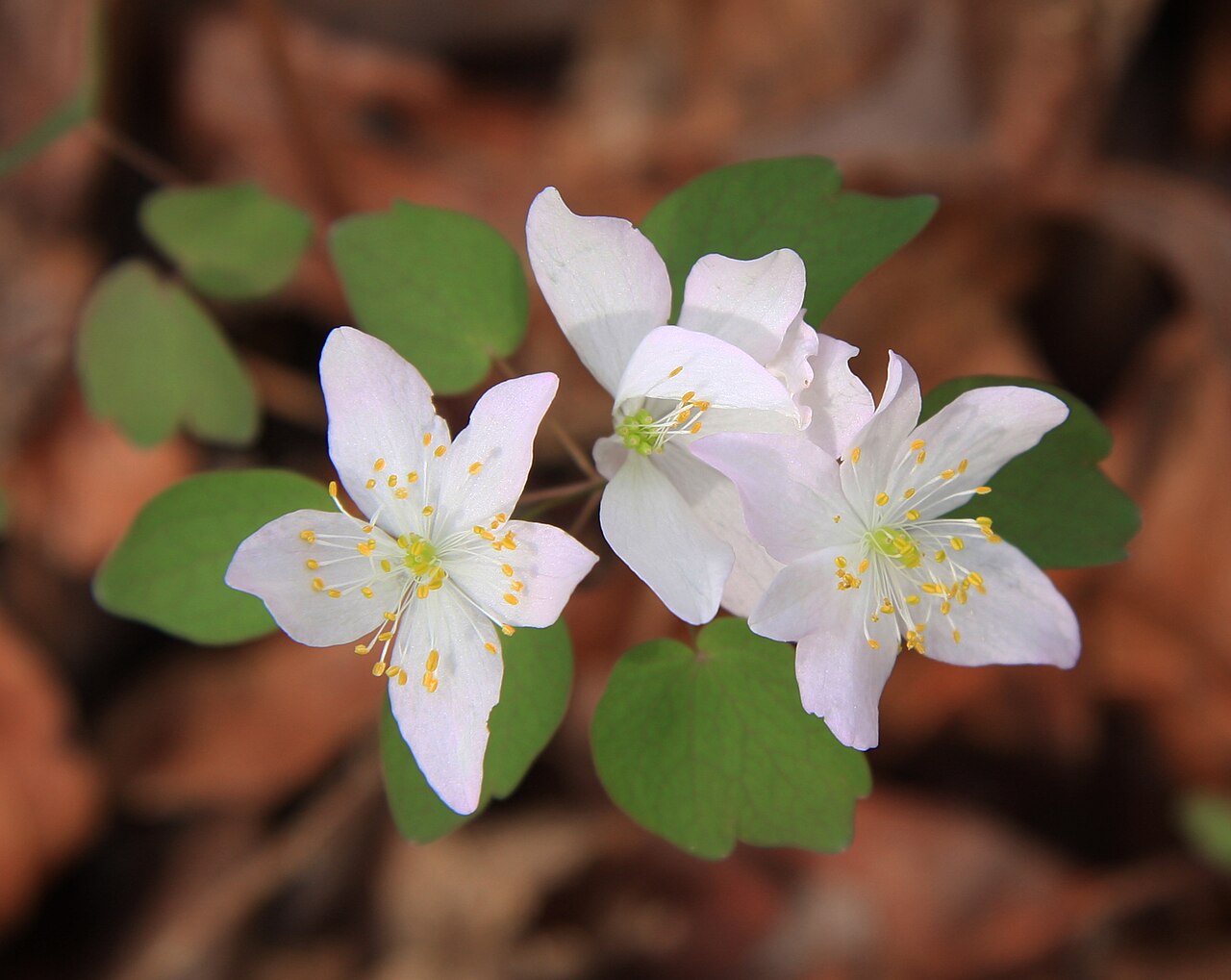
Thalictrum thalictroides, known as Rue Anemone, is one of the daintiest spring wildflowers of eastern North American woodlands. From a small cluster of tuberous roots it sends up wiry, purplish stems 4 to 9 inches tall, topped by a whorl of rounded, three-lobed leaflets and a small cluster of white to soft pink flowers about an inch across. It belongs to the buttercup family (Ranunculaceae) and grows in open deciduous and mixed woods, on wooded slopes and bluffs, and along shaded stream banks.
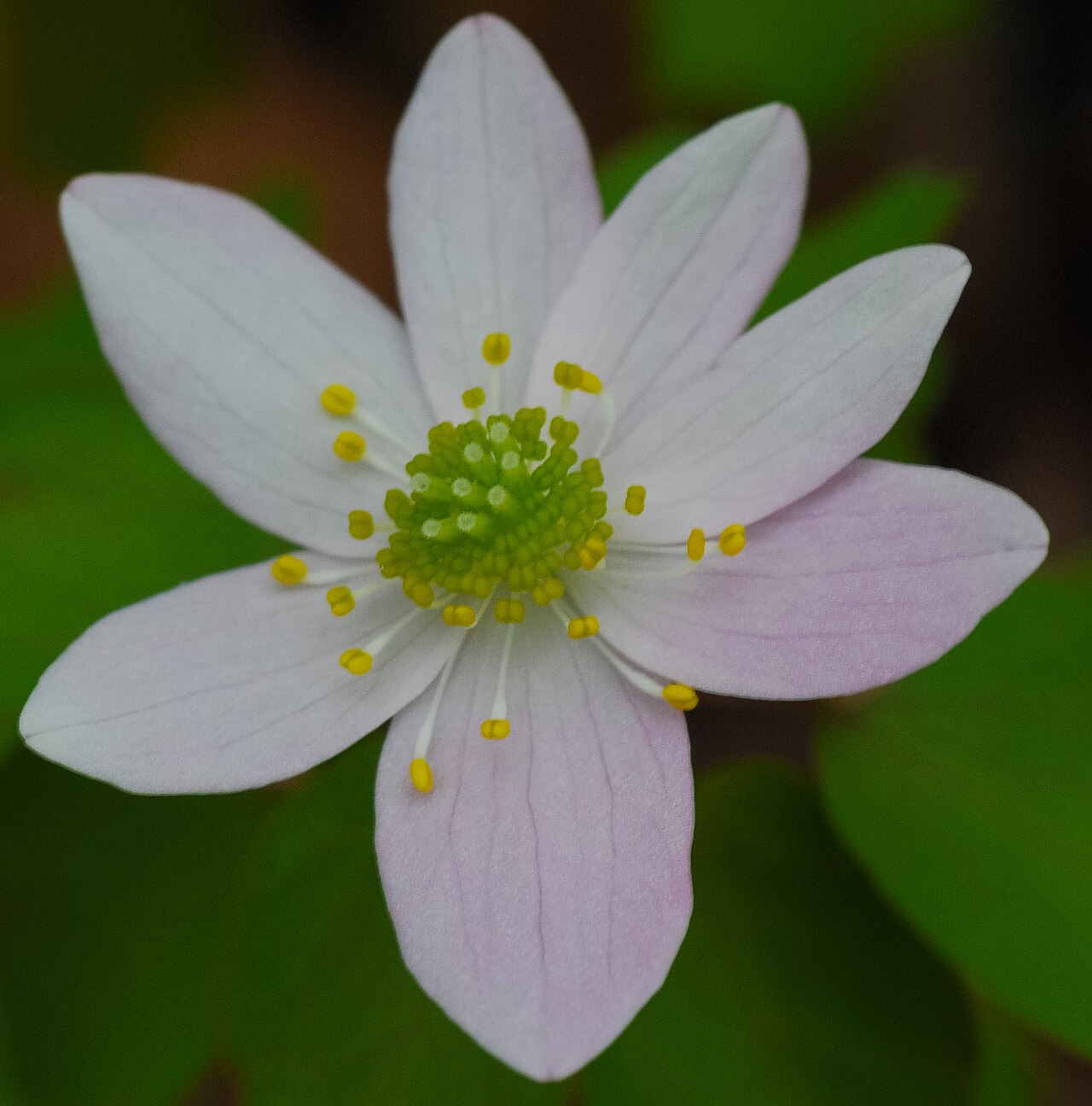
Rue anemone blooms early, often in March in the South and April or May in the North, and it keeps flowering for several weeks, far longer than most spring ephemerals. Its flowers have no true petals. The five to ten white or pink “petals” are sepals, and the green center is a cluster of pistils ringed by many yellow-tipped stamens. The plant offers pollen but little or no nectar, and small native bees and flies visit it on cool spring days when few other flowers are open.
For many years botanists placed it in its own genus as Anemonella thalictroides, and that name is still common in nurseries and older field guides. Today it is included in Thalictrum, the meadow-rue genus, whose lacy leaves it resembles. This guide covers how to tell rue anemone from its look-alikes, where it grows, how to grow it in a shade garden, and how it fits into the life of a spring woodland.
Identification
Rue anemone is small and delicate, and it often grows mixed with other spring wildflowers that have similar white flowers. Look at the leaves and the number of flowers per stem to identify it with confidence.
Roots & Stems
Each plant grows from a small cluster of thickened, spindle-shaped tuberous roots, a little like a miniature dahlia. The flowering stems are smooth, slender and wiry, green to reddish-purple, and usually 4 to 9 inches tall, occasionally a little taller. Plants form small clumps over the years, and in good sites they spread into loose colonies by self-sown seed.
Leaves
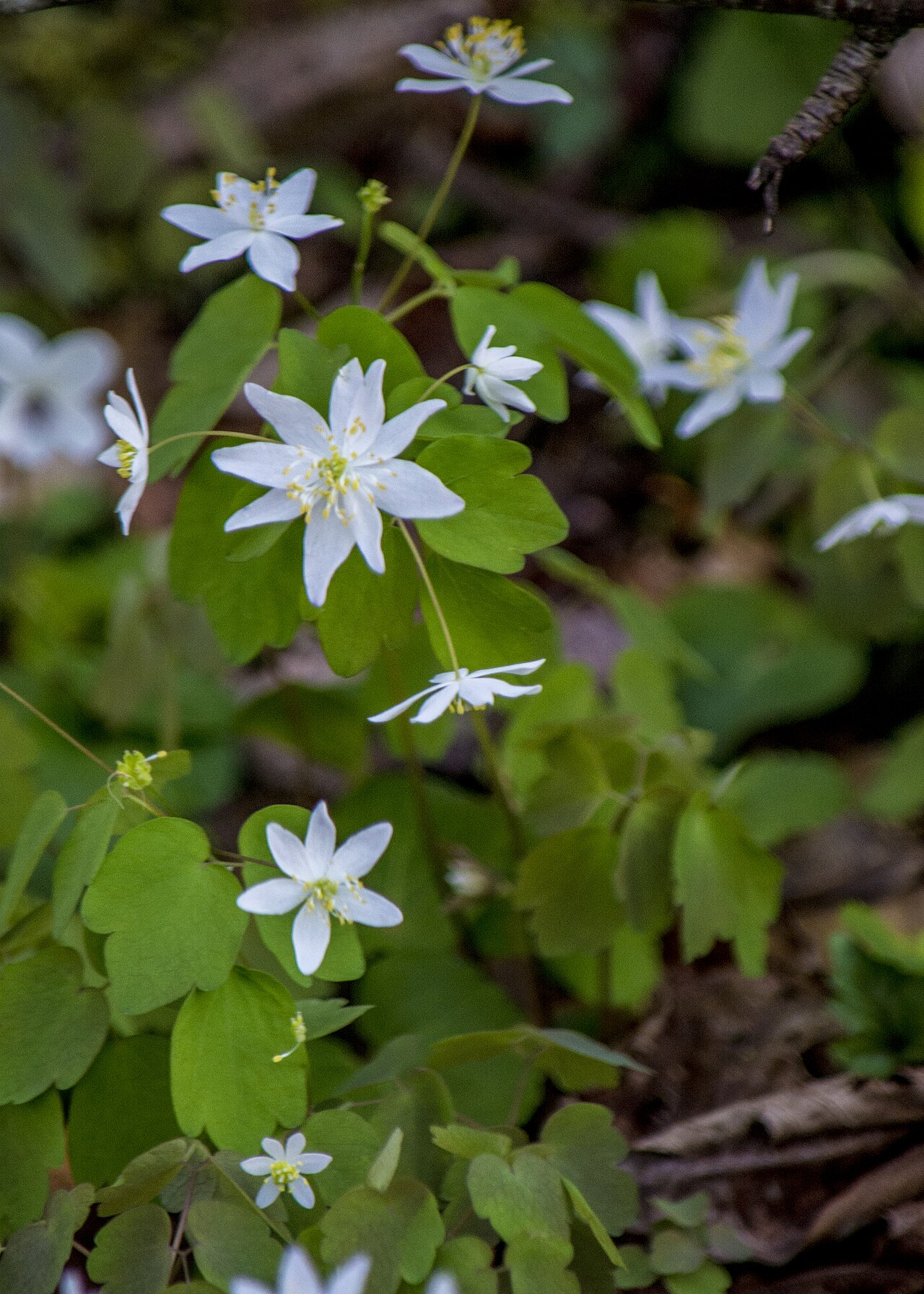
There are two kinds of leaves. Long-stalked basal leaves rise directly from the roots and are divided two or three times into small leaflets. At the top of the flowering stem sits a whorl of leaf-like bracts, each divided into three stalked leaflets. Every leaflet is rounded, about ½ inch long, bluish-green, and shallowly three-lobed at the tip, very like the leaflets of a meadow-rue (Thalictrum) or the herb rue, which is where the common name comes from. Young leaves are often bronzy or purplish.
Flowers
Above the whorl of leaflets, two to six flowers grow on slender stalks in a loose umbel. The central flower usually opens first. Each flower is ½ to 1 inch wide, with five to ten (most often six) oval, petal-like sepals that are white or blushed with pink. The center holds a ring of numerous stamens with pale yellow anthers around a small cluster of green pistils. Pink forms are frequent in some populations, and double-flowered plants occur rarely in the wild.
Flowering runs from about March to May, a little later in the far north, and an individual plant can stay in bloom for three or four weeks.
Fruit & Seeds
Each flower produces a small cluster of 8 to 12 hard, ribbed, seed-like fruits (achenes), each about ⅛ inch long. They ripen in late spring and drop near the parent plant. Soon afterward the foliage yellows and the plant goes dormant, usually by midsummer, especially in dry years.
Look-alikes
False rue anemone (Enemion biternatum) has very similar leaves but always has five white sepals, alternate leaves along the stem rather than a whorl, and usually grows in richer, moister bottomland soils. Wood anemone (Anemone quinquefolia) carries a single flower above a whorl of three deeply toothed, sharply divided leaves. Round-lobed hepatica has leathery three-lobed leaves that last through winter and hairy flower stalks.
Quick Facts
| Scientific Name | Thalictrum thalictroides (syn. Anemonella thalictroides) |
| Family | Ranunculaceae (buttercup family) |
| Plant Type | Herbaceous perennial spring wildflower from tuberous roots |
| Mature Height | 4–9 in |
| Mature Spread | 4–8 in per clump |
| Growth Rate | Slow |
| Sun Exposure | Part shade to full shade (sun in early spring before trees leaf out) |
| Water Needs | Medium; moist in spring, tolerates dry summer dormancy |
| Soil Type | Humus-rich, well-drained woodland loam |
| Soil pH | About 5.5–7.0 (slightly acidic to neutral) |
| Bloom Time | March–May (to June in the north) |
| Flower Color | White to pale pink |
| Fall Color | None; foliage dies back by midsummer |
| Fruit | Small cluster of ribbed achenes |
| Deer Resistant | Generally yes; rarely browsed |
| USDA Hardiness Zones | 4–8 |
Native Range
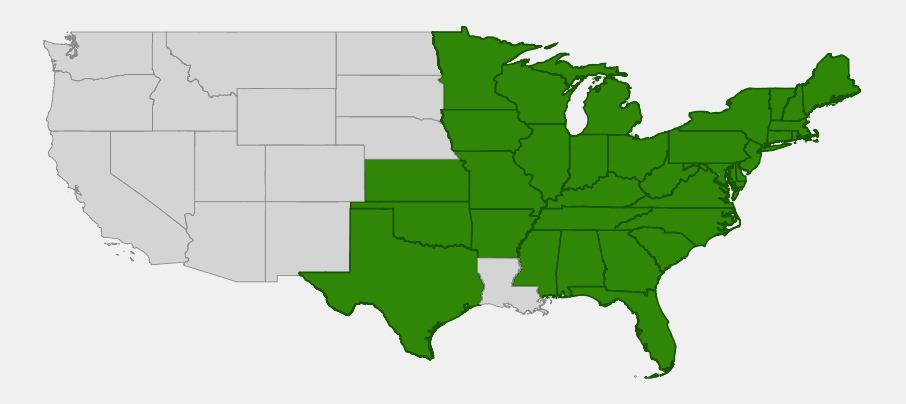
Rue anemone is widespread in the eastern half of the United States. USDA PLANTS records it as native in 33 states and the District of Columbia, from southwestern Maine, Vermont and New Hampshire west through New York, the Great Lakes states and Minnesota, and south to the Florida Panhandle, the Gulf states, Arkansas, eastern Kansas, Oklahoma and Texas. In Canada it is known only from southern Ontario.
It is most common in the Appalachians, the Piedmont, the Ohio Valley and the Ozarks, where it is a familiar part of the spring woodland flora on slopes, ravines and bluffs. At the edges of its range it becomes local: it is uncommon in northern New England, in Florida (where it reaches only the northern Panhandle), and on the western prairie fringe in Kansas, Oklahoma and Texas, where it is confined to wooded ravines and stream valleys.
Within its range it favors well-drained, open hardwood forests of oak, hickory, beech and maple, and it tolerates thinner, drier soils than many spring wildflowers. It is often found on north- and east-facing slopes, on rocky wooded hillsides and along the upper banks of streams, rather than in wet bottomlands.
📋 Regional plant lists featuring Rue Anemone: New York, Pennsylvania & Northern New Jersey · Ohio & Indiana · Michigan, Wisconsin & Eastern Minnesota · Kentucky & Tennessee · Nebraska, Kansas & Eastern Colorado · Connecticut, Massachusetts & Rhode Island · New Hampshire, Maine & Vermont · Maryland, Virginia & West Virginia · Delaware, Southern New Jersey & Long Island · Illinois, Iowa & Missouri · Alabama, Georgia & Mississippi · North & South Florida
Growing & Care Guide
Rue anemone is an easy, long-lived plant for a shady woodland garden, as long as it gets good drainage and is left undisturbed. It is small, so it shows best planted in groups along a path, at the front of a shade border or among rocks where it can be seen up close. Buy nursery-propagated plants; wild plants should be left where they grow.
Light
Give it the conditions of a deciduous forest floor: bright light or even sun in early spring, followed by light to full shade once the trees leaf out. Dappled shade under oaks, maples or other deep-rooted trees is ideal. It struggles in dense evergreen shade and in hot, exposed sun.
Soil & Water
Plant in loose, humus-rich, well-drained soil. Rue anemone dislikes waterlogged ground, especially while dormant, and the tuberous roots can rot in heavy, wet clay. Keep the soil evenly moist from late winter through flowering. Once the plant goes dormant in summer it tolerates dry shade well. A light mulch of shredded leaves mimics the natural forest litter. Fertilizer is unnecessary.
Planting Tips
Set potted plants in early spring or fall, at the same depth they grew in the pot, about 6 to 8 inches apart in small drifts. Mark their positions: the plants disappear by midsummer, and it is easy to dig into dormant clumps by mistake. Good companions are later-emerging ferns, wild ginger, sedges and hostas, which fill the gap left after rue anemone goes dormant.
Pruning & Maintenance
Very little care is needed. Let the foliage yellow and die back naturally, because it feeds the tuberous roots for the next year. Leave fallen leaves in place in autumn. Keep vigorous groundcovers and invasive plants such as garlic mustard and lesser celandine from smothering the clumps.
Propagation
Rue anemone can be grown from seed sown outdoors in fall as soon as it ripens in late spring or early summer, or sown after about three months of cold, moist stratification. Seedlings usually take two or three years to flower. Established clumps can be carefully divided while dormant, keeping several tuberous roots with each piece. Double-flowered cultivars are propagated only by division.
Landscape Uses
- Woodland and shade gardens: a long-blooming early spring flower for dappled shade under deciduous trees
- Rock gardens: tucked into shady pockets between rocks, where the small flowers can be seen up close
- Path edges and front of the border: planted in groups of five or more for a drift of white and pink
- Naturalizing: self-sows slowly into leaf litter to form loose colonies over time
- Early-season pollinator plantings: pollen for small native bees and flies on cool spring days
Wildlife & Ecological Value
Rue anemone is part of the spring ephemeral community that makes the most of the short window of sunlight before the forest canopy closes. Its early, long flowering season makes it more valuable to insects than its small size suggests.
For Pollinators
The flowers produce pollen but little or no nectar. They are visited mostly by small bees, including sweat bees (Halictidae), small carpenter bees and mining bees (Andrena), and by syrphid flies and bee flies looking for pollen. Because rue anemone opens very early and stays in bloom for weeks, it is a reliable pollen source for queens and females provisioning the first nests of the season.
For Birds
Rue anemone has little direct food value for birds. It is part of the leaf-litter flora that supports the spring insects many forest birds feed on.
For Mammals
Deer and rabbits generally leave it alone, probably because of the irritant compounds found in many members of the buttercup family. Small mammals may occasionally eat the tuberous roots.
Ecosystem Role
Like other spring ephemerals, rue anemone takes up nutrients early in the year, before the trees leaf out, and returns them to the soil when its foliage dies back. Its seeds simply fall near the parent plant, so colonies spread slowly, which is one reason the plant is a good indicator of long-undisturbed woodland.
Cultural & Historical Uses
Linnaeus described the plant in 1753 as Anemone thalictroides, “the anemone that looks like a Thalictrum.” It was later moved to its own genus, Anemonella (“little anemone”), and Arthur Eames and Bernard Boivin later transferred it to Thalictrum. That is why its scientific name now repeats itself: the meadow-rue that resembles a meadow-rue. Genetic studies have supported placing it within the meadow-rue group.
Older books sometimes call it windflower, a name shared with true anemones. Some older edible-plant books describe cooking the tubers, but like many buttercup relatives the fresh plant contains irritant compounds that can blister skin and upset the stomach, so it should not be eaten.
Rue anemone has long been a favorite of wildflower gardeners. Selected forms, including double pink and double white plants such as ‘Schoaf’s Double Pink’ and ‘Cameo’, have been grown in rock and woodland gardens for decades. They are slower to increase than the wild form but bloom for even longer.
Frequently Asked Questions
Is rue anemone easy to grow?
Yes, in the right place. Give it light shade under deciduous trees, loose humus-rich soil that drains well, and moisture in spring. Plant nursery-propagated plants and leave them undisturbed; clumps slowly increase for many years.
Why did my rue anemone disappear in summer?
It is a spring ephemeral. The foliage yellows and dies back after the seeds ripen, usually by midsummer, and the plant rests underground as tuberous roots until the next spring. Mark the spot so you do not dig into it.
How do I tell rue anemone from false rue anemone?
Rue anemone has a whorl of leaflets just below a small cluster of flowers with 5 to 10 white or pink sepals. False rue anemone (Enemion biternatum) has alternate leaves along the stem and flowers with exactly five white sepals.
Is rue anemone poisonous?
It belongs to the buttercup family, and the fresh plant contains irritant compounds. The sap can irritate skin, and eating the plant can cause mouth irritation, vomiting and diarrhea. Do not eat it, and keep children and pets from chewing on it.
Does rue anemone attract pollinators?
Yes. Its early, long-lasting flowers supply pollen to sweat bees, mining bees, small carpenter bees and syrphid flies at a time of year when few other flowers are open.

Looking for a nursery that carries Rue Anemone?
Browse our native plant nursery directory: Alabama & Arkansas · Connecticut, Delaware, Florida & Georgia · Illinois, Indiana, Iowa & Kansas · Kentucky, Maine, Maryland, Massachusetts, Michigan, Minnesota, Mississippi & Missouri · New Hampshire, New Jersey, New York, North Carolina, Ohio & Oklahoma · Pennsylvania, Rhode Island, South Carolina, Tennessee, Texas, Vermont & Virginia · West Virginia & Wisconsin