
Virginia Stickseed (Hackelia virginiana)
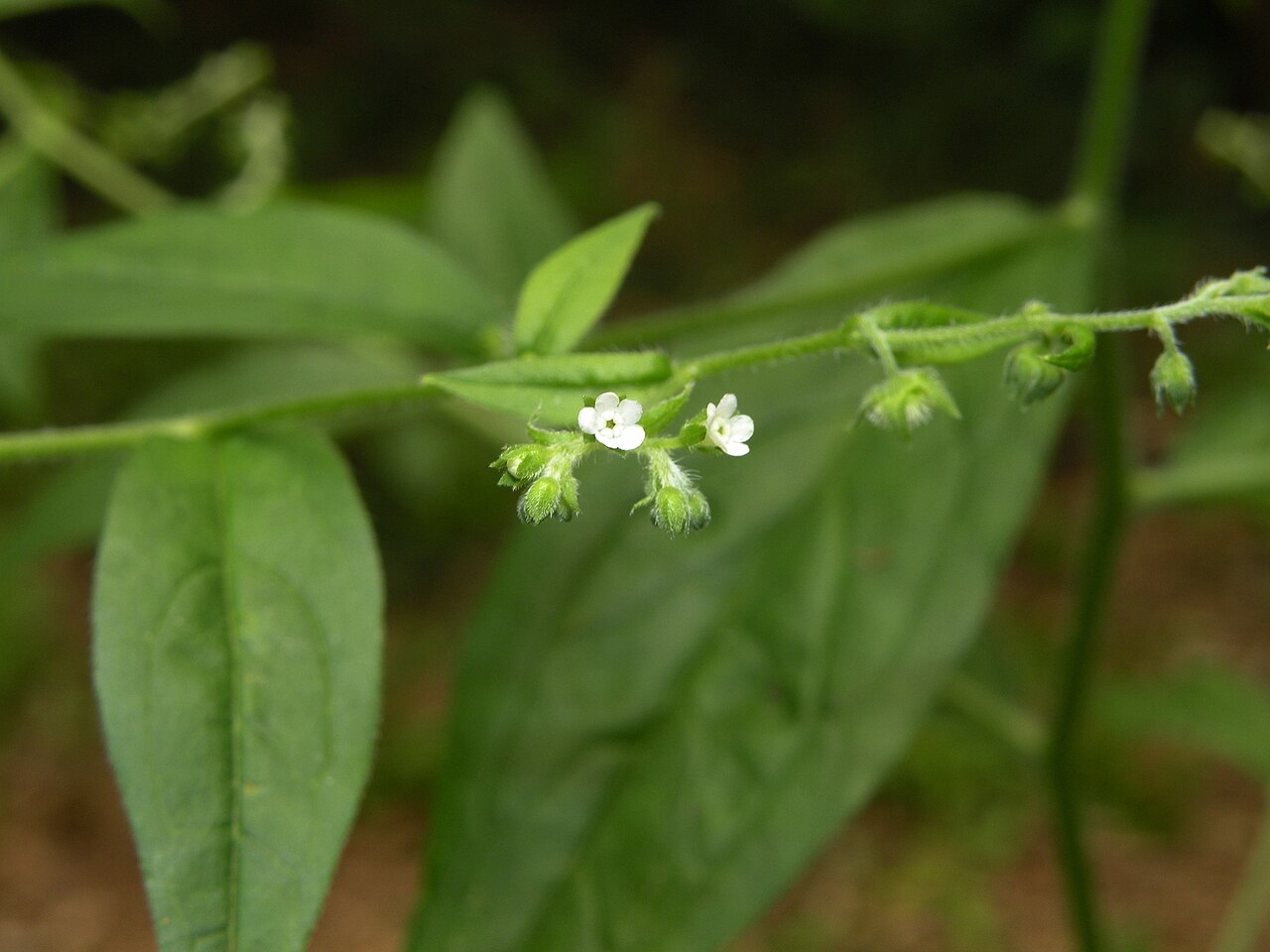
Hackelia virginiana, known as Virginia Stickseed and listed by USDA PLANTS as beggarslice (often written beggar’s lice), is a native biennial or short-lived perennial of the borage family (Boraginaceae). It grows in woodland edges, thickets, floodplain forests and partly shaded disturbed ground across most of the eastern and central United States. In its second year it sends up a branching stem 1 to 4 feet tall, spreading at the top into wiry, nearly horizontal branches that carry tiny white to pale blue flowers from early summer into early fall.
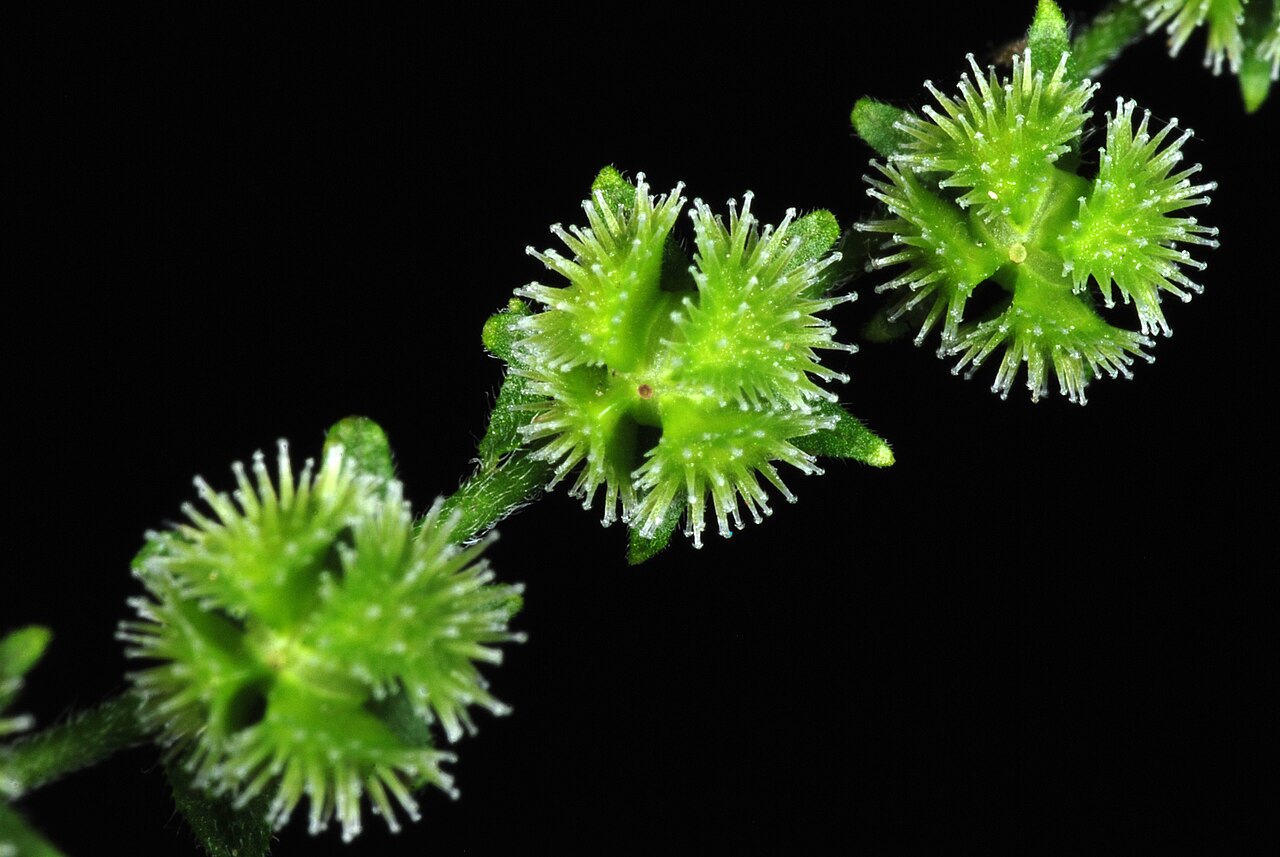
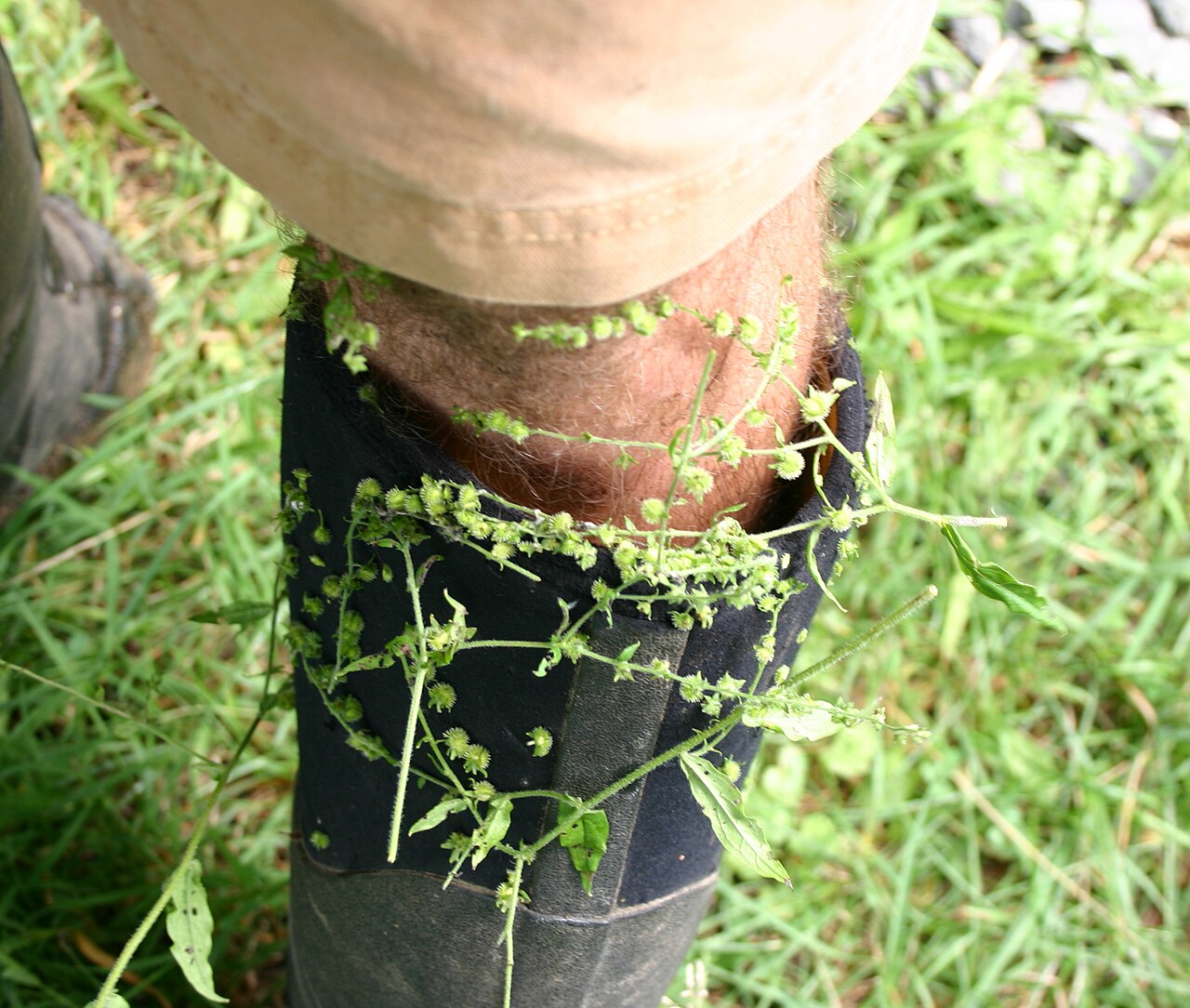
Most people meet this plant by its fruit rather than its flowers. Each flower ripens into four small nutlets covered with minute barbed prickles, and by late summer the plant is loaded with them. Brush past and they cling to socks, shoelaces, pant legs, dog fur and deer hair in great numbers. That habit gives the plant both of its common names, and it is the main way the species gets around: its seeds travel on passing animals rather than on the wind.
Virginia stickseed is not a showy garden flower, and many gardeners consider it a nuisance. It does have a place, though. It is a genuine part of eastern woodland flora, it fills shady gaps along trails and forest edges, and its small flowers feed little native bees and flies. This guide covers how to identify it and tell it from similar plants, where it grows, how to manage it in a naturalized landscape, and what role it plays in the woods.
Identification
Virginia stickseed is easiest to recognize from midsummer on, when its open, sprawling branches are lined with bristly fruit. Before it flowers it can pass for many other broad-leaved woodland weeds. Look at the leaf shape of the first-year rosette, the airy branching of the flowering stem, and above all the prickly four-part fruit.
Growth Habit & Stems
In its first year the plant forms a low rosette of large, long-stalked leaves that stays green into fall. In the second year (occasionally later) it produces a single upright, hairy stem 1 to 4 feet tall. Above the middle the stem branches widely, and the flowering branches spread almost horizontally, giving a mature plant a loose, open, somewhat untidy outline. After seeding, the plant dies, though the dry, brittle skeleton often stands into winter still holding fruit.
Leaves
Rosette leaves are broadly oval to nearly heart-shaped, up to about 8 inches long including the stalk, and rough with short hairs. Stem leaves are alternate, lance-shaped to elliptic, 2 to 8 inches long, pointed at the tip and narrowed at the base, becoming smaller and stalkless higher on the stem. The leaf surfaces are finely hairy and slightly rough to the touch, as in many members of the borage family.
Flowers
The flowers are tiny, only about 2 to 3 mm (roughly an eighth of an inch) across, with five rounded white or very pale blue petals around a small yellowish center. They are carried well apart on slender, one-sided spikes at the ends of the branches. As in other borage family plants, these spikes uncoil as they grow, so each branch has a few open flowers near the tip and developing fruit behind them. Flowering runs mostly from June through August, sometimes into September.
Fruit & Seeds
After flowering, each fruit stalk bends downward, and the fruit develops into four flattened nutlets held together in a round bur about a quarter inch across. Each nutlet is covered on its face and margins with short prickles that end in tiny anchor-shaped barbs (glochids). The nutlets separate easily when ripe and stick to anything that brushes past. Under a hand lens, the fully prickled face of each nutlet helps separate this species from nodding stickseed (Hackelia deflexa), whose nutlets carry prickles only along the margins.
Similar Species
Wild comfrey (Cynoglossum virginianum) shares the same woods but has larger, clearly blue flowers held on a long, nearly leafless stalk, and big clasping leaves. The weedy European houndstongue (Cynoglossum officinale) has dull maroon flowers and larger burs. Stickseeds of the genus Lappula are smaller plants of dry open ground with blue flowers. Tick-trefoils (Desmodium) also produce clinging seeds, but they are legumes with three-part leaves and flat, segmented pods.
Quick Facts
| Scientific Name | Hackelia virginiana (syn. Lappula virginiana, Myosotis virginiana) |
| Family | Boraginaceae (borage family) |
| Plant Type | Herbaceous biennial or short-lived perennial |
| Mature Height | 1–4 ft |
| Mature Spread | 1–3 ft (branches spread widely) |
| Growth Rate | Fast in its flowering year |
| Sun Exposure | Partial shade to full shade; tolerates some sun at woodland edges |
| Water Needs | Medium; prefers evenly moist soil |
| Soil Type | Loam, clay loam or rich woodland soil; tolerates disturbed ground |
| Soil pH | About 5.5–7.5 |
| Bloom Time | June–August, sometimes into September |
| Flower Color | White to very pale blue |
| Fall Color | None of note; the plant dries to a tan skeleton after seeding |
| Fruit | Round bur of four prickly nutlets that cling to fur and clothing |
| Deer Resistant | Generally yes; the rough, hairy foliage is seldom browsed |
| USDA Hardiness Zones | 3–9 |
Native Range
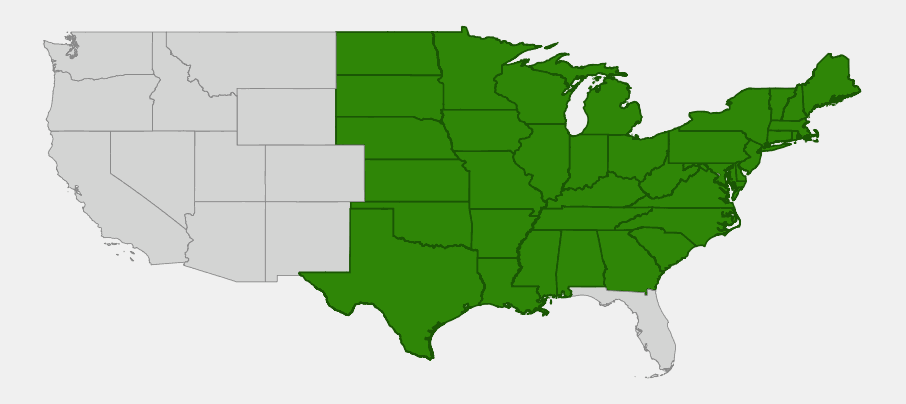
Virginia stickseed has a broad eastern North American range. USDA PLANTS records it as native in 36 states and the District of Columbia, from Maine, Vermont and New Hampshire west through the Great Lakes states to Minnesota and the Dakotas, and south to Georgia, the Gulf states and eastern Texas. Its western limit runs through the eastern Great Plains, in Nebraska, Kansas and Oklahoma. In Canada it grows in southern Ontario and Quebec.
It is most common in the deciduous forest region, from the Ohio and Mississippi valleys east to the Appalachians and the Piedmont. It favors rich, moist woodlands, especially their edges and openings: trailsides, floodplain terraces, ravines, thickets, fencerows and young woods regrowing on old fields. It tolerates disturbance well and often turns up along logging roads, in tree-fall gaps and in shady corners of yards next to woods. It is scarcer on the Atlantic and Gulf Coastal Plain and on the prairies at the western edge of its range.
Because its seeds hitch rides on deer, raccoons, dogs and people, stickseed is quick to colonize new openings in and near forests, and it is often more abundant along heavily used trails than in the surrounding woods. It is not known to spread aggressively into intact, undisturbed forest interiors.
📋 Regional plant lists featuring Virginia Stickseed: New York, Pennsylvania & Northern New Jersey · Ohio & Indiana · Michigan, Wisconsin & Eastern Minnesota · Kentucky & Tennessee · Nebraska, Kansas & Eastern Colorado · Connecticut, Massachusetts & Rhode Island · New Hampshire, Maine & Vermont · Maryland, Virginia & West Virginia · Delaware, Southern New Jersey & Long Island · Illinois, Iowa & Missouri · Alabama, Georgia & Mississippi
Growing & Care Guide
Few people plant Virginia stickseed on purpose, and that is worth saying plainly. It is a modest-looking plant, and its clinging nutlets are a nuisance on pets and clothing. In larger naturalized landscapes, woodland restorations and wild edges, though, it is a legitimate native plant that needs no care at all. The practical question for most gardeners is where to tolerate it and where to pull it.
Light
Virginia stickseed grows best in partial shade, such as a woodland edge, a gap in the canopy, or the dappled shade under tall trees. It tolerates fairly deep shade, where it becomes thinner and flowers less, and it can handle morning sun if the soil stays moist.
Soil & Water
It prefers moist, reasonably fertile loam or clay loam, the kind of soil found in rich deciduous woods and floodplains. It also grows in compacted or disturbed soil along paths. Once established it needs no watering in most of its range, though plants in dry, sunny spots may wilt and finish early in drought.
Planting Tips
If you want it in a naturalized area or restoration planting, scatter fresh nutlets in fall on bare or lightly disturbed soil in partial shade. The seed needs a winter of cold, moist conditions before it germinates in spring. Plants are rarely sold. Keep it away from paths, patios, dog runs and play areas, where the burs will be a constant annoyance.
Pruning & Maintenance
Because each plant flowers once and then dies, managing stickseed means managing its seed. To keep it out of a garden bed, pull first-year rosettes or second-year plants before the fruit ripens; the taproot comes up easily from moist soil. Wear gloves and long sleeves once plants are in fruit. In a wild area you can simply leave it, and cutting the dry stalks in late fall keeps the burs from catching on passers-by all winter.
Propagation
Propagation is by seed only. Seeds germinate after cold, moist stratification, and plants self-sow freely in suitable sites. Most woodland gardeners who have it find it arrives on its own, carried in on boots or animal fur.
Landscape Uses
- Woodland restoration: as part of the native herb layer on forest edges and in canopy gaps, within its range
- Naturalized woodland edges: an easy native filler for shady, out-of-the-way corners
- Floodplain and riparian buffers: in moist, partly shaded ground along streams
- Wildlife and pollinator areas: where small native bees and flies can use its long flowering season
- Teaching gardens: a vivid example of seed dispersal by animals (epizoochory)
Wildlife & Ecological Value
Virginia stickseed does not draw crowds of butterflies, but it fills a niche in the forest edge community. It flowers for weeks in midsummer, when spring woodland wildflowers are long finished, and its whole life cycle is tied to the animals that carry its seed.
For Pollinators
The tiny flowers are visited mainly by small insects, including sweat bees and other small native bees, small flies and syrphid flies. Each flower offers only a little nectar and pollen, but the plant keeps producing new flowers along its branches for much of the summer.
For Birds
Stickseed is not an important food plant for birds. The nutlets are small and heavily armed, and they are taken only occasionally. The thickets and woodland edges where it grows are prime habitat for birds such as indigo buntings, gray catbirds and eastern towhees.
For Mammals
Mammals are the plant’s seed carriers. White-tailed deer, raccoons, foxes, rabbits and domestic dogs pick up the nutlets in their fur and drop them along trails and edges, sometimes far from the parent plant. Deer rarely eat the rough, hairy leaves.
Ecosystem Role
As a biennial of disturbed woodland ground, stickseed is one of the plants that quickly cover soil in new canopy gaps, along stream banks after floods and on paths. This helps hold soil while longer-lived woodland plants re-establish. Its reliance on animal dispersal also makes it a good example of how plants and animals are connected in the forest edge.
Cultural & Historical Uses
Linnaeus described this plant in 1753 as Myosotis virginiana, placing it with the forget-me-nots. Later botanists moved it to Lappula, and in the twentieth century the American botanist Ivan M. Johnston transferred it to Hackelia. That genus honors Josef Hackel, a nineteenth-century Czech botanist. Older field guides often call it Lappula virginiana.
The common names are all about the burs. “Beggar’s lice” and “beggar’s ticks” are old names applied to several plants with clinging seeds, comparing them to the vermin that afflicted travelers. “Stickseed” is more straightforward. Generations of farm children, hunters and hikers have spent autumn evenings picking these nutlets out of wool socks and dog coats.
Stickseed has little documented history as a food or medicinal plant. Some members of the family contain pyrrolizidine alkaloids, which can damage the liver, so it should not be eaten or used as a home remedy. Its main value today is ecological and educational.
Frequently Asked Questions
Is Virginia stickseed native?
Yes. Hackelia virginiana is native to most of the eastern and central United States and to southern Ontario and Quebec. It is sometimes mistaken for an introduced weed because it thrives along trails and in disturbed shade, but it is a natural part of eastern woodland flora.
How do I get stickseed burs off clothing and pets?
Pick them off by hand or with a fine comb before they work deeper. A lint roller or a strip of duct tape removes many at once from fabric. On dogs, a slicker brush followed by a flea comb works well. Prevention is easier: pull plants near paths before the fruit ripens in midsummer.
Should I remove it from my garden?
In formal beds, along paths and in yards with dogs, most gardeners pull it, and that is reasonable. In larger wild areas and woodland edges it can be left as part of the native plant community. Since each plant dies after setting seed, removing plants before fruiting gradually reduces it.
Is beggarslice the same plant as beggar ticks?
Not always. USDA uses “beggarslice” for Hackelia virginiana, but “beggar’s lice” and “beggar ticks” are also used for tick-trefoils (Desmodium) and for Bidens species. The scientific name is the reliable way to tell them apart.
Is Virginia stickseed poisonous?
It is not known as a significant poison, and the rough, prickly plant is unappealing to livestock and pets. Some relatives in the borage family contain liver-damaging pyrrolizidine alkaloids, though, so do not eat it or brew it as tea.

Looking for a nursery that carries Virginia Stickseed?
Browse our native plant nursery directory: Alabama & Arkansas · Connecticut, Delaware & Georgia · Illinois, Indiana, Iowa & Kansas · Kentucky, Louisiana, Maine, Maryland, Massachusetts, Michigan, Minnesota, Mississippi & Missouri · Nebraska, New Hampshire, New Jersey, New York, North Carolina, North Dakota, Ohio & Oklahoma · Pennsylvania, Rhode Island, South Carolina, South Dakota, Tennessee, Texas, Vermont & Virginia · West Virginia & Wisconsin