
Crane-fly Orchid (Tipularia discolor)
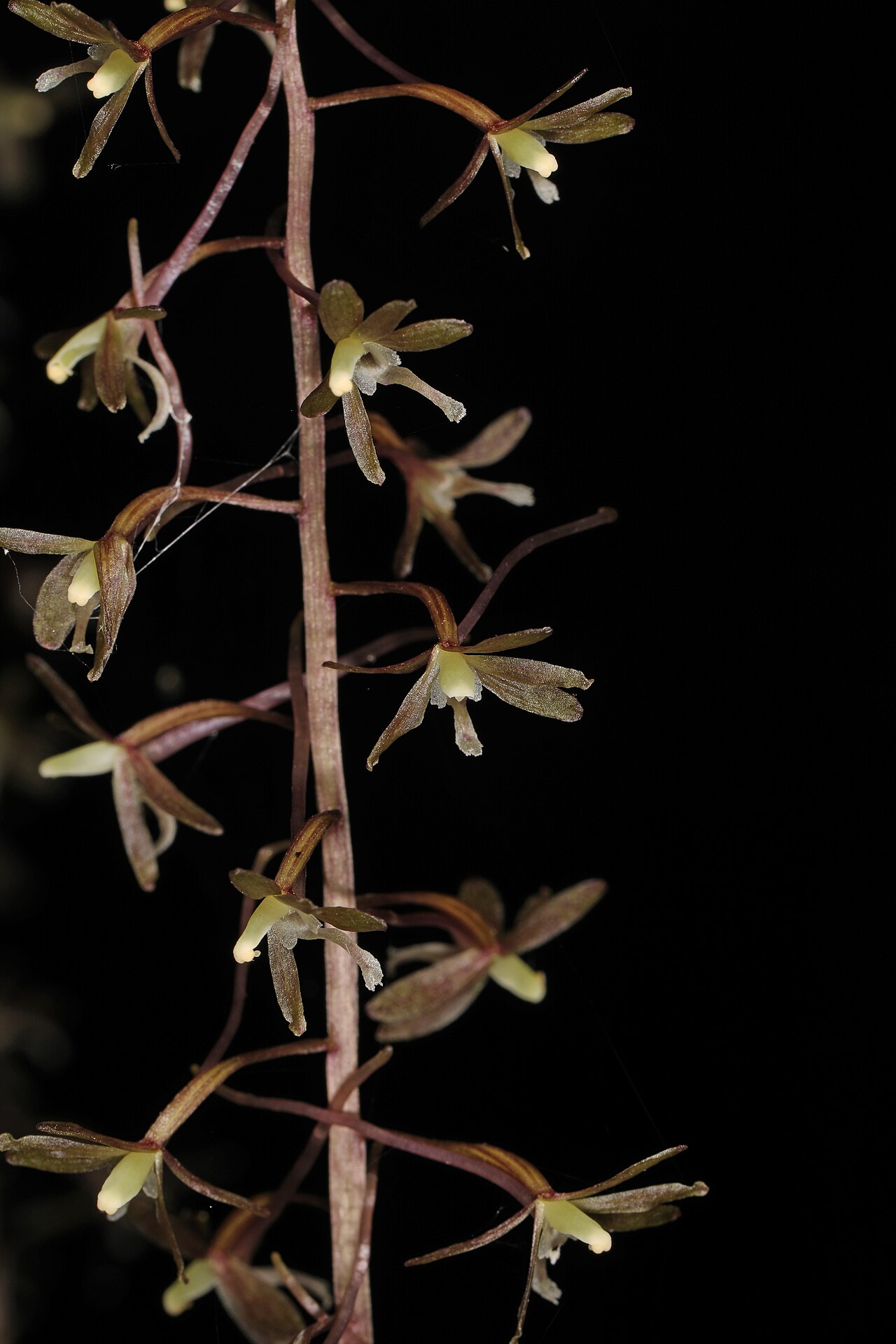
Tipularia discolor, the Crane-fly Orchid, is a native woodland orchid of the eastern and southern United States with an unusual year. Its single leaf appears in autumn, stays green all winter on the forest floor, and withers in spring. Then in mid to late summer, with no leaf in sight, a slender stalk rises and opens dozens of small, spidery, brownish-green flowers. USDA PLANTS lists it under the name crippled cranefly, after the lopsided shape of its flowers.
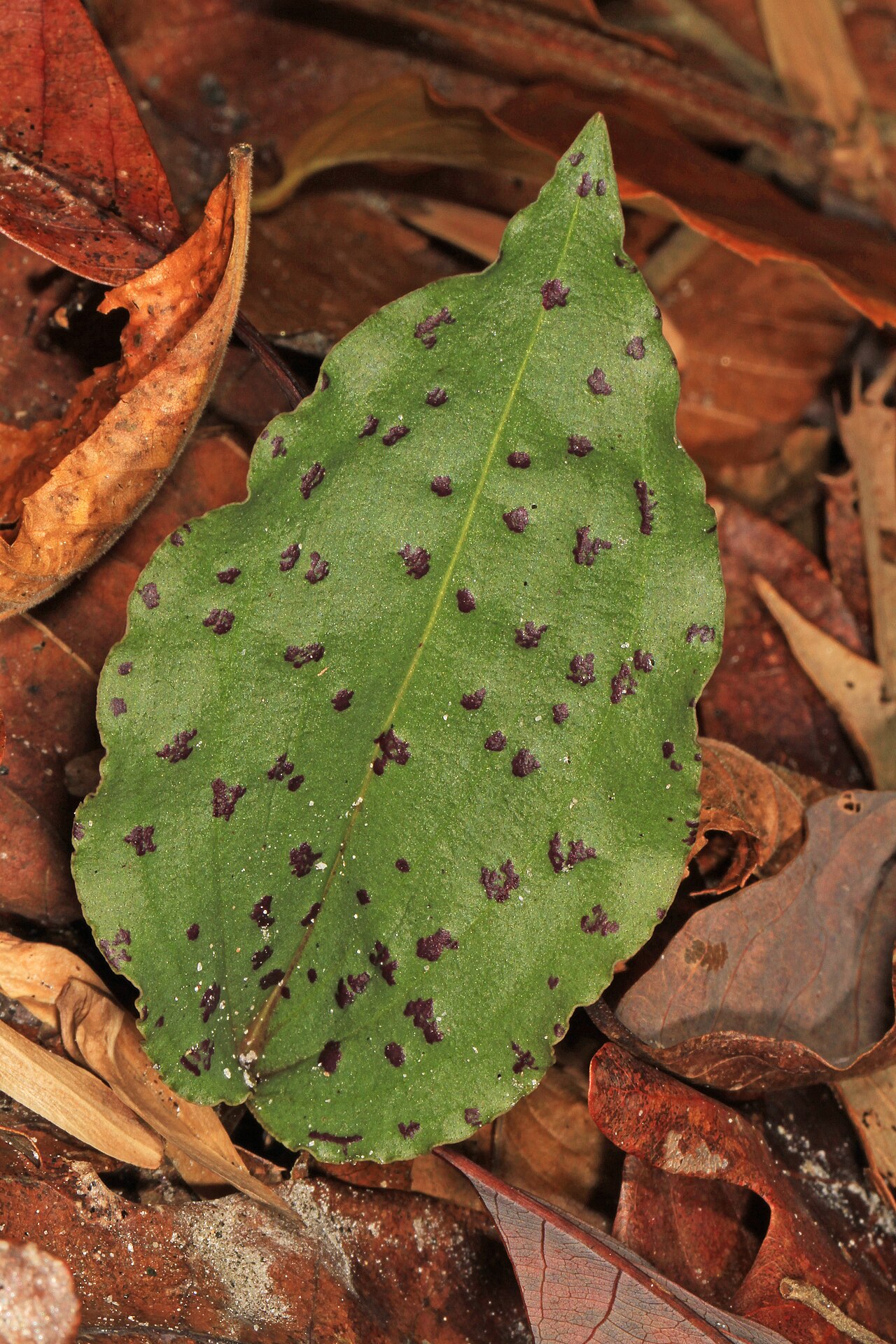
The leaf is the easiest part to find. It is oval, pleated, dull green above with scattered purple spots, and a rich purple underneath, which gives the species its name discolor (“two-colored”). The genus name Tipularia comes from Tipula, the crane flies, because the flowers, with their thin sepals and long spurs, look like a cloud of the insects hovering above the leaf litter.
Crane-fly orchid is widespread in the Southeast but rare at the northern edge of its range, and it has protected status in some states. Like all native orchids it depends on soil fungi for its whole life, and it is almost never available as nursery-propagated stock. This page is mainly an identification and appreciation guide: how to recognize it in every season, where it grows, and how to protect it where it occurs. Never dig crane-fly orchids from the wild.
Identification
Crane-fly orchid is easy to recognize in winter by its leaf, and in summer by its flowering stalk, but the two never appear together. The only similar plant in eastern woods is puttyroot (Aplectrum hyemale), another orchid with a single winter leaf.
Corms
The plant grows from a chain of small, rounded corms just below the surface of the leaf litter, joined to each other by short rhizome segments. A new corm forms each year, so the chain records several years of growth. The corms store the food made by the winter leaf and fuel the summer flowering stalk.
Winter Leaf
There is one leaf per plant. It appears in September or October, lies close to the ground, and is about 2 to 4 inches long, broadly oval with a pointed tip, on a short stalk. The upper surface is dull to dark green with fine pleats and usually small raised purple spots. The underside is a deep, glossy purple. The leaf makes food all winter while the trees above are bare, then turns yellow and disappears in late spring. Puttyroot has a larger leaf with fine white parallel stripes and a green-purple, not deep purple, underside.
Flowers
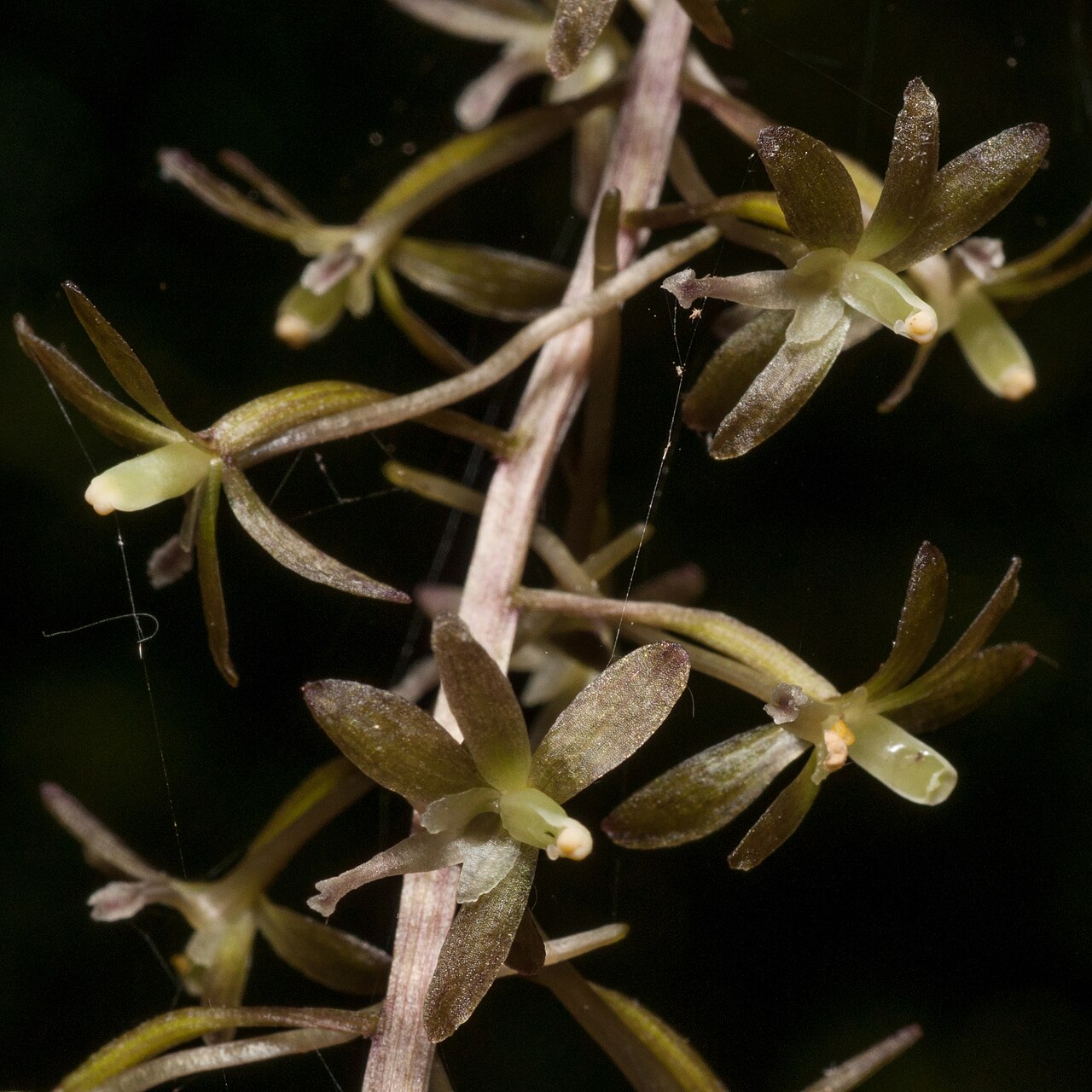
In July to September the leafless flowering stalk appears, usually 10 to 20 inches tall (up to about 2 feet) and purplish-brown. It carries 20 to 40 or more small flowers in a loose spike. Each flower is greenish, tan or bronze, often flushed with purple, with narrow sepals and petals and a three-lobed lip. A slender spur up to about 3/4 inch long projects backward. One petal overlaps the upper sepal, so the flower looks slightly twisted, and this asymmetry is behind the USDA name “crippled cranefly”. The flowers blend into the shady forest floor and are easy to miss even when the stalk is in full bloom.
Fruit & Seeds
Pollinated flowers form small, drooping, oval capsules that ripen in autumn. The dry stalk with its empty capsules often persists through winter beside the new leaf, which helps to locate plants. Each capsule releases thousands of dust-fine seeds that need a compatible fungus to germinate.
Quick Facts
| Scientific Name | Tipularia discolor (syn. Tipularia unifolia) |
| Common Names | Crane-fly orchid, cranefly orchid, crippled cranefly (USDA) |
| Family | Orchidaceae (orchid family) |
| Plant Type | Terrestrial orchid; herbaceous perennial from a chain of corms, with a winter leaf |
| Mature Height | Leaf flat on the ground; flowering stalk 10–20 in (to about 2 ft) |
| Mature Spread | About 3–4 in per leaf; scattered colonies |
| Growth Rate | Very slow |
| Sun Exposure | Shade to part shade under deciduous trees |
| Water Needs | Medium; moist to fairly dry, well-drained forest soils |
| Soil Type | Humus-rich, leaf-mold forest soil over sand, loam or decaying wood |
| Soil pH | Acid to slightly acid (about 4.5–6.5) |
| Bloom Time | July–September (June in some northern sites) |
| Flower Color | Greenish, tan or bronze, often tinged purple |
| Fall Color | None; the new leaf appears in fall and stays green through winter |
| Fruit | Small drooping capsule with dust-like seeds |
| Deer Resistant | Unknown; leaves are sometimes grazed by deer and other animals |
| USDA Hardiness Zones | 5–9 |
Native Range
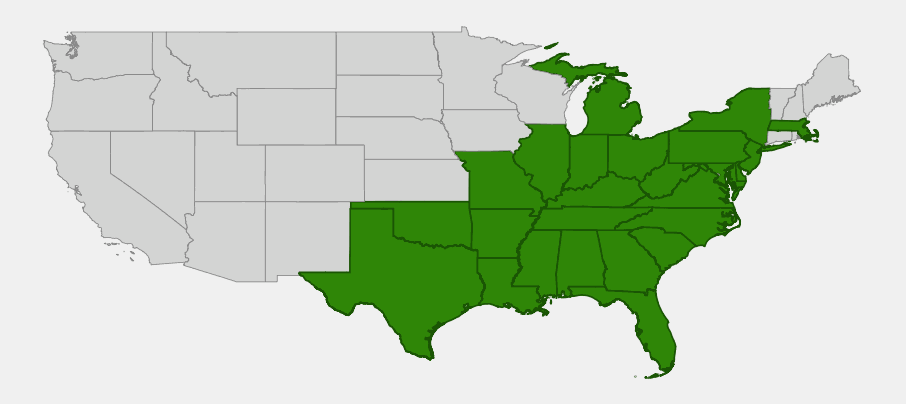
Crane-fly orchid is native to the eastern and southern United States. USDA PLANTS records it from 25 states, from Massachusetts, New York and southern Michigan south to northern Florida, and west to Missouri, Oklahoma and eastern Texas. It is not known from Canada. Its closest relatives grow in eastern Asia, a pattern shared by many plants of the eastern North American forests.
The plant is most common in the Southeast, particularly the Piedmont and Coastal Plain from Virginia to Georgia, Alabama and Mississippi, and in the Ozarks and the lower Ohio Valley. In these areas it can be abundant in the right woods. North of Maryland and the Ohio River it becomes scattered and local. At the northern edge of its range, in New England, New York and Michigan, it is known from only a few sites and is considered rare.
It grows in deciduous and mixed forests: upland oak and hickory woods, beech and tulip-tree forests, pine-hardwood stands, ravine slopes and the drier edges of floodplains. It favors acid, humus-rich soils, often around old stumps or rotting logs, where its fungal partners live.
📋 Regional plant lists featuring Crane-fly Orchid: New York, Pennsylvania & Northern New Jersey · Ohio & Indiana · Michigan, Wisconsin & Eastern Minnesota · Kentucky & Tennessee · Connecticut, Massachusetts & Rhode Island · New Hampshire, Maine & Vermont · Maryland, Virginia & West Virginia · Delaware, Southern New Jersey & Long Island · Illinois, Iowa & Missouri · Alabama, Georgia & Mississippi · North & South Florida
Growing & Care Guide
Crane-fly orchid is best enjoyed where it grows. Like other native orchids it depends on specific soil fungi throughout its life, and plants dug from the wild almost always decline and die. It is very rarely offered as nursery-propagated stock. Never dig it from the wild, and treat any plant offered for sale with suspicion unless the seller can show it was propagated. The sections below describe the conditions where it grows naturally and how to look after plants that already grow on your land.
Light
In the wild it grows in shade to part shade under deciduous trees. The leaf needs the light that reaches the forest floor in winter, when the canopy is bare. Plants under dense evergreens or in deep, permanent shade are rare.
Soil & Water
It grows in acid, well-drained, humus-rich soil with a deep layer of decaying leaves, and often near rotting logs and stumps that support its fungal partners. It tolerates fairly dry upland woods as well as moist slopes. It does not grow in permanently wet ground.
Planting Tips
Crane-fly orchid is not a plant to plant. If it already grows on your property, the best help is to leave the area alone. Keep leaf litter, fallen logs and decaying wood in place, avoid raking, mulching with bark or wood chips, or adding fertilizer, and do not compact the soil or build paths over colonies. Removing invasive shrubs and ground covers, such as Japanese honeysuckle, English ivy and Japanese stiltgrass, helps native orchids survive.
Pruning & Maintenance
No maintenance is needed. Do not cut the winter leaves, which the plant depends on for food, and leave the old flowering stalks to release seed. Mark the location of plants, since the leaf vanishes in spring and the flowering stalk is easy to trample in summer.
Propagation
Crane-fly orchid spreads slowly by its corm chains and by dust-like seed that germinates only with the help of a compatible fungus, often in decaying wood. Propagation is a job for orchid conservation laboratories, not home gardeners. Do not collect seed or corms from wild plants.
Landscape Uses
- Nature study: an easy native orchid to find and identify in winter woods
- Woodland stewardship: an indicator of undisturbed forest floor with intact leaf litter and decaying wood
- Native orchid conservation: existing colonies are worth protecting, especially at the northern edge of the range
- Photography: the purple leaf undersides and spidery summer flowers make good subjects
Wildlife & Ecological Value
Crane-fly orchid has one of the more remarkable pollination systems among North American orchids, and its life cycle is tied closely to the seasons of the deciduous forest.
For Pollinators
The flowers produce nectar in their long spurs and are visited at night by moths, especially noctuid (owlet) moths. Because the flower is lopsided, a moth probing the spur is pushed to one side, and the pollen mass sticks to one of its compound eyes rather than to its tongue. The moth then carries the pollen to the next flower it visits. Studies in Maryland in the late twentieth century described this unusual mechanism, and moths with orchid pollen on their eyes have been caught in the wild.
For Birds
Crane-fly orchid has little direct value for birds. Its presence indicates a forest floor rich in leaf litter and insects, which ground-feeding birds such as thrushes and ovenbirds depend on.
For Mammals
Deer, rabbits and small rodents sometimes eat the winter leaves or dig the corms. In some areas deer browsing has reduced orchid populations.
Ecosystem Role
The winter leaf is an adaptation to life under deciduous trees. It makes most of the plant’s food from autumn to spring, when sunlight reaches the forest floor, and the plant rests in summer shade before flowering. Like all orchids, crane-fly orchid relies on mycorrhizal fungi to germinate and to obtain nutrients. Its fungal partners decompose wood, so the orchid is part of the recycling of fallen logs and stumps.
Cultural & Historical Uses
The species was first described by Frederick Pursh in 1814 as Orchis discolor, and Thomas Nuttall moved it to his new genus Tipularia in 1818. It was also called Tipularia unifolia in older works. Its other relatives grow in Japan, China and the Himalayas, and they also have single leaves and small, spurred flowers.
Naturalists have long noted the two-colored leaf. A leaf flipped over to show its purple underside is a familiar winter sight on nature walks in the Southeast, and many people know the plant only by its leaf. The summer flowers are so inconspicuous that many people who recognize the leaf have never seen the plant in bloom.
Because it is common in parts of the Southeast and listed as rare farther north, crane-fly orchid is a useful example of how a species can be secure in one area and vulnerable in another. In all states the safest approach is the same: enjoy it, photograph it, and leave it in place.
Frequently Asked Questions
Why does crane-fly orchid have a leaf only in winter?
It grows under deciduous trees, which leave the forest floor sunny from autumn to spring. The leaf uses that winter light to make food, then dies back as the canopy closes. The plant flowers in summer using stored energy.
Can I grow crane-fly orchid in my garden?
In practice, no. It depends on specific soil fungi and is almost never available as nursery-propagated stock. Wild plants should never be dug, since they rarely survive and digging harms wild populations. If you already have it, protect the leaf litter and decaying wood where it grows.
Why is it called “crippled cranefly”?
The flowers are slightly asymmetrical, with one petal overlapping the upper sepal, so they look bent or twisted. That shape is part of how the flower places pollen on the eye of a visiting moth.
How can I tell crane-fly orchid from puttyroot?
Both have a single winter leaf. Crane-fly orchid’s leaf is smaller, usually spotted with purple above and deep purple beneath. Puttyroot (Aplectrum hyemale) has a larger leaf with fine white or silvery stripes along the veins. Puttyroot flowers in spring, crane-fly orchid in late summer.
When does crane-fly orchid bloom?
Mostly from July into September, depending on location. The leaf is gone by then, so look for a thin, purplish-brown stalk with many small, spidery flowers in shady woods.

Looking for a nursery that carries Crane-fly Orchid?
Browse our native plant nursery directory: Alabama & Arkansas · Delaware, Florida & Georgia · Illinois & Indiana · Kentucky, Louisiana, Maryland, Massachusetts, Michigan, Mississippi & Missouri · New Jersey, New York, North Carolina, Ohio & Oklahoma · Pennsylvania, South Carolina, Tennessee, Texas & Virginia · West Virginia