
Wild Comfrey (Cynoglossum virginianum)
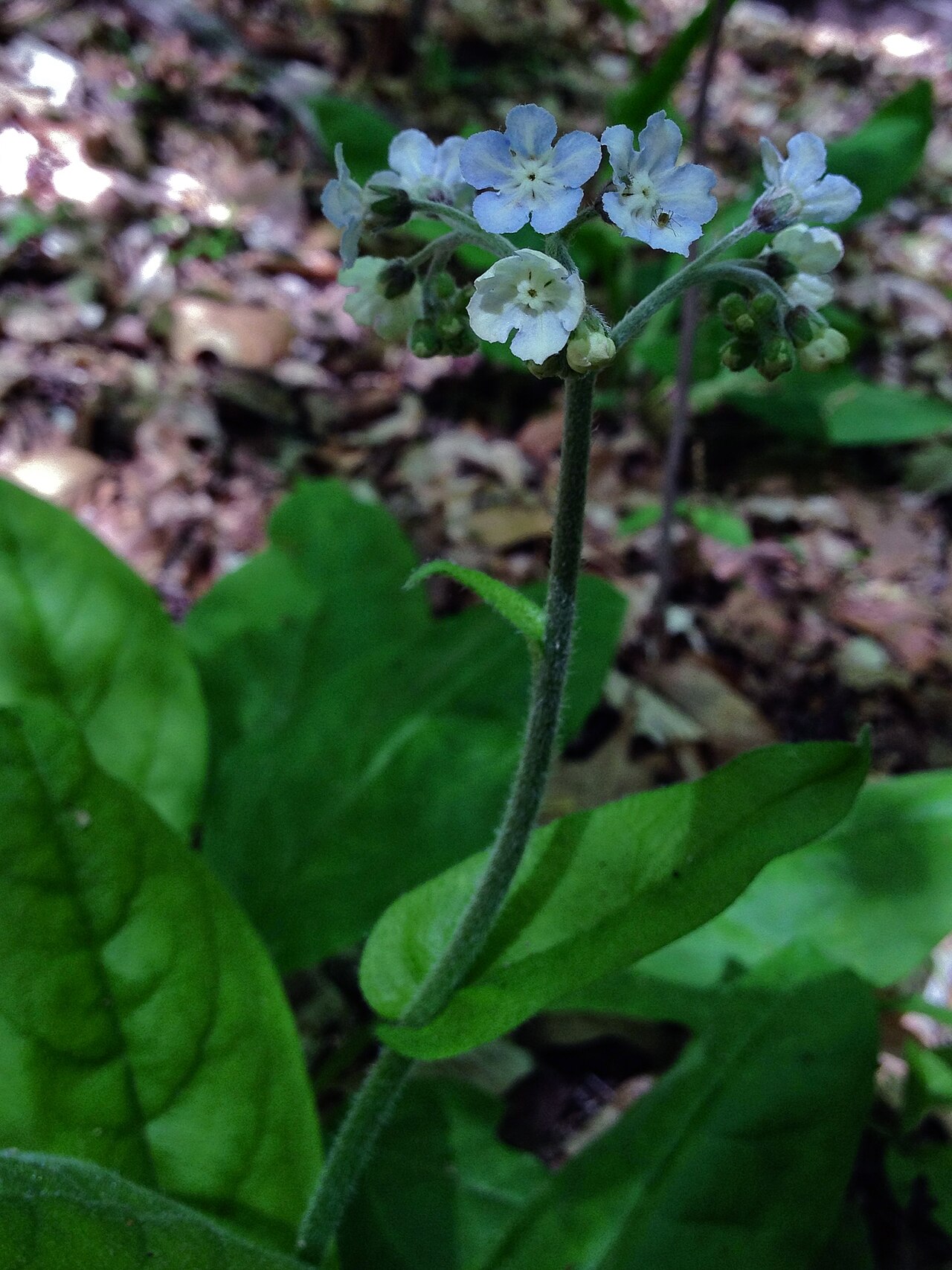
Cynoglossum virginianum, known as Wild Comfrey or wild hound’s-tongue, is a native perennial wildflower of eastern North American woodlands and a member of the borage family (Boraginaceae). In spring it raises a hairy stalk 1 to 2½ feet tall from a rosette of large, rough, tongue-shaped leaves, and tops it with a small, branched cluster of pale blue flowers about half an inch across. It grows in dry to moist deciduous and mixed woods, usually in light shade, from the Gulf Coast and northern Florida to New England and the upper Midwest.
Despite its name, wild comfrey is not a true comfrey. The garden and herbal comfreys belong to the Eurasian genus Symphytum. The name comes from the resemblance of its big, hairy leaves to those of comfrey. The genus name Cynoglossum means “dog’s tongue” in Greek, another reference to the leaves. Some botanists now place this species in the genus Andersonglossum, so you may see it listed as Andersonglossum virginianum.
Wild comfrey is a quiet, attractive plant for shade gardens and woodland restorations, and its flowers are a spring nectar source for bumblebees and other native bees. Like many members of its family, it contains pyrrolizidine alkaloids that can damage the liver, so it should never be eaten or used as an herbal substitute for comfrey. This guide covers identification, range, growing it from seed, its wildlife value and that safety point.
Identification
Wild comfrey is distinctive once you know it. Few other spring woodland wildflowers combine a rosette of large, bristly leaves with a tall, almost leafless stalk of small sky-blue flowers.
Leaves
The basal leaves are the most noticeable part of the plant for most of the year. They are oblong to elliptic, up to about 8 to 12 inches long and several inches wide, with a long stalk, a blunt or pointed tip and a smooth edge. Both surfaces are covered with stiff hairs, so they feel rough, almost like fine sandpaper. The flowering stem carries only a few leaves, which become smaller upward and clasp the stem with a broad, somewhat heart-shaped base and no leaf stalk. Plants that do not flower in a given year produce only the rosette.
Stems
The flowering stem is single, erect and densely covered with spreading, bristly hairs. It is usually 1 to 2½ feet tall, occasionally a little taller, and leafless for most of its upper length. The plant grows from a thick taproot.
Flowers
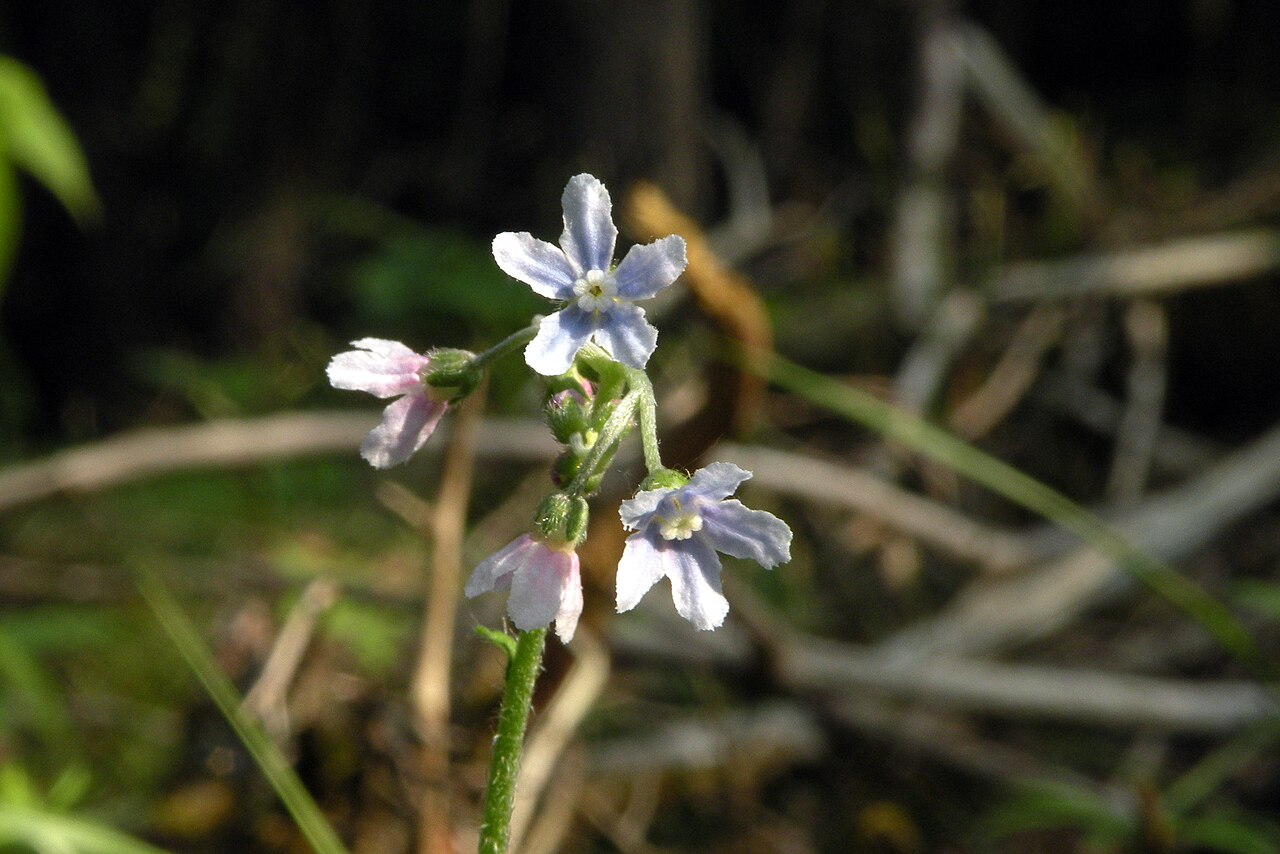
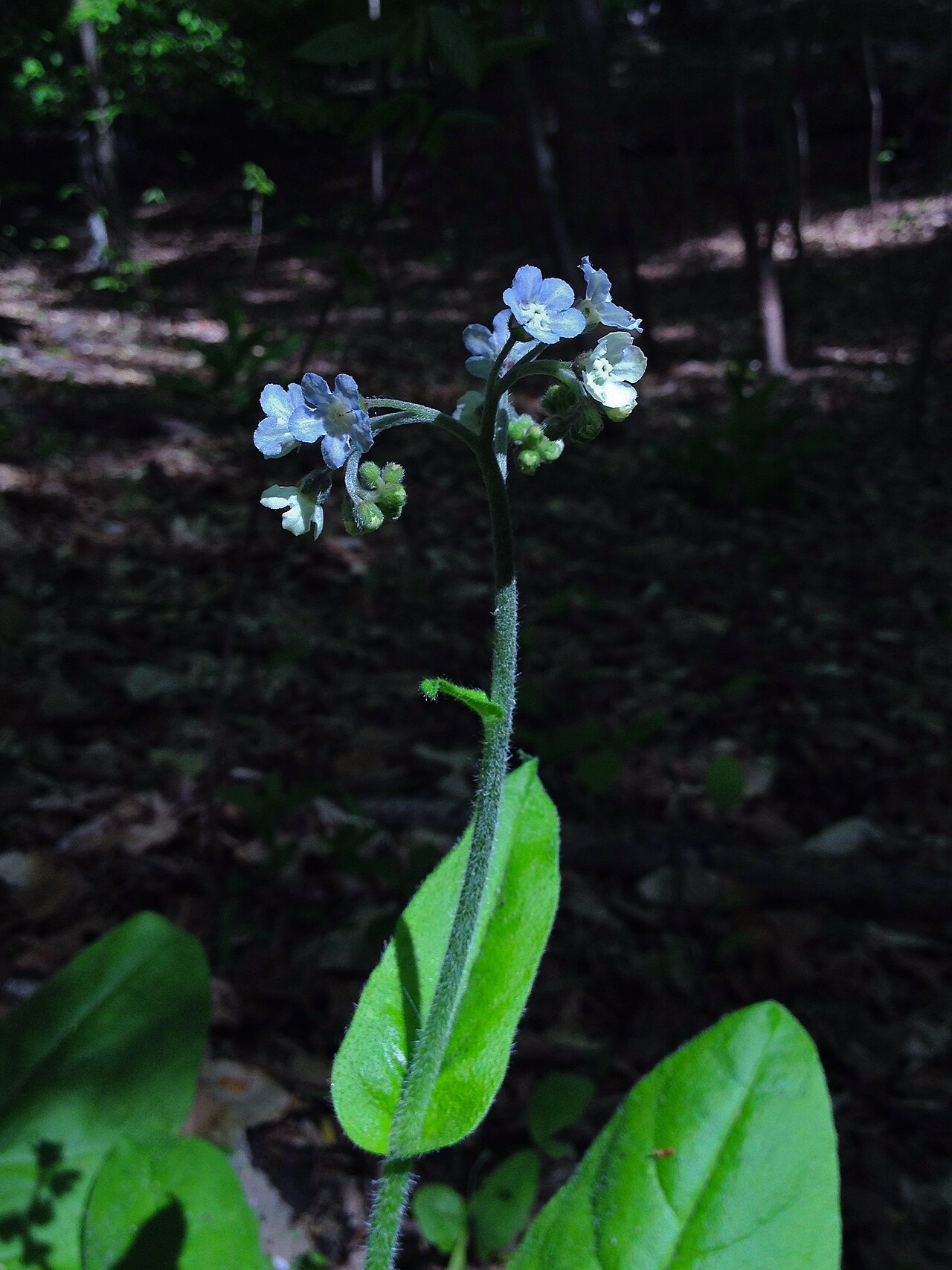
The flowers are borne at the top of the stalk in a loose cluster of two to four short, curling branches, each carrying several flowers. They open from pinkish buds to pale blue or light lavender, rarely white, and are about ⅜ to ½ inch across, with five rounded, spreading petals fused at the base into a short tube. Small white bumps (fornices) ring the throat, much like those on a forget-me-not. Flowering is mostly April to June, earlier in the South.
Fruit & Seeds
After flowering, each flower forms four rounded nutlets, about a quarter inch across, held flat and spreading at the top of a bent stalk. The nutlets are densely covered with short, barbed prickles and cling readily to fur and clothing, though they are less of a nuisance than the burs of stickseeds or the European houndstongue.
Similar Species
Northern wild comfrey, var. boreale (sometimes treated as the separate species Andersonglossum boreale), is a smaller-flowered plant of northern coniferous and mixed forests. Its stem leaves usually have narrowed rather than clasping bases. Introduced houndstongue (Cynoglossum officinale) has dull maroon flowers and a leafy stem. Virginia Stickseed has much smaller white flowers on widely spreading branches. Virginia bluebells (Mertensia virginica) have smooth leaves and nodding, trumpet-shaped flowers.
Quick Facts
| Scientific Name | Cynoglossum virginianum (syn. Andersonglossum virginianum) |
| Family | Boraginaceae (borage family) |
| Plant Type | Herbaceous perennial with a taproot |
| Mature Height | 1–2½ ft in flower |
| Mature Spread | 1–1½ ft (basal rosette) |
| Growth Rate | Slow to moderate |
| Sun Exposure | Partial shade to full shade |
| Water Needs | Low to medium; dry to moist, well-drained soil |
| Soil Type | Loam or sandy loam with leaf litter; tolerates rocky and clay soils |
| Soil pH | About 5.0–7.0 (slightly acidic preferred) |
| Bloom Time | April–June |
| Flower Color | Pale blue to lavender; rarely white |
| Fall Color | None of note; basal leaves may persist into fall |
| Fruit | Four rounded nutlets covered in barbed prickles |
| Deer Resistant | Generally yes; the bristly leaves are seldom browsed |
| USDA Hardiness Zones | 4–8 |
Native Range
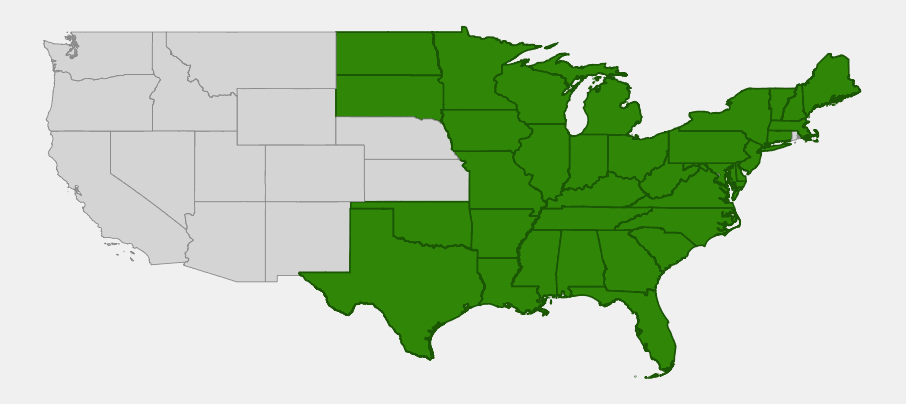
Wild comfrey is native across much of the eastern United States. USDA PLANTS records it from 34 states and the District of Columbia, from Maine, Vermont and New Hampshire south to northern Florida, and west to Minnesota, the Dakotas, Iowa, Missouri, Oklahoma and eastern Texas. In Canada the species, mostly in the form of northern wild comfrey (var. boreale), ranges from the Maritime provinces and Newfoundland west through Quebec, Ontario and the Prairie Provinces to British Columbia and the Yukon.
The typical variety, var. virginianum, is a plant of the eastern deciduous forest. It is most frequent in the Appalachians, Piedmont, Ozarks and Ohio Valley, in upland oak and oak-hickory woods, wooded slopes and the edges of clearings. It tends to favor drier, well-drained soils than many spring wildflowers and is often found on slopes and ridges rather than in floodplains. On the Coastal Plain it is scattered, and in Florida it is limited to the northern part of the state.
Northern wild comfrey replaces it to the north, in the boreal and Great Lakes forests of Minnesota, Wisconsin, Michigan, northern New York and New England, where it grows in mixed woods with aspen, birch, fir and pine. Where both occur, they can be told apart by flower size and the shape of the stem leaf bases.
📋 Regional plant lists featuring Wild Comfrey: New York, Pennsylvania & Northern New Jersey · Ohio & Indiana · Michigan, Wisconsin & Eastern Minnesota · Kentucky & Tennessee · Connecticut, Massachusetts & Rhode Island · New Hampshire, Maine & Vermont · Maryland, Virginia & West Virginia · Delaware, Southern New Jersey & Long Island · Illinois, Iowa & Missouri · Alabama, Georgia & Mississippi · North & South Florida
Growing & Care Guide
Wild comfrey is not difficult to grow in a shady, well-drained spot, but it is seldom sold, and its deep taproot makes established plants hard to move. The best approach is to start it from seed or from small nursery-grown plants and site it where it can stay. Never dig plants from the wild.
Light
Give it partial shade or the light, dappled shade under deciduous trees. It enjoys spring sun before the canopy fills in and tolerates fairly deep summer shade. In full sun the leaves tend to scorch in summer heat, especially in the South.
Soil & Water
Wild comfrey prefers well-drained, humus-rich loam with a layer of leaf litter, but it is more tolerant of dry, rocky or clay soils than many woodland wildflowers. Water new plants during their first season. Afterward it is fairly drought tolerant, though the basal leaves may wither and go dormant early in a hot, dry summer. Avoid soggy sites, where the crown can rot.
Planting Tips
Sow fresh seed outdoors in fall, about a quarter inch deep, or give it 60 to 90 days of cold, moist stratification before spring sowing. Seedlings form only a rosette the first year and usually flower in their second or third year. Set nursery plants in spring or fall, with the crown at soil level, and plant them in loose groups among other woodland perennials and ferns. Allow 12 to 18 inches between plants.
Pruning & Maintenance
Very little care is needed. Leave fallen leaves in place as a natural mulch. If the burry nutlets are a problem near a path, cut the flowering stalks after bloom; otherwise leave them to self-sow. Wear gloves when handling the bristly leaves, which can irritate sensitive skin.
Propagation
Propagate from seed. Because of the taproot, division is difficult, and older plants seldom survive being moved. Plants self-sow modestly in good conditions without becoming weedy.
Landscape Uses
- Shade and woodland gardens: an early-season blue accent among ferns, sedges and other spring wildflowers
- Dry shade: one of the better native wildflowers for well-drained, rooty soil under oaks
- Woodland restoration: for upland oak and mixed hardwood plantings within its native range
- Pollinator gardens in shade: spring nectar for bumblebees and other native bees
- Naturalized areas: self-sows gently in woodland edges without crowding out other plants
Wildlife & Ecological Value
Wild comfrey flowers in mid to late spring, a time when queen bumblebees and other early bees are building their colonies and nests and need reliable sources of nectar and pollen in the woods.
For Pollinators
The pale blue flowers are visited mainly by bees, including bumblebees, mason bees, small carpenter bees and sweat bees, which reach into the short tube for nectar. Butterflies such as skippers and swallowtails visit occasionally. The flowers open over several weeks, providing a steady food source after the earliest spring ephemerals have faded.
For Birds
Wild comfrey is not a significant food plant for birds. It contributes to the layered understory of upland woods that supports ground-nesting and foraging birds such as ovenbirds, wood thrushes and eastern towhees.
For Mammals
Deer and rabbits rarely browse the rough, hairy leaves, which also contain bitter, toxic alkaloids. Mammals help spread the plant when the prickly nutlets catch in their fur.
Ecosystem Role
Wild comfrey is one of the characteristic herbs of dry to moist upland oak forests. Its seeds are dispersed by animals rather than wind or ants, so it can colonize new openings at a distance. It is common in some places but uncommon at the edges of its range, where populations depend on intact, unfragmented woodland.
Cultural & Historical Uses
Linnaeus described Cynoglossum virginianum in 1753 from plants collected in Virginia. In 2015 the botanist James Cohen proposed moving the North American species once grouped in Cynoglossum into a new genus, Andersonglossum, based on DNA studies and differences in the nutlets. Both names are in current use, and USDA PLANTS still lists the plant as Cynoglossum virginianum.
Wild comfrey appears in records of Cherokee and other Native American medicine, and early herbalists treated it much like Old World comfrey and houndstongue. Those historical uses are part of the plant’s story, not a recommendation.
Safety note: wild comfrey, like true comfrey and houndstongue, contains pyrrolizidine alkaloids. These compounds can cause serious, cumulative liver damage when taken internally, and they are also toxic to livestock. Do not eat the plant, make tea from it, or use it as a substitute for comfrey. Keep children and pets from chewing it. The hairy leaves can also cause mild skin irritation in some people.
Frequently Asked Questions
Is wild comfrey the same as comfrey?
No. True comfreys are Eurasian plants in the genus Symphytum. Wild comfrey is a native North American plant in the related genus Cynoglossum (or Andersonglossum). It gets the name from its large, hairy, comfrey-like leaves.
Is wild comfrey poisonous?
It contains pyrrolizidine alkaloids, which can damage the liver if eaten, especially over time. It should not be eaten or used as an herbal remedy, and it can be harmful to grazing livestock. Handling it is generally safe, though the bristly hairs can irritate sensitive skin.
Will wild comfrey grow in dry shade?
Yes, it is one of the better native wildflowers for dry, well-drained shade under oaks and other deciduous trees once it is established. It does best with a layer of leaf litter and some spring sun before the trees leaf out.
How do I grow wild comfrey from seed?
Collect ripe nutlets in early summer and sow them outdoors in fall, or stratify them in a cold, moist medium for two to three months before spring sowing. Expect only a rosette the first year and flowers in the second or third year.
Do the seeds stick to clothes?
Yes, the nutlets carry small barbed prickles and cling to clothing and pet fur. They are fewer and less troublesome than those of stickseeds or introduced houndstongue. Cutting the stalks after bloom prevents them near paths.

Looking for a nursery that carries Wild Comfrey?
Browse our native plant nursery directory: Alabama & Arkansas · Connecticut, Delaware, Florida & Georgia · Illinois, Indiana & Iowa · Kentucky, Louisiana, Maine, Maryland, Massachusetts, Michigan, Minnesota, Mississippi & Missouri · New Hampshire, New Jersey, New York, North Carolina, North Dakota, Ohio & Oklahoma · Pennsylvania, South Carolina, South Dakota, Tennessee, Texas, Vermont & Virginia · West Virginia & Wisconsin