
Philadelphia Fleabane (Erigeron philadelphicus)
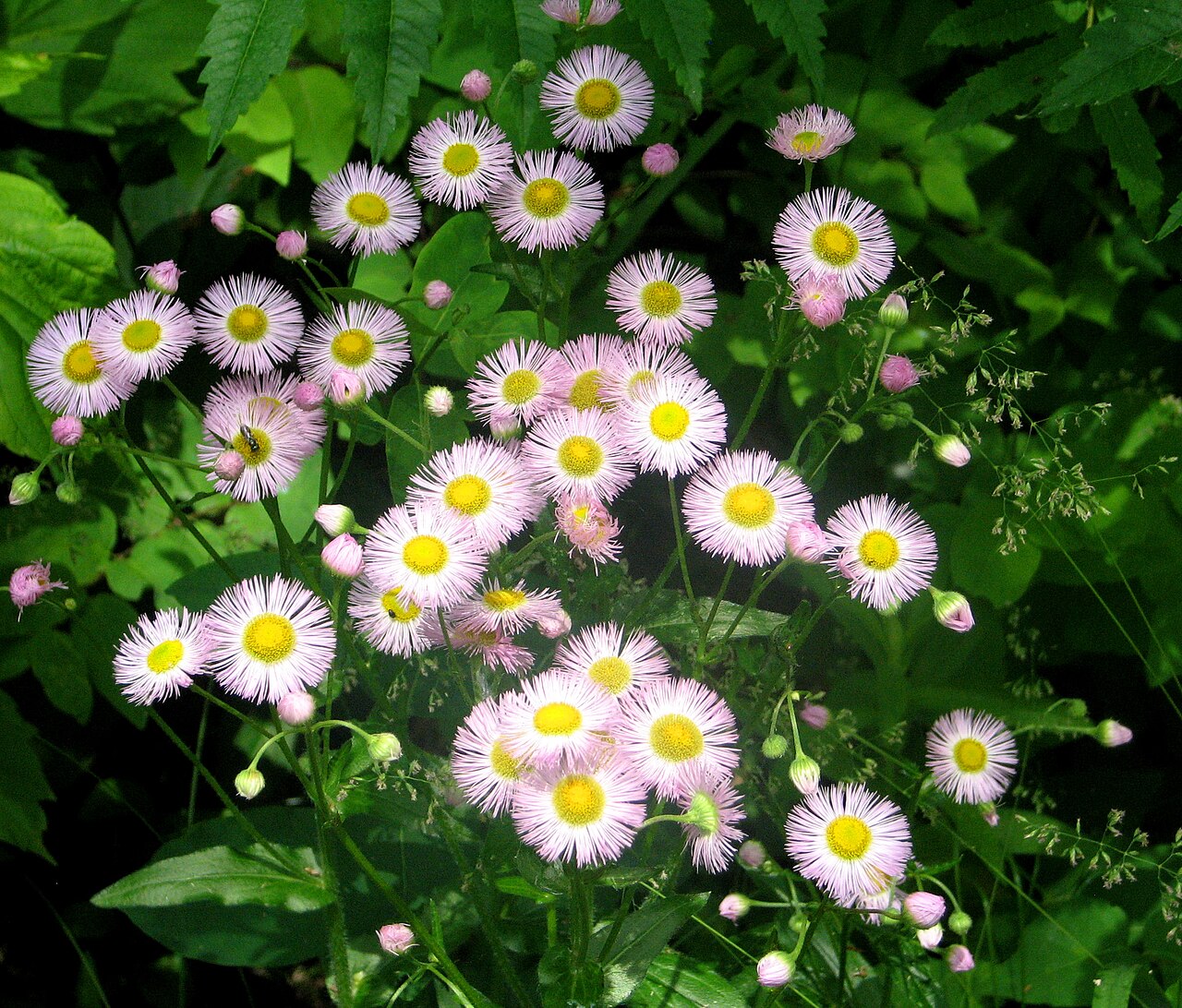
Erigeron philadelphicus, known as Philadelphia Fleabane or common fleabane, is one of the first native daisies to bloom in spring across North America. From a rosette of soft, hairy leaves it sends up leafy stems 1 to 2½ feet tall that branch near the top into loose clusters of small flower heads. Each head is ½ to 1 inch across, with a yellow button center surrounded by a fringe of 150 or more extremely fine, thread-like rays in white or soft pink. It belongs to the aster family (Asteraceae).
Philadelphia fleabane is a plant of moist, open or partly shaded ground: meadows, stream banks, woodland edges and clearings, old fields, roadsides, and often lawns and garden beds. It blooms mainly from April to June, earlier in the South, and its buds famously nod downward before they open. It is a biennial or short-lived perennial that reseeds freely, so it comes and goes from year to year, but it is one of the most valuable early-season flowers for small native bees and flies.
The species was named from specimens collected around Philadelphia, which is how it got its scientific and common names. It grows in almost every part of the United States and across Canada. This guide covers how to tell it from its close look-alikes, where it grows, how to manage it in a garden, and its role in the spring food web.
Identification
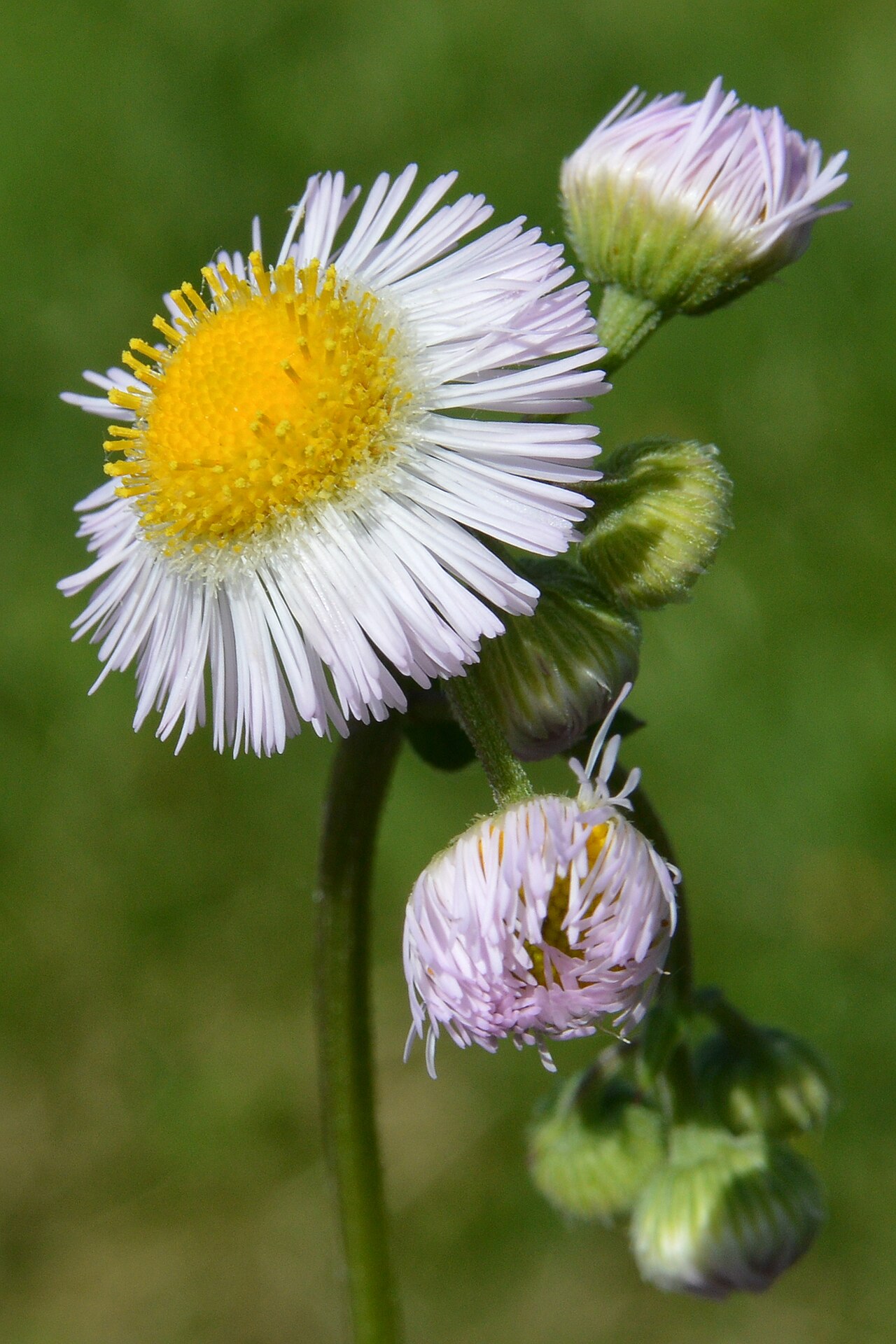
Several white “fleabane daisies” bloom in late spring and early summer, and they can be hard to tell apart. Philadelphia fleabane is identified by its clasping leaves, its very numerous, extremely thin rays, and its nodding buds.
Stems & Growth Habit
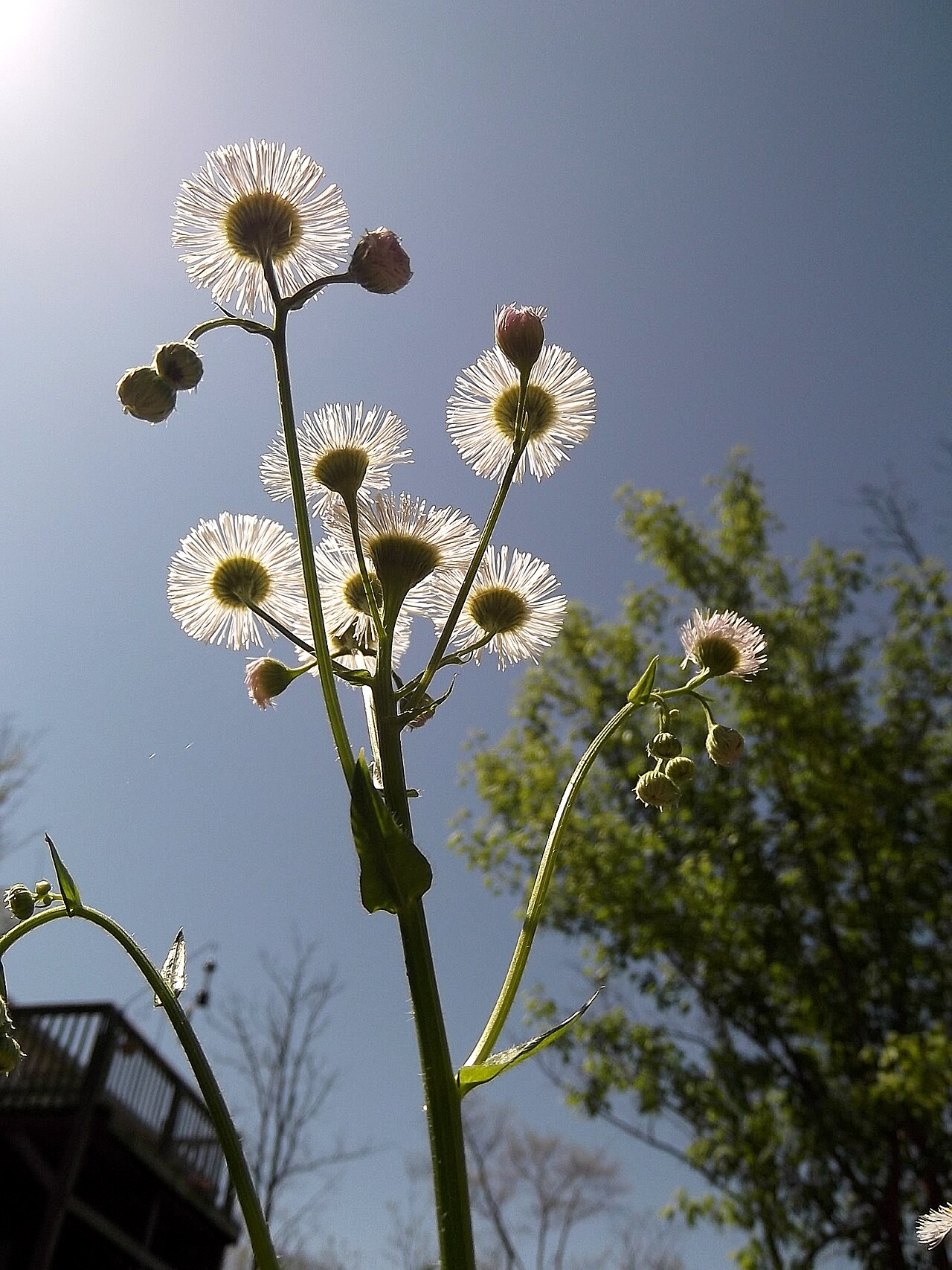
Plants begin as a flat basal rosette that often overwinters. In spring they send up one to a few erect stems, usually 1 to 2½ feet tall, which are soft, hairy and somewhat hollow. They branch in the upper part into an open cluster of flower heads. Plants growing in mowed lawns can flower on stems only a few inches tall.
Leaves
Basal leaves are spoon-shaped to oval, 1 to 6 inches long, softly hairy and coarsely toothed or scalloped, tapering to a winged stalk. Stem leaves are smaller, oblong to lance-shaped, and alternate. The key feature is that the stem leaves are stalkless and clasp the stem with two small, ear-like lobes at their base. Other common fleabanes have stem leaves that taper and do not clasp.
Flowers
The flower heads are ½ to 1 inch wide and have a central disk of many tiny yellow disk florets surrounded by 150 to 400 ray florets. The rays are so narrow that they look like fine threads, and they are white, pale pink or lilac-pink, often pinker in cool weather. Before opening, the buds hang down and look pink, then turn upward as they open. Bloom time is mostly April through June, sometimes later.
Fruit & Seeds
Each fertile floret produces a tiny seed-like fruit (achene) with a tuft of fine bristles (pappus) that carries it on the wind. Seed is produced in large quantities, which is why the plant appears readily in gardens and disturbed ground.
Look-alikes
Daisy fleabane (Erigeron annuus) and prairie fleabane (E. strigosus) bloom a little later, have fewer (about 40 to 130) wider rays, upright buds, and stem leaves that do not clasp the stem. Robin’s plantain (E. pulchellus) has larger heads on fewer stems, spreads by runners, and grows mostly in drier woodland edges.
Quick Facts
| Scientific Name | Erigeron philadelphicus |
| Family | Asteraceae (aster family) |
| Plant Type | Biennial or short-lived perennial wildflower |
| Mature Height | 1–2½ ft |
| Mature Spread | 6–12 in |
| Growth Rate | Fast |
| Sun Exposure | Full sun to part shade |
| Water Needs | Medium; moist soils preferred |
| Soil Type | Moist loam, clay or sandy soils; tolerates disturbed soil |
| Soil pH | About 5.5–7.5 |
| Bloom Time | April–June (sometimes into summer) |
| Flower Color | White to pale pink, with a yellow center |
| Fall Color | None; basal rosettes stay green into winter |
| Fruit | Tiny achenes with fine bristles, dispersed by wind |
| Deer Resistant | Moderate; occasionally browsed |
| USDA Hardiness Zones | 3–9 |
Native Range
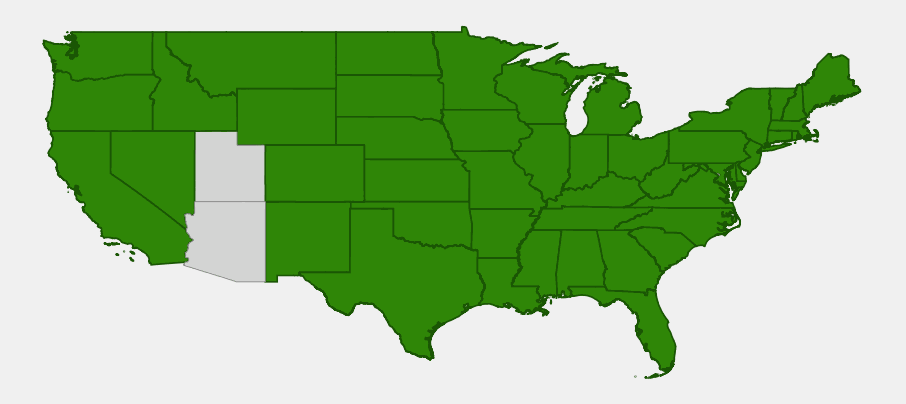
Philadelphia fleabane has one of the widest native ranges of any North American wildflower. USDA PLANTS lists it as native in 46 of the lower 48 states, everywhere except Arizona and Utah, and in almost every Canadian province and territory, from British Columbia and the Yukon to Newfoundland and the Maritimes.
It is most common in the East and Midwest, where it is a familiar sight in moist meadows, along roads and trails and at the edges of woods. In the West it is more scattered and tied to moisture, growing along streams, around springs and seeps, in wet meadows and in irrigated ground in the Rockies, the Great Basin, California and the Pacific Northwest. In the Deep South it blooms in March and April, while in the far north it flowers into early summer.
Because it colonizes disturbed soil readily, Philadelphia fleabane is a common volunteer in gardens and lawns. It has also spread outside North America: it was introduced to East Asia and Europe, and in Japan it has become a widespread weed. Within its native range, however, it is a natural part of open, moist plant communities.
📋 Regional plant lists featuring Philadelphia Fleabane: New York, Pennsylvania & Northern New Jersey · Idaho, Eastern Oregon & Eastern Washington · Ohio & Indiana · Montana & Wyoming · Michigan, Wisconsin & Eastern Minnesota · Kentucky & Tennessee · Nebraska, Kansas & Eastern Colorado · Connecticut, Massachusetts & Rhode Island · New Hampshire, Maine & Vermont · Maryland, Virginia & West Virginia · Delaware, Southern New Jersey & Long Island · Illinois, Iowa & Missouri · Alabama, Georgia & Mississippi · North & South Florida
Growing & Care Guide
Philadelphia fleabane is easy to grow, and in many gardens it arrives on its own. Its best use is in informal meadows, woodland edges and pollinator plantings, where its self-sowing habit is an asset rather than a nuisance.
Light
It grows in full sun to partial shade, and it is one of the few spring-blooming daisies that flowers well in the light shade of woodland edges. In full sun it needs more consistent moisture.
Soil & Water
Give it average to moist soil. It is not fussy about soil type and grows in loam, clay and sandy soils, including compacted or disturbed ground. It tolerates periodic flooding along streams but does poorly in very dry, sandy soils in full sun. No fertilizer is needed.
Planting Tips
The simplest way to establish it is to scatter seed on bare soil in fall, or to leave volunteer rosettes where they come up. Small potted plants can be set out in spring or fall, about 12 inches apart. Because individual plants live only one to three years, plan on letting some plants reseed each year to keep a patch going.
Pruning & Maintenance
Leave the flowers to set seed if you want it to persist. If it is spreading more than you like, cut the stems back as the flowers fade and before the fluffy seed heads open, or pull unwanted rosettes in fall or early spring; the roots are shallow and come up easily. In lawns, it often blooms between mowings in spring and is a good reason to delay the first cut.
Propagation
Seed germinates readily without special treatment. Surface-sow it, since the tiny seed needs light, and keep it moist. Rosettes that form in summer or fall usually bloom the following spring. Larger clumps of short-lived perennial plants can also be divided in early spring.
Landscape Uses
- Pollinator gardens: very early, long-flowering nectar and pollen for small native bees, flies and butterflies
- Meadows and naturalized areas: fills gaps in spring before warm-season grasses and wildflowers grow up
- Woodland edges and rain gardens: tolerates partial shade and moist or briefly wet soil
- No-mow and pollinator-friendly lawns: blooms between mowings in spring
- Stream bank and wet meadow restoration: quick, self-sowing cover on moist disturbed ground
Wildlife & Ecological Value
Philadelphia fleabane is an unassuming plant, but it fills an important gap in spring, when many native bees are active and relatively few open, easy-to-reach flowers are available.
For Pollinators
The shallow flower heads offer easy access to nectar and pollen, and they are visited by a wide range of small insects: sweat bees, mining bees, small carpenter bees, cuckoo bees, syrphid and tachinid flies, beetles and small butterflies such as skippers and crescents. The Xerces Society lists it as a plant of special value to native bees and notes that it supports beneficial insects that help control garden pests.
For Birds
Finches and sparrows occasionally pick at the small seeds. More importantly, the many insects visiting the flowers and feeding on the foliage are food for birds feeding nestlings in spring.
For Mammals
Rabbits and deer sometimes graze the leaves and flowers, but the hairy, somewhat bitter foliage is usually not a favorite.
Ecosystem Role
As a fast-growing, self-sowing pioneer, Philadelphia fleabane is one of the first plants to cover bare, moist ground after floods, disturbance or clearing. Its leaves and flowers feed the caterpillars of several small moths, and its early bloom helps support pollinators until later wildflowers take over.
Cultural & Historical Uses
Linnaeus described the species in 1753, naming it after Philadelphia, the source of the North American material he knew. The genus name Erigeron comes from Greek words meaning “early” and “old man,” probably referring to the early flowering and the fluffy, white seed heads.
The name “fleabane” reflects an old European belief that dried fleabanes, burned or stuffed into bedding, would drive away fleas and other insects. There is little evidence that they work. Several Native American peoples used Philadelphia fleabane medicinally, and nineteenth-century American herbalists used it as a diuretic and astringent, but these uses are historical, and it should not be used as a medicine without expert guidance.
Today Philadelphia fleabane is valued mostly as a pollinator plant. It is often among the first native wildflowers to appear in a newly planted meadow or a lawn left unmowed in spring, and many gardeners have come to appreciate its pink-flushed spring flowers.
Frequently Asked Questions
Is Philadelphia fleabane a weed?
It is a native wildflower, but because it reseeds readily into lawns and garden beds, some gardeners treat it as a weed. Within its native range it is valuable for pollinators. If it spreads too much, cut it back before it sets seed or pull extra rosettes.
How do I tell Philadelphia fleabane from daisy fleabane?
Philadelphia fleabane blooms earlier, has 150 or more very fine rays, nodding buds and stem leaves that clasp the stem. Daisy fleabane (Erigeron annuus) blooms later, has fewer and wider rays, upright buds and leaves that do not clasp the stem.
Does fleabane really repel fleas?
Not reliably. The name comes from an old belief that dried fleabanes kept fleas away. There is no good evidence for it.
Is Philadelphia fleabane a perennial?
It is usually a biennial or short-lived perennial. Plants grow as a rosette, flower, and then often die after one to three years, but they reseed to keep a patch going.
Which pollinators visit Philadelphia fleabane?
Mostly small native bees, such as sweat bees and mining bees, along with syrphid flies, small butterflies and beetles. It is one of the most important early spring flowers for these insects in many areas.

Looking for a nursery that carries Philadelphia Fleabane?
Browse our native plant nursery directory: Alabama & Arkansas · California · Colorado, Connecticut, Delaware, Florida & Georgia · Idaho, Illinois, Indiana, Iowa & Kansas · Kentucky, Louisiana, Maine, Maryland, Massachusetts, Michigan, Minnesota, Mississippi, Missouri & Montana · Nebraska, Nevada, New Hampshire, New Jersey, New Mexico, New York, North Carolina, North Dakota, Ohio & Oklahoma · Oregon · Pennsylvania, Rhode Island, South Carolina, South Dakota, Tennessee, Texas, Vermont & Virginia · Washington · West Virginia, Wisconsin & Wyoming